
Key takeaways
Here are the key insights from our website breakdown analysis of Braze.
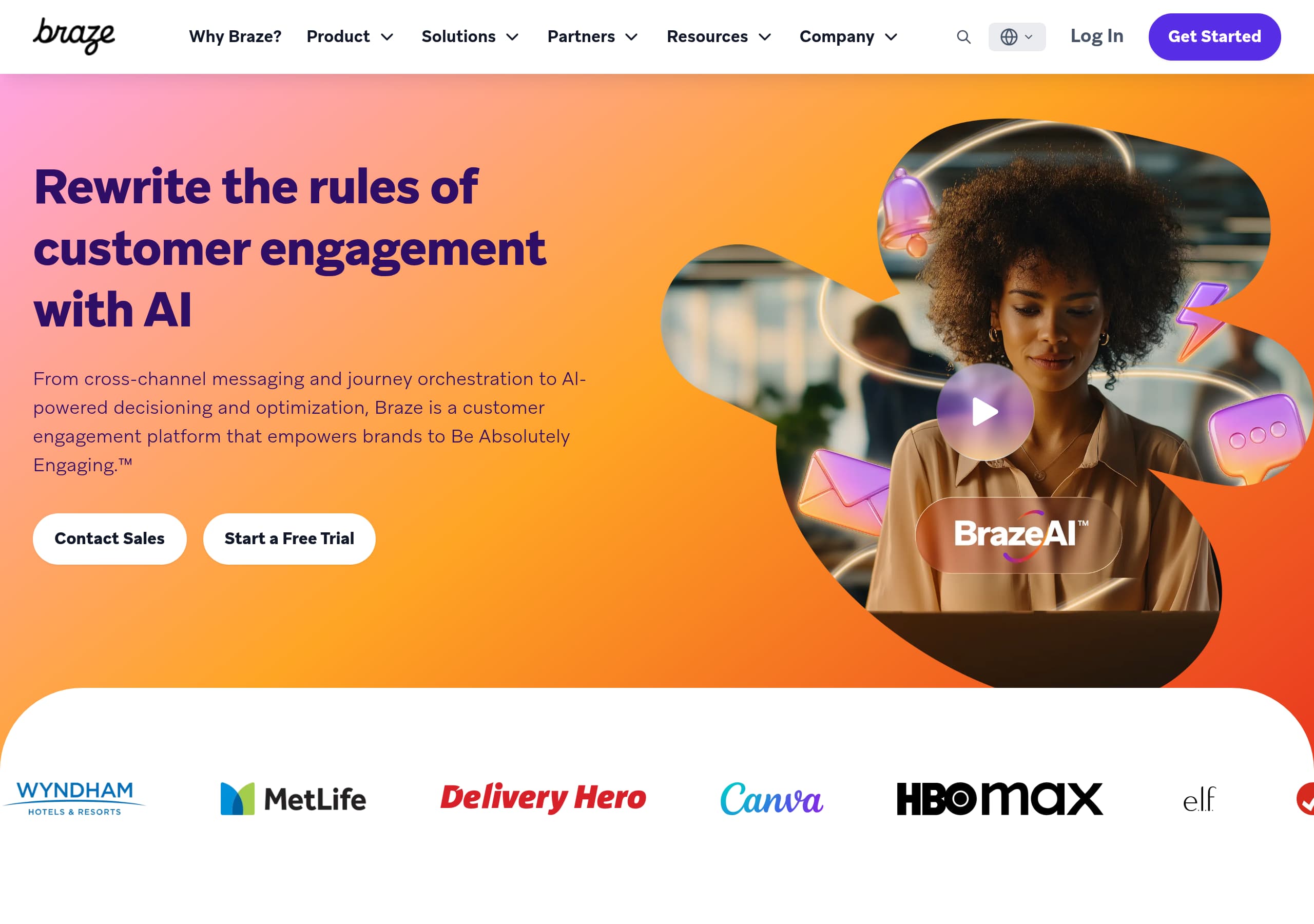
Braze’s homepage wins by collapsing a complex “customer engagement platform” story into a simple 3-part narrative: unify data, add AI, and execute cross-channel messaging, reinforced by dual CTAs (“Contact Sales” and “Start a Free Trial”).
The navigation is built for enterprise evaluation, with clear paths for Product, Solutions (industries and use cases), Partners (140+ integrations), and Resources, which reduces buyer friction for multiple stakeholders.
Braze positions AI as a concrete product suite (BrazeAI™, BrazeAI Decisioning Studio™, BrazeAI Agents) rather than a vague promise, helping buyers map AI claims to named capabilities.
Social proof is unusually dense and quantifiable: named customer quotes plus outcome metrics (e.g., 21% revenue increase, 15% ticket decrease), and third-party validation (Gartner MQ, Forrester Wave, IDC MarketScape, G2).
The site’s conversion design supports both PLG and sales-led motions, repeatedly pairing “See How Braze Works” educational CTAs with “Get Started”/trial CTAs for different readiness levels.
Braze strengthens trust through repeated “leader” positioning, awards, and enterprise-ready IA (Documentation, System Status, Support), even when explicit security/compliance copy is not prominent in the provided excerpt.
Home
Braze’s homepage is optimized for fast comprehension of a broad platform by anchoring everything to a single, repeatable storyline: data → AI → cross-channel orchestration. The hero headline (“Rewrite the rules of customer engagement with AI”) immediately frames the differentiator, and the dual CTAs—Contact Sales and Start a Free Trial—signal two buying motions without forcing a choice.
Key homepage patterns visible in the excerpt and screenshot:
- A top-level nav built for evaluation: Why Braze, Product, Solutions, Partners, Resources, Company, Support. This matches how enterprise deals are researched (marketing, engineering, procurement).
- A “platform as one place” framing (“All your data, channels, and orchestration needs in one place”), reducing perceived integration risk.
- The AI layer is productized: BrazeAI™, BrazeAI Decisioning Studio™, and BrazeAI™ Agents are presented as distinct modules rather than marketing copy.
The mid-page sections reinforce the narrative with scannable subheads:
- Braze Data Platform: “Unify and activate your data in real time…without relying on technical teams,” which directly addresses a common objection (engineering dependency).
- Decisioning: “Put AI decisioning behind every move” and “optimize the KPIs that matter most,” translating AI into measurable outcomes.
- Cross-channel: “Make every interaction feel human,” then enumerates channels (Email, Mobile App Messaging, Web, SMS/RCS, WhatsApp, LINE), which clarifies breadth.
Finally, the homepage uses “See How Braze Works” as an educational CTA to catch mid-funnel visitors, while keeping “Get Started” persistent. Net effect: high message clarity, strong CTA hierarchy, and platform breadth explained in a controlled, repeatable structure.
Pricing
Braze does not surface pricing in the provided navigation or homepage excerpt, which is a deliberate enterprise positioning choice: pricing is handled via sales-led discovery rather than self-serve plan comparison. This approach can increase lead quality for a platform that is typically scoped by data volume, channels (e.g., SMS/WhatsApp), regions, and add-ons (AI modules), but it also shifts conversion pressure onto “Contact Sales” and proof assets.
Observable cues that pricing is de-emphasized:
- The primary CTAs are Contact Sales and Start a Free Trial, with no “View Pricing” link in the top nav snippet.
- The IA prioritizes evaluation content—How It Works, Case Studies, Reports & Guides, Documentation—which is consistent with complex, usage-based pricing.
What this pricing posture does well:
- It avoids misleading sticker prices for a configurable platform spanning Braze Data Platform, Journey Orchestration, and multi-channel delivery.
- It enables packaging around outcomes (e.g., “Reduce Churn,” “Increase Engagement”) and stakeholder needs (Marketing vs. Engineering).
Where the site could tighten pricing conversion (within the same sales-led strategy):
- Add a “Pricing” or “Plans” node that explains the model: typical drivers like MAUs, message volume, channel mix (SMS/RCS), and optional modules (e.g., BrazeAI Decisioning Studio™).
- Offer a lightweight estimator or “What affects cost?” section to pre-qualify and reduce sales cycles.
- Clarify what “Start a Free Trial” includes (channels enabled, limits, duration) to prevent mismatch between PLG expectations and enterprise realities.
Overall, Braze’s pricing presentation is optimized for enterprise fit and controlled scoping, but it relies on strong sales follow-up and clear trial parameters to stay conversion-friendly.
Features
Braze presents features as a vertically integrated platform with clear modular anchors, which is essential for a product that spans data, orchestration, channels, AI, and analytics. The main takeaway is that the site avoids a flat “feature checklist” and instead groups capabilities into a logical system: platform foundation, AI layer, and execution across channels.
Feature architecture (as shown in nav and homepage sections):
- Platform core: Braze Data Platform (“Unify, activate, and distribute your data”) positions Braze as more than a messaging tool; it’s the hub for real-time activation.
- AI suite: BrazeAI™, BrazeAI Decisioning Studio™, and BrazeAI™ Agents are distinct products. The copy calls out “composable predictive, generative, and agentic intelligence,” which signals breadth while still mapping to named modules.
- Orchestration: Journey Orchestration is explicitly called out as “multi-step, cross-channel experiences,” a key enterprise requirement.
- Measurement: Reporting & Analytics is placed alongside orchestration, reinforcing optimization loops rather than one-off campaigns.
- Channels: A dedicated list of “Featured Channels” (Email, Mobile App Messaging, Web Messaging, SMS/RCS, WhatsApp, LINE, Media Audience Sync) makes channel coverage scannable.
Notable conversion-supporting feature patterns:
- “View the platform” and “See How Braze Works” act as progressive disclosure for complex architecture, reducing cognitive load.
- The phrase “Send all your messages from one place” is a single-sentence value prop that frames consolidation.
Where the features story is strongest:
- It ties features to outcomes: “anticipate customer behavior,” “optimize KPIs,” “deliver consistent, responsive experiences.”
- It addresses internal friction: “without relying on technical teams” directly targets marketer autonomy.
Overall, Braze’s feature presentation is modular, enterprise-oriented, and aligned to use cases and buying criteria, not just UI widgets.
Signup
Braze’s conversion flow is designed to support both enterprise sales cycles and hands-on evaluation, using repeated CTAs and multiple “entry points” rather than a single hard gate. The key takeaway is that Braze uses dual-path conversion—Start a Free Trial for product-led evaluation and Contact Sales for scoped enterprise buying—while also offering “See How Braze Works” as a mid-funnel alternative.
Observable signup/onboarding cues from the excerpt:
- Persistent, high-contrast CTAs: “Contact Sales” and “Start a Free Trial” appear in the hero, and “Get Started” appears again near the bottom (“It’s time to be a better marketer”).
- The IA includes Log In, Support, and Documentation, suggesting that trial users can transition into a technical onboarding path (developer guides, user guides).
What this does well:
- Reduces friction for teams at different readiness levels: marketers can explore the platform story and case studies; technical users can jump to docs; buyers can request a sales conversation.
- Increases capture opportunities by pairing education (“See How Braze Works”) with action CTAs, a proven pattern for high-consideration SaaS.
Potential friction (and how to mitigate it):
- If “Start a Free Trial” requires significant setup (SDKs, data pipelines), the site should set expectations upfront: trial length, required integrations, and which channels are enabled.
- Adding a “3-step trial” explanation (e.g., create workspace → connect a data source → send first campaign) would increase conversion confidence.
Because Braze is a platform that often touches PII, deliverability, and multiple channels (SMS/WhatsApp), onboarding clarity matters as much as the CTA. The site already signals maturity with System Status and Support links; pairing that with explicit trial details would make the signup experience more predictable and conversion-efficient.
Trust
Braze builds trust primarily through authority signals (analyst leadership, awards), operational maturity (support and system status), and enterprise-ready information architecture. The key takeaway is that trust is not confined to a “security page” in the provided excerpt; it’s embedded across navigation and proof blocks to reassure buyers that Braze can operate at scale.
Primary trust signals visible:
- Analyst validation: “Leader in the 2025 Gartner® Magic Quadrant™ for Multichannel Marketing Hubs” plus Forrester Wave and IDC MarketScape mentions. These are high-weight signals for enterprise procurement.
- Marketplace validation: G2 category leadership (“Ranked #1…ahead of 56 competitors”) and TrustRadius awards (Top Rated, Buyer’s Choice, Tech Cares).
- Quantified outcomes in testimonials (21% revenue, 15% ticket reduction) show real-world impact rather than generic praise.
Operational trust and buyer enablement:
- The global nav includes Support, Professional Services, and Customer Success, indicating post-sale investment and implementation support.
- Footer and header provide System Status and “Technical Support,” which signals reliability expectations typical of mission-critical messaging platforms.
- The presence of User Documentation and separate user/developer guides suggests a mature product surface with formal docs.
Where trust could be even stronger (based on what’s not prominent in the excerpt):
- More explicit security/compliance surfacing (e.g., SOC 2, ISO 27001, GDPR tooling, DPA availability) within the primary nav or near CTAs.
- Clear privacy language tied to the Preference Center and cookies controls, explaining consent and data handling in plain language.
Even without detailed compliance copy in the provided snippet, the combination of analyst leadership, enterprise support structure, and public operational links provides strong buyer reassurance for Braze Customer Engagement Platform.
Footer
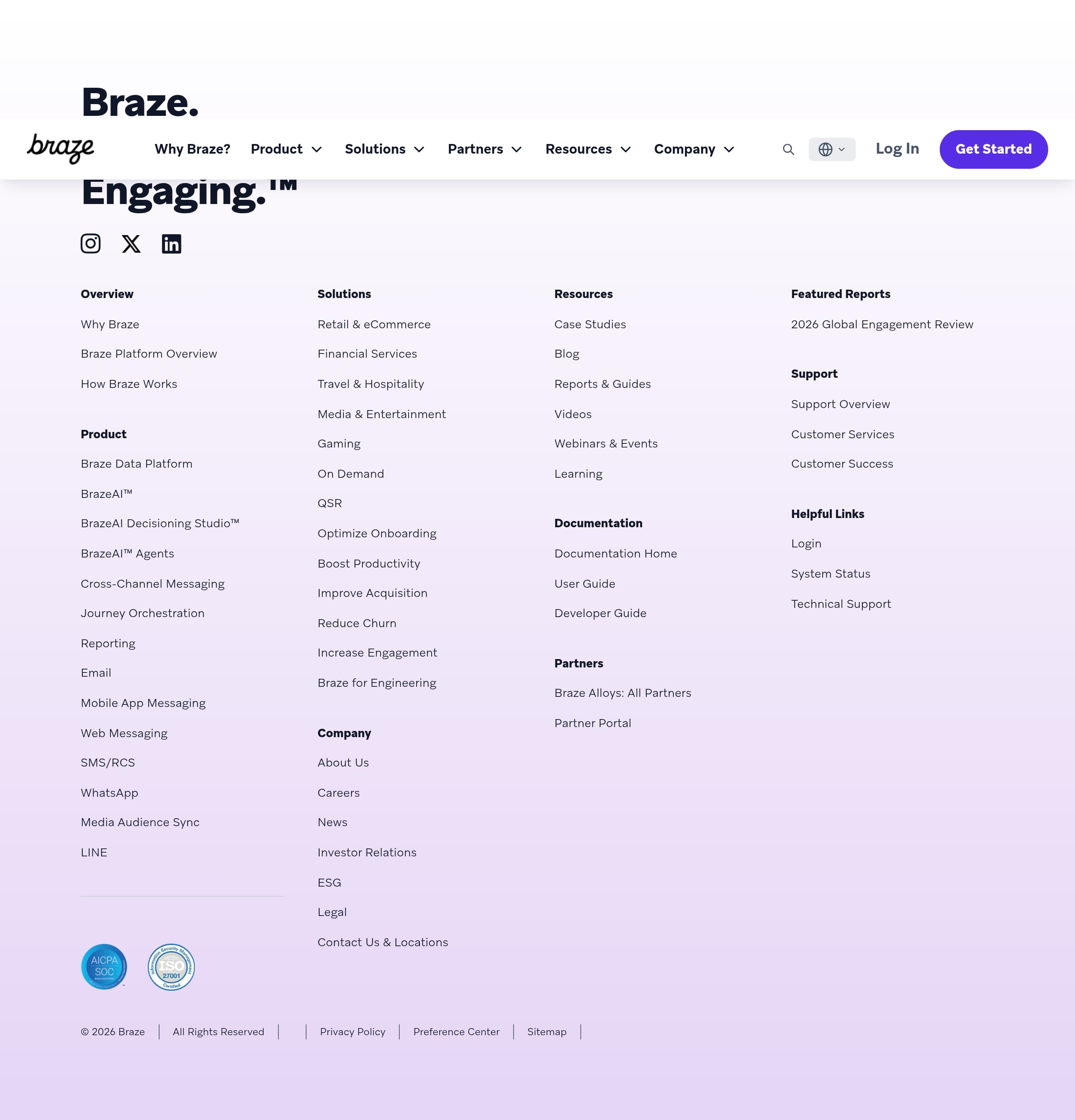
Braze’s footer functions as an enterprise-grade sitemap: it’s dense, structured, and optimized for multiple stakeholder journeys (marketing, engineering, procurement, partners). The key takeaway is that the footer is not decorative—it’s a navigation safety net that reinforces product breadth, evaluation content, and legal trust elements.
Observable footer structure (from the provided footer screenshot and excerpt):
- Product and platform links are grouped logically: Braze Data Platform, BrazeAI™, BrazeAI Decisioning Studio™, BrazeAI™ Agents, Cross-Channel Messaging, Journey Orchestration, Reporting, plus channel pages (Email, SMS/RCS, WhatsApp, LINE, Media Audience Sync).
- Solutions are split by Industries (Retail & eCommerce, Financial Services, Travel & Hospitality, Media & Entertainment, Gaming, On Demand, QSR) and Use Cases (Optimize Onboarding, Improve Acquisition, Reduce Churn, Increase Engagement). This mirrors how buyers self-identify.
- Resources are extensive: Case Studies, Blog, Reports & Guides, Videos, Webinars & Events, Learning, and Documentation (User Guide, Developer Guide). This supports SEO and long-cycle nurturing.
Trust and governance links are present and easy to find:
- Privacy Policy, Cookies, Preference Center, and Sitemap.
- Company-level pages like ESG, Legal, Investor Relations, and News help with enterprise vetting.
- “System Status” and “Technical Support” appear under Helpful Links, signaling operational transparency.
Two noteworthy conversion details:
- “Login” is accessible, reducing friction for existing customers.
- The footer repeats “Contact Us & Locations,” which is important for global enterprise buyers.
If Braze wanted to push conversion further, it could add a footer-level “Request a demo” or “Start trial” button near legal links, but as-is it excels at discoverability, compliance accessibility, and reinforcing that Braze is a full platform, not a point tool.
Detected tech stack
Tools and technologies we detected on Braze's site. Detection is best-effort and may be incomplete.
Scores
Our framework scores for Braze's website in terms of clarity, conversion, and trust. See our methodology for how we calculate these.
How clear the value prop and structure are.
How conversion-friendly signup and pricing are.
How well trust and compliance are surfaced.
FAQ
Braze leads with a clear AI-driven customer engagement message, then breaks the platform into three understandable pillars: Braze Data Platform, BrazeAI, and cross-channel messaging. The navigation supports enterprise evaluation with dedicated paths for Product, Solutions, Partners, Resources, and Support. Dual CTAs (“Contact Sales” and “Start a Free Trial”) let both procurement-led and hands-on teams take the next step.
In the provided homepage content, Braze does not prominently display a pricing page link or plan grid. Instead, it pushes sales-led evaluation via “Contact Sales” while still offering “Start a Free Trial” for product evaluation. This setup suggests pricing is likely scoped based on factors like channels, usage, and platform modules rather than a simple published tier list.
Braze uses a combination of quantified customer testimonials and third-party analyst validation. Testimonials include named leaders from brands like Pizza Hut, BEES/Anheuser Busch-InBev, Virgin Red, and Hugosave, paired with metrics such as 21% revenue increase or 15% ticket reduction. It also cites Gartner Magic Quadrant leadership, Forrester Wave recognition, IDC MarketScape, G2 rankings, and TrustRadius awards.
Braze positions AI as a suite of named products—BrazeAI, BrazeAI Decisioning Studio, and BrazeAI Agents—rather than a generic claim. The homepage ties AI to concrete outcomes like 1:1 personalization, smarter decisioning, and KPI optimization. It also describes AI as “predictive, generative, and agentic,” implying multiple AI modes embedded across orchestration and messaging.
Braze provides two primary conversion paths: “Start a Free Trial” for self-directed evaluation and “Contact Sales” for guided enterprise buying. It also offers educational CTAs like “See How Braze Works,” plus accessible Documentation and Support links for implementation. This structure supports different stakeholders, though trial expectations (limits, setup steps, enabled channels) are not detailed in the provided excerpt.

The world's best-performing SaaS businesses share surprisingly similar patterns. We help you learn and apply them through our human-designed methodology, with AI-assisted research.