
Key takeaways
Here are the key insights from our website breakdown analysis of Square.
Square positions itself as an all-in-one commerce operating system by mapping navigation to real business types (Food & Beverage, Retail, Beauty, Services) and then to capabilities like payments, payroll, marketing, and banking.
The homepage converts with a tight hero message and two primary CTAs (“Get started” and “Contact sales”), then immediately anchors the offer in tangible hardware pricing (e.g., Square Register $899 or $44/mo).
Square reduces perceived risk using explicit scale statistics (e.g., 450,000+ sellers, $39B+ generated, 15M+ appointments/month, $93B+ invoiced) placed directly in the main flow.
Pricing is framed as flexible and reversible (“No hidden fees or locked-in contracts. Cancel or switch plans anytime.”) and reinforced with a visible free-trial callout, which helps mid-funnel evaluation.
Trust is strengthened with regulated-finance disclosures (Block, Inc., Sutton Bank, FDIC pass-through, Mastercard) and clear customer support phone numbers, making Square feel enterprise-grade while still SMB-friendly.
Home
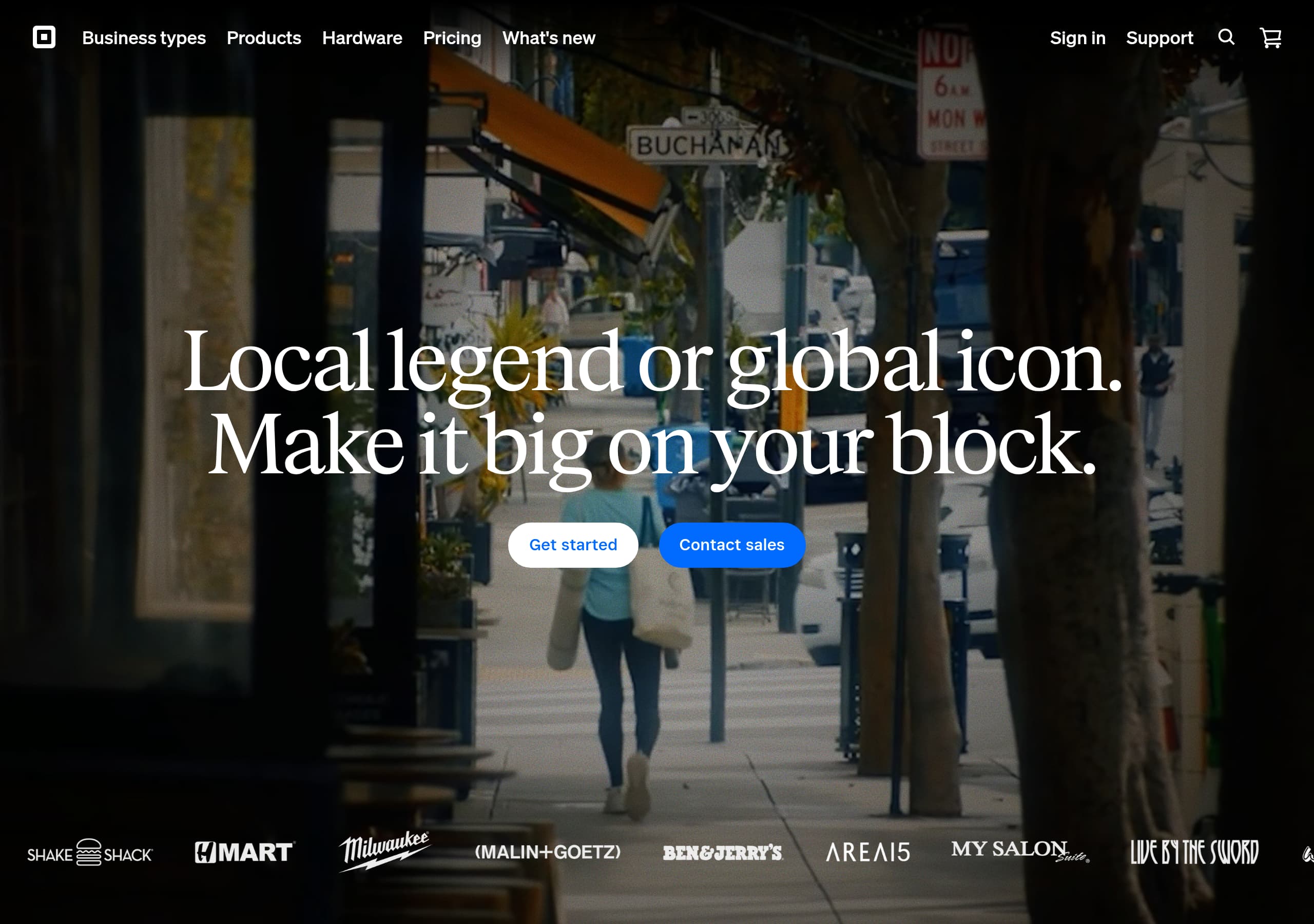
Square’s homepage sells the idea of an integrated commerce stack by pairing a broad promise with immediately scannable proof.
- The hero message (“Local legend or global icon. Make it big on your block.”) keeps the value proposition aspirational, while dual CTAs (Get started / Contact sales) support both self-serve and higher-touch buyers.
- The next section makes the platform tangible through hardware cards with pricing and financing (e.g., Square Register $899 or $44/mo; Square Reader $59), which answers “what will I actually buy?” early.
The mid-page capability row (“Point of sale,” “Manage your team,” “Grow your customer base,” “Control your cash flow,” “Connect your favorite apps”) is written as outcomes, each with a “Learn more” CTA, which reduces cognitive load.
Finally, the industry block adds quantified proof (450,000+ sellers; $39B+ retail GMV; 15M+ appointments/month; $93B+ invoices), making the broad claim feel credible.
Pricing
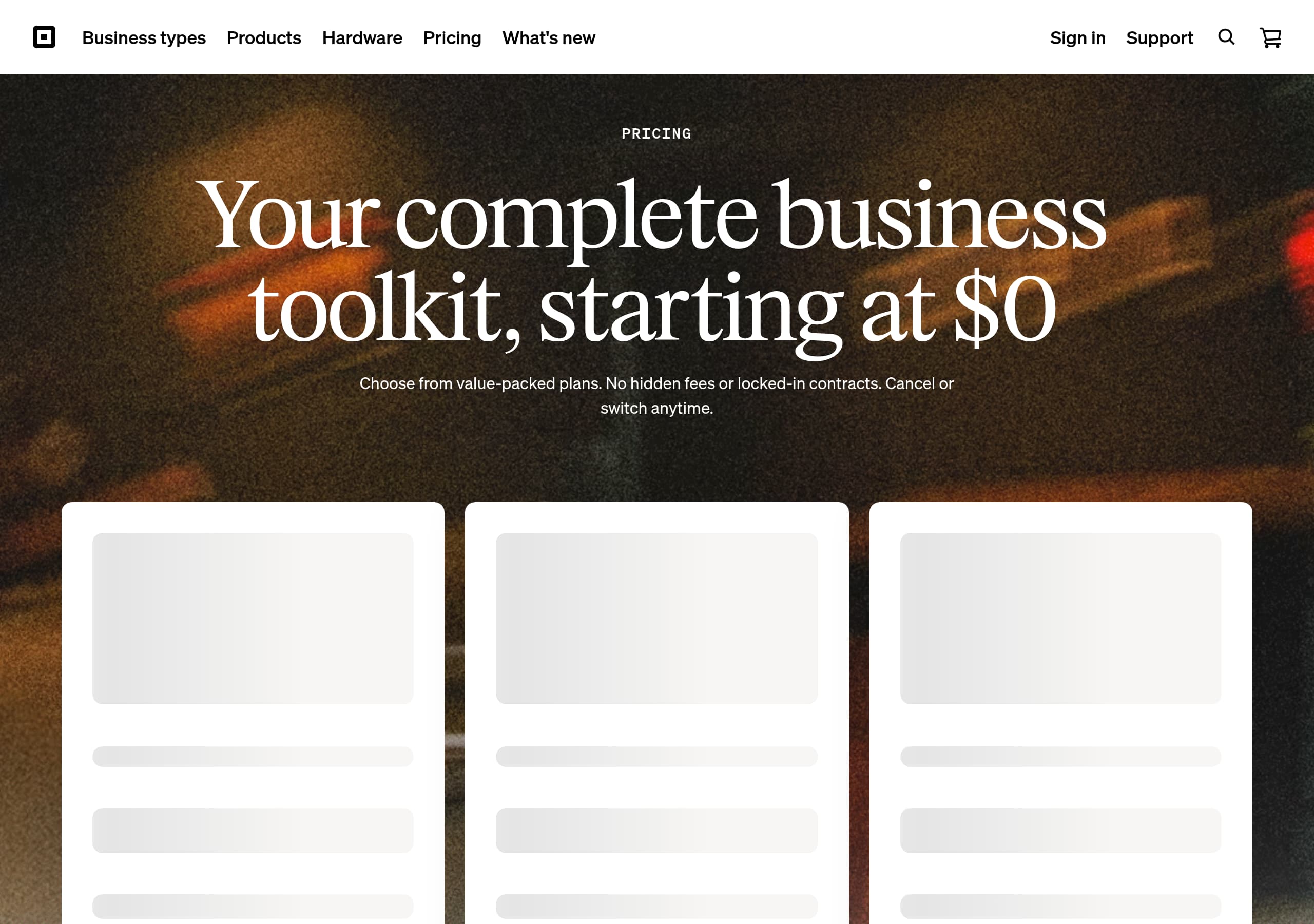
Square’s pricing presentation is designed to reduce perceived risk and speed up evaluation.
- The headline promise (“Run your entire business with one plan”) and the line “No hidden fees or locked-in contracts” address the two most common SMB objections: surprise costs and long commitments.
- A visible free trial CTA (“Try free for X days”) creates a low-friction next step for buyers comparing Square with Toast, Clover, or Shopify POS.
Square also clarifies hardware affordability through explicit price anchoring on the main flow (e.g., Square Register $899 or $44/mo) and detailed financing footnotes (APR 15%; installment lengths from 3 to 24 months depending on purchase amount). That combination supports both cash buyers and budget-conscious operators.
Tactically, keeping “Get started” alongside “Contact sales” preserves one-page momentum while still offering an assisted path for multi-location or complex setups.
Features
Square’s feature communication is organized as interoperable modules that map to how merchants run operations, not just how payments work.
The core feature set is presented as a clean grid of outcomes:
- Point of sale for in-person and online selling
- Team management via payroll and shift scheduling
- Customer growth via marketing campaigns and loyalty programs
- Cash flow control through checking, savings, and faster access to loans
- App integrations (“partners with hundreds of apps”)
Each item uses a single-sentence description plus a “Learn more” CTA, which makes the page skimmable and supports deep dives without overwhelming first-time visitors.
Square also surfaces advanced entities—Square AI, Reporting, Loyalty, Customer Directory, Banking, Developers/APIs—through the top navigation, signaling that the platform competes beyond POS (e.g., with Lightspeed Retail, Shopify, or Toast) and can scale from a solo operator to a multi-location business.
Signup
Square’s signup path is optimized for routing users to the right funnel rather than forcing a one-size-fits-all registration.
The site consistently offers two primary actions: Get started (self-serve) and Contact sales (assisted). This helps match intent: a single-location retailer can start quickly, while a higher-revenue business can talk to sales.
A “Nice to meet you” intake form appears that collects structured qualification data:
- Name, phone, business name
- Industry selection (e.g., Retail, Food and Drink, Wellness)
- Estimated annual revenue bands (0–$10k up to >$50M)
That’s a classic lead-scoring pattern for a platform that spans POS, payroll, and banking. The form also includes explicit consent language for automated calls/texts (“not a condition of purchase”), which reduces compliance risk.
Tactically, the dynamic free-trial placement (“Try free for X days”) keeps the conversion door open for buyers who aren’t ready to talk to sales.
Trust
Square builds trust by pairing consumer-friendly language with enterprise-grade compliance disclosures and financial-partner transparency.
Key trust signals visible in the page content include:
- Clear identification of Block, Inc. as the parent entity and Square Financial Services, Inc. as a subsidiary
- Banking language that clarifies Square is “not an FDIC-insured bank,” plus FDIC pass-through details via Sutton Bank, Member FDIC and a $250,000 coverage explanation
- Card network and issuance details (Square Debit Card issued by Sutton Bank pursuant to a license from Mastercard)
- Hardware financing footnotes including eligibility, APR (15%), and installment terms
This level of specificity reduces fear around funds availability and financial products, particularly for merchants adopting Square Checking, Loans, or Credit.
The site also includes a “Security” link in the footer and provides direct support phone numbers, reinforcing operational reliability beyond marketing claims.
Footer
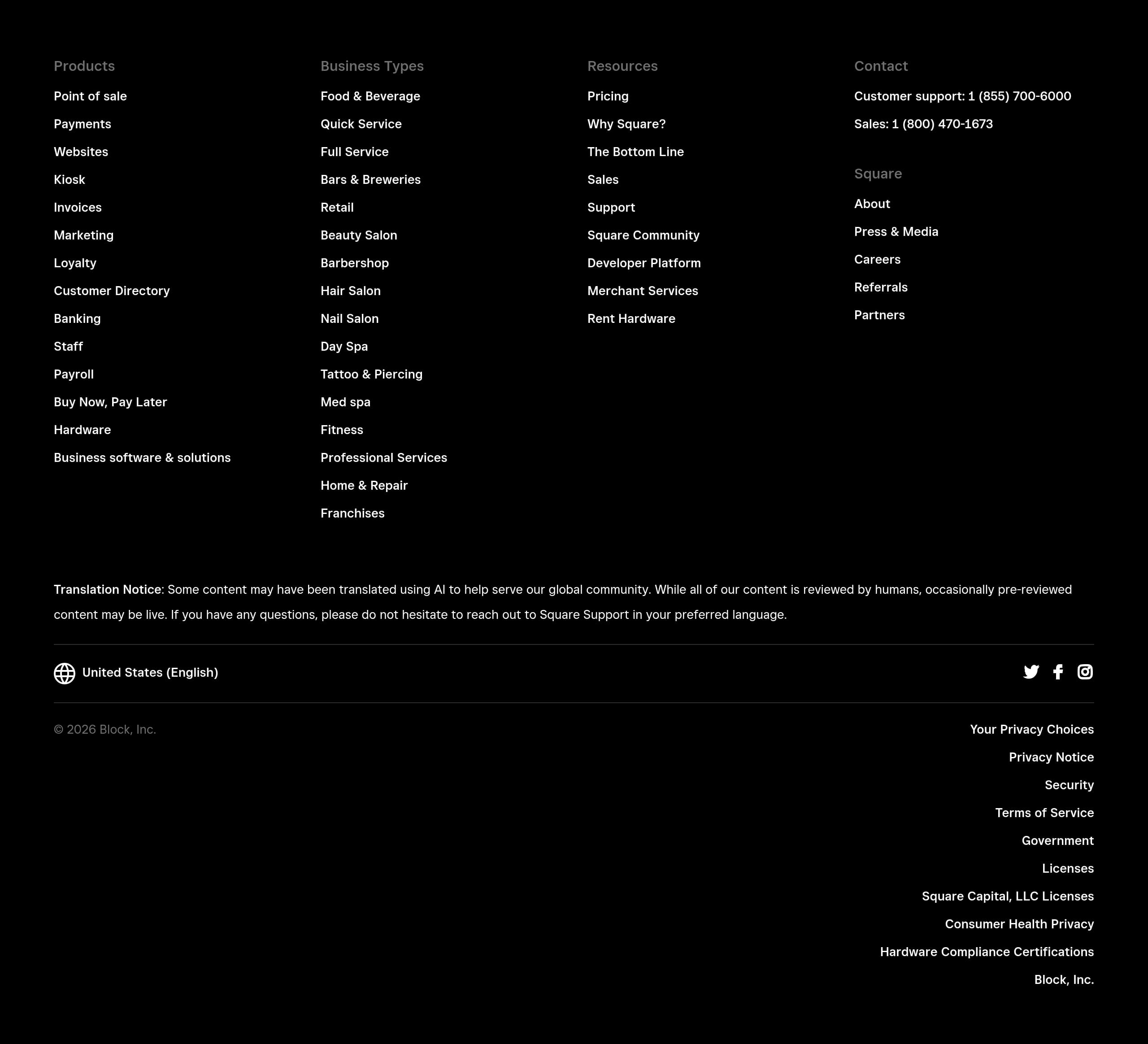
Square’s footer functions as a credibility index: it’s dense, structured, and geared toward regulated commerce.
It includes clear pathways for different user needs:
- Support and Sales phone numbers (customer support and sales lines listed separately)
- Policy and compliance links: Privacy Notice, Security, Terms of Service, Government Licenses, hardware compliance/certifications
- Business expansion and ecosystem routes: Developer Platform, Merchant Services, Partner directories, Specialists
The footer also clarifies global presence with a region/language selector (United States, Canada, France, Japan, UK, etc.), which supports international trust and localization.
Notably, Square includes an AI translation notice explaining that some content “may have been translated using AI” but “reviewed by humans,” which is an uncommon transparency cue.
Finally, trademark and issuer disclosures (Block, Inc., Sutton Bank, Square Capital) provide legal clarity that many SMB sites omit, which improves confidence for buyers evaluating payments and banking together.
Detected tech stack
Tools and technologies we detected on Square's site. Detection is best-effort and may be incomplete.
Scores
Our framework scores for Square's website in terms of clarity, conversion, and trust. See our methodology for how we calculate these.
How clear the value prop and structure are.
How conversion-friendly signup and pricing are.
How well trust and compliance are surfaced.

The world's best-performing SaaS businesses share surprisingly similar patterns. We help you learn and apply them through our human-designed methodology, with AI-assisted research.