
Key takeaways
Here are the key insights from our website breakdown analysis of Algolia.
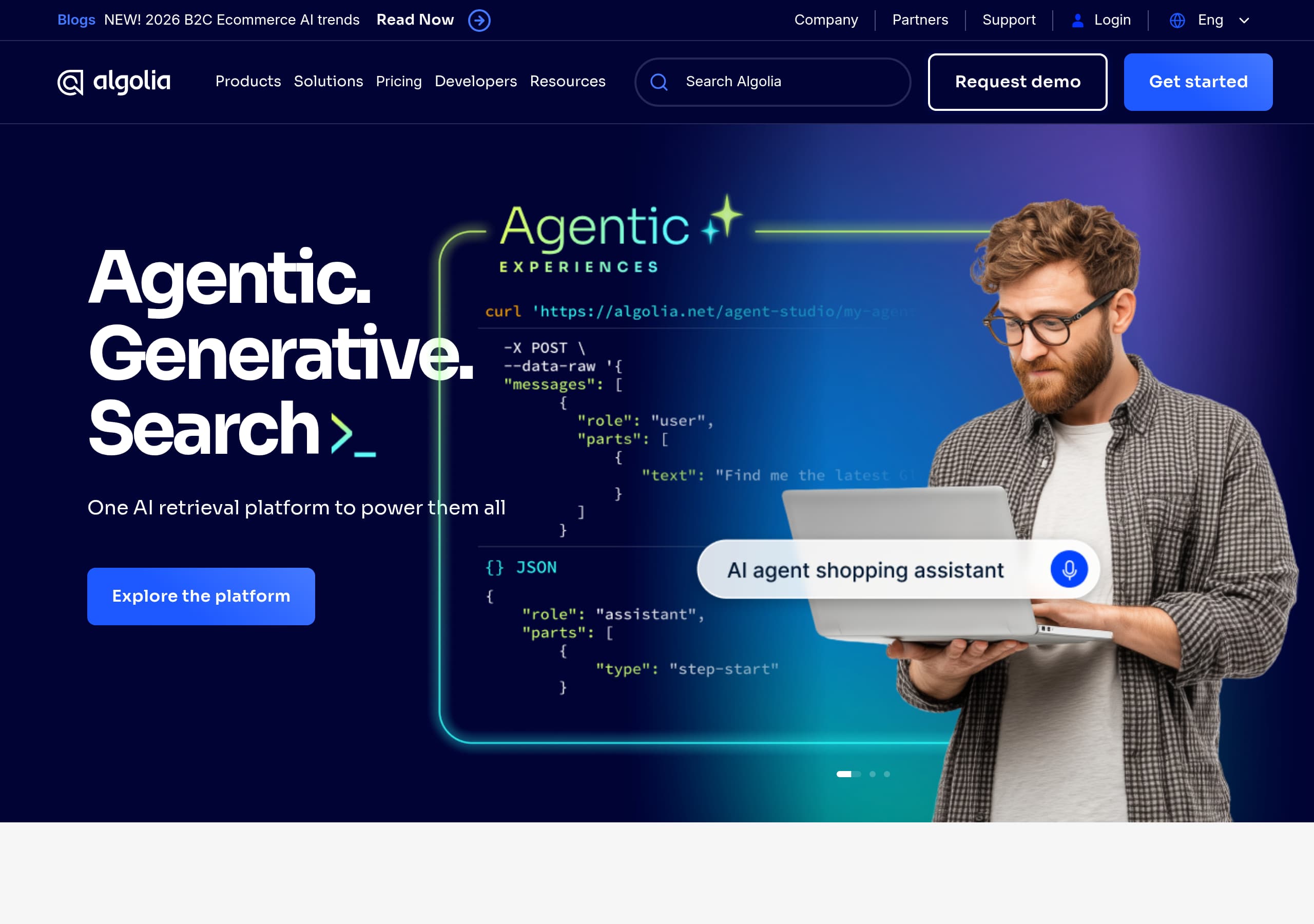
Algolia makes its positioning unambiguous by framing the product as “The AI search and retrieval platform” and then immediately clarifying the three modes it supports: Agentic, Generative, and Search.
The homepage uses dual primary CTAs, Explore the platform for evaluators and Get started for builders, which reduces decision friction across enterprise and developer audiences.
Algolia strengthens credibility with concrete, scannable proof points such as “More than 18,000 customers across 150+ countries” plus a prominent Gartner Magic Quadrant leader callout and downloadable report.
The site sells outcomes, not just features, by mapping capabilities to business goals like “Quickly surface the right content” and “Personalize for more engagement,” while still providing a clear path to the Developer Hub for implementation.
Trust is supported with specific compliance badges (for example ISO27001, SOC 2 Type 2, GDPR, CCPA) and infrastructure specifics like 70+ data centers across 17 regions, which helps enterprise buyers justify vendor selection.
The navigation is intentionally dense but well-structured, separating Products, Artificial Intelligence, Intelligent Data Kit, Industries, and Use Cases, which makes Algolia easier to evaluate for multiple search scenarios like documentation search, site search, and enterprise search.
Home
Algolia’s homepage is built to answer one question fast: what it is, who it is for, and why it matters. The hero headline, “The AI search and retrieval platform”, pairs with the three-part framing “Agentic | Generative | Search”, which immediately clarifies the scope and prevents the product from sounding like only site search.
Key homepage mechanics that drive clarity and movement:
- A strong above-the-fold CTA pair: Explore the platform (evaluation) and Get started (activation). This is a deliberate dual-CTA pattern that fits both enterprise buyers and developers.
- A specific market claim, “More than 18,000 customers across 150+ countries”, placed near the top, so the buyer gets scale reassurance early.
- Use-case tiles that translate the platform into outcomes: Product Discovery, Generative AI (explicitly calling out RAG grounding), Guided Shopping, and Documentation. Each tile includes a “Learn more” link, creating a low-friction next step.
The page also uses a “solutions to fulfill your business goals” section to shift from features to business language: “Quickly surface the right content,” “Understand user intent,” and “Stay on top of trends.” These are written as outcome statements, while still hinting at underlying mechanics like AI algorithms, index, and milliseconds performance framing.
Finally, the homepage keeps developers in the buying conversation by linking to View developer hub and showing deep navigation to Developer Hub, Documentation, Integrations, and UI components like Autocomplete. The result is a homepage that balances brand positioning, buyer assurance, and implementation pathways without forcing users into a single persona flow.
Pricing
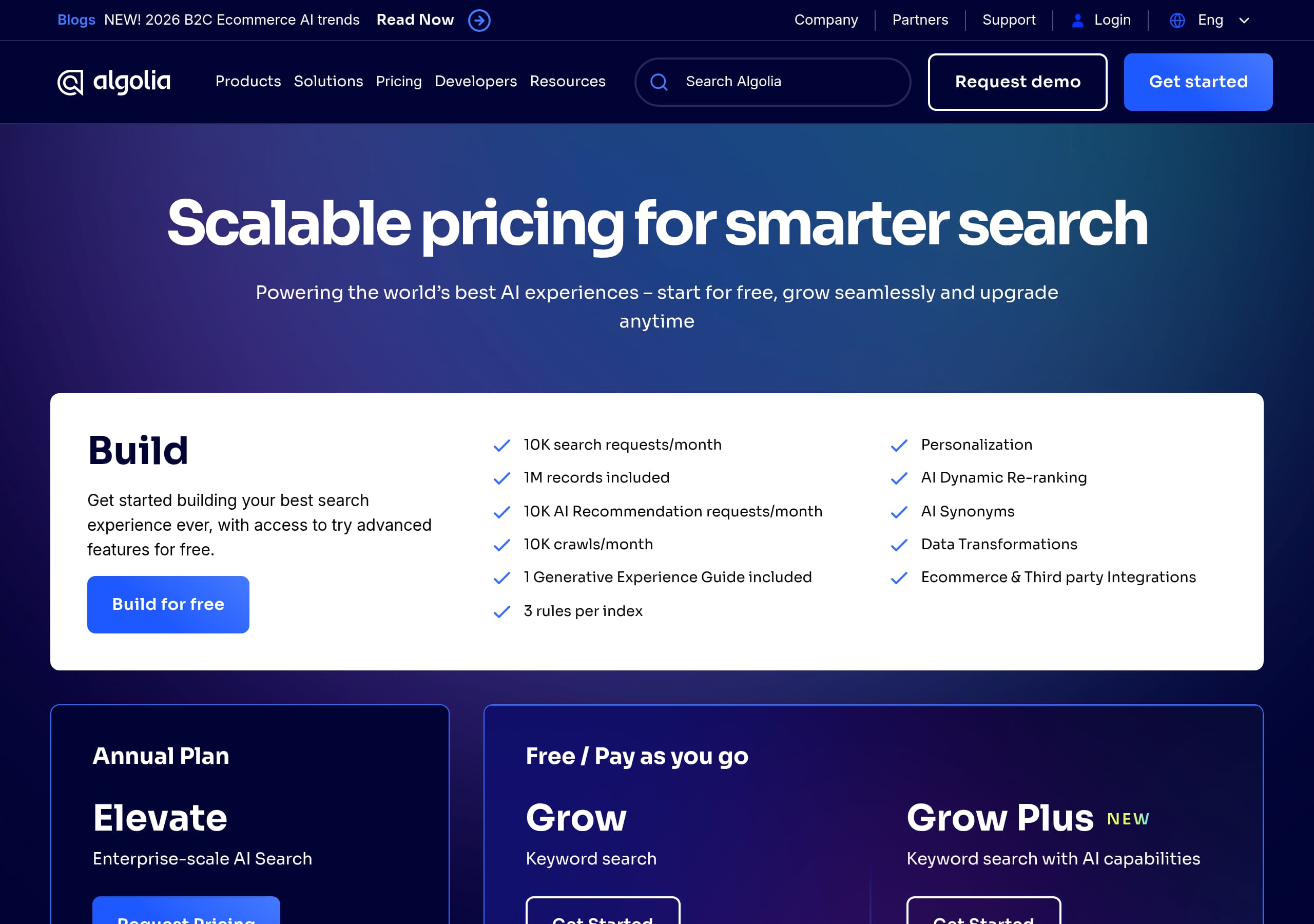
Algolia’s pricing experience is structured to support both self-serve onboarding and sales-led evaluation, which is consistent with the site-wide presence of Get started and Request demo. From the provided site context and the pricing screenshot, the key pattern is a pricing page that acts as an intent sorter: it helps visitors decide whether they can start immediately or need a conversation for enterprise needs.
What stands out from a conversion perspective is how Algolia frames pricing relative to product modules and use cases. The main navigation repeatedly reinforces that Algolia is not one SKU, it is a platform covering AI Search, Recommendations, Browse, Ask AI, and Agent Studio. That matters on pricing because buyers typically want to map cost to capabilities, indexing scale, and channels (site search vs documentation search vs ecommerce discovery). A good sign here is the repeated presence of action CTAs across the site, which indicates pricing likely offers multiple next steps rather than a dead-end grid.
Tactically, Algolia also reduces pricing anxiety by surrounding the purchase decision with evidence and implementation routes:
- Links to Developer Hub and Integrations suggest you can validate feasibility before committing.
- Prominent enterprise trust signals elsewhere (for example SOC 2 Type 2 and ISO27001) reduce risk objections that often block pricing acceptance.
One improvement opportunity, based on the platform’s breadth, is ensuring the pricing page clearly states what is metered (records, searches, indexing operations, or feature tiers) in plain language and ties each tier to a “best for” scenario like B2C ecommerce, SaaS, or documentation search. When pricing connects directly to the use-case language on the homepage, it shortens the path from curiosity to qualified lead.
Features
Algolia’s feature presentation is designed as a platform map, not a single product page, and that is a good fit for buyers evaluating “search” plus new AI capabilities. The navigation and feature taxonomy break the offering into clearly named modules: Search, Recommendations, Personalization, Analytics, and Browse, then a distinct Artificial Intelligence cluster including Agent Studio, Generative Experiences, Ask AI, and an MCP Server.
This structure does two important jobs. First, it prevents feature overload by grouping capabilities by job-to-be-done. For example, “Show users what they’re looking for with AI-driven results” is positioned under Search, while “Use behavioral cues to drive higher engagement” lives under Recommendations. Second, it reflects how organizations actually buy and implement: ecommerce teams might start with product discovery, then expand into personalization and analytics as maturity increases.
The homepage use-case tiles further translate features into scenarios:
- Product Discovery explicitly references practical search mechanics, “filtering, facets, and business rules,” which makes the value concrete for merchandisers and product teams.
- Generative AI is framed with RAG grounding: “accurate and on-brand,” “verified data,” and “consistent with your search logic,” which addresses hallucination and brand control concerns.
- Documentation focuses on “reduce support load” and “deliver precise answers,” connecting retrieval to cost reduction.
Algolia also foregrounds implementation support with a clear engineering path: “Index your content with our API clients or partner integrations… launch with our UI components. All in minutes,” plus a direct link to View developer hub. That blend of platform modularity, use-case framing, and developer enablement makes the features feel both enterprise-grade and buildable, which is critical in the search infrastructure category.
Signup
Algolia’s signup and onboarding path is positioned as a two-lane funnel: self-serve for builders and sales-assisted for enterprise buyers. This is visible throughout the header and page sections via persistent CTAs like Get started and Request demo, plus deep developer destinations including Developer Hub, Documentation, and Quick Start Guide.
From a conversion design standpoint, this is effective because AI search and retrieval purchases often begin in two different ways:
- A developer or product manager needs to validate indexing, relevance, and UI quickly, so Get started needs to be prominent and accessible from multiple page points.
- A director or procurement-led buyer needs assurances about data residency, compliance, and scale, so Request demo becomes the primary action.
Algolia reinforces “build now” behaviors with navigation items that reduce first-week friction: UI Components (including Autocomplete), Integrations, and an API Status page. The explicit mention of “Index your content with our API clients… fine-tune your rankings… launch with our UI components” suggests the onboarding narrative centers on indexing, relevance tuning, and front-end components rather than a vague setup.
There is also a subtle but important trust-to-signup bridge: the site highlights Security & Compliance and global infrastructure (70+ data centers, 17 regions) in the same ecosystem as the conversion CTAs. That matters because many teams will not even create an account if they assume the tool cannot pass internal review.
One area to watch is cognitive load. The header contains many product lines and use cases, which is great for discovery but can distract from signup if not balanced with a simplified “Start in 3 steps” style prompt on the signup page itself. Still, the overall structure is conversion-friendly because it consistently connects developer readiness to enterprise sales motion without forcing a single path.
Trust
Algolia’s trust posture is unusually concrete for a marketing homepage, and that is a competitive advantage in search infrastructure. Two types of trust signals are made explicit: compliance/security certifications and global reliability infrastructure.
On compliance, the page presents a visible set of badges and standards: BSI C5, GDPR, CCPA, ISO27001, SOC 2 Type 2, and SOC 3, paired with a “Learn more” link. This layout works because it is scannable and recognizable to security reviewers. It communicates that Algolia expects to be evaluated by enterprises and has prepared documentation for it.
On reliability and scale, Algolia provides a specific infrastructure claim in navigation: “70+ data centers across 17 regions.” Even without additional uptime numbers in the excerpt, this level of specificity increases believability and helps global businesses evaluate latency, redundancy, and data residency fit.
Trust is also reinforced through ecosystem and governance pathways:
- A dedicated Trust Center link appears in the footer, alongside Privacy Policy and Terms of Service, which is exactly where procurement teams look.
- The footer references GDPR and AI Act resources, signaling awareness of modern AI governance concerns, relevant for features like Ask AI and Generative Experiences.
- The site includes API Status, which is a practical trust signal for engineering teams who care about incident transparency.
Finally, Algolia’s “Compliant. Secure. Award-winning.” phrase positions trust as a product attribute, not an afterthought. The key is that these signals are not generic claims, they are anchored by named standards and an infrastructure footprint. For buyers comparing Algolia to alternatives like Elasticsearch/OpenSearch-based solutions or other hosted search providers, this combination of certifications, global infrastructure, and operational transparency materially reduces perceived risk.
Footer
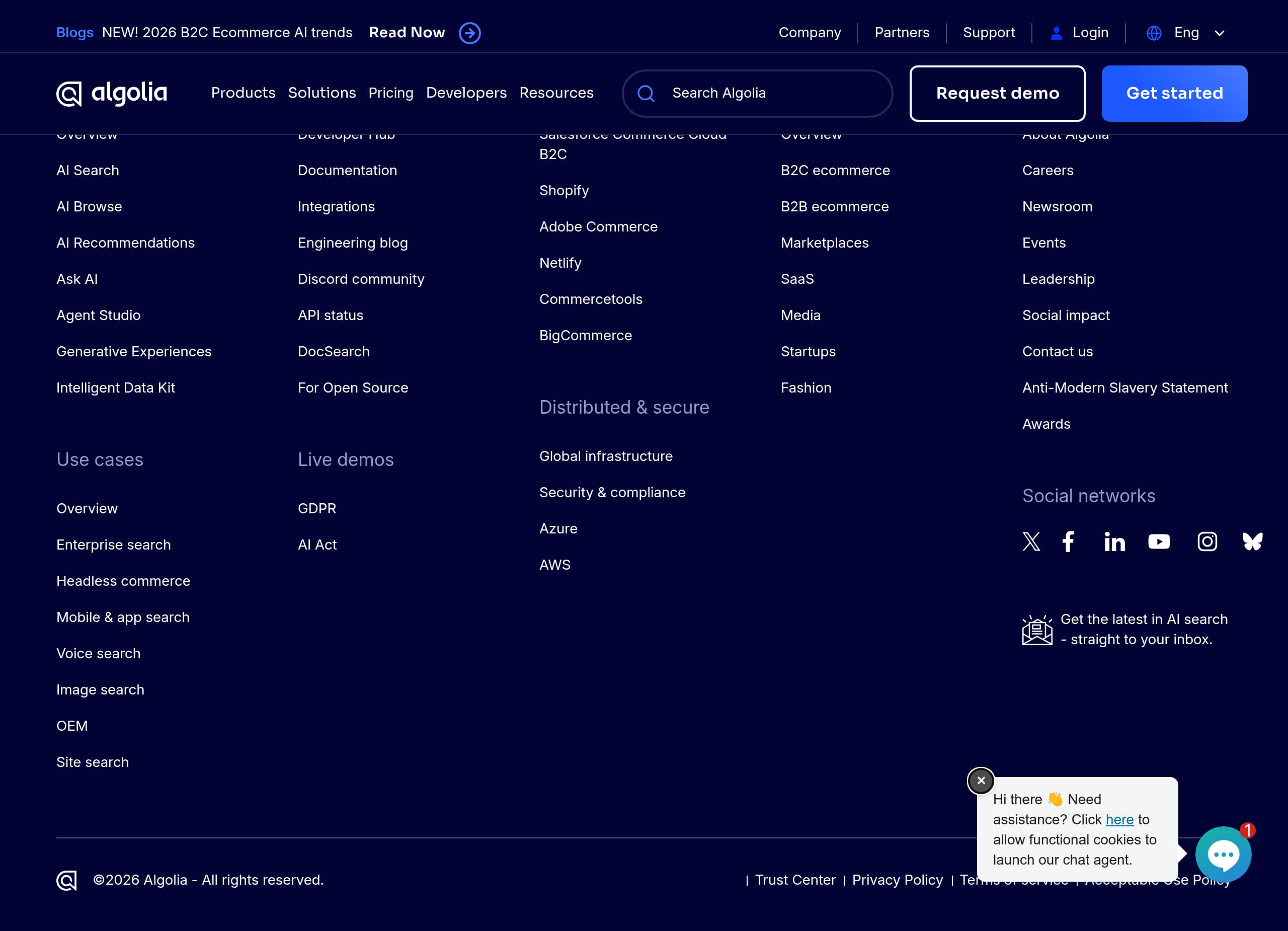
Algolia’s footer is designed as a full sitemap plus governance hub, which is appropriate for a complex platform with multiple personas. The footer groups links into clear clusters: Products, Use cases, Developers, Industries, Integrations, Distributed & secure, and Company. This matters because visitors frequently land on a single page from search and then need a reliable way to navigate to documentation, compliance, or a specific use case like enterprise search.
Several footer choices strengthen SEO and self-serve evaluation:
- Repetition of core entity pages (for example AI Search, AI Recommendations, Ask AI, Agent Studio) helps search engines and users understand the product hierarchy.
- Developer destinations are first-class citizens: Developer Hub, Documentation, Engineering blog, Discord community, API status, plus DocSearch For Open Source and Live demos. This makes the footer a practical “next step” tool, not just corporate links.
- Integrations are explicitly named, including Salesforce Commerce Cloud, Shopify, Adobe Commerce, Netlify, and Commercetools, reinforcing platform compatibility.
The legal and compliance strip is also strong. It includes Trust Center, Privacy Policy, Terms of service, and Acceptable Use Policy, plus Cookie settings. These items are exactly what security and legal reviewers seek when vetting a vendor.
A notable conversion-supporting element is the newsletter signup: “Get the latest in AI search,” which provides a softer opt-in for visitors not ready for a demo. The chat prompt at the bottom mentions functional cookies and “launch our chat agent,” which is transparent about consent requirements.
Overall, the footer serves as a structured index of Algolia’s platform and proof assets, improving discoverability for both humans and crawlers while reinforcing developer enablement and compliance readiness.
Detected tech stack
Tools and technologies we detected on Algolia's site. Detection is best-effort and may be incomplete.
Frontend
Scores
Our framework scores for Algolia's website in terms of clarity, conversion, and trust. See our methodology for how we calculate these.
How clear the value prop and structure are.
How conversion-friendly signup and pricing are.
How well trust and compliance are surfaced.
FAQ
Algolia leads with “The AI search and retrieval platform” and immediately specifies the scope as “Agentic | Generative | Search.” It then supports that positioning with use-case blocks like Product Discovery, Generative AI (with RAG grounding), Guided Shopping, and Documentation. Two prominent CTAs, “Explore the platform” and “Get started,” let evaluators and builders choose the right next step without hunting.
Algolia consistently offers two buying motions across the site: “Get started” for self-serve adoption and “Request demo” for sales-led evaluation. This matches the product’s enterprise and developer audiences. The platform is also presented as multiple modules (Search, Recommendations, Ask AI, Agent Studio), which sets the expectation that pricing may vary by capability and scale, not just a single flat plan.
Algolia uses three visible forms of proof: a scale claim (“More than 18,000 customers across 150+ countries”), third-party validation (recognized as a Leader in the 2025 Gartner Magic Quadrant for Search and Product Discovery, two years running), and quantified impact metrics such as “+112% CVR boost” and “34% increased search revenue.” It also points users to customer stories for deeper verification.
Algolia displays recognizable compliance and audit standards directly on the page, including BSI C5, GDPR, CCPA, ISO27001, SOC 2 Type 2, and SOC 3. It also provides a Trust Center link in the footer alongside core legal policies. For infrastructure reassurance, it states a global footprint of 70+ data centers across 17 regions, which supports enterprise requirements around scale and latency.
Algolia is positioned for both. Business teams get outcome-oriented sections like “Solutions that fulfill your business goals” and modules like Recommendations and Personalization. Developers get prominent access to the Developer Hub, Documentation, UI Components (such as Autocomplete), Integrations, and an API Status page. The dual CTAs, “Get started” and “Request demo,” reflect these two primary personas.

The world's best-performing SaaS businesses share surprisingly similar patterns. We help you learn and apply them through our human-designed methodology, with AI-assisted research.