
Key takeaways
Here are the key insights from our website breakdown analysis of Confluent.
Confluent’s homepage nails positioning by pairing a single, category-defining headline with immediate authority—“The World’s Data Streaming Platform, by the original co-creators of Apache Kafka®”—which clarifies why it is not just “managed Kafka.”
Conversion paths are clearly segmented: “Start for Free” targets self-serve users, while “Contact Sales” and “Contact a Specialist” serve enterprise buyers—reducing choice overload without hiding high-intent CTAs.
The navigation is intentionally practitioner-friendly, with product pillars like “Connectors,” “Stream Governance,” “Stream Processing,” and “Tableflow,” plus deployment choices like Confluent Cloud, Confluent Platform, and Confluent Private Cloud to match buyer constraints early.
Confluent uses quantified outcome proof directly in the core value sections, such as “SAS saved 69%,” “Notion powers 100M+ users daily,” and “14x predictive performance at GEP,” which makes benefits feel measurable rather than conceptual.
Trust is strengthened through direct competitive framing (“Confluent vs. Apache Kafka®”), a “Cost Estimator,” and technical FAQ content that references specifics like the Kora engine and “20–90%+ throughput savings,” though deeper security and compliance badges should be surfaced more prominently on the homepage.
The site is built to educate and capture demand simultaneously, with heavy internal pathways into the Blog, Data Glossary, Documentation, Training, Demo Center, and reference architectures that support both SEO discovery and technical evaluation.
Home
Confluent’s homepage works because it establishes category leadership immediately, then routes different buyers to the right next step without forcing them through a single narrative.
What the hero gets right
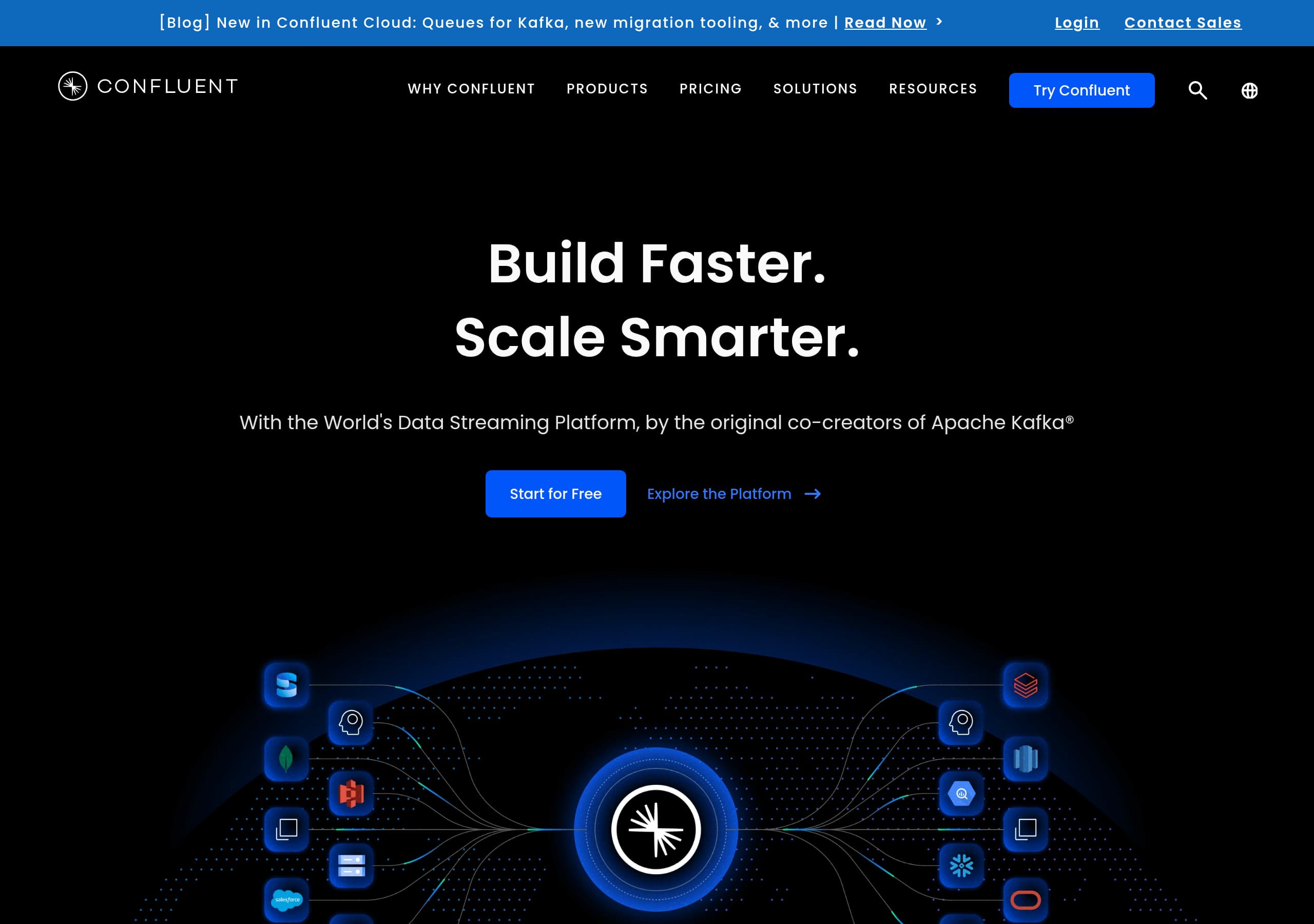
The hero headline, “Build Faster. Scale Smarter.” followed by “With the World’s Data Streaming Platform, by the original co-creators of Apache Kafka®,” does two jobs at once: it communicates the category (data streaming platform) and anchors credibility with Apache Kafka® provenance. The primary CTA “Start for Free” sits alongside “Explore the Platform,” which clearly separates action from exploration.
How the page supports fast self-qualification
Below the hero, the page repeats three core outcomes in a carousel-like structure (labeled 1, 2, 3) that reads like a tight value framework:
- “Eliminate costly data infrastructure,” with a concrete proof point, “See how SAS saved 69%.”
- “Clean data at the source,” linked to “See how Notion powers 100M+ users daily.”
- “Be ready for AI now,” backed by “See 14x predictive performance at GEP.” These are not feature claims; they are business outcomes with numbers, which helps enterprise buyers justify evaluation.
Information architecture that matches real buying patterns
The top navigation is dense but well structured, with clear groupings: Products (Data Streaming, Connectors, Stream Governance, Stream Processing, Tableflow), Deployments (Confluent Cloud, Confluent Platform, Confluent Private Cloud, WarpStream), plus Solutions and Industries. This is especially effective for infrastructure software where requirements differ by governance, latency, and deployment constraints. The repeating “Watch Demo” and “Try Confluent” buttons create multiple entry points without relying on a single scroll depth for conversion.
Pricing
Confluent’s pricing UX is positioned as a decision toolkit, not a static price list, which fits a consumption-based platform where costs depend on workload, cloud, and scale.
Pricing is framed around transparency and comparison
In navigation, “Confluent Pricing” is paired with a “Cost Estimator” that explicitly promises comparison against “a self-managed Kafka deployment.” That pairing is a strong conversion pattern for skeptical evaluators: it lets Confluent sell total cost of ownership instead of defending a single unit price. The homepage further reinforces this with the claim of “transparent consumption-based pricing,” and it places pricing alongside “Confluent vs. Apache Kafka®,” which nudges visitors into a structured evaluation path.
What the site does well for mixed buyer intent
Confluent supports at least two pricing mindsets:
- Self-serve developers who just need to start, routed through “Start for Free” and “Try for Free.”
- Enterprise buyers who need confidence and customization, routed to “Contact Sales” and “Contact a Specialist.” This dual path reduces friction because it avoids forcing an enterprise-ready platform into a purely PLG pricing page.
Where pricing could become even more conversion-friendly
From the provided homepage excerpt, the pricing details are one click away, but the hero area does not preview even a minimal “starting at” or “free tier includes” snippet. For high-intent searches, that can introduce an extra step.
Tactically, the strongest next improvements would be:
- A short, above-the-fold pricing teaser that clarifies what ‘free’ means (time limit, credits, usage caps).
- A visible checklist of what is included across deployment options, since “Confluent Cloud,” “Confluent Platform,” and “Confluent Private Cloud” imply different cost models.
Overall, Confluent treats pricing as a guided evaluation, using estimation tools and competitive comparison to match how Kafka decisions are actually made.
Features
Confluent’s feature presentation is strongest when it shifts from “Kafka” to a complete platform story, with clear modules and deployment choices that match real architecture decisions.
Feature taxonomy is platform-oriented
The Products menu acts as a feature map, breaking the platform into recognizable capabilities:
- Data Streaming for real-time architectures.
- Connectors for integrating databases and SaaS apps.
- Stream Governance for access, quality, and compliance workflows.
- Stream Processing for transformation and real-time computation.
- Tableflow positioned as “Topics to tables in a few clicks,” which signals a bridge to analytics table formats. This modular structure helps buyers understand that Confluent is not only brokers; it is the surrounding tooling required to operate Kafka at scale.
Deployment options are treated as first-class features
“Choose Your Deployment” lists Confluent Cloud, Confluent Platform (on-premises), Confluent Private Cloud, and WarpStream. Making deployment explicit is a strong enterprise UX decision because it lets teams self-identify constraints like data residency, network topology, and cloud strategy early. It also supports hybrid cloud integration messaging seen later on the page.
AI positioning is productized, not just marketing
The site introduces “Confluent Intelligence” with “Real-time, context-aware AI Streaming Agents,” and the Solutions area includes “Generative AI” for RAG and agentic use cases. This framing is effective because it connects platform primitives (streams, governance, processing) to new buyer demand for AI systems that require real-time contextual data.
Feature messaging is anchored by “The Confluent Difference”
The three-part differentiation—“Cloud-Native,” “Complete,” and “Everywhere”—is a concise feature-to-benefit bridge. It also enables direct competitive comparison via “Confluent vs. Apache Kafka®.”
Opportunity: the homepage is rich in modules, but a simple visual architecture diagram (sources, connectors, topics, governance, sinks, tables) would reduce cognitive load for first-time visitors. Still, Confluent’s feature structure is unusually aligned with how streaming platforms are evaluated in practice.
Signup
Confluent’s signup approach is optimized for enterprise-grade self-serve: it repeatedly invites trial starts while keeping a parallel path for guided evaluation.
Clear CTAs, repeated deliberately
The homepage uses multiple high-intent CTAs: “Start for Free” in the hero, “Try Confluent,” “Try Now for Free,” and “Try for Free” in later sections. In parallel, it offers “Contact Sales” in the header and “Contact a Specialist” as a prominent alternative. This is a strong pattern for complex infrastructure because it avoids forcing every visitor into the same funnel.
Signup is supported by learning and demo scaffolding
Confluent pairs trial CTAs with “Watch Demo,” “Visit the Demo Center,” and “Explore Demos,” plus deep developer enablement routes like “Documentation,” “Training and Certification,” and “Confluent Developer Courses.” That means the signup does not have to carry the entire evaluation burden. Visitors can convert into an educational path first, then return to the product trial when ready.
What the homepage implies about onboarding
While the excerpt does not show the actual form, the wording “Start streaming your data in minutes” suggests the onboarding promise is speed-to-first-stream. The surrounding IA also hints at likely next steps after signup: connect systems through the “Confluent Marketplace” with “200+ Connectors and native integrations,” then govern and process streams.
Where signup clarity could improve
Because “Start for Free” is a primary conversion lever, the page would benefit from one line of specificity near the CTA: what a free user can do immediately (for example, create a cluster, run a connector, or execute a tutorial). Without that, enterprise visitors may wonder if “free” is a sales-led trial.
Overall, Confluent’s signup strategy is practical: strong multi-CTA routing, plenty of developer enablement, and clear separation between self-serve trial and specialist-led evaluation.
Trust
Confluent builds trust primarily through technical specificity, competitive transparency, and education, rather than through heavy security-badge decoration on the homepage.
Trust via authority and provenance
The hero explicitly references being “by the original co-creators of Apache Kafka®,” which is a powerful credibility cue in the Kafka ecosystem. It signals deep expertise and reduces the risk perception that Confluent is “just another hosted service.”
Trust via technical detail in FAQs
The FAQ section does more than define terms. It includes product-specific claims like “Confluent Cloud is powered by Kora, our cloud-native engine” and mentions “autoscaling” and “20–90%+ throughput savings.” This kind of technical anchoring is persuasive for practitioners because it demonstrates that the product has proprietary engineering beyond packaging.
Trust via transparency in evaluation tools
Confluent links “Confluent vs. Apache Kafka®” and an “Estimate Your Savings” pathway, reinforcing that it expects to be compared. The existence of a cost estimator in navigation is a practical trust move: it implies Confluent is willing to quantify tradeoffs rather than hide behind “contact us.”
Trust via risk reduction paths
Multiple routes reduce perceived risk:
- “Professional Services” and “Contact Support” for implementation confidence.
- “Documentation,” “Training and Certification,” and “Reference Architectures” for technical validation.
- “Our Partners” for procurement-friendly delivery.
Gap to address
From the provided content and screenshot context, explicit security and compliance artifacts (for example, SOC 2, ISO, GDPR statements, data residency options) are not prominent on the homepage. For regulated industries like Financial Services and Public Sector, placing a compact security and compliance trust block near the primary CTAs would likely increase conversion from high-intent evaluators.
Net: Confluent’s trust strategy is strong in technical legitimacy and transparent comparison, and it could be further strengthened with more visible security posture cues above the fold.
Footer
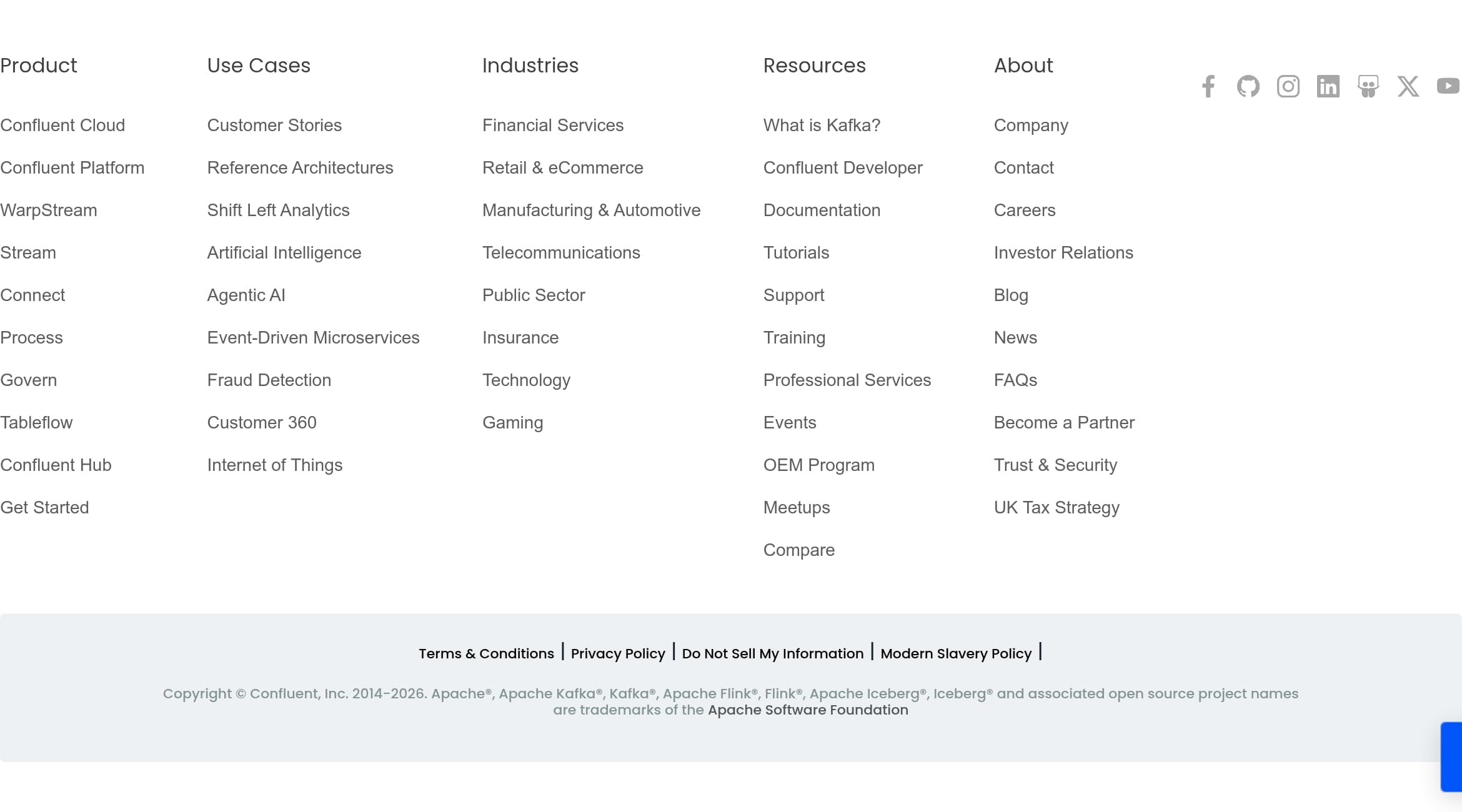
Confluent’s footer appears designed as a comprehensive enterprise sitemap, which is valuable for a broad platform with many buyer journeys, but it must balance completeness with scannability.
What the footer likely does well
From the site structure visible in the excerpt, Confluent has a large set of destinations that users actively need: Products, Pricing, Solutions, Resources, Developer Resources, Support, and company pathways like Partners and Customers. A strong footer for this kind of SaaS usually functions as:
- A secondary navigation hub for users who scroll, especially after reading FAQs.
- A compliance and governance anchor, including legal pages and policy links.
- A conversion backstop with persistent routes to “Contact Sales,” demos, or trials.
What to look for in the current footer screenshot
Given Confluent’s enterprise context, the footer should visibly include:
- Legal and policy links (Privacy, Terms), plus cookie preferences if applicable.
- Company credibility links (About, Careers, Press) to support vendor due diligence.
- Support and documentation links to reduce friction for technical users.
- Region or language selection, since the header indicates “US English.” These elements are not “nice to have”; they are practical procurement requirements for infrastructure software.
Tactical improvements that would raise performance
If the footer is very dense, it can become hard to scan. Two patterns typically help:
- Grouping links by persona, for example “Developers,” “Architects,” “Security and Compliance,” “Procurement,” rather than only by internal org structure.
- Adding one short conversion module, such as “Try Confluent Cloud” plus “Contact Sales,” so the footer still drives action.
Overall, Confluent’s footer should be judged by how quickly it helps a visitor find critical evaluation assets, especially documentation, support, and legal readiness. For a platform this broad, a well-structured footer is a meaningful conversion contributor.
Detected tech stack
Tools and technologies we detected on Confluent's site. Detection is best-effort and may be incomplete.
Scores
Our framework scores for Confluent's website in terms of clarity, conversion, and trust. See our methodology for how we calculate these.
How clear the value prop and structure are.
How conversion-friendly signup and pricing are.
How well trust and compliance are surfaced.
FAQ
Confluent leads with a category statement and authority in one place: “The World’s Data Streaming Platform, by the original co-creators of Apache Kafka®.” It then translates the platform into three outcome blocks with measurable proof, including “SAS saved 69%,” “Notion powers 100M+ users daily,” and “14x predictive performance at GEP.” The page also offers clear next steps like “Start for Free” and “Explore the Platform.”
Confluent treats pricing as an evaluation workflow. In navigation it offers “Confluent Pricing” and a dedicated “Cost Estimator” that compares savings versus a self-managed Kafka deployment. The homepage reinforces “transparent consumption-based pricing” and links into “Confluent vs. Apache Kafka®,” encouraging visitors to compare alternatives. This approach fits a usage-based platform where costs depend on workload, deployment model, and scale.
Confluent uses dual conversion routes throughout the homepage. Self-serve users are guided through “Start for Free,” “Try Now for Free,” and similar trial CTAs. Enterprise buyers are routed to “Contact Sales” and “Contact a Specialist” for guided evaluation. Confluent also supports pre-signup learning with “Watch Demo,” the Demo Center, documentation, and training links, which reduces friction for technical evaluators.
Confluent organizes the platform into clear modules: Data Streaming, Connectors, Stream Governance, Stream Processing, and Tableflow (“Topics to tables in a few clicks”). It also elevates deployment choice as a core decision, listing Confluent Cloud, Confluent Platform (on-premises), Confluent Private Cloud, and WarpStream. This structure helps visitors map features to architecture requirements and constraints early.
Confluent builds trust through authority, specificity, and proof. It highlights Kafka credibility by referencing the original co-creators of Apache Kafka®. It includes quantified customer outcomes (69% savings, 100M+ users, 14x performance) and offers transparent evaluation tools like “Confluent vs. Apache Kafka®” and “Estimate Your Savings.” The FAQ also includes product-specific technical details such as the Kora engine and autoscaling.

The world's best-performing SaaS businesses share surprisingly similar patterns. We help you learn and apply them through our human-designed methodology, with AI-assisted research.