
Key takeaways
Here are the key insights from our website breakdown analysis of ThoughtSpot.
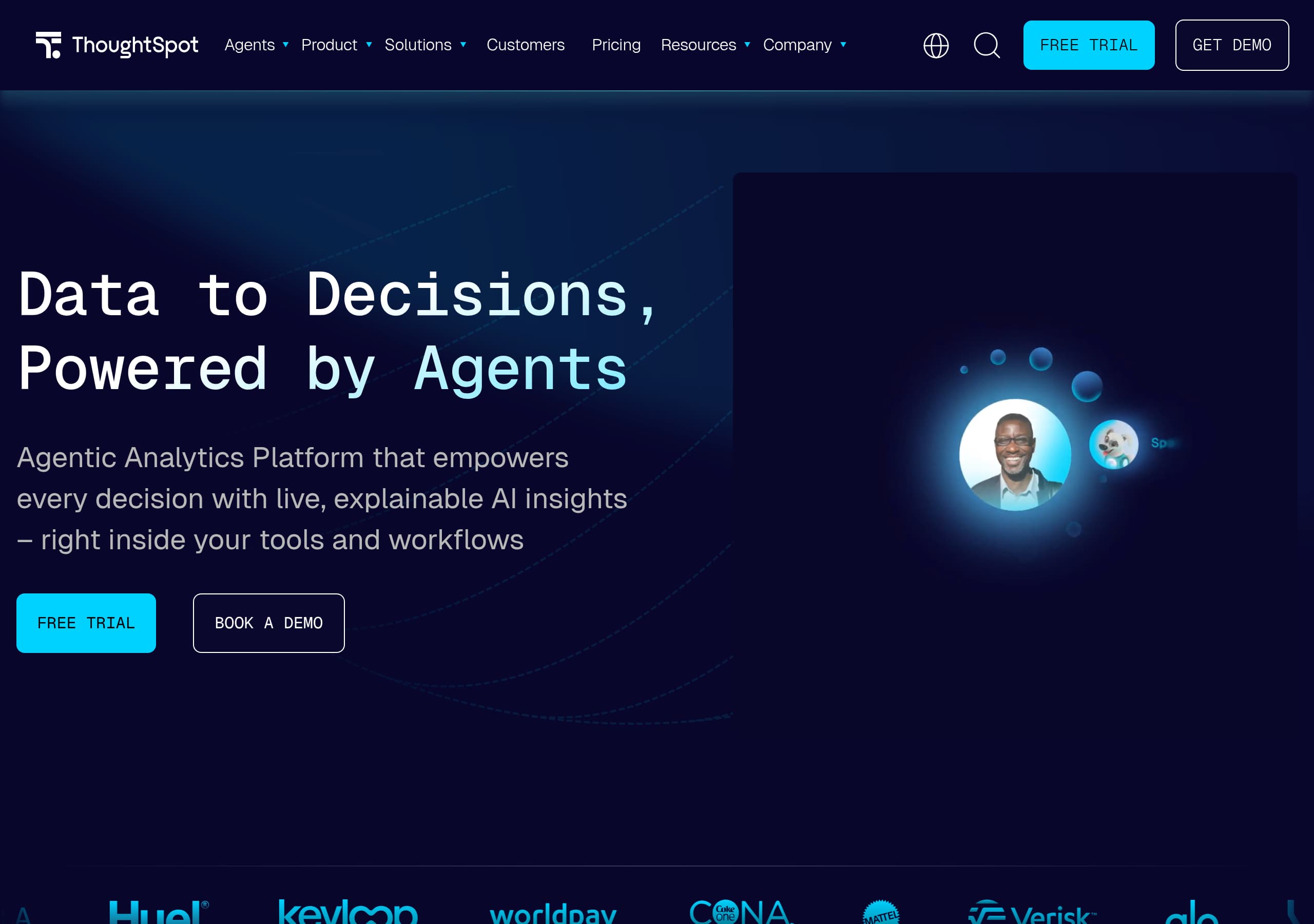
ThoughtSpot’s homepage quickly establishes a clear category narrative by pairing “Data to Decisions, Powered by Agents” with an explicit definition of an “Agentic Analytics Platform,” reducing ambiguity for both BI and GenAI buyers.
Conversion paths are intentionally split between “Free Trial” and “Book a Demo,” a dual-CTA pattern that supports self-serve evaluation while still capturing enterprise intent.
Feature positioning is organized around workflows and roles—not just capabilities—with repeated “Learn more” links that let prospects self-navigate by use case, role, or product module (Spotter, SpotterModel, SpotterViz, SpotterCode).
Social proof is unusually concrete for an enterprise analytics product: it combines a “Leader in Data Analytics 2025” block with multiple named, attributed customer quotes, increasing credibility and buyer confidence.
ThoughtSpot emphasizes explainability and governance in its core messaging (for example, “live, explainable AI insights” and “governed answers”), which is essential for AI analytics adoption in regulated environments.
The site supports evaluation at scale with a robust resource ecosystem (blog, analyst reports, case studies, ThoughtSpot University, community, developer events), helping both champions and technical evaluators build a business case.
Home
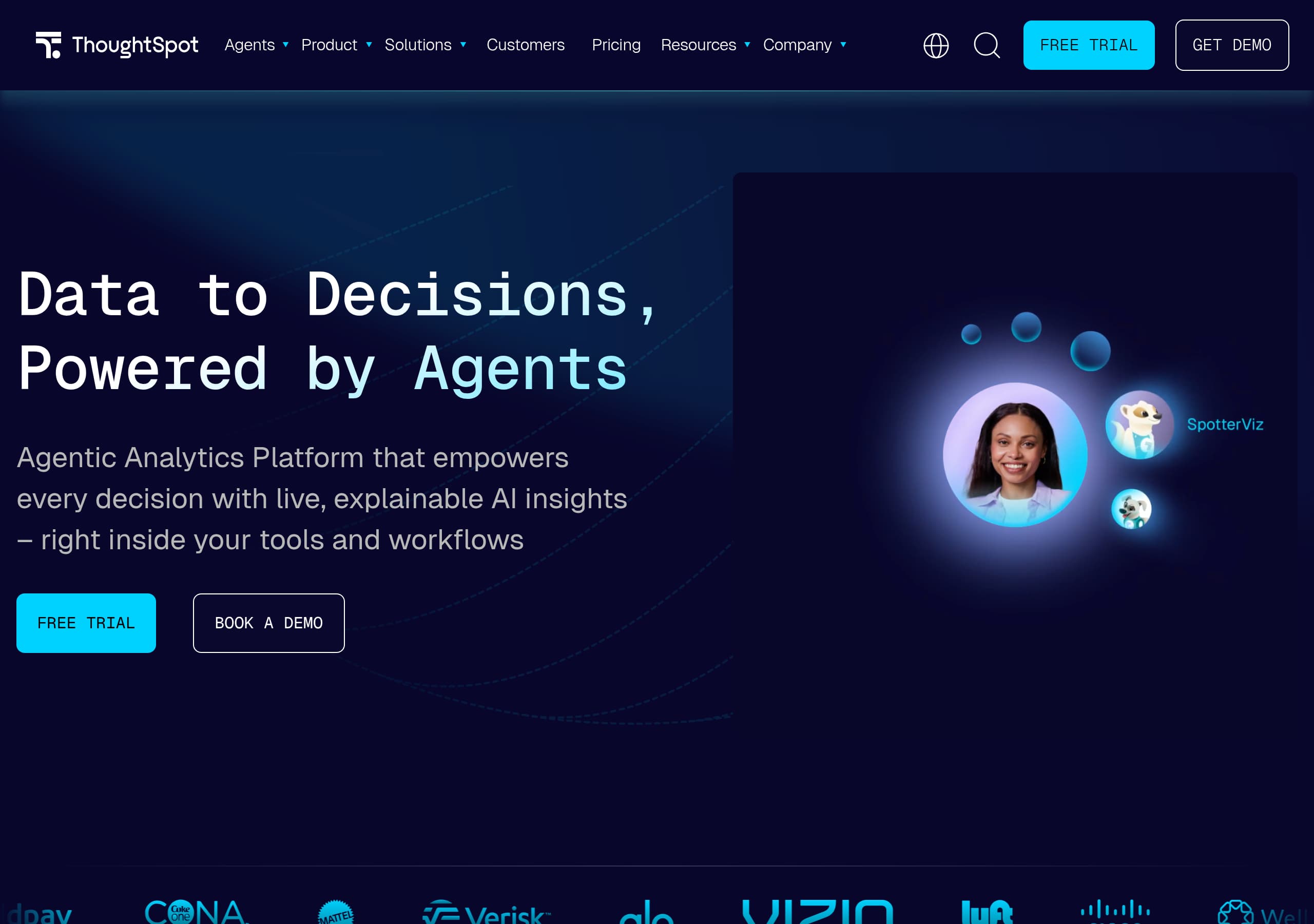
ThoughtSpot’s homepage is effective because it defines the product category and the promise in one screen: “Data to Decisions, Powered by Agents” and an “Agentic Analytics Platform” that delivers “live, explainable AI insights” inside existing tools and workflows. This is clarity-first messaging that immediately answers what it is, why it matters, and where it fits.
The hero section uses a conversion-ready layout: two primary CTAs, Free Trial and Book a Demo, sit directly under the value proposition. That dual-CTA approach reduces friction for mixed-intent traffic (self-serve evaluators versus enterprise buyers) without forcing a single path. The copy also includes concrete qualifiers like “right inside your tools and workflows,” which sets up embedded analytics and integrations before the visitor scrolls.
The mid-page structure reinforces the narrative with an explicit “Traditional BI Can’t Keep Up” problem statement, listing specific pain points: “static dashboards,” “request backlogs,” and “stale data.” Immediately after, ThoughtSpot introduces “THE NEW STANDARD FOR BI in the Age of AI,” then enumerates the pillars buyers expect: AI Agents, Self-Service Guided Discovery, Embedded Analytics, Semantic Model, and Transparent AI. This reads like an RFP checklist while still staying readable.
The feature teasers are written as outcome modules with matching CTAs:
- “Talk to Your Data in a Whole New Way” positions natural language Q&A as governed, live answers.
- “Smarter Dashboards, No Overhead” describes a single “Liveboard” that supports drill-anywhere exploration—a direct anti-sprawl message.
- “AI-Augmented Insights” explicitly moves from “What Happened” to “Why” and “What If,” signaling deeper analytical workflows.
Overall, the homepage uses repeated, consistent phrasing around “governed,” “live,” and “where work happens,” which is crucial for differentiating ThoughtSpot from classic BI tools like Tableau-style dashboarding alone.
Pricing
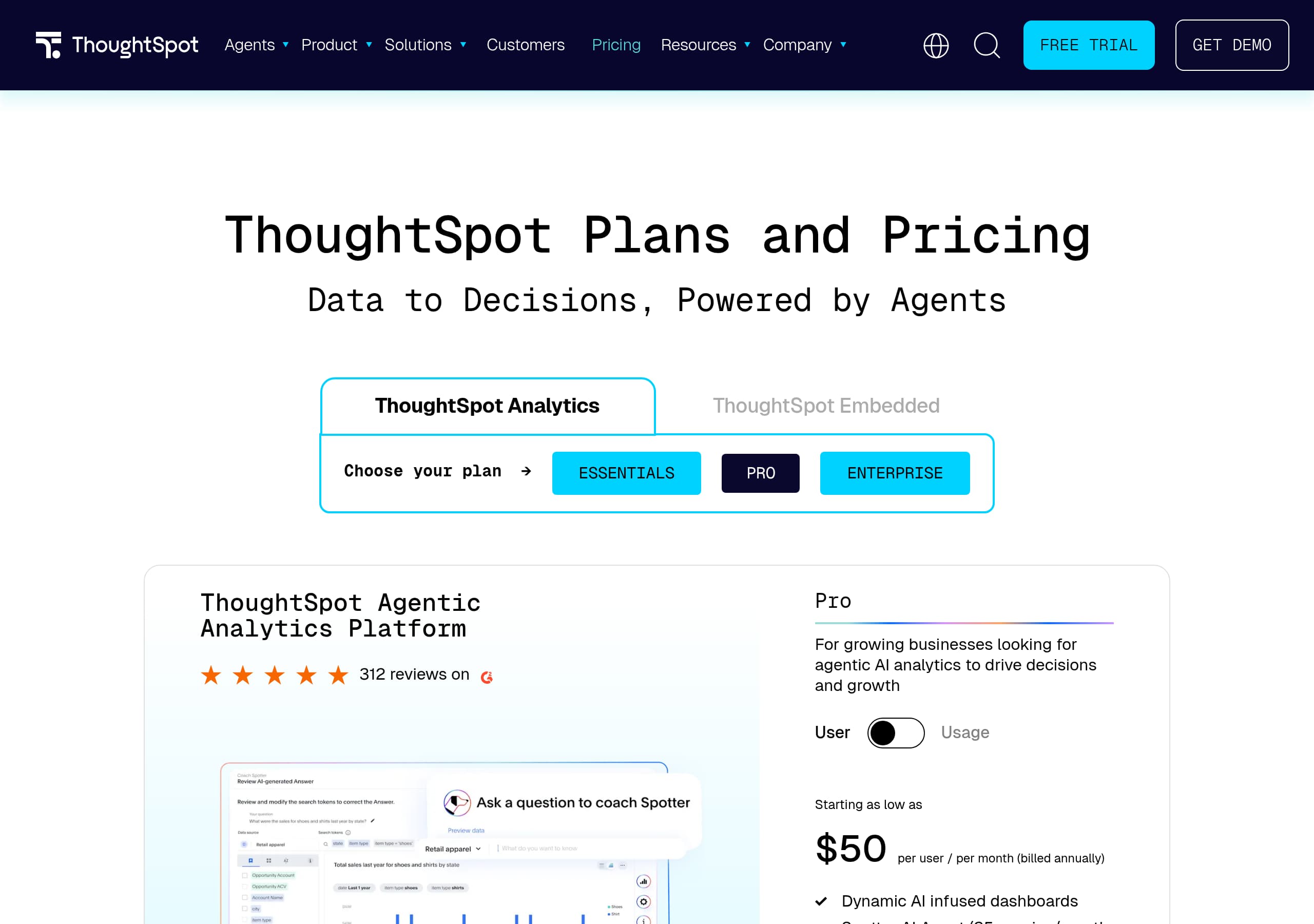
ThoughtSpot’s pricing experience is positioned as an enterprise-friendly decision page rather than a simplistic plan grid, which matches how analytics platforms are typically purchased. In the site navigation, “Pricing” is a first-class item alongside Product and Solutions, so buyers do not have to hunt for commercial information—a meaningful conversion advantage for high-intent traffic.
From the provided screenshot of the Pricing page, the layout appears structured and scannable, with plan-level framing and clear segmentation intended to help different buyer types self-identify. This matters for ThoughtSpot because the product targets multiple personas: business leaders, data leaders, and product developers who embed analytics. A pricing page that supports role-based evaluation reduces uncertainty and lowers the number of pre-sales back-and-forth questions.
What the pricing presentation does well from a conversion standpoint:
- It aligns with the site’s broader dual-path motion: the global CTAs still emphasize Free Trial and Book a Demo, so pricing can support both product-led and sales-led motions.
- It likely supports modular positioning that mirrors the product architecture shown elsewhere (for example, BI, Agents, Embedded Analytics, Analyst Studio), helping buyers map costs to the parts they actually need.
- It functions as a qualification layer, letting visitors understand whether ThoughtSpot is built for enterprise analytics and embedded use cases without requiring a call just to get basic context.
Where ThoughtSpot could further strengthen pricing clarity, based on visible site patterns:
- Add explicit “who it’s for” bullets per tier using the same language as the homepage, such as “governed natural language answers” or “embedded analytics in Salesforce and ServiceNow,” to reduce cognitive load.
- Provide a short FAQ on the page addressing common procurement questions—for example, licensing basis, deployment options, and how embedded pricing works.
Net: ThoughtSpot treats pricing as part of a guided evaluation journey, consistent with its platform positioning and the realities of enterprise purchasing.
Features
ThoughtSpot’s feature presentation works because it is organized as an end-to-end analytics workflow with agent modules, not a flat list of capabilities. The site repeatedly frames the product as a “Superteam of Agents” that can “automate every stage of the analytics workflow,” a clear differentiation from traditional BI that focuses mainly on dashboard building.
The feature narrative is layered in three ways that match how buyers evaluate analytics platforms:
-
Core platform pillars: “AI Agents,” “Self-Service Guided Discovery,” “Embedded Analytics,” “Semantic Model,” and “Transparent AI.” This reads like a buying checklist for governed self-service and embedded delivery.
-
Outcome-driven modules with clear headings and CTAs:
- “Talk to Your Data” emphasizes natural language questions with “instant, governed answers on live data.”
- “Smarter Dashboards, No Overhead” focuses on reducing dashboard sprawl using a single “Liveboard” that supports drill-anywhere exploration.
- “AI-Augmented Insights” introduces automated trend detection and alerts, plus the “Why” and “What If” progression.
- “Connected to Where Work Happens” explicitly calls out delivery into tools like Salesforce and ServiceNow, plus “low-code” and “developer-friendly.”
- What’s New, with named agent products that make the platform tangible:
- Analyst Studio for data prep across SQL, Python, and spreadsheets.
- SpotterModel for automated semantic modeling with “human-in-the-loop validation.”
- SpotterViz for “data to dashboards” with automated layout and styling.
- SpotterCode for AI-assisted embedded development inside an IDE.
A particularly strong detail is the repeated emphasis on governance and correctness, using phrases like “governed accuracy,” “trusted and secure metrics layer,” and validation loops. That reduces a common buyer fear about AI analytics hallucinations.
If ThoughtSpot wants to further improve scannability, it could add a simple comparison table between the four Spotter modules to clarify “who uses it” and “what it outputs,” but the current structure already communicates a coherent, agent-led workflow.
Signup
ThoughtSpot optimizes signup for mixed enterprise and self-serve intent by making “Free trial” and “Get demo” persistent entry points across the site, including the header and the final CTA block (“Ready to Try ThoughtSpot? FREE TRIAL BOOK A DEMO”). This is a practical approach for an analytics platform where some prospects want hands-on evaluation and others need stakeholder alignment before access.
From the homepage excerpt, the signup experience is not presented as a single forced funnel. Instead, ThoughtSpot offers multiple evaluation routes:
- Free Trial for product-led discovery, likely oriented around quickly experiencing natural language Q&A and Liveboards.
- Book a Demo for guided exploration, useful for embedded analytics and governed semantic modeling discussions.
The site also supports pre-signup education to reduce early churn. Before asking for credentials, ThoughtSpot provides:
- Short, clear “Learn more” paths under each capability, for example “Talk to Your Data,” “AI-Augmented Insights,” and “Connected to Where Work Happens.”
- A large “Resources” hub (Analyst Reports, Case Studies, Ebooks, Product Videos, Webinars, Documentation, ThoughtSpot University, Community), helping visitors self-qualify and arrive at signup with clearer expectations.
Another conversion-positive pattern is event-style banners like “[Last chance to register]” and virtual event CTAs (“Save your spot”). These act as softer conversions for visitors who are not ready for a trial or demo, while still capturing leads.
The main risk in the signup path is potential ambiguity about what a trial includes, especially with many agent-branded components (Spotter 3, SpotterModel, SpotterViz, SpotterCode, MCP Server). To improve, ThoughtSpot could add a short trial promise near the CTA—for example, “trial includes sample data and guided prompts”—and a line about whether setup requires connecting a warehouse.
Overall, ThoughtSpot’s signup motion is mature: it uses multiple CTAs, supports education, and keeps prompts consistent across pages.
Trust
ThoughtSpot’s trust messaging is embedded directly into the product narrative instead of being relegated to a compliance page, which is important for AI analytics. The homepage repeatedly uses phrases like “live, explainable AI insights,” “governed answers,” and “Transparent AI,” signaling that accuracy, auditability, and governance are core product requirements, not optional add-ons.
There are several explicit trust anchors visible in the navigation and footer pathways:
- A dedicated Trust Center link under Company, which is a standard enterprise expectation for security reviews.
- Legal links in the footer, including Terms of Use, Privacy Statement, and Cookie Policy, supporting compliance and procurement diligence.
- Product-language details that imply enterprise controls, such as “Trusted & Secure Metrics Layer,” “Data Security,” “Unified Metadata and Compliance,” and “end-to-end governance.” These are concrete trust-adjacent terms that reduce perceived risk for regulated buyers.
ThoughtSpot also positions reliability and correctness through workflow design. For example, SpotterModel is described as building semantic models with “human-in-the-loop validation” and “your team reviews and approves,” a trust-building mechanism aligned with how data teams adopt AI. Similarly, “Ask questions in natural language and get instant, governed answers on live data” implies the system is grounded in controlled definitions, not freeform generation.
What would make the trust story even stronger on primary pages:
- Surface a few recognizable compliance badges or certifications near the Trust Center link (only if they exist), because buyers often scan for them.
- Add a short explanation of how ThoughtSpot handles data access controls and permissions in embedded contexts, since the site heavily promotes “anywhere you work” delivery.
Even without those details in the excerpt, ThoughtSpot’s site does a good job connecting AI capability to explainability and governance, which is the key trust hurdle for agentic analytics.
Footer
ThoughtSpot’s footer is designed for enterprise evaluation and ongoing customer engagement, not just legal cleanup. It repeats the primary positioning statement (“ThoughtSpot is the Agentic Analytics platform that empowers everyone to ask and answer any question, on any data, anywhere you work”), reinforcing brand recall at the moment a visitor might otherwise drop off.
Structurally, the footer is dense and intentionally segmented into buyer navigation paths:
- Product and platform discovery: Product areas like AI Agents, Augmented Dashboards, Analyst Studio, Embedded Analytics, Automated Insights, and “Any Data, Anywhere.”
- Solution segmentation: roles (Business Leader, Product Leader, Data Leader, Developer, Analyst) and industries (Financial Services, Supply Chain, Retail and Ecommerce, Healthcare, Procurement, Communications). This mirrors the top navigation and helps late-stage visitors find a tailored path.
- Proof and enablement: Resources such as Data Trends, The Data Chief, Analyst Reports, Case Studies, Ebooks, Demo Videos, Training, Webinars, Documentation, Community, and Developer Events, supporting both champions and technical implementers.
- Company and comparison: “How we compare,” “Why ThoughtSpot,” and “ThoughtSpot vs Tableau,” a high-intent SEO and conversion section for competitive evaluations.
From a trust and compliance standpoint, the footer includes essential legal links: Terms of Use, Privacy Statement, and Cookie Policy, plus a copyright line “©2026 ThoughtSpot Inc. All Rights Reserved.” It also lists a direct phone number ((800) 508-7008), which is a subtle but meaningful trust signal for enterprise buyers who want a human contact.
One potential improvement is to make the Trust Center more prominent in the footer groupings (it appears under Company in the main nav), since security reviewers often scroll directly to the bottom looking for it. Overall, the footer functions as a comprehensive site map that supports self-serve navigation, competitive research, and procurement readiness.
Detected tech stack
Tools and technologies we detected on ThoughtSpot's site. Detection is best-effort and may be incomplete.
Scores
Our framework scores for ThoughtSpot's website in terms of clarity, conversion, and trust. See our methodology for how we calculate these.
How clear the value prop and structure are.
How conversion-friendly signup and pricing are.
How well trust and compliance are surfaced.
FAQ
ThoughtSpot’s homepage quickly defines the product as an “Agentic Analytics Platform” and ties it to a concrete outcome: “Data to Decisions, Powered by Agents.” It pairs that with dual primary CTAs, “Free Trial” and “Book a Demo,” so both self-serve and enterprise buyers have a clear next step. The page also contrasts “Traditional BI” pain points (static dashboards, stale data) with live, governed, explainable AI insights.
ThoughtSpot surfaces “Pricing” directly in the main navigation, signaling that pricing is part of the evaluation journey, not hidden behind sales. The pricing page appears designed for enterprise buying, with structured sections that help different users self-identify what they need. Across the site, ThoughtSpot keeps “Free trial” and “Get demo” CTAs prominent, so pricing supports both product-led evaluation and sales-led purchasing.
ThoughtSpot highlights a set of agent-driven modules under the Spotter brand: Spotter (AI analyst), SpotterModel (automated semantic modeling with human-in-the-loop validation), SpotterViz (data to dashboards and Liveboards automatically), and SpotterCode (AI-assisted coding for embedded analytics). It also promotes Analyst Studio for data prep across SQL, Python, and spreadsheets, aligning the product story to the full analytics workflow.
ThoughtSpot offers two primary entry points: “Free Trial” for hands-on evaluation and “Book a Demo” for guided exploration. The site supports pre-signup education with many “Learn more” links and a large Resources hub that includes documentation, training via ThoughtSpot University, webinars, and community. This structure helps prospects arrive at a trial or demo with clearer expectations about governance, Liveboards, and embedded delivery.
ThoughtSpot builds trust by making governance and explainability part of the core messaging, using phrases like “live, explainable AI insights,” “governed answers,” and “Transparent AI.” It also points buyers to a Trust Center and includes standard legal links (Terms of Use, Privacy Statement, Cookie Policy). Customer testimonials with named executives and a “Leader in Data Analytics 2025” section further support credibility.

The world's best-performing SaaS businesses share surprisingly similar patterns. We help you learn and apply them through our human-designed methodology, with AI-assisted research.