
Key takeaways
Here are the key insights from our website breakdown analysis of PostHog.
PostHog’s homepage clarifies positioning fast by anchoring on a developer-first category label, “We make dev tools for product engineers,” then immediately exposing the Product OS suite to reduce ambiguity about what you can buy.
Conversion is supported by repeated, consistent CTAs, especially “Get started, free” and “Sign up,” plus a standout “Install with AI” terminal command that reduces setup friction for technical buyers.
Pricing is unusually concrete for a modern SaaS, showing four popular products with explicit free tiers and per-unit rates (events, recordings, requests, rows), which helps teams self-qualify without sales involvement.
Social proof is framed with a credibility angle, “paying customers” and “they actually use us,” which preempts the common skepticism around logo walls and strengthens the believability of the customer list.
PostHog differentiates on trust and brand by publishing internal operational assets (company handbook, sales manual, strategy) and by emphasizing “actually technical support,” both of which signal competence to engineers.
The site uses a playful, self-aware tone (including a “Shameless CTA” section) without hiding the core buying information, which can increase time on page while still preserving decision-making clarity.
Home
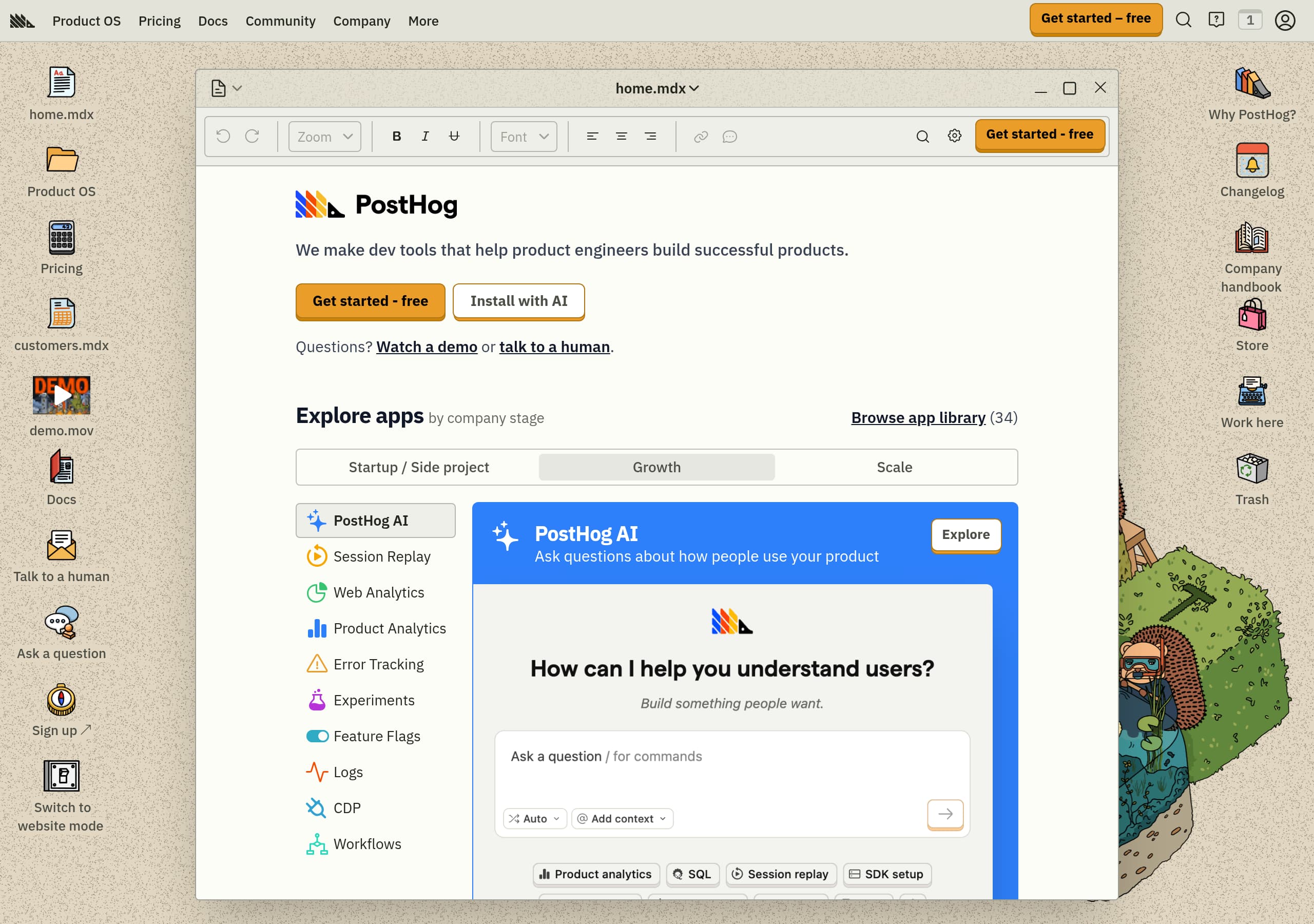
PostHog’s homepage works because it communicates a developer-oriented identity immediately, then backs it up with tangible ways to start using the product. The top navigation sets expectations with “Product OS,” “Pricing,” “Docs,” “Community,” and a persistent Get started, free CTA, which is a strong match for engineering-led evaluation.
Key hero and above-the-fold choices visible in the excerpt and home screenshot:
- The headline “We make dev tools for product engineers” positions PostHog as a suite for builders, not a generic analytics dashboard.
- A secondary, highly actionable path, “Install with AI,” includes an explicit command, “npx @posthog/wizard,” which is a rare, conversion-positive pattern for dev tools: it collapses the “how do I implement this?” question into one step.
- The page offers parallel help routes, “Watch a demo” and “Talk to a human,” giving both self-serve and assisted buyers an immediate next action.
The product architecture is also made concrete instead of implied. The “Explore apps by company stage” module, with categories like Startup, Growth, and Scale, plus an “app library (34),” reframes PostHog as modular. That reduces anxiety for teams that only need one component (for example, Session Replay or Feature Flags) while still advertising a broader platform.
Finally, PostHog uses a “Why PostHog?” section to differentiate through operating model, not vague claims: Transparency (handbook, sales manual, strategy), “We ship fast” (changelog), and actually technical support (engineers on support). These are specific, inspectable proofs that appeal to engineers who distrust marketing-only assurances.
Pricing
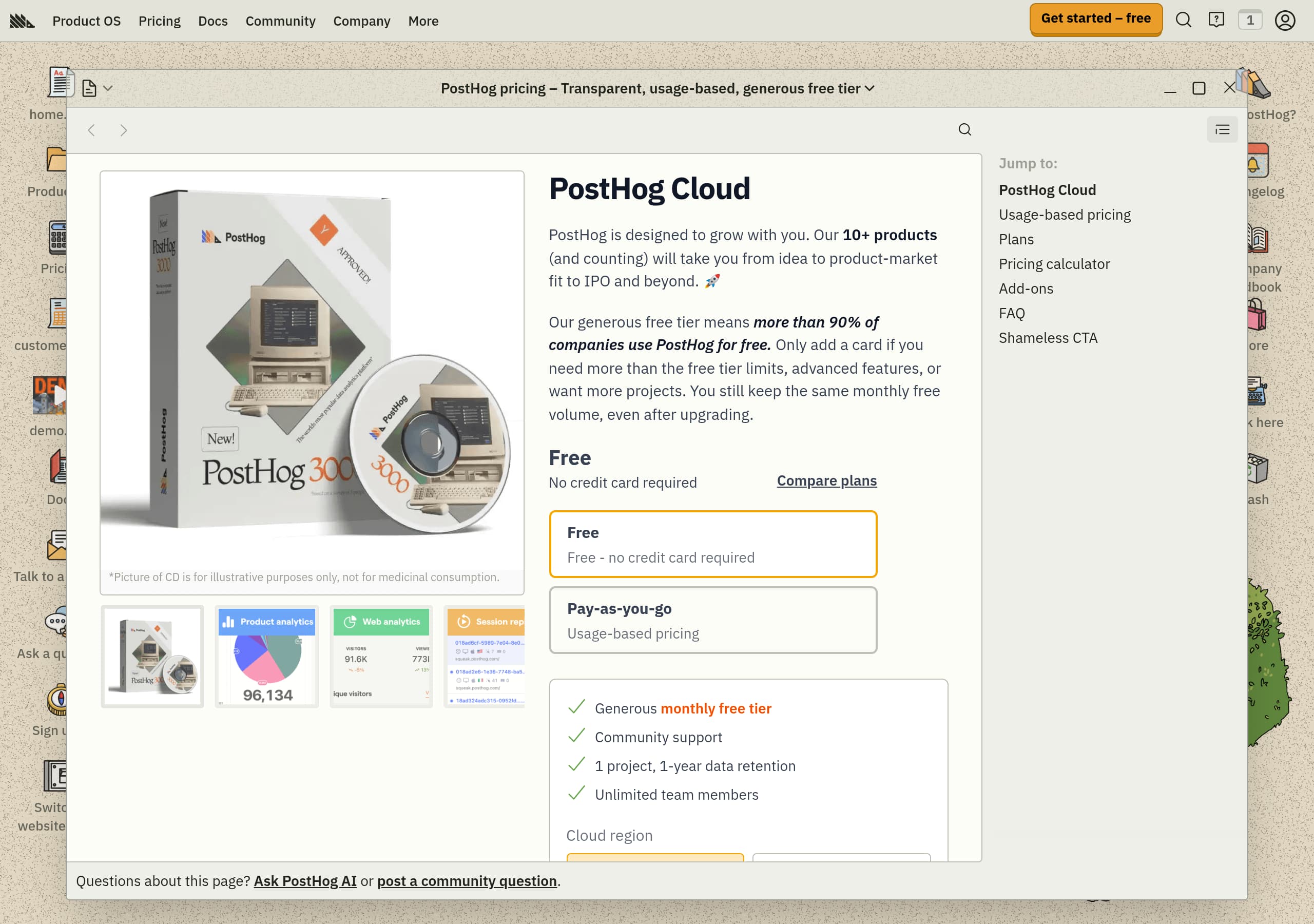
PostHog’s pricing presentation is effective because it is explicit, unit-based, and paired with generous free tiers, which lets teams estimate cost without contacting sales. The page states a clear philosophy, “Usage-based pricing,” and reinforces a self-serve posture with “You never have to jump on a quick call with sales,” directly addressing a common objection in the analytics and CDP category.
The strongest execution detail is that PostHog does not stop at “starting at $0.” It lists concrete examples for four popular products, each with a free tier and a per-unit rate:
- Product Analytics: free tier of 1 million events/mo, then $0.00005 per event
- Session Replay: free tier of 5,000 recordings/mo, then $0.005 per recording
- Feature Flags: free tier of 1 million requests/mo, then $0.0001 per request
- Managed warehouse: free tier of 1 million rows/mo, then $0.000015 per row
This table structure is a conversion asset because it maps pricing to how engineers think about instrumentation volume. It also implicitly teaches what the billing meters are, events, recordings, requests, and rows, which reduces uncertainty during implementation planning.
The copy also positions cost competitiveness carefully. It claims “we aim to be the cheapest option at scale,” but it anchors the trust claim with operational mechanics: pay-per-use, “generous monthly free tiers,” and the notable statement that “98% of our customers use PostHog for free.” Even if a reader does not fully accept the percentage at face value, the message reinforces low-risk evaluation and encourages activation before procurement.
Features
PostHog’s features messaging is strongest when it bundles tools into an operating system narrative, while still naming individual apps so buyers can start narrow. The site repeatedly uses the “Product OS” umbrella, then enumerates apps like Web Analytics, Product Analytics, Session Replay, Error Tracking, Experiments, Feature Flags, Logs, CDP, and Workflows. This dual structure supports two evaluation modes: platform consolidation and point-solution replacement.
A concrete feature module in the excerpt is “PostHog data stack, built for data teams and loved by product teams,” followed by a “Built-in, Product OS ships with:” list. The list is specific enough to map to real workflows:
- A data warehouse
- 120+ sources/destinations
- SQL editor + BI + data viz
- User activity feed (CDP-lite)
- API, webhooks
This is effective because it explains how PostHog extends beyond front-end analytics events into a broader customer data context. The supporting paragraph reinforces the integration story with explicit examples of outside-product data: “payments from Stripe,” “exceptions in an error tracking tool,” and “tickets in your support platform.” Those examples create a mental model for unifying product usage with business and support signals.
The “Explore apps by company stage” and “Go to app library (34)” elements also reduce feature overwhelm. Instead of a single mega-grid, PostHog provides a browsing mechanism that implies modular adoption. Combined with the PostHog AI positioning (“Ask questions about how people use your product”), the feature set reads as both deep and navigable, which is key for a suite that could otherwise feel sprawling.
Signup
PostHog’s signup and onboarding story is built around minimizing time-to-first-event for engineers. The most conversion-relevant element in the excerpt is the direct install path: “Install with AI in a single prompt,” paired with a copyable command, “npx @posthog/wizard.” This is an onboarding design choice that assumes a technical user and meets them in their environment, terminal and editor, instead of routing them through a lengthy form-first flow.
The site also keeps multiple entry points visible. In the header and body, CTAs like Get started, free and “Sign up ↗” appear alongside assistance routes like “Watch a demo” and “Talk to a human.” That combination reduces friction for two common scenarios:
- An engineer who wants to implement immediately and validate data collection.
- A lead who needs confirmation about architecture, pricing meters, or procurement constraints.
Another subtle signup aid is navigational clarity. “Pricing,” “Docs,” and “Product OS” sit close to the primary CTA, which helps the reader resolve doubts without leaving the main journey. The presence of “Switch to website mode” and content blocks like “home.mdx” in the excerpt suggests PostHog intentionally blends marketing with a docs-like interface, which can make onboarding feel familiar to GitHub-native users.
What is not shown in the provided content is the actual form fields, SSO options, or the number of steps after clicking “Get started.” Because of that, the analysis hinges on what is observable: PostHog optimizes signup by making installation the star, using a single-command wizard and consistently repeating the free-start CTA to encourage activation before deep comparison shopping.
Trust
PostHog builds trust primarily through transparency, technical posture, and self-serve purchasing, rather than through compliance badge overload in the visible excerpt. The “Why PostHog?” section is explicit about differentiators that can be verified: Transparency with links to “company handbook,” “sales manual,” and “company strategy,” plus a shipping cadence signal via “See our changelog.” For technical buyers, these are concrete artifacts that indicate operational maturity.
Support is positioned as an expertise claim with detail: “Actually technical support,” clarified by “support folks all have engineering backgrounds.” This matters in categories like analytics, session replay, and feature flags, where implementation and data correctness questions are unavoidable. The phrasing implies that PostHog expects deep technical questions and is staffed accordingly.
Pricing transparency also contributes to trust. The site explicitly rejects sales gating with “You never have to jump on a quick call with sales,” which reduces perceived procurement risk and aligns with modern developer tool expectations. The pricing table’s specific meters, events, recordings, requests, rows, also prevents the common fear that “usage-based” equals “unpredictable.”
PostHog AI messaging adds a forward-looking trust component, but it stays relatively cautious. It states PostHog AI “works across PostHog,” helps automate summarization, and “will soon have the ability to make code changes.” The inclusion of “soon” is important because it avoids overstating shipped capability.
What is not visible in the provided excerpt is security compliance detail such as SOC 2, ISO 27001, DPA links, or uptime SLAs. If those exist elsewhere, they are not used as the primary trust lever here. Instead, PostHog relies on inspectable company materials and engineering credibility to earn trust.
Footer
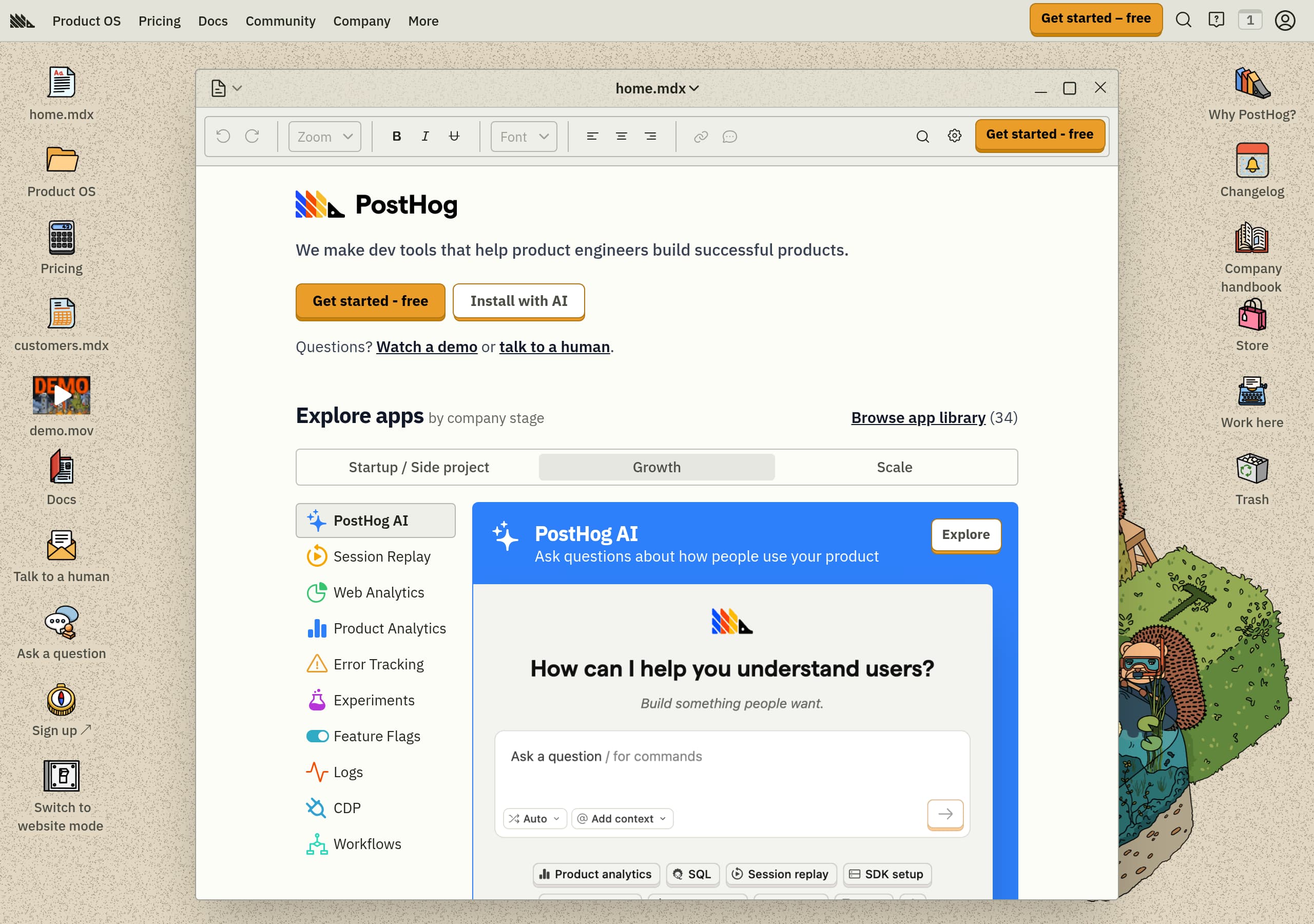
PostHog’s footer, as shown in the screenshot, appears to prioritize navigability for multiple audiences: product engineers, data teams, and buyers seeking company context. The site already exposes many destinations in the main navigation (Pricing, Docs, Community, Company), and the footer typically functions as the definitive site map for SEO and user recovery when someone reaches the bottom of a long page.
From the excerpt, PostHog also includes a “Bedtime reading” cluster with links like “technical docs,” “API,” “Ask a question,” and “Small teams at PostHog.” That is a footer-like behavior even if it is placed above the formal footer. It’s a smart pattern for developer tools because it routes different intent types:
- Implementation intent: technical docs, API
- Evaluation intent: “demo.mov,” “Ask a question”
- Brand and hiring intent: “Work here,” company materials
The “Shameless CTA” block near the bottom is intentionally humorous, with an e-commerce parody card (“Eco-friendly PostHog Cloud,” region selector US Virginia and EU Frankfurt, “Starts at: $0,” and scarcity jokes like “> 1 left at this price!!”). While playful, it still repeats the core conversion action, Get started, and it exposes a concrete operational detail: cloud region selection. That can reduce friction for EU buyers who care about data residency.
For trust and procurement, the footer is where users expect legal and policy links (terms, privacy, security pages). Those specific links are not readable in the excerpt, but the presence of a structured footer screenshot implies PostHog is using standard SaaS footer conventions. Net effect: the footer acts as both SEO scaffolding and a practical escape hatch for users who are not ready to click “Get started, free.”
Detected tech stack
Tools and technologies we detected on PostHog's site. Detection is best-effort and may be incomplete.
Scores
Our framework scores for PostHog's website in terms of clarity, conversion, and trust. See our methodology for how we calculate these.
How clear the value prop and structure are.
How conversion-friendly signup and pricing are.
How well trust and compliance are surfaced.
FAQ
PostHog emphasizes usage-based pricing with generous free tiers and publishes per-unit rates for common products. The site lists examples like Product Analytics (1 million events per month free, then $0.00005 per event) and Session Replay (5,000 recordings per month free, then $0.005 per recording). It also states you do not need to get on a sales call to buy, reinforcing self-serve evaluation.
The homepage leads with a developer-oriented value proposition, “We make dev tools for product engineers,” and immediately provides an implementation path with “Install with AI” and a copyable command (npx @posthog/wizard). It also keeps Docs, Pricing, and Get started, free close to the top navigation, so engineers can validate technical fit and cost without hunting for core information.
PostHog frames itself as a Product OS, then lists multiple apps including Product Analytics, Session Replay, Web Analytics, Feature Flags, Experiments, Error Tracking, Logs, CDP, and Workflows. It also highlights a built-in data stack with a data warehouse, 120+ sources and destinations, SQL editor plus BI and visualization, an activity feed (CDP-lite), and APIs and webhooks.
PostHog includes a customer section that explicitly calls out “paying customers” and adds a credibility note that the logos are not just from someone who tried the product years ago. The UI includes a “Shuffle companies” interaction, which implies a larger, dynamic customer list. This approach leans on authenticity and breadth rather than long testimonial quotes.
PostHog differentiates with inspectable transparency, linking to its company handbook, sales manual, and strategy, and it points to a public changelog as evidence of shipping pace. It also claims “actually technical support,” specifying that support staff have engineering backgrounds. Combined with published usage-based pricing and a no-sales-call stance, the trust posture is operational and verifiable.

The world's best-performing SaaS businesses share surprisingly similar patterns. We help you learn and apply them through our human-designed methodology, with AI-assisted research.