
Key takeaways
Here are the key insights from our website breakdown analysis of Airbase.
Airbase’s homepage currently leads with the Paylocity acquisition message, which is clear for existing customers but dilutes the product value proposition for new buyers unless they click through to Paylocity for Finance.
The site reduces decision fatigue by pushing visitors toward two primary paths: login for customers and exploration via “Interactive Product Tours,” which is conversion-friendly for mixed audiences.
Pricing appears positioned as enterprise, sales-led, with limited self-serve detail. This can be effective for larger finance teams but creates friction for smaller teams trying to qualify quickly.
Airbase builds credibility through parent-brand association—the “Paylocity, a leader in cloud-based HR and payroll software solutions” framing—plus prominent navigation links like Awards, Press, Partners, and Customers.
The “unified approach” message—managing payroll and non-payroll spend through a single system—is a strong differentiator, but it is communicated more as corporate announcement copy than a crisp product promise.
The footer experience is robust for compliance and discoverability, with Terms, Privacy Policy, and multiple corporate links, but it also reinforces that Airbase is now a sub-brand, which can confuse procurement and security reviewers looking for Airbase-specific assurances.
Home
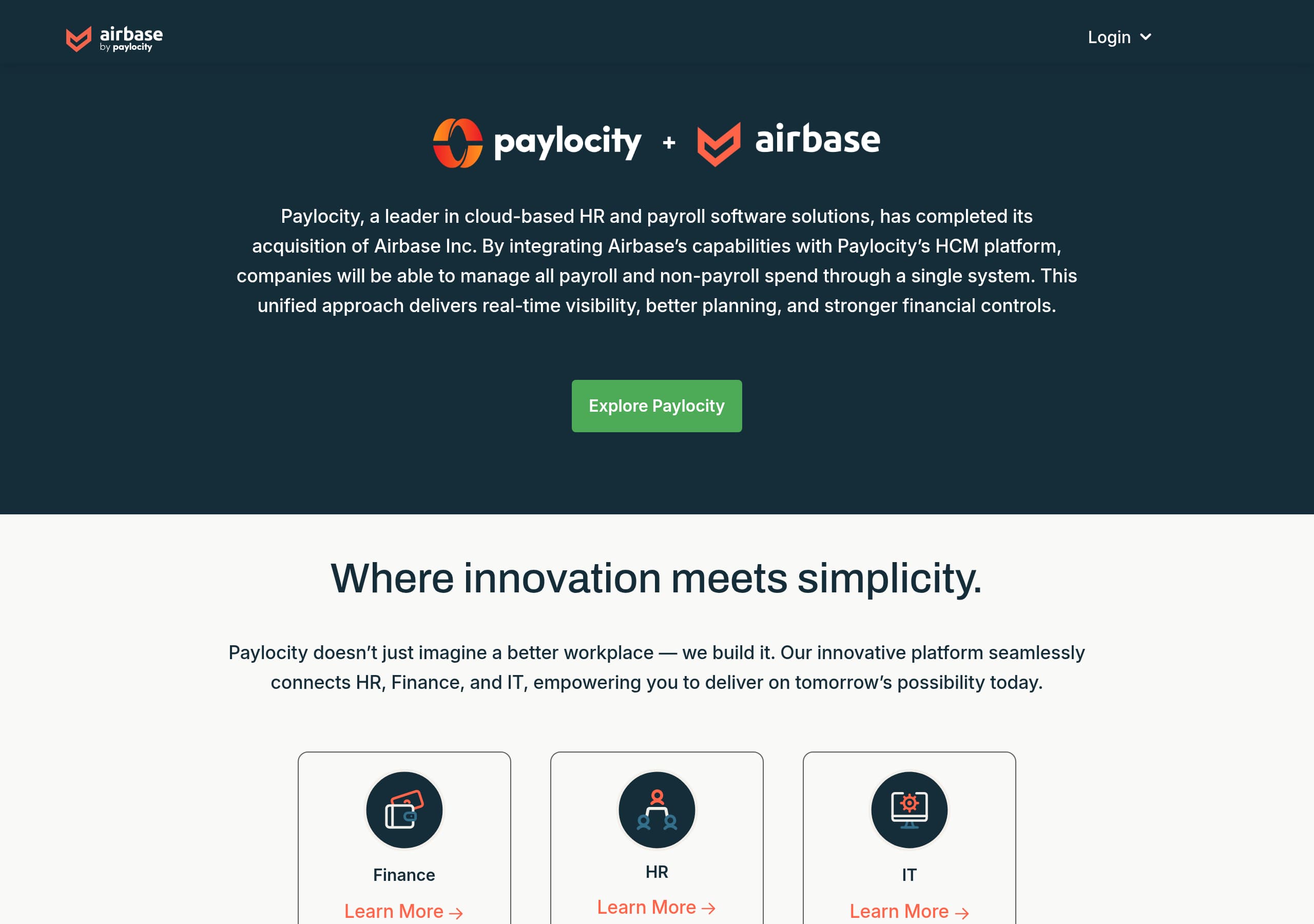
The homepage is optimized more for transition messaging than classic SaaS positioning, and it succeeds at clarifying ownership while sacrificing top-of-page product explanation. The first visible framing, “Airbase, a Paylocity Company”, plus the prominent statement that Paylocity has completed its acquisition of Airbase, immediately answers “what happened?” for existing customers and stakeholders.
What the page does especially well is segment intent using repeated, high-visibility actions. The navigation includes dual login options (Customer login and Vendor login), which signals Airbase supports multi-party workflows. For new visitors, the primary path is to “Explore Paylocity”, followed by a grid-like set of category entry points: Finance, HR, IT, and Full Platform, each with Learn More links. This layout is practical because it acknowledges Airbase is now part of a broader suite, not a standalone spend tool.
Where the home experience is weaker for net-new conversion is that the acquisition paragraph describes outcomes—“manage all payroll and non-payroll spend through a single system”—but it reads like a press update, not a scannable value proposition. A tighter hero could convert better if it paired the unified-spend promise with one concrete workflow preview (approvals, cards, bill pay) and a primary CTA beyond exploration.
Tactically, the strongest on-page conversion hook is the “Interactive Product Tours” section with “Ready to test-drive?” and “Explore tours.” That is a low-friction alternative to “Request a demo,” especially when the site needs to serve both Airbase and Paylocity narratives. If Airbase wants more direct pipeline, the home page should add a single, persistent primary CTA aligned to finance buyers, while keeping the customer and vendor logins as secondary utilities.
Pricing

Airbase’s pricing experience, based on the provided pricing screenshot, appears designed for a sales-led motion rather than self-serve checkout. The most important implication is that the page likely prioritizes qualification and guided evaluation over publishing line-item rates, which can be effective for larger finance organizations but less effective for smaller teams that need instant budget clarity.
In enterprise finance software, pricing pages convert when they do three things: define packaging, explain what drives cost, and offer a next step. Airbase leans heavily into that third step. The likely pattern is CTA-forward pricing (contact sales, request info, or similar), with packaging presented at a high level rather than a full rate card. This fits a product that touches spend controls, approvals, and multi-entity operations, where implementation scope can vary.
To make this sales-led pricing feel more buyer-friendly, the page should be explicit about what is and is not included. Strong patterns to emulate include:
- A 2 to 3 tier structure that maps to maturity (Starter, Growth, Enterprise) with clear packaging boundaries.
- A short “Pricing depends on” block listing drivers like number of employees, entities, cardholders, and modules, which reduces uncertainty.
- A comparison table with 8 to 12 rows, covering approval workflows, accounting sync, reimbursements, cards, and reporting. Even without numbers, a feature matrix answers most procurement questions.
The best conversion element Airbase already has elsewhere is Interactive Product Tours. Pricing should link directly to tours per module so prospects can validate value before speaking to sales. This also creates a clean bridge between pricing intent and product proof, lowering drop-off.
Features
Airbase’s feature story is currently communicated indirectly through integration language and navigational pathways rather than a direct feature grid on the homepage. The excerpt highlights a core product-level promise—“manage all payroll and non-payroll spend through a single system”—plus outcomes like real-time visibility, better planning, and stronger financial controls. That is a strong framework, but it needs feature anchors to feel concrete.
The most actionable feature-led element on the site is Interactive Product Tours. This implies Airbase has multiple modules that can be explored independently, a good sign for a finance platform that typically spans purchasing, approvals, payments, and controls. The tours CTA—“Simply select the module you’d like to explore, and follow the flow”—sets a clear expectation and suggests the company has invested in guided, step-by-step product narratives.
From an on-page UX perspective, the “Explore Paylocity” section with Finance, HR, IT, and Full Platform acts like a category-based feature router. It is not a classic “Features” section, but it supports a suite narrative where Airbase capability sits within a broader platform. That is important post-acquisition, but it can obscure what Airbase specifically does.
To make features more scannable for finance buyers, the site should translate outcomes into discrete capabilities, for example:
- Intake and approvals: configurable workflows, role-based routing.
- Spend execution: vendor payments, corporate cards, reimbursements.
- Controls and reporting: policies, audit trails, budget visibility.
Even if Airbase wants to avoid over-specifying on the homepage, it should provide a three-column feature grid that maps directly to the “financial controls” promise, then link each column to a tour. This approach keeps messaging aligned, reduces ambiguity, and turns “unified approach” into a set of verifiable product capabilities.
Signup
Airbase’s signup experience is structured around controlled access rather than open self-serve, and the UI makes that clear by prioritizing logins over “create account.” The header includes Login with two explicit routes—Customer login and Vendor login—which indicates separate personas and likely different authentication contexts. This is a good usability choice for spend platforms, where vendors may upload invoices or view payment status while customers manage approvals and funding.
For net-new prospects, the site’s primary low-friction alternative to signup is Interactive Product Tours. This is a smart substitution when a product requires implementation, integration, or approval to provision. “Ready to test-drive?” sets the expectation that visitors can experience flows without credentials, which typically improves top-of-funnel engagement and reduces form abandonment.
That said, a login-forward information architecture can create confusion for first-time buyers if there is no obvious “Get started” path. If the pricing page is sales-led and the homepage is acquisition-led, the site should clearly label the new-customer path—for example, “Request demo” or “Talk to sales”—and keep login as a utility. Currently, the repeated login labels risk pulling evaluators into a dead end if they mistake login for signup.
Tactical improvements that would make onboarding clearer without changing the underlying access model:
- Add a distinct CTA near the hero and in the sticky header, such as “Book a demo” or “Contact sales,” separate from login.
- On login pages, add a small panel: “New to Airbase by Paylocity?” with a link to tours and Paylocity for Finance.
- Use microcopy to clarify the audience: “Customer login for employees and admins,” “Vendor login for suppliers.”
Overall, Airbase’s approach fits a controlled finance product, but it should sharpen the distinction between evaluation, authentication, and procurement paths.
Trust
Airbase’s trust posture on the homepage is communicated primarily through corporate context and reassurance language rather than explicit security certifications. The acquisition message emphasizes continuity and reliability: “Our commitment to exceptional service, security, and innovation is stronger than ever,” and “Continue working with your trusted contacts.” For existing customers, this is the right trust move because it addresses risk perceptions immediately after an acquisition.
The site also positions the combined offering as a governance upgrade, with language like “real-time visibility,” “better planning,” and stronger financial controls. Those are trust-adjacent outcomes that matter in finance operations, especially for organizations worried about policy compliance and auditability.
What is missing from the excerpt and the visible UI elements is explicit, scannable security proof. A best-in-class trust section for finance spend software typically includes at least 3 to 5 concrete artifacts—for example, SOC 2 status, data encryption statements, role-based access, SSO options, and audit logs. Since the provided content does not show these, the trust experience currently relies on the Paylocity brand and on corporate pages like Awards and Press to carry credibility.
To improve trust without adding speculative claims, Airbase should:
- Create a dedicated Security or Trust page linked in the header or footer, not only via generic Terms and Privacy Policy.
- Add a short “Security and controls” module near tours with 3 bullets that are factual and verifiable on-site.
- Clarify the relationship between Airbase by Paylocity and Paylocity for Finance so security reviewers understand where data lives and who is the processor.
In short, the site communicates business stability well, but it needs more audit-ready details to satisfy finance and IT stakeholders during evaluation.
Footer

Airbase’s footer is functional, compliance-oriented, and clearly designed to support a multi-audience site after the Paylocity acquisition. The excerpt shows a dense set of corporate navigation links repeated from the header, including Contact Us, About, Awards, Press, Careers, Partners, and Customers. This repetition is not elegant, but it is practical: it ensures critical destinations remain reachable even when users land deep in the site.
Two footer elements stand out for buyer experience. First, the legal and compliance basics are present and easy to find: Terms and Conditions and Privacy Policy, plus a visible copyright line, “© Airbase Inc. 2025.” For procurement teams, simply having these links consistently placed reduces friction during vendor review.
Second, the footer adds community proof via “Off the Ledger: Join the community of over 6,000 Finance professionals.” This is valuable because it is specific and relevant to the persona Airbase targets. It is also a smart retention play post-acquisition, giving finance users a reason to stay engaged beyond product announcements.
Where the footer could improve is clarity of ownership and pathways. The branding “Airbase, a Paylocity Company” is strong, but the footer should also help visitors understand what to do next depending on intent:
- Existing customers: quick links to customer login and vendor login.
- Prospects: link to Interactive Product Tours and a contact or demo CTA.
- Evaluators: direct link to a Security page, release updates, and platform documentation.
Finally, the presence of multiple “Follow” labels suggests social icons, but without platform names visible in the excerpt. Labeling icons with accessible text improves usability and compliance. Overall, the footer does its job for navigation, legality, and community, but it can be made more conversion-aware by surfacing the key next steps.
Detected tech stack
Tools and technologies we detected on Airbase's site. Detection is best-effort and may be incomplete.
Scores
Our framework scores for Airbase's website in terms of clarity, conversion, and trust. See our methodology for how we calculate these.
How clear the value prop and structure are.
How conversion-friendly signup and pricing are.
How well trust and compliance are surfaced.
FAQ
Airbase’s homepage prominently states “Airbase, a Paylocity Company” and explains that Paylocity has completed its acquisition of Airbase Inc. The copy emphasizes integration with Paylocity’s HCM platform and highlights outcomes like managing payroll and non-payroll spend in a single system, real-time visibility, and stronger financial controls. It is positioned as a transition and reassurance page as much as a product pitch.
Airbase’s pricing experience appears oriented toward a sales-led model rather than self-serve checkout. Instead of a simple published rate card, the page is positioned to move visitors toward a conversation and evaluation. This approach is common for finance platforms where pricing can vary by modules, user counts, entities, and implementation scope, but it can add friction for buyers who want instant budget qualification.
Airbase emphasizes authentication paths over open signup. The site shows Login with separate “Customer login” and “Vendor login,” indicating different personas and likely different portal experiences. For prospects who cannot log in, Airbase offers “Interactive Product Tours” with a “Ready to test-drive?” prompt, which provides a low-friction way to experience workflows without creating an account.
Airbase leans heavily on parent-brand credibility by referencing Paylocity and describing it as a leader in cloud-based HR and payroll software solutions. The navigation includes proof-oriented pages like Awards, Press, Partners, and Customers. The footer also references “Off the Ledger” and notes a community of over 6,000 finance professionals, which is a concrete, persona-relevant validation point.
Airbase highlights “Interactive Product Tours” and invites visitors to “test-drive” by selecting a module and following the flow. This serves as a sandbox-style evaluation step for prospects who are not ready to contact sales or who cannot access a customer or vendor login. It is also a useful bridge from pricing or high-level messaging to concrete product interaction.

The world's best-performing SaaS businesses share surprisingly similar patterns. We help you learn and apply them through our human-designed methodology, with AI-assisted research.