
Key takeaways
Here are the key insights from our website breakdown analysis of Workday.
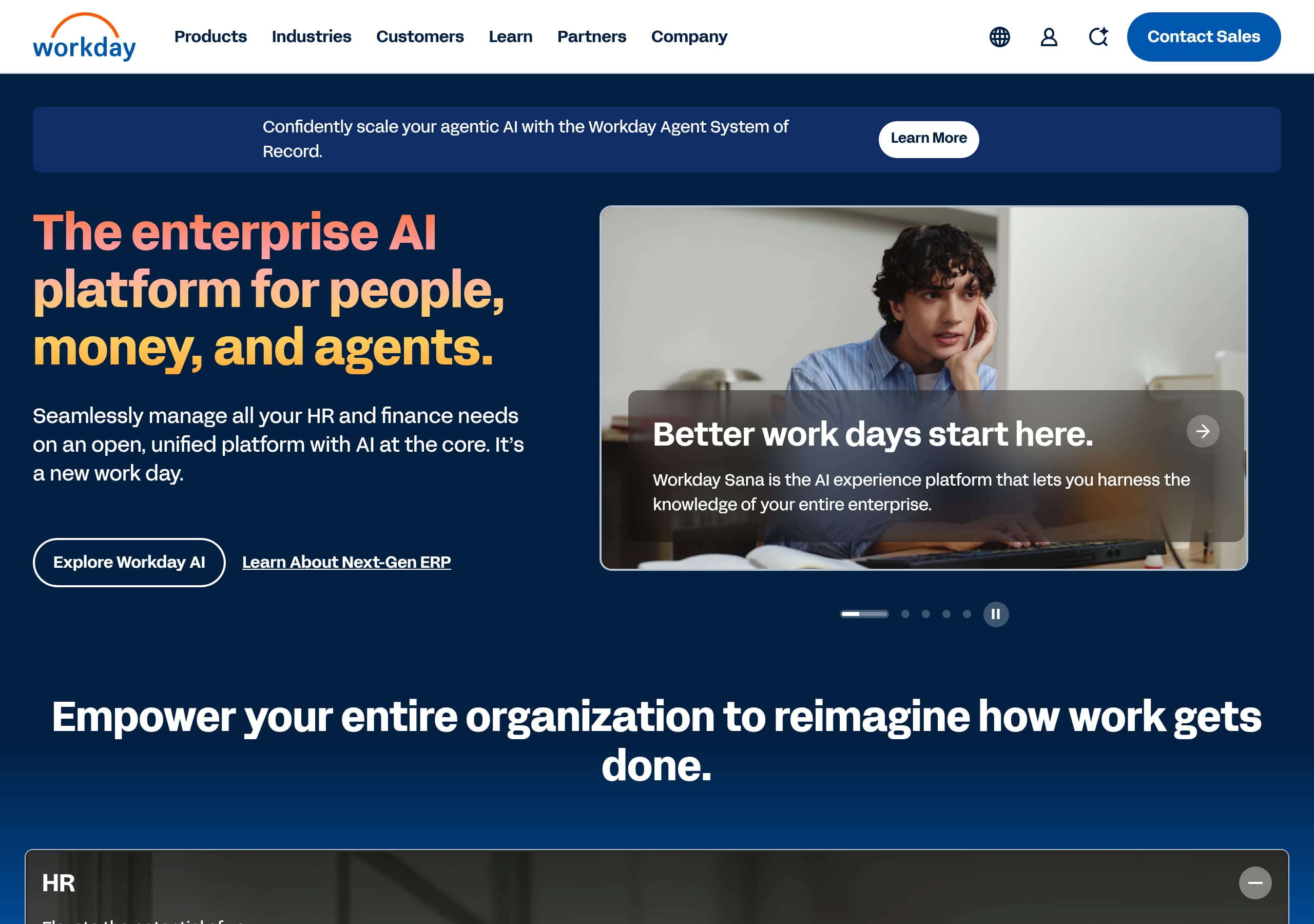
Workday’s homepage clarifies positioning fast by anchoring the message around an “enterprise AI platform” that unifies HR and finance, then reinforces it with multiple product-entry CTAs (AI, HR, Finance, IT, Legal, Operations).
The navigation is designed for complex enterprise buying: it supports both solution-based exploration (HR, Finance, IT) and product-based discovery (HCM, Financial Management, Workday Sana, Agent System of Record), reducing confusion for multi-stakeholder teams.
Workday uses heavyweight enterprise credibility markers—Gartner Magic Quadrant and Forrester Wave mentions plus “11,000+ organizations” and Fortune 500 references—to de-risk purchase decisions without relying on hypey testimonials.
Conversion is optimized for sales-led motion: CTAs like “Contact Sales,” “Read Report,” “Read Guide,” and “Demos” are placed repeatedly, while direct self-serve purchase paths are intentionally minimized.
The site consistently frames AI in governance terms (e.g., “Agent System of Record,” “Responsible AI”), which supports trust and compliance narratives important for HR/Finance systems of record.
Regional and language selectors and a prominent login/digital ID state indicate a global enterprise footprint and a bifurcated experience between prospects and existing customers.
Home
Workday’s homepage works because it states a category-level promise immediately—“The enterprise AI platform for people, money, and agents”—and then routes different buyer types into dedicated paths without forcing a single narrative.
What’s happening above the fold
The hero combines a single-sentence value prop with repeated, high-intent CTAs: Explore Workday AI, “Learn More,” “Contact Sales,” and “Demos” appear in close proximity. This is a classic enterprise pattern: a broad promise for awareness, plus multiple next steps for evaluators. The phrase “open, unified platform with AI at the core” also signals platform strategy (not point solutions), which aligns with HR/Finance consolidation budgets.
How the page handles complex product sprawl
Workday reduces overwhelm with structured lanes:
- A top mega-nav segmented by Products, Industries, Customers, Services, Partners, and Company.
- Mid-page “pill” style entry points (HR, Finance, IT, Legal, Operations) each with a concise benefit statement and 2–3 sub-links (e.g., Financial Management, Spend Management, Financial Planning).
- A dedicated “midsize business” track (“Workday GO”) that prevents smaller prospects from feeling like the site is only for Fortune 500.
AI positioning that’s enterprise-safe
Instead of generic AI claims, Workday names specific AI constructs—Workday Sana, Agent System of Record, Responsible AI—which implies governance, auditability, and lifecycle control. The “Stop paying the AI tax” research CTA is a smart mid-funnel bridge: it offers a story and data before asking for a sales conversation.
Key terms emphasized on the page include enterprise AI platform, unified platform, Workday Sana, Agent System of Record, and next-gen ERP.
Pricing
Workday’s site experience strongly implies that pricing is handled via sales engagement rather than a transparent self-serve pricing page, which is consistent with enterprise HCM/ERP buying and the product breadth shown in the navigation.
What you can infer from the live experience
On the homepage, primary conversion CTAs are “Contact Sales,” “Demos,” and gated-value actions like “Read Report” and “Read Guide.” Notably absent are “Buy now,” “Start trial,” or a pricing tier table. That absence is itself a positioning signal: Workday expects customization by employee count, regions, modules (HR, Finance, Planning, Payroll), and implementation scope.
How Workday likely frames pricing conversations
Based on the product taxonomy visible (Human Capital Management, Financial Management, Spend Management, Planning, Contract Lifecycle Management, Industry solutions), Workday is set up for packaging by:
- Suite vs module bundling (Workday Suite, Workday Adaptive Planning, Workday Extend, Workday Peakon).
- Complexity drivers like payroll geographies (local & global payroll), integrations, and compliance requirements.
- Segment-based offers (explicit “Midsize Business Solutions” and “Workday GO”).
What’s effective—and what could be clearer
This sales-led approach improves deal control and allows value-based pricing, but it increases early-stage friction for comparison shoppers evaluating Workday against SAP SuccessFactors, Oracle Cloud HCM/ERP, UKG, ADP, or Rippling.
A pricing page (if present) would benefit from concrete “starting points” without undermining enterprise flexibility, such as:
- Typical pricing drivers (employees, modules, countries)
- A 3-step “request a quote” flow preview
- Implementation ranges and timelines
Key terms that define the pricing motion here: Contact Sales, sales-led, module-based packaging, enterprise licensing, and implementation scope.
Features
Workday’s features messaging is effective because it’s organized like an enterprise product map: it groups capabilities by business domain (HR, Finance, IT, Legal, Operations) and then drills down into recognizable modules buyers expect in an ERP/HCM suite.
Feature structure that matches enterprise evaluation
Instead of a generic grid, Workday uses domain sections with short outcome statements:
- HR: “Elevate the potential of your people… with human-AI collaboration.”
- Finance: “Optimize transactions and processes… deliver data-driven insights.”
- IT: “Turn AI into ROI… driven by trust, agility, and data readiness.”
- Legal: contracts and “contract data into actionable insights.”
- Operations: “frontline operations… mobile tools.” This sequencing mirrors real buying committees—CHRO/CFO/CIO/GC—each seeing “their” lane.
Concrete module naming improves clarity
Workday lists modules that are widely understood and searchable, such as Human Capital Management, Financial Management, Spend Management, Workforce Management, Payroll, Analytics & Reporting, and Contract Lifecycle Management. It also surfaces ecosystem concepts like Workday Marketplace and Workday Extend, implying extensibility and partner solutions.
AI as a product layer (not a bolt-on)
Workday’s AI messaging is embedded across lanes via “Workday AI,” “AI agents,” “Workday Sana,” and the “Agent System of Record.” That framing suggests consistent data governance across HR and finance records—an important differentiator versus disconnected point AI tools.
Tactical improvements that could increase scan-ability
For such a broad suite, a comparison-friendly feature table (by persona or by suite tier) could reduce cognitive load. Also, more explicit “integrates with any ERP/GL” language (already present for Planning) could be replicated across other modules.
Key feature terms emphasized: Human Capital Management, Financial Management, Workday Sana, Agent System of Record, Workday Extend, and Analytics & Reporting.
Signup
Workday’s “signup” experience is intentionally not a typical SaaS self-serve flow; it’s split between (1) prospect conversion via sales and demos, and (2) customer access via organization-specific login, which is standard for enterprise HCM/ERP platforms.
Two parallel entry paths: prospects vs customers
From the live header and utility links, Workday presents:
- Prospect actions: Contact Sales, “Demos,” “Read Report,” “Read Guide,” and solution exploration.
- Customer actions: “Login,” “Help,” “Community,” and product-specific logins (e.g., Workday Adaptive Planning, Workday Extend, Workday Peakon, Evisort). The page explicitly states: “To access your Workday account, please reach out to your HR or IT department for a link to your company’s unique sign in page.” That sentence reduces support tickets and sets correct expectations.
Digital identity and session behavior
The banner “You are automatically signed in to workday.com with your Workday Digital ID account” indicates single identity across Workday properties (marketing site + community + product portals). This is an enterprise-friendly pattern: it supports role-based access, procurement control, and consolidated account management.
Conversion mechanics you can see
Workday uses repeated CTAs (“Learn More” appears multiple times) and introduces “Ready to talk? Get in touch.” near the bottom—an end-cap CTA for buyers who scrolled through proof and product lanes. The presence of “Play Video” suggests a multimedia mid-funnel step before a sales form.
Where signup could be improved (if targeting more self-serve)
If Workday wanted more PLG motion, it could add a clearly labeled sandbox trial for a limited module (e.g., planning demo environment). But for ERP/HCM, the current sales-led onboarding is coherent and reduces misfit signups.
Key terms: Contact Sales, Workday Digital ID, organization-specific sign-in, Workday Community, and sales-led onboarding.
Trust
Workday’s trust strategy is built into positioning and navigation rather than isolated on a single security page: it repeatedly emphasizes governance, responsibility, and enterprise readiness—especially around AI.
Trust signals visible in the core messaging
The homepage leads with “enterprise AI platform” and quickly narrows into controlled concepts like Agent System of Record and Responsible AI (explicitly present in the AI navigation). For HR and finance systems, this matters because buyers worry about AI permissions, data leakage, audit trails, and decision explainability. Naming “system of record” also implies stronger controls than a typical chatbot layer.
Institutional trust via third parties
The “Leader” and “Strong Performer” callouts from Gartner and Forrester act as risk-reduction for executives and procurement. The site positions these as downloadable reports, which is a common enterprise trust tactic: analyst validation + lead capture.
Operational trust: global and support readiness
Workday’s global region/language selector spans North America, EMEA, and APJ with many localized options (e.g., 日本語, 한국어, multiple European languages). That breadth is a trust cue for multinationals assessing rollout feasibility. Additionally, “Support,” “Community,” “Training & Certifications,” and “Success Plans” are prominent, signaling post-sale enablement.
Trust gaps to consider
From the excerpt, there aren’t explicit on-page security metrics like uptime percentages, SOC 2/ISO badges, or detailed privacy/security CTAs within the hero sections. Those may exist elsewhere (e.g., Trust or Security pages), but not being surfaced above the fold means some security-first buyers must hunt.
What Workday gets right
By integrating AI governance language, global readiness, and support pathways directly into the primary IA, Workday sustains trust across the entire evaluation journey.
Key terms: Responsible AI, Agent System of Record, Workday Digital ID, Training & Certifications, and Success Plans.
Footer
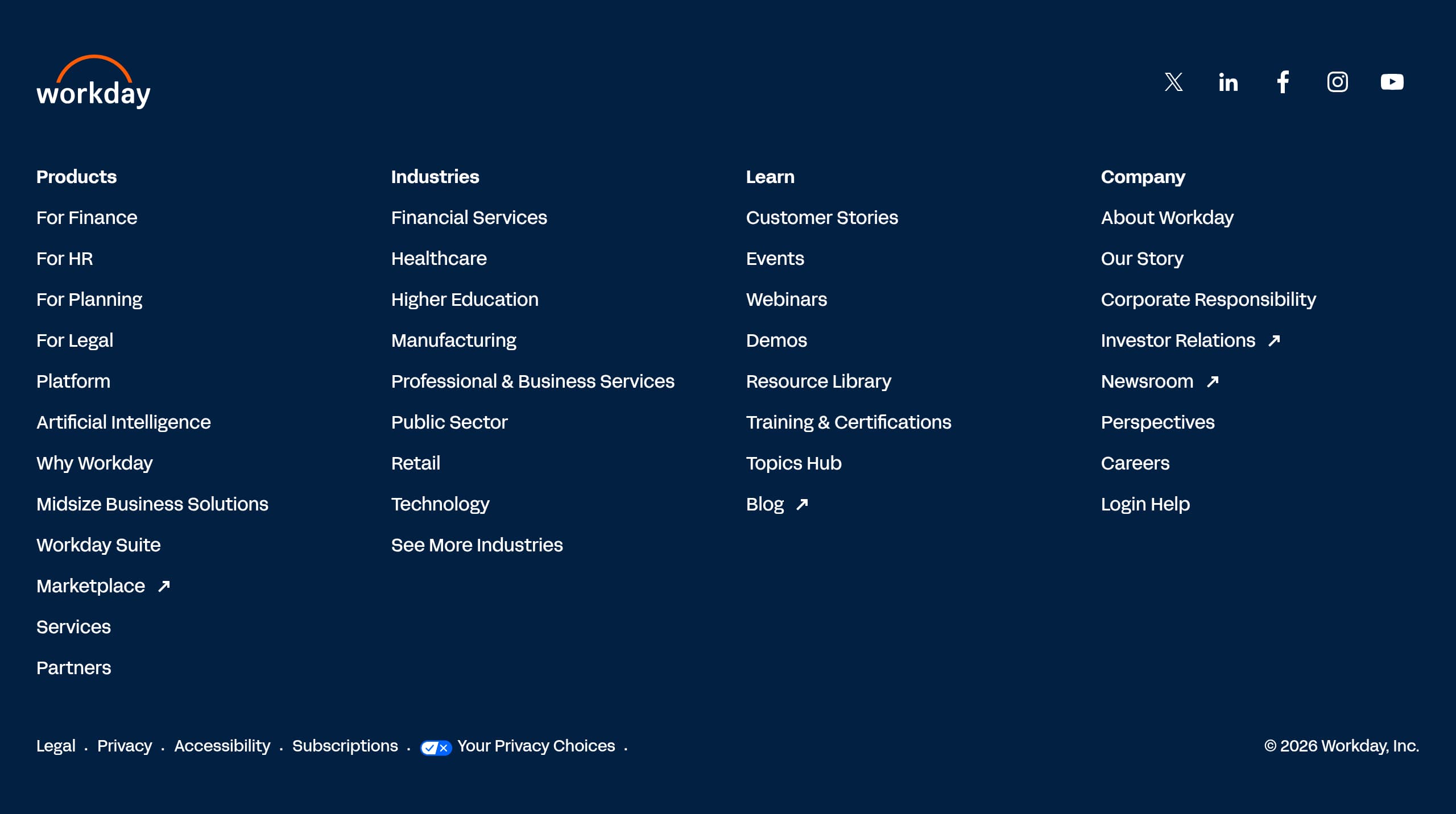
Workday’s footer is built for enterprise due diligence: it’s dense, utility-first, and optimized for compliance, investor scrutiny, and support discovery rather than lightweight consumer navigation.
What’s in the footer (and why it matters)
From the screenshot and excerpted links, the footer includes the expected enterprise essentials:
- Legal and compliance links: Legal, Privacy, Accessibility, “Subscriptions,” and “Your Privacy Choices.”
- Corporate credibility: Investor Relations, “Newsroom,” “Perspectives,” and “Corporate Responsibility.”
- Help and enablement: “Login,” “Help,” “Training & Certifications,” “Resource Library.” This arrangement supports the reality that Workday buyers include procurement, security, and legal reviewers who scroll for policy links.
Cookie and embedded content controls
A visible cookie gate (“Please accept cookies to continue”) and YouTube consent messaging (“This content is blocked due to your cookie preferences… accept YouTube’s Terms of Service”) signals modern privacy handling and explicit third-party content consent. That’s a tangible trust pattern for regulated industries.
Global operations and localization
The site includes a prominent Region & Language selector with many locales (APJ, EMEA, North America), which is critical for a platform selling payroll, HR, and finance globally. The presence of localized language options reduces friction for international evaluators and improves SEO footprint by region.
UX observations
The footer is intentionally comprehensive, but it can feel overwhelming. A tactical improvement would be clearer grouping headers (e.g., “Products,” “Industries,” “Support,” “Company,” “Legal”) and a short “Contact Sales” CTA inside the footer for late-stage buyers.
Key terms in the footer experience: Privacy, Accessibility, Your Privacy Choices, Region & Language, and Investor Relations.
Detected tech stack
Tools and technologies we detected on Workday's site. Detection is best-effort and may be incomplete.
Scores
Our framework scores for Workday's website in terms of clarity, conversion, and trust. See our methodology for how we calculate these.
How clear the value prop and structure are.
How conversion-friendly signup and pricing are.
How well trust and compliance are surfaced.
FAQ
Workday leads with a single, category-defining value proposition: “The enterprise AI platform for people, money, and agents.” It then routes visitors into distinct solution lanes (HR, Finance, IT, Legal, Operations) with short outcome statements and module links. Repeated CTAs like “Explore Workday AI,” “Demos,” and “Contact Sales” match a sales-led enterprise evaluation rather than a self-serve product tour.
The homepage experience suggests pricing is primarily quote-based. Instead of a tier table or “Start trial” button, Workday emphasizes “Contact Sales,” “Demos,” and analyst reports. This fits enterprise HCM/ERP buying where costs depend on employee count, modules (HCM, Financial Management, Planning, Payroll), geographies, integrations, and deployment scope. The site nudges visitors into a sales conversation to define packaging and implementation needs.
Workday highlights analyst recognition and adoption scale rather than star ratings. The homepage references Gartner Magic Quadrant leadership for Cloud ERP and Cloud HCM and a Forrester Wave “Strong Performer” mention for CLM platforms, each paired with “Read Report.” It also states “11,000+ organizations worldwide trust Workday” and references Fortune 500 usage, which reduces perceived risk for enterprise procurement.
Workday separates prospect conversion from customer access. Prospects are guided to “Contact Sales” and “Demos,” while customers are directed to “Login,” “Help,” and product/community portals. The site states that Workday accounts are accessed via a company-specific sign-in page provided by an organization’s HR or IT team. A “Workday Digital ID” banner indicates centralized identity across Workday properties.
Workday avoids generic AI claims and uses governance-oriented naming like “Agent System of Record,” “Responsible AI,” and “Workday Sana.” This framing implies permissioning, oversight, and controlled deployment—important for HR and finance systems of record. The site also ties AI to business outcomes in each solution lane (HR productivity, finance optimization, IT ROI), reinforcing AI as an embedded platform layer rather than an add-on.

The world's best-performing SaaS businesses share surprisingly similar patterns. We help you learn and apply them through our human-designed methodology, with AI-assisted research.