
Key takeaways
Here are the key insights from our website breakdown analysis of Segment.
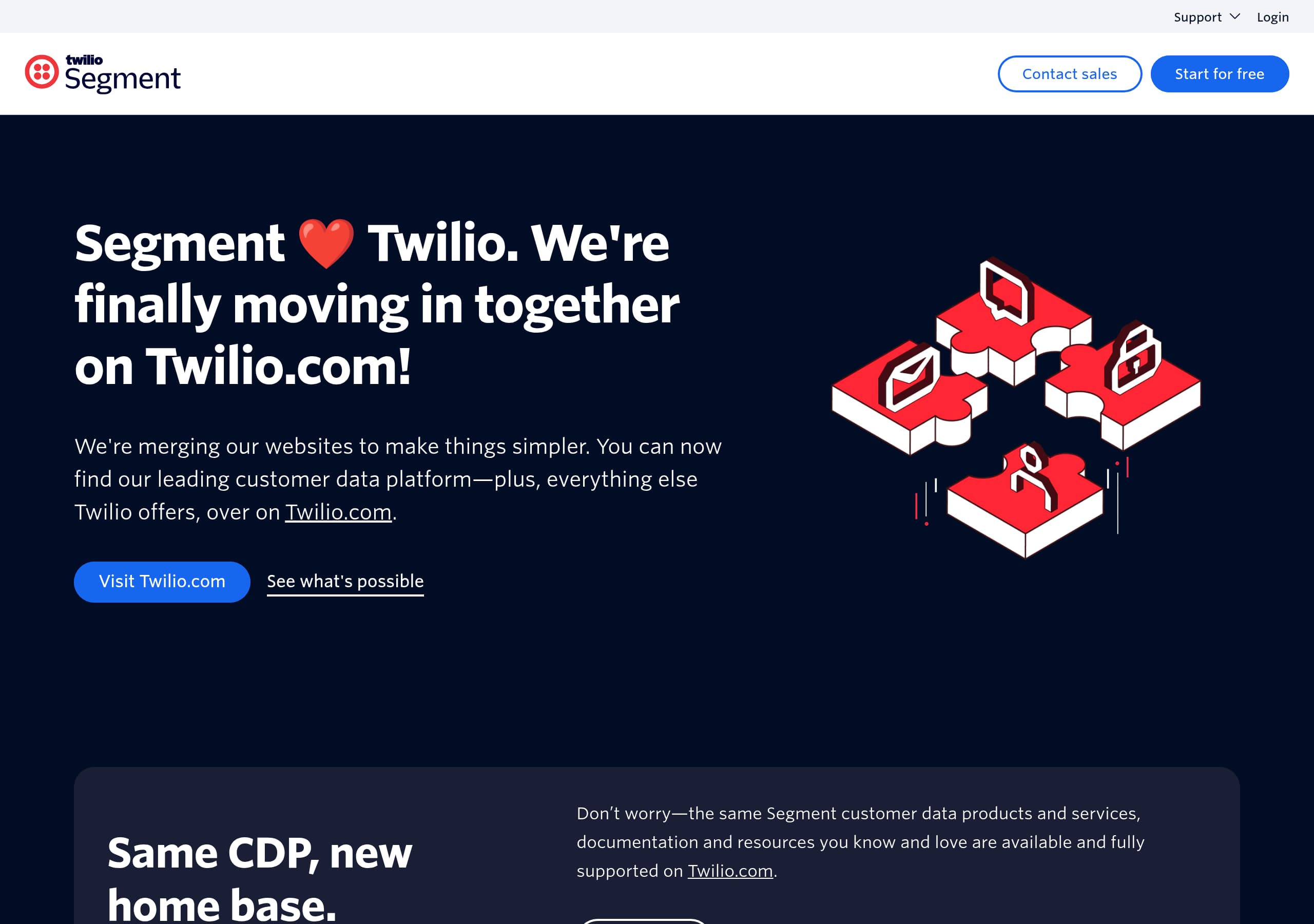
Segment’s homepage positions it within the broader Twilio “Customer Engagement Platform,” which increases enterprise credibility but slightly reduces immediate clarity for buyers who came specifically for a CDP.
The site uses persistent, high-intent CTAs like “Start for free” and “Contact sales,” which clearly separates self-serve trials from enterprise procurement and reduces decision friction.
Navigation is designed for complex buying committees, with audience paths (Developers, Data Engineering, Marketing, Product, Customer Experience) and product clusters (Connections, Unify, Engage) that map to common CDP evaluation criteria.
Pricing is framed as “Transparent pricing with discounts as you scale” plus “free trial, no credit card required,” a strong conversion pattern, but it risks pushing critical buyers into extra clicks before they can validate cost-to-value.
Trust is reinforced through platform-level signals like a dedicated status ecosystem (“Segment status”), support plans, and a prominent Gartner Magic Quadrant mention, which helps Segment compete against Adobe Experience Platform, mParticle, and Tealium in enterprise deals.
The footer and global header function like an enterprise resource hub, surfacing documentation, partner programs, and professional services to match long, multi-stakeholder implementation cycles.
Home
Segment’s homepage is optimized for enterprise discovery, but it trades some CDP-specific immediacy for broader Twilio platform positioning. The header label “Twilio Segment Customer Data Platform” is clear, yet the global navigation quickly expands into “Customer Engagement Platform” and multiple Twilio product families, which can distract first-time CDP evaluators.
What the hero and header communicate
The top navigation is dense and intentionally committee-friendly: Products, Solutions, Why Twilio, Resources, Pricing, plus direct access to Login and Support. This structure signals a serious platform, not a lightweight tool. The most conversion-oriented elements are persistent CTAs like Start for free and Contact sales, which appear alongside pricing language in the excerpt and align with typical CDP buying motions.
IA patterns that help Segment sell to multiple roles
Segment is presented through product groupings under Customer Data: Connections, Unify, and Engage. Even without reading long copy, this taxonomy implies a journey: collect data, unify profiles, activate audiences. The Solutions menu also segments buyers by teams (Developers, Data Engineering, Marketing, Product, Customer Experience), which is a practical way to reduce bounce for visitors who arrive with different jobs-to-be-done.
Where clarity could improve
Because “One flexible platform that combines data, AI, and the communication channels your customers love” is broad Twilio platform language, it can blur what Segment specifically does first. A CDP buyer typically wants an immediate promise around event collection, identity resolution, and downstream activation. The site’s structure supports that, but the first-screen message risks feeling more like Twilio overall than Segment specifically.
Overall, the homepage works best for enterprise and multi-product customers, with strong platform navigation, dual CTA routing, and role-based paths that match how CDPs are evaluated.
Pricing
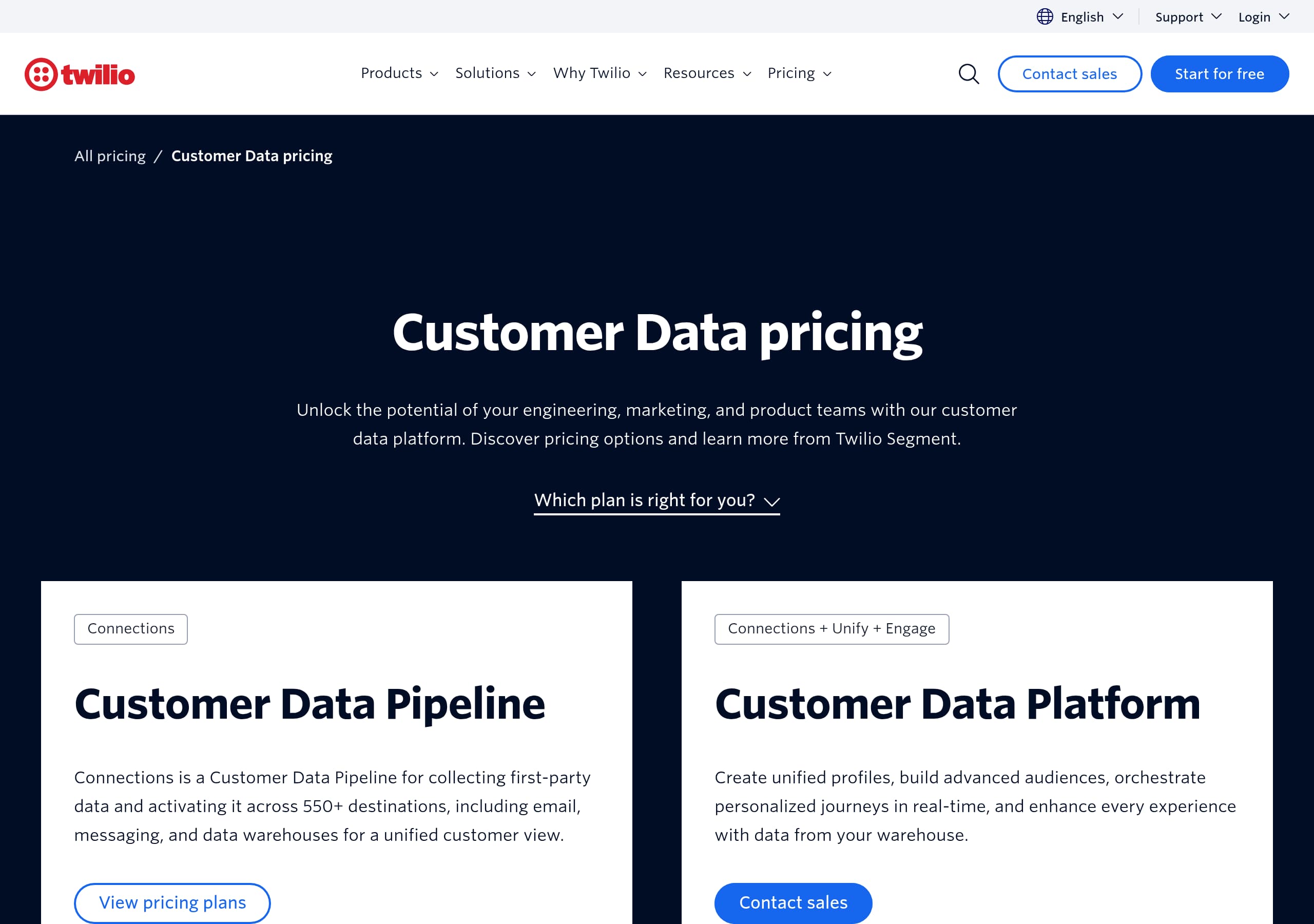
Segment’s pricing entry points are conversion-forward, emphasizing self-serve access while preserving an enterprise path. The strongest message is explicit in the excerpt: “Transparent pricing with discounts as you scale. Sign up for a free trial, no credit card required.” That combination reduces anxiety (cost predictability) and removes the most common trial blocker (payment details).
What pricing communicates at a glance
The pricing navigation is organized as a portfolio, not a single page: “All Pricing” plus categories for Communications and Customer Data. Under Customer Data, buyers can choose Customer Data Platform and Customer Data Pipeline, which helps users price the correct product family rather than guessing. This is especially useful because Segment can be evaluated as both a CDP and a data collection pipeline.
Conversion mechanics that work
From a funnel perspective, the site repeats two strong actions: Start for free and Contact sales. This creates a clean fork:
- Self-serve evaluators can start immediately via free trial, no credit card required.
- Larger teams can route into procurement via Contact sales.
Where pricing may still create friction
The portfolio structure can introduce extra clicks for visitors who only want Segment CDP pricing quickly. If the pricing screenshot is representative of other Twilio pages, it likely uses plan cards and feature comparisons, but the excerpt alone shows navigation depth more than concrete numbers. For a CDP buyer comparing Segment to alternatives like mParticle or Tealium, the key questions are typically: what is metered (events, profiles, MTUs), what is included, and what triggers enterprise pricing.
Net effect: pricing is strong on trial accessibility and scalable positioning, but it may require deeper exploration to answer the most critical “what do I pay for?” questions for Segment’s CDP modules.
Features
Segment’s feature positioning is expressed through a product architecture that mirrors the CDP lifecycle: connect data sources, unify identity, and activate audiences. The navigation under Customer Data is explicit: Connections (Warehouses, Reverse ETL, Functions, Protocols), Unify (Profiles, Sync, Unified Profiles), Engage (Audiences, Journeys, Intelligence, Predictions, Recommendations), plus Data Observability. Even without long-form copy, that hierarchy acts like a feature map.
Feature taxonomy that reduces complexity
Instead of listing dozens of capabilities in a flat grid, Segment uses grouped modules:
- Connections: suggests collection and routing, including warehouses and reverse ETL.
- Unify: suggests identity resolution and profile stitching via profiles and sync.
- Engage: suggests activation, including audiences and journeys, with AI-adjacent items like predictions and recommendations.
- Data Observability: signals monitoring and reliability, a key enterprise CDP requirement.
Builder and developer orientation
“Built for builders” appears as a differentiator in the Why Twilio menu, and Resources exposes Documentation, Code samples, Developer Hub, Changelog, and Serverless. That implies Segment expects technical evaluation and supports it with implementation assets. The inclusion of Functions and Protocols in the Connections cluster also points to governance and customization, which are common decision points against platforms like RudderStack or in-house pipelines.
Where feature messaging could be tightened
Because the broader Twilio platform also includes Communications and Authentication, the site can feel like a suite catalog. Segment’s feature story is strongest when it stays anchored to the CDP outcomes: unified customer profiles, audience activation, and real-time routing. A clearer “start here” path for first-time Segment buyers, such as a 3-step diagram that matches Connections, Unify, Engage, would reduce the cognitive load created by the mega-menu.
Overall, the features are presented in an enterprise-friendly way: modular, lifecycle-based, and reinforced by developer resources and observability positioning.
Signup
Segment’s signup motion is designed to be low-friction for evaluators while preserving a sales-led option for enterprises. The site repeatedly surfaces Start for free alongside Contact sales, and the pricing excerpt explicitly states “Sign up for a free trial, no credit card required,” which removes a major onboarding barrier.
What the CTA system implies about onboarding
Even without seeing the full form flow, the information architecture suggests two parallel paths:
- Trial-driven users can self-serve quickly via Start for free.
- Organizations with governance and procurement requirements can use Contact sales to enter a guided evaluation.
The header also includes “Login” and a specific note: “Log in to Messaging, Voice, Verify, Video, and more Twilio. Or log in to access: Customer Data Platform Twilio Segment Email Twilio SendGrid.” That indicates a unified Twilio authentication layer. This can streamline cross-product adoption, but it can also create minor confusion if a Segment-only evaluator is unsure which account type they need.
Strengths for product-led evaluation
The strongest conversion lever is the “no credit card required” promise, which encourages engineers or data teams to instrument early. The proximity of Documentation, Code samples, and Developer Hub in the global nav also supports onboarding by letting users jump directly into implementation resources after creating an account.
Likely friction points
Unified platform login can add a step where users must choose the right workspace or product (Segment vs other Twilio products). For a first-time Segment user, the ideal onboarding would confirm: data source selection, destination selection, and a first event verified, a clear 3-step “first data sent” milestone approach.
Net result: Segment’s signup strategy is strong on trial accessibility, supported by developer-first resources, and balanced with a clear enterprise handoff via Contact sales, which fits how CDPs are typically adopted inside larger organizations.
Trust
Segment’s trust posture is communicated through enterprise scaffolding: security positioning in the navigation, formal support infrastructure, and operational transparency via status pages. The “Differentiators” menu explicitly calls out Privacy and security, Enterprise scale, Infrastructure, and Real-time customer data, which frames Segment as a dependable system for sensitive customer data flows.
Observable trust signals on the site
From the excerpt and navigation, key trust-building elements include:
- A dedicated Privacy and security differentiator section.
- Support ecosystem links: Help Center, Support plans, Professional services.
- Operational transparency: Status pages including Segment status.
- Partner ecosystem: Find a partner, Become a partner.
These are particularly relevant for a CDP because buyers worry about data governance, uptime, incident response, and implementation risk. The presence of professional services and partners signals that Twilio Segment can be deployed in complex environments, not just trialed.
Analyst and platform trust
The Gartner Magic Quadrant reference (even if CPaaS-focused) serves as third-party validation that the parent platform is considered a Leader, which can reduce perceived vendor risk. Combined with “Enterprise” and “Startup” solution paths, it also signals Segment is built to scale across company sizes.
Where trust could be more Segment-specific
Trust navigation is strong, but the excerpt does not show concrete compliance badges or security specifics on the Segment page itself (for example SOC 2, ISO 27001, DPA links). If those exist deeper in the site, elevating them closer to Segment CDP pages would help security reviewers. CDP buyers often want immediate confirmation of data residency options, access controls, and audit documentation.
Overall, Segment’s trust strategy is enterprise-aligned: privacy and security positioning, support plan depth, and status transparency communicate operational maturity that is essential for customer data infrastructure.
Footer
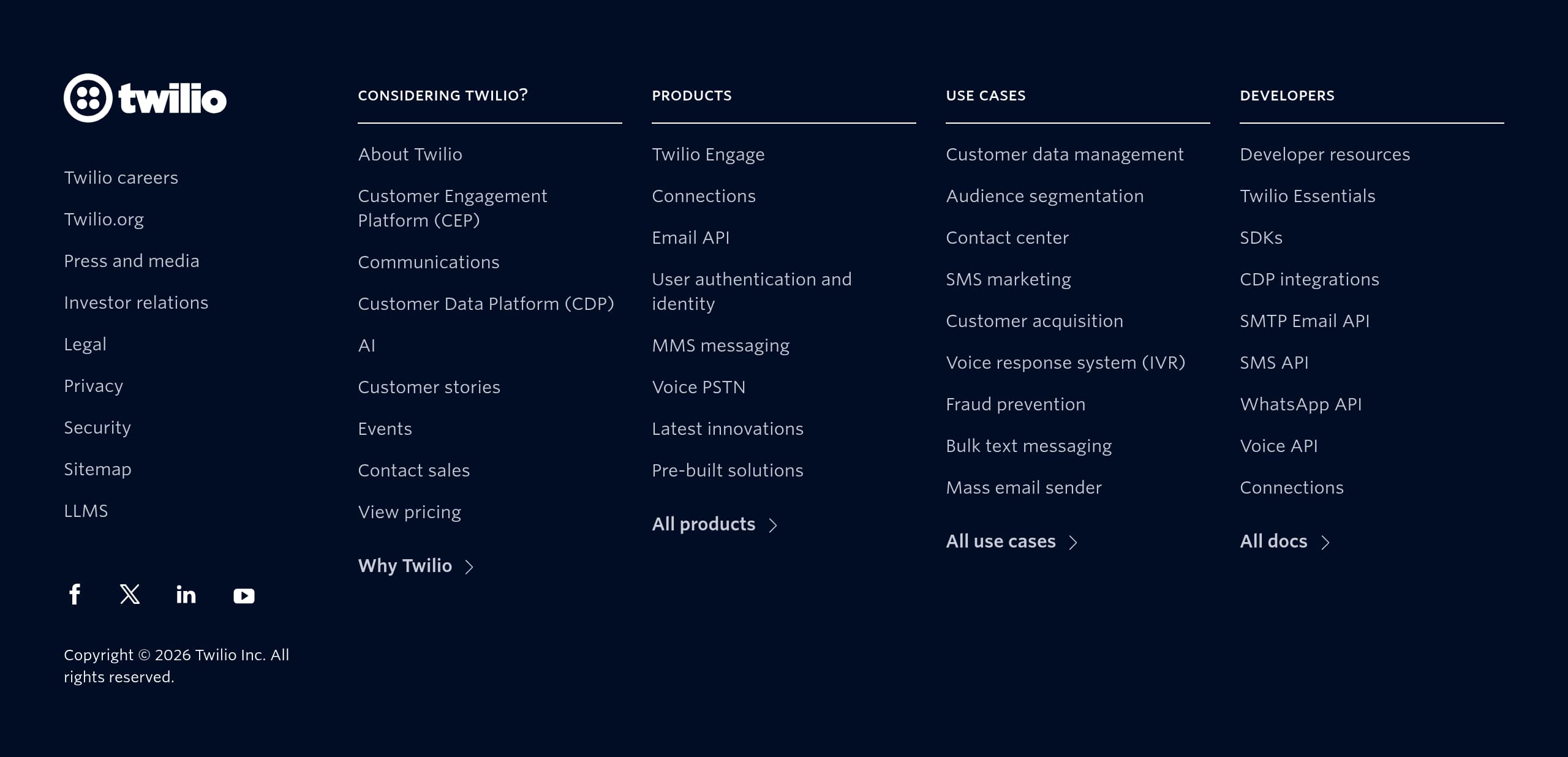
The footer functions as a comprehensive enterprise directory rather than a minimal legal strip, which matches Segment’s long evaluation and implementation cycles. Based on the screenshot context and the excerpt’s site-wide structure, the footer likely consolidates product navigation, resources, and support links that a buyer returns to repeatedly while comparing vendors and preparing an internal rollout.
What the footer is optimized for
Segment sits inside Twilio’s broader platform, so the footer’s job is to keep users oriented and moving forward. The surrounding nav patterns suggest the footer will include:
- Resource depth: Documentation, Guides, Reports, Webinars, Podcasts.
- Support depth: Help Center, Support plans, Professional services.
- Operational links: Status pages like Segment status.
- Partnership pathways: Find a partner, Become a partner.
This is practical because CDP implementation typically involves engineers (docs), marketers (use cases), and procurement (support terms). A footer that exposes those paths reduces backtracking through mega-menus.
Trust and compliance hygiene
The excerpt includes “Privacy Policy” near the site search disclosure (“Data is collected based on search terms. Privacy Policy”), which indicates the site surfaces privacy handling where user tracking could be implied. A strong footer typically reinforces this with legal links and corporate pages (Investor relations, Press and media, Careers), which are important for E-E-A-T because they demonstrate organizational legitimacy.
Conversion reinforcement
If the footer mirrors common Twilio patterns, it likely repeats primary CTAs or at least links to Pricing and Contact sales. This matters because many users scroll to the bottom after scanning and then choose a next step. Keeping Pricing, Contact sales, and Start for free accessible near the bottom improves conversion for indecisive visitors.
Net: Segment’s footer is best understood as an enterprise enablement tool, surfacing support infrastructure, implementation resources, and legal clarity so teams can progress from interest to deployment with fewer navigation dead ends.
Detected tech stack
Tools and technologies we detected on Segment's site. Detection is best-effort and may be incomplete.
Frontend
Scores
Our framework scores for Segment's website in terms of clarity, conversion, and trust. See our methodology for how we calculate these.
How clear the value prop and structure are.
How conversion-friendly signup and pricing are.
How well trust and compliance are surfaced.
FAQ
Segment’s homepage benefits from Twilio’s enterprise platform framing and navigation. The header clearly labels “Twilio Segment Customer Data Platform,” then offers role and use-case paths (Developers, Data Engineering, Marketing, Product, Customer Experience). Persistent CTAs like “Start for free” and “Contact sales” support both self-serve evaluation and sales-led procurement, which is typical for CDP purchases.
Segment pricing is positioned within Twilio’s broader pricing hub, with an “All Pricing” overview and separate entries under Customer Data for “Customer Data Platform” and “Customer Data Pipeline.” The messaging emphasizes “Transparent pricing with discounts as you scale” and highlights a “free trial, no credit card required,” which reduces friction for initial evaluation while still supporting enterprise sales conversations.
Segment uses a low-friction trial motion, repeatedly surfacing “Start for free” and stating that the free trial requires no credit card. The site also includes prominent developer resources like Documentation, Code samples, Developer Hub, and Changelog, which supports onboarding after account creation. Login is unified across Twilio products, indicating a shared authentication layer for Segment and other Twilio services.
Segment organizes features by lifecycle modules under the Customer Data category: Connections (Warehouses, Reverse ETL, Functions, Protocols), Unify (Profiles, Sync, Unified Profiles), Engage (Audiences, Journeys, Intelligence, Predictions, Recommendations), plus Data Observability. This structure helps visitors understand how Segment moves from data collection to identity unification to activation, rather than presenting a flat feature list.
Segment leans on enterprise trust infrastructure: a “Privacy and security” differentiator, support links (Help Center, Support plans, Professional services), and operational transparency through status pages including “Segment status.” The site also references third-party validation via a Gartner Magic Quadrant mention for Twilio’s CPaaS leadership, which can reduce perceived vendor risk during enterprise evaluations.

The world's best-performing SaaS businesses share surprisingly similar patterns. We help you learn and apply them through our human-designed methodology, with AI-assisted research.