
Key takeaways
Here are the key insights from our website breakdown analysis of Beamery.
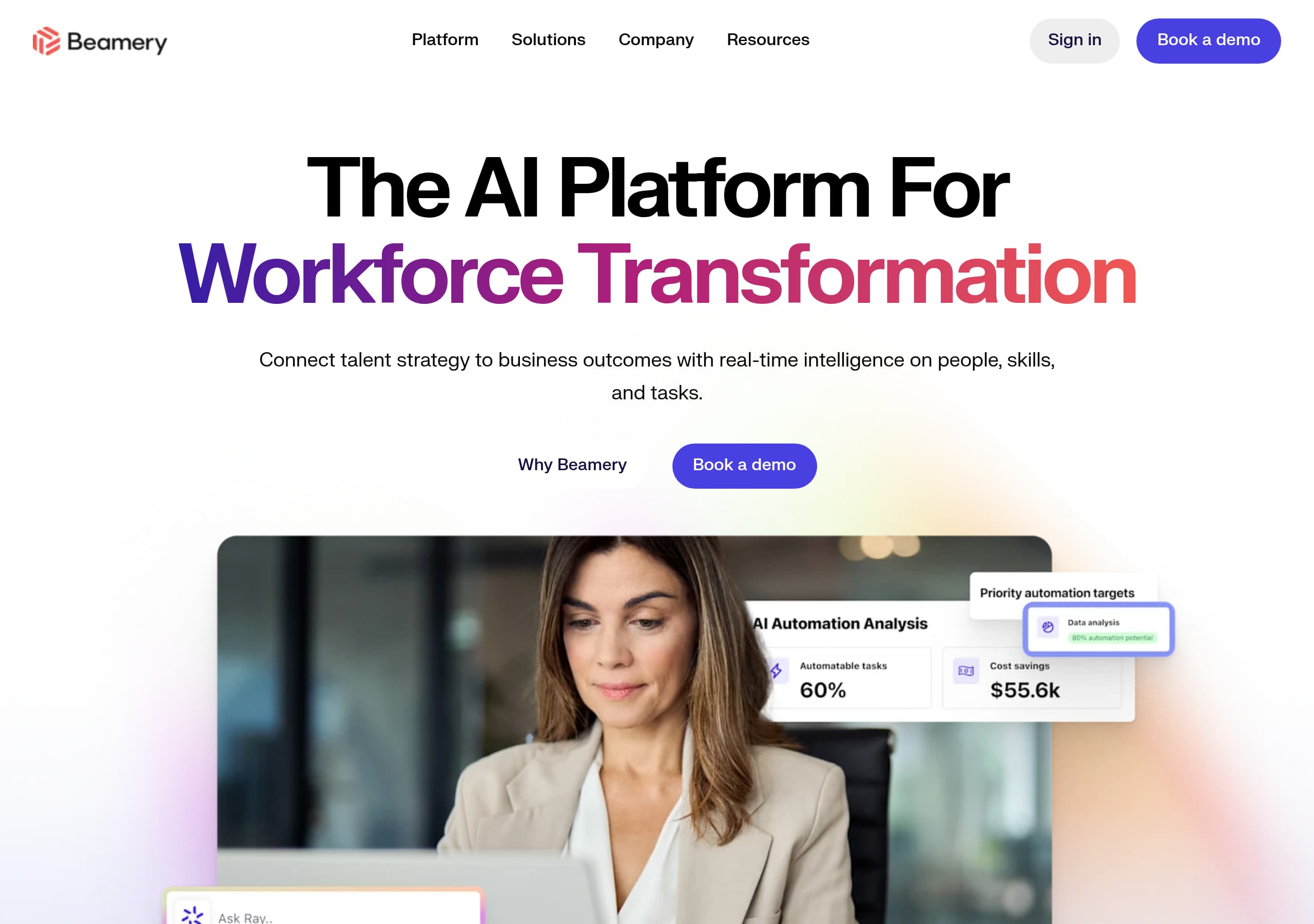
Beamery’s homepage nails enterprise positioning with a single, outcome-led headline, “The AI Platform For Workforce Transformation,” and supports it with concrete objects: people, skills, and tasks.
Conversion is optimized around a consistent primary CTA, “Book a demo,” repeated in the header, hero, and page end, which fits an enterprise sales motion but leaves self-serve users without a clear path.
The platform story is easy to scan because it is structured into four clear pillars—Data Platform, Workforce Intelligence, Agentic AI (Ray), and Execution Suite—each with its own short explanation and “Explore” link.
Social proof is unusually strong and specific, featuring recognizable enterprise names (Salesforce, Wells Fargo, Hilti, Flex) plus case-study cards that include employee counts and industry context.
Beamery builds credibility with explicit ethical framing, “Highly Effective, Ethical AI,” and visible governance links like Trust Center, Bug Bounty, and “Assured by Warden AI,” which reduce perceived AI risk for HR buyers.
The site communicates ecosystem fit through prominent integration references to Workday and SAP SuccessFactors, reinforcing the message that Beamery connects to existing HR systems rather than replacing them.
Home
Beamery’s homepage succeeds because it states the category and outcome immediately, then backs it with a structured platform narrative that matches how enterprises buy. The hero headline, “The AI Platform For Workforce Transformation,” is paired with a crisp subhead about “real-time intelligence on people, skills, and tasks,” which makes who it is for and what it transforms clear without jargon overload.
The page is organized like an enterprise product tour:
- A persistent top navigation splits the world into Platform, Solutions, Partners & Integrations, Company, and Resources, plus two sign-in options and a primary Book a demo CTA.
- Directly under the hero, Beamery introduces four pillars, Data Platform, Workforce Intelligence Suite, Agentic AI Consultant, and Execution Suite, each with a short “why it matters” paragraph and an “Explore the Beamery Platform” link. This creates a scannable, decision-friendly path for different stakeholders.
The site also does a strong job of mapping to multiple buyer personas with a dedicated section, “Unlock Data-Driven Workforce Decisions At Every Level,” and four tiles: Executives, Human Resources, Recruiters, and Candidate Experiences. That choice signals cross-functional adoption and helps procurement-minded buyers see breadth.
Where the homepage is less complete is the “how to start” story. The primary next step is consistently “Book a demo,” which is appropriate for enterprise, but there is no visible pricing anchor or lightweight self-serve evaluation path. For a visitor arriving from search, adding a short product video, a 3-step evaluation checklist, or a “See it in action” interactive preview could reduce friction without changing the sales-led model.
Pricing
Beamery’s marketing experience is clearly optimized for a sales-led enterprise motion, and the clearest pricing signal is what is not present: the primary conversion path is “Book a demo,” not a public plan grid. In the provided navigation and page excerpt, there is no “Pricing” item in the top menu, and the repeated CTA pattern points to custom enterprise pricing rather than self-serve checkout.
This approach can work well for HR platforms that depend on integrations, data governance, and multi-stakeholder rollouts. Beamery reinforces that context with language like “Designed For Enterprises,” “Connecting HR Ecosystems,” and partner references to Workday and SAP SuccessFactors, implying that scope and cost depend on ecosystem complexity.
What Beamery does well for pricing-stage visitors is provide substitute reassurance content that typically answers pricing objections:
- Clear platform modules, Data Platform, Workforce Intelligence Suite, Agentic AI (Ray), and Execution Suite, which hints at packaging.
- Case studies and quotes that imply ROI and scale, including a card that states “Planning to save $260M,” which functions as value framing even if it is not a price.
- Multiple routes to deeper detail, such as “Explore the Beamery Platform,” “Discover Integrations,” and “View all case studies,” which help buyers build an internal business case.
The tradeoff is evaluation friction. Without an explicit pricing page, visitors cannot quickly confirm budget fit, compare tiers, or understand what is included at a minimum. A strong enterprise compromise is a pricing explainer that includes packaging principles, example ranges, or “what drives cost” (seats, modules, integrations, regions, support level), plus a “Request pricing” form. That would keep sales control while improving conversion from high-intent search.
Features
Beamery’s feature presentation works because it avoids a flat checklist and instead groups capabilities into a platform architecture that maps to enterprise workforce transformation. The site repeatedly frames the product as a “Workforce Intelligence Platform,” then explains four major building blocks, which helps buyers understand how the system is supposed to be deployed.
From the excerpt, the feature story is anchored by these pillars:
- Data Platform: positioned as “connected, trusted data,” explicitly calling out fragmented data across skills, roles, people, and market data, and promising a “dynamic, reliable source of truth.”
- Workforce Intelligence Suite: focused on modeling future scenarios, uncovering talent risks, and understanding how work gets done, with language about balancing automation, reskilling, and hiring.
- Agentic AI Consultant (Ray): a named AI capability, described as “embedded” and “context-aware,” with emphasis on “robust ethical AI models” and “transparent recommendations.”
- Execution Suite: execution-oriented features like “AI-powered sourcing, matching, and engagement,” and a key promise of being “fully integrated into your existing HR systems.”
This structure is strong because it ties feature value to a sequence: unify data, generate insight, use AI guidance, then activate workflows. It also reduces the risk of buyers misunderstanding Beamery as “just a recruiting CRM,” since “Workforce Transformation” and skills and tasks intelligence are foregrounded.
What is less visible in the provided content is feature depth per module. The footer lists additional products like “Talent CRM,” “Sourcing & Matching,” “Talent Marketing,” “Talent Analytics,” “Career Sites & Chatbot,” and “Talent Intelligence,” but those read like a catalog. On feature pages, Beamery could increase clarity by adding screenshots per capability, a “what you get” bullet list per module, and 2 to 3 integration-specific examples (Workday flow, SAP SuccessFactors sync) to make implementation feel concrete.
Signup
Beamery’s signup experience is intentionally gated, and the site makes that clear through repeated pathways that favor demos and authenticated sign-in. The primary conversion action across the header and page sections is Book a demo, which aligns with enterprise HR buying where requirements, integrations, and compliance reviews precede access.
In the header, Beamery includes “Sign in” with two explicit options: “Sign into Beamery CRM” and “Sign into Beamery CRM (SSO).” That is a meaningful usability and trust cue because it signals:
- The product supports SSO-based enterprise authentication, which is expected for large organizations.
- Existing customers have a clear, direct route to access, reducing support load and friction.
For new prospects, however, there is no visible “Start free trial” or “Create account” path in the provided excerpt. That is not inherently negative for Beamery’s segment, but it does create a sharper cliff between marketing interest and product experience. The site counters this by offering multiple “Explore the Beamery Platform” links and a deep Resources area (whitepapers, webinars, case studies), which acts as pre-demo enablement.
To improve conversion without abandoning a sales-led model, Beamery could add one or two intermediate, low-risk steps:
- A “Watch a 3-minute platform tour” CTA adjacent to “Book a demo.”
- A “Get a sample workforce intelligence report” download that captures intent and qualifies leads.
- A short “Tell us your systems” pre-form (Workday, SAP SuccessFactors) to personalize the demo request.
Overall, the flow is consistent and enterprise-appropriate, but it is optimized for high-intent buyers. If Beamery wants more pipeline from search traffic, adding guided evaluation assets would reduce perceived commitment while keeping the same end goal.
Trust
Beamery’s trust messaging is strong because it addresses the two biggest enterprise anxieties in HR AI products: ethical AI behavior and governance-grade compliance. In the primary navigation and repeated “Why Beamery” cluster, Beamery explicitly positions itself as “Highly Effective, Ethical AI” and “Designed For Enterprises,” which sets expectations that the platform is built for regulated, high-stakes people decisions.
A major credibility boost is the presence of multiple trust-specific destinations in the footer, including Trust Center, “Report Unethical Behavior,” and “Bug Bounty.” Those links indicate operational maturity and make it easier for security teams to self-serve initial due diligence. The footer also includes “Assured by Warden AI,” which reads as a third-party assurance marker, and reinforces the ethical AI theme without relying only on marketing claims.
The copy around Ray, the “agentic AI consultant,” includes careful phrasing like “transparent, context-aware recommendations” and “robust ethical AI models.” That matters because it signals explainability and controlled decision support, which is important for HR leaders who need defensible hiring and mobility decisions.
What is less explicit in the excerpt is the usual set of compliance logos or detailed standards (for example SOC 2, ISO 27001, GDPR details). They may exist on the Trust Center, but they are not surfaced in the main page content provided. A practical improvement would be adding a compact trust strip near the demo CTA that links to the Trust Center and highlights key certifications, data residency options, and AI governance principles. That would shorten the path from marketing to security review and increase confidence for enterprise evaluators who land directly on the homepage from search.
Footer
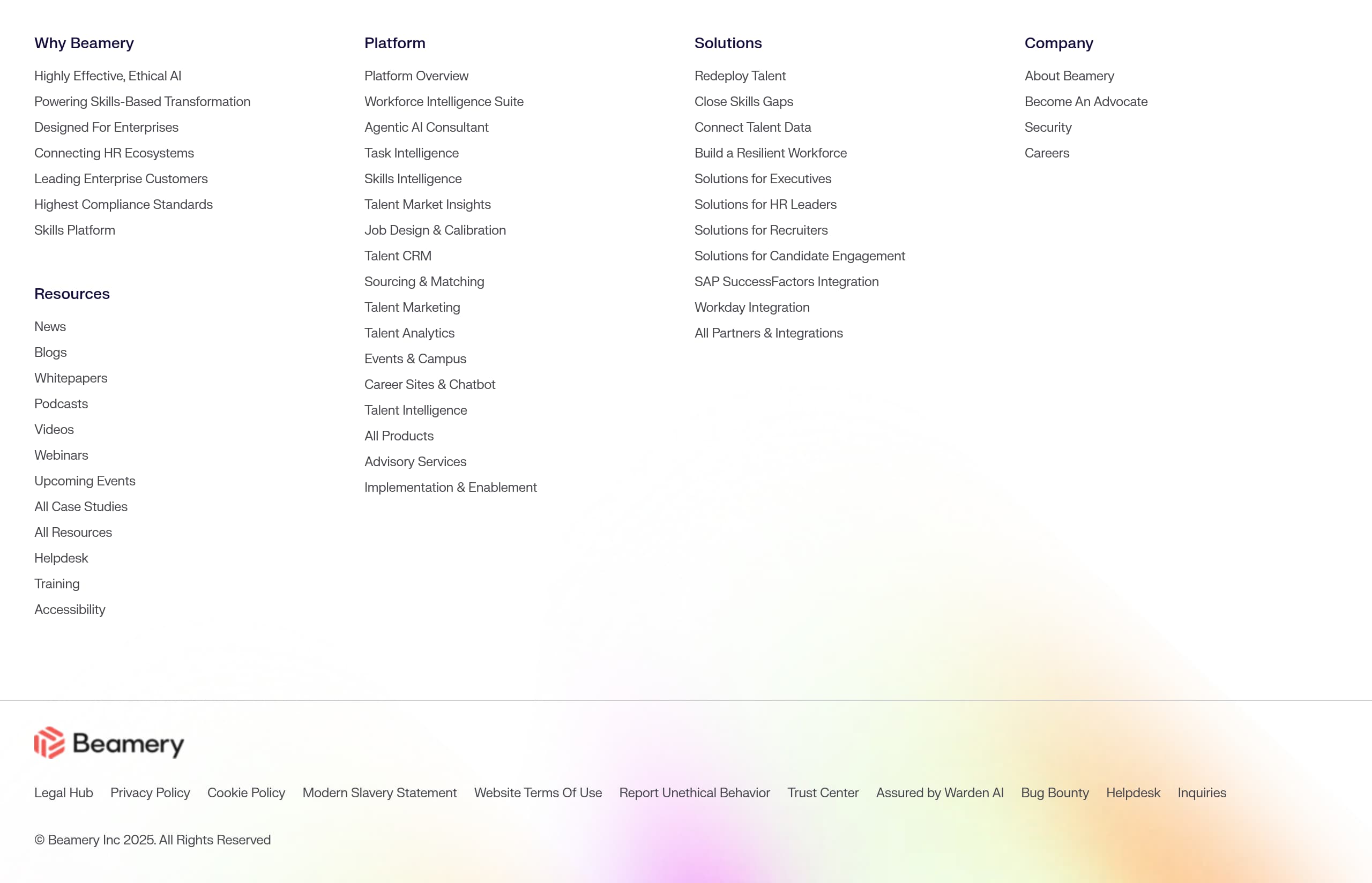
Beamery’s footer is built for enterprise evaluation, and its main strength is how comprehensively it supports both discovery and due diligence. The footer clusters links into product, solutions, partners, company, and resources, effectively acting as a secondary sitemap for a complex platform. It also repeats important platform entities like Workforce Intelligence Suite, Agentic AI Consultant, “Talent Market Insights,” and execution products such as “Talent CRM” and “Sourcing & Matching,” which helps reinforce the breadth of the platform.
From a conversion perspective, the footer supports multiple user states:
- Prospects can move into deeper evaluation via “All Case Studies,” “Webinars,” “Whitepapers,” and “FAQs.”
- Existing customers can find Helpdesk and Training, which reduces churn risk by making support obvious.
- Accessibility is explicitly linked, which is a subtle but meaningful enterprise trust signal.
Where the footer is most notable is governance and legal completeness. It contains a “Legal Hub” and direct links to Privacy Policy, Cookie Policy, “Modern Slavery Statement,” “Website Terms Of Use,” and “Report Unethical Behavior.” For enterprise HR, these items matter because procurement and compliance teams often require them early.
The inclusion of “Trust Center,” “Assured by Warden AI,” and “Bug Bounty” adds additional layers of confidence and gives security reviewers quick starting points. Also, the copyright line “© Beamery Inc 2025. All Rights Reserved” signals the site is actively maintained.
A minor usability risk is link density. The footer appears quite long and may be overwhelming on mobile. Beamery could improve scanability by collapsing link groups into accordions, adding top tasks (Book a demo, Trust Center, Workday integration, SAP SuccessFactors integration), and ensuring the most business-critical links remain visible without excessive scrolling.
Detected tech stack
Tools and technologies we detected on Beamery's site. Detection is best-effort and may be incomplete.
Frontend
Scores
Our framework scores for Beamery's website in terms of clarity, conversion, and trust. See our methodology for how we calculate these.
How clear the value prop and structure are.
How conversion-friendly signup and pricing are.
How well trust and compliance are surfaced.
FAQ
Beamery leads with a clear category statement, “The AI Platform For Workforce Transformation,” and immediately explains the data objects it covers: people, skills, and tasks. The page then organizes the product into four pillars—Data Platform, Workforce Intelligence Suite, Agentic AI (Ray), and Execution Suite—each with its own short description and “Explore” links. A persistent “Book a demo” CTA matches an enterprise sales motion.
Beamery does not surface a public pricing grid in the provided navigation and homepage excerpt. Instead, the site consistently uses “Book a demo” as the primary next step, which strongly suggests custom, enterprise pricing. Packaging cues are implied through the platform pillars and the product catalog in the footer (for example Talent CRM, Sourcing & Matching, Talent Analytics), but exact costs are handled via sales engagement.
Beamery emphasizes a demo-first onboarding flow. The main conversion CTA is “Book a demo,” while existing users are routed through “Sign into Beamery CRM” and “Sign into Beamery CRM (SSO),” indicating enterprise authentication support. There is no visible self-serve account creation in the provided content, which is typical for HR platforms that require integration planning, security review, and role-based deployment.
Beamery features named testimonials from recognizable enterprise brands and roles, including a quote attributed to a Salesforce leader. It also presents case study cards for companies like Flex, Salesforce, Hilti, and Wells Fargo, with details such as employee counts, headquarters, industry, and a short outcome summary, each linking to “Read case study.” This makes the proof both recognizable and contextual.
Beamery emphasizes “Highly Effective, Ethical AI” and describes Ray as providing “transparent, context-aware recommendations,” which addresses AI governance concerns. In the footer, Beamery links to a Trust Center, Bug Bounty, and “Report Unethical Behavior,” plus legal pages like Privacy Policy and Cookie Policy. The footer also references “Assured by Warden AI,” adding an assurance-oriented trust marker.

The world's best-performing SaaS businesses share surprisingly similar patterns. We help you learn and apply them through our human-designed methodology, with AI-assisted research.