
Key takeaways
Here are the key insights from our website breakdown analysis of Paradox.
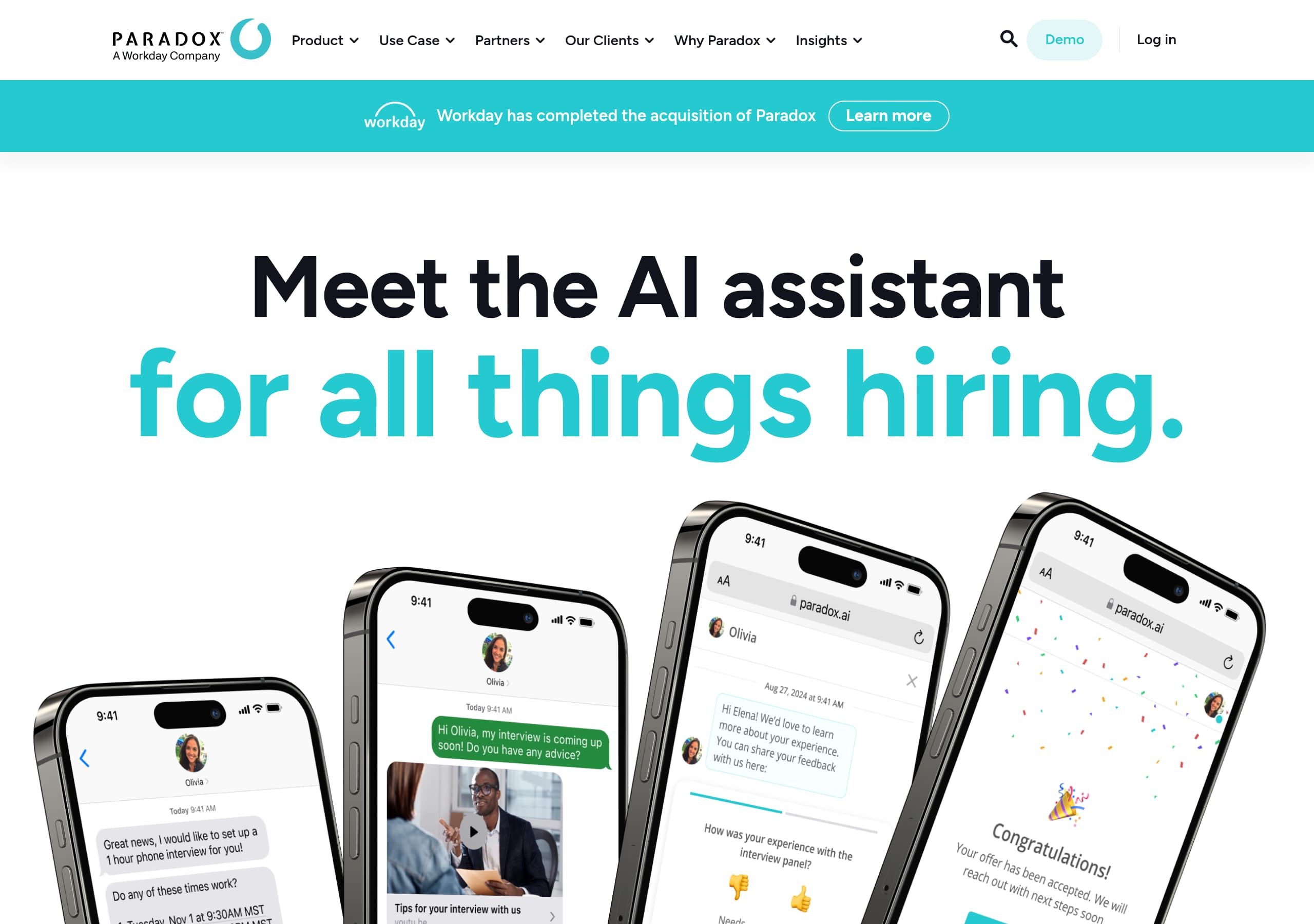
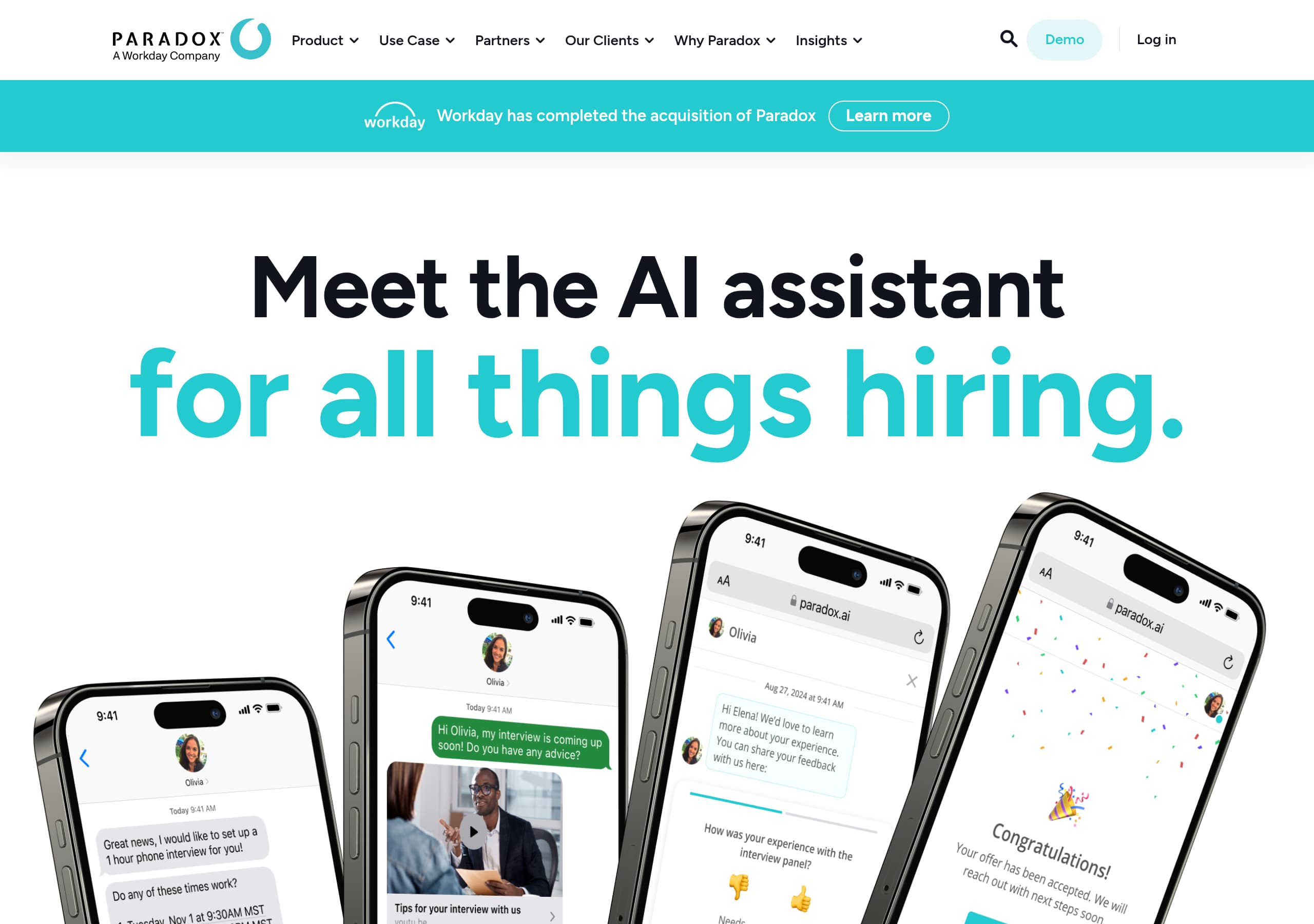
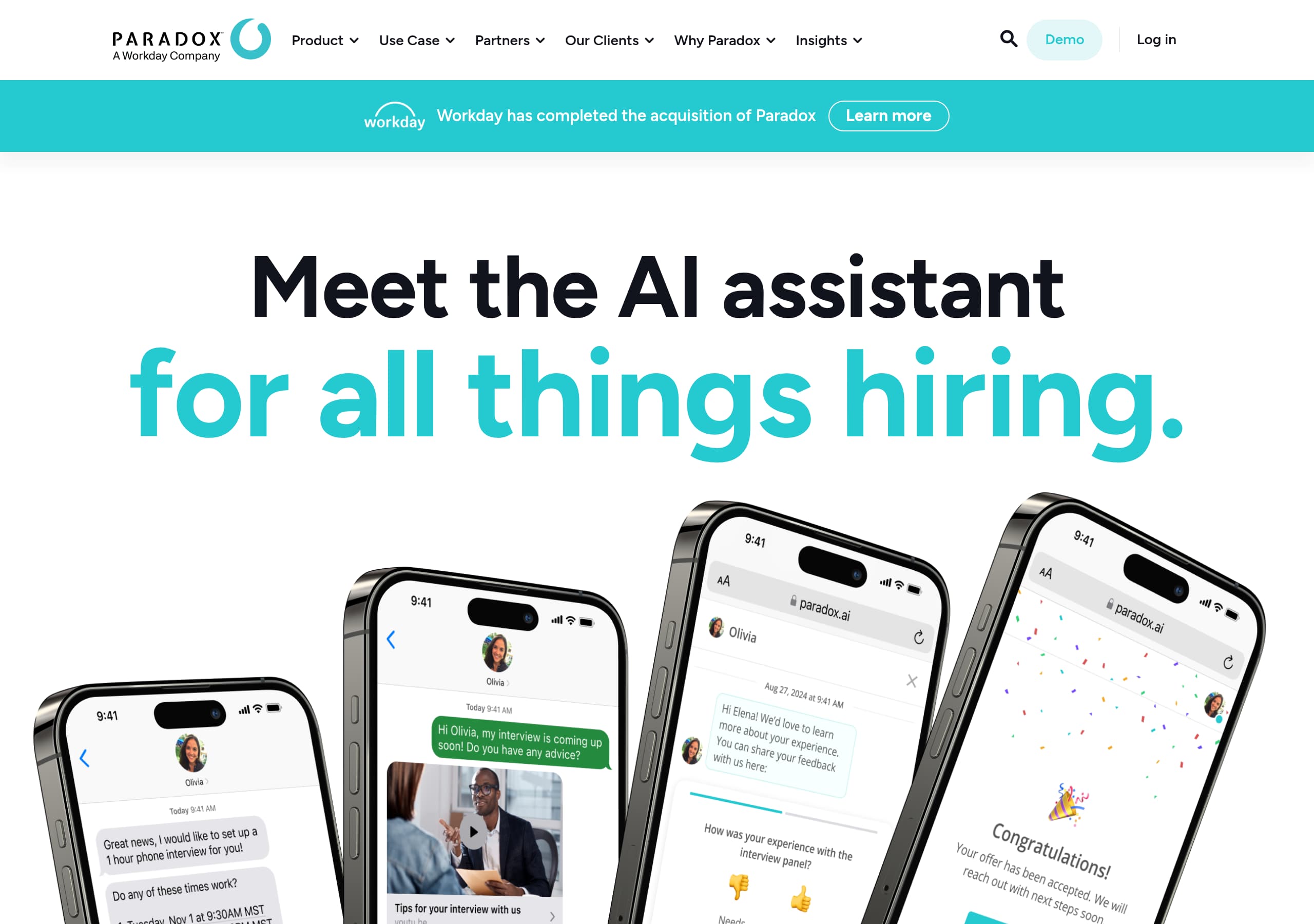
Paradox makes its value proposition immediately concrete by pairing the hero line, “Meet the AI assistant for all things hiring,” with a single dominant CTA, “Request demo,” so enterprise buyers know the next step without hunting.
The site converts well for high-volume hiring use cases by breaking automation into a clear workflow list—job search and apply, screening, scheduling, offers, onboarding, events—which maps directly to how TA leaders budget and measure outcomes.
Paradox uses unusually specific proof points for credibility, including “58% decrease in time-to-apply,” plus named customer stories like 7-Eleven, Compass Group, and Essentia Health, which reduces perceived risk for enterprise stakeholders.
Integration-led positioning is a major strength: “Paradox for Workday,” “Paradox for SAP SuccessFactors,” and “Indeed Apply” are presented as first-class paths, reinforcing “Keep your ATS, and we’ll make it better.”
Trust messaging is reinforced with explicit ethical AI language, plus security and compliance claims framed as “validated and certified,” which aligns with procurement and legal review expectations.
Pricing appears to be sales-led rather than self-serve: the strongest conversion mechanics are repeated “Request demo” CTAs, not plan comparisons, which fits the enterprise HR software buying motion but may frustrate SMB evaluators.
Home
Paradox’s homepage works because it states the product category and the outcome in one pass: conversational hiring software anchored around “the AI assistant… Olivia,” then immediately routes enterprise traffic to a single primary action, Request demo.
What’s on the page, and why it reduces confusion
The hero framing, “Imagine if you had an assistant to get work done… Meet the AI assistant for all things hiring,” sets a clear mental model: this is not a generic ATS; it is automation across the hiring journey. The supporting line, “automating tasks so you spend more time with people, not software,” is benefit-led and readable in one scan.
Strong product navigation for complex buyers
The top navigation exposes both products and use cases (Conversational ATS, Conversational CRM, Conversational Apply, Conversational Scheduling, Career Sites, Events). This product suite architecture is helpful for enterprises that already have an ATS and need point solutions. The page reinforces that positioning with “Automate the boring stuff, everywhere you hire,” then lists workflow modules like job search and apply, screening, scheduling, candidate prep, video interviewing, offers, onboarding, and events.
Early credibility and a timely enterprise signal
Paradox adds high-intent credibility blocks: “Workday has completed the acquisition of Paradox” is a direct, high-trust procurement signal for risk-averse buyers. The page also features “Named 2025 Top HR Product of the Year by HR Executive,” and it quickly surfaces integration paths (Workday, SAP SuccessFactors, Indeed). Together, these elements create enterprise readiness while keeping the page action-oriented through repeated “Learn more” links and demo-first conversion.
Pricing
Paradox’s pricing experience is designed for enterprise sales qualification, not self-serve checkout: the site pushes visitors toward Request demo rather than publishing tiers, seat counts, or per-location rates.
What the pricing page likely communicates from the UI
From the pricing screenshot, the dominant pattern is a conversion-focused layout with branded headers and clear sections, but without the common SaaS grid of plans. This is consistent with the rest of paradox.ai, where “Request demo” appears repeatedly across product modules (Conversational ATS, Career Sites, Scheduling, Apply) and across integrations (“Paradox for Workday,” “Paradox for SAP SuccessFactors”). The practical implication is that pricing is treated as a consultative step tied to hiring volume, modules, and integrations.
Why this fits Paradox’s target buyer
Paradox sells into high-volume hiring environments (retail, restaurants, logistics, healthcare). In those contexts, pricing typically depends on:
- Which modules are included (apply, screening, scheduling, events, onboarding).
- How the product integrates with an existing ATS, highlighted by “Keep your ATS, and we’ll make it better.”
- Multi-location rollouts and global requirements, supported by “Localization made simple” and multilingual support.
This structure supports enterprise deal packaging and procurement-friendly scoping, but it creates friction for smaller teams that want a quick price range.
Conversion recommendations that preserve a sales-led motion
If Paradox wants more inbound efficiency without publishing full pricing, it could add price anchoring (starting-at ranges by module) and a short “what affects price” list, plus a secondary CTA like “See example packages.” That maintains sales-assisted pricing while answering the first question buyers ask: “Is this in our budget?”
Features
Paradox’s features section is strongest when it translates “AI assistant” into a step-by-step hiring workflow, then adds enterprise-grade capabilities like multilingual support, integrations, analytics, and compliance positioning.
Workflow features mapped to hiring tasks
The “Automate the boring stuff” list reads like a hiring operations checklist: job search and apply, applicant screening, interview scheduling, candidate prep, video interviewing, creating offers, onboarding, hiring events, referrals, collecting feedback. This journey-based feature framing is more persuasive than technical specs because it matches how TA teams experience pain: admin work and candidate drop-off.
Differentiators called out in the excerpt
Several capability blocks go beyond the basics:
- Multilingual: “Respond instantly in 100+ languages,” with language detection and automatic translation.
- Personalization: customize the assistant’s voice, tone, and photo, positioning Olivia as an employer brand ambassador.
- Analytics: “track over 1,000+ metrics,” dashboards, filters, and sFTP export to BI tools.
- Events: automated registration, reminders, screening, Q&A, and instant scheduling.
- Integrations: direct integrations plus an open API, with spotlight pages for Workday, SAP SuccessFactors, and Indeed.
Product packaging helps buyers self-select
Paradox segments products as “Conversational ATS,” “Conversational Career Sites,” “Conversational Apply,” and “Conversational Scheduling,” then repeats dual CTAs, “Learn more” and Request demo, at the module level. That lets an enterprise buyer start with a single pain area while still seeing a cohesive suite.
What to watch
Because “AI assistant Olivia” is a central character, the site must avoid sounding like a chatbot-only solution. Paradox does mitigate this by repeatedly grounding features in admin tasks and integrations, but it could strengthen clarity further by showing a simple “where Olivia lives” diagram—SMS, web chat, ATS, and recruiter app—to reduce ambiguity for technical evaluators.
Signup
Paradox’s signup experience is intentionally sales-led: instead of a self-serve trial, the site funnels visitors into a Request demo path that likely includes qualification, scheduling, and solution scoping.
What the site signals about the flow
Across the homepage and product cards, the primary CTA is “Request demo,” with a secondary “Log in” link for existing users. This separation is a common enterprise pattern: new prospects convert into pipeline; current customers authenticate. The navigation also includes “Contact Us,” “Help Center,” and “FAQ,” which supports the idea that onboarding includes customer success and implementation rather than instant activation.
Why demo-first is rational for Paradox
Paradox deployments often involve:
- ATS and HRIS integration (explicitly highlighted with “Paradox for Workday” and “Paradox for SAP SuccessFactors”).
- Multi-location and frontline hiring volumes.
- Compliance review, security validation, and brand customization (voice, tone, photo).
These requirements make a standard “email and password” trial less realistic. A demo can also align stakeholders across recruiting, HRIS, IT, operations, and legal.
Conversion friction to manage
A sales-led flow can lose high-intent buyers if the demo request form is long or unclear. The site partially offsets this with strong proof (case studies, ROI metrics) and clear module explanations. To improve without changing the business model, Paradox could:
- Offer a “See a 2-minute product tour” as a pre-demo step.
- Provide a short “What happens after you request a demo” timeline, for example: discovery call, tailored demo, integration review.
- Add persona-specific routing (recruiting leader vs. HRIS) since the site already segments by experience.
Overall, Paradox optimizes signup for implementation-grade buyers, prioritizing qualified demand over volume signups, which is consistent with enterprise HR tech purchasing.
Trust
Paradox builds trust by speaking directly to legal, security, and accessibility requirements, then reinforcing enterprise credibility through integrations and the Workday acquisition notice.
Compliance and ethical AI positioning
A standout section is “Fairness and compliance: AI your legal team can get behind,” followed by explicit principles: “Transparent, explainable, fair, accountable, secure, and safe.” This is more concrete than vague “responsible AI” language, and it signals that Paradox expects formal review. The copy also frames AI as “purposeful, thoughtful,” which helps reduce fear of black-box automation.
Security and certification framing
The security block, “Reliability and scale you can count on. Validated and certified by the experts,” is procurement-oriented. While the excerpt does not list specific standards, the phrasing suggests formal certifications and an emphasis on protecting “candidates’ data and personal information.” This is important in hiring contexts where PII and messaging channels (SMS) elevate risk.
Accessibility and global readiness
Paradox includes an accessibility mission statement and references conformity to “industry standard accessibility guidelines,” which matters for career sites and candidate experiences. The “Global” section emphasizes localization, data privacy, scalability, and compliance with local regulations. Combined with “Respond instantly in 100+ languages,” the site signals global hiring support for distributed employers.
Integrations as a trust signal
“Keep your ATS, and we’ll make it better,” plus dedicated pages for Workday and SAP SuccessFactors, reduces migration anxiety and implies mature enterprise interoperability. The “open API” mention adds technical credibility for HRIS teams.
What would make trust even stronger
For maximum buyer confidence, Paradox could surface a security and compliance hub link near the hero or footer, listing specific certifications, data retention, and SMS provider details. Even without that, the current structure does a good job of aligning messaging with how enterprise HR software is actually approved: legal review, security posture, and implementation readiness.
Footer
Paradox’s footer appears designed to support enterprise evaluation and customer operations, not just basic navigation, and it reinforces trust by making support, resources, and contact paths easy to find.
What the footer is doing well
From the footer screenshot, the layout uses multi-column link groupings, a common pattern for large SaaS sites with many audiences. The excerpt also indicates key destinations that are typically represented in the footer: Help Center, FAQ, Contact Us, blog and reports, plus partner and integration information. This supports both pre-sale research and post-sale usage, which is critical for a product that spans candidates, recruiters, and hiring managers.
Trust and procurement expectations
Enterprise HR buyers often look for legal and corporate links in the footer because that is where privacy, terms, security documentation, and company details live. Even when not explicitly shown in the excerpt, Paradox’s positioning around security, privacy, and accessibility suggests those links are expected. A footer that clearly exposes Privacy Policy and Terms reduces friction for procurement teams that need to validate governance before scheduling a demo.
Conversion support without being pushy
A strong enterprise footer typically repeats a contact path rather than pushing aggressive CTAs. Paradox already uses “Request demo” heavily above the fold, so the footer’s job is to provide reassurance and self-serve learning: resource center, reports (Bersin, Aptitude Research), events, and integrations. This helps visitors who are not ready for a demo continue progressing.
Improvements that would increase SEO and AI visibility
To improve crawlability and internal linking depth, Paradox could add a “Popular pages” cluster for core commercial queries, such as Conversational ATS, Conversational Scheduling, Paradox for Workday, and Conversational Career Sites. Adding a short, one-sentence descriptor under each footer category would also improve information scent for scanners.
Net effect: the footer functions as an enterprise navigation hub, balancing support needs with evaluation content, which is consistent with Paradox’s sales-led motion.
Detected tech stack
Tools and technologies we detected on Paradox's site. Detection is best-effort and may be incomplete.
Scores
Our framework scores for Paradox's website in terms of clarity, conversion, and trust. See our methodology for how we calculate these.
How clear the value prop and structure are.
How conversion-friendly signup and pricing are.
How well trust and compliance are surfaced.
FAQ
Paradox leads with a clear category and mental model, “Conversational hiring software” and “Meet the AI assistant for all things hiring,” then pairs it with a single primary CTA, “Request demo.” It quickly shows where the product applies by listing workflow modules like screening, scheduling, offers, onboarding, and events. It also adds immediate enterprise credibility with the Workday acquisition notice and named client stories.
Paradox uses a sales-led pricing approach rather than publishing self-serve plan tiers. Across product modules and integration pages, the site repeatedly prompts “Request demo,” signaling that pricing depends on scope such as modules (Apply, Scheduling, ATS), hiring volume, and integrations like Workday or SAP SuccessFactors. This fits enterprise procurement but provides less immediate budget guidance for smaller teams.
Paradox mixes quantitative outcomes with recognizable brands. The homepage highlights a metric like “58% decrease in time-to-apply” and pairs it with customer narratives such as 7-Eleven saving “40,000 hours per week” and Compass Group hiring 120,000 workers annually with a small recruiting team. It also lists many featured client stories across industries, reinforcing breadth beyond a single vertical.
Paradox emphasizes end-to-end hiring automation through conversational workflows: job search and apply, screening, interview scheduling, candidate prep, video interviewing, offers, onboarding, events, referrals, and feedback surveys. It also highlights enterprise capabilities like multilingual support in 100+ languages, analytics with 1,000+ tracked metrics, open API and direct integrations, and customizable assistant branding (voice, tone, photo).
Paradox explicitly frames “Fairness and compliance” as “AI your legal team can get behind,” listing principles like transparent, explainable, fair, accountable, secure, and safe. It also describes security as “validated and certified,” and discusses accessibility goals aligned to industry accessibility guidelines. Global readiness is supported through localization, privacy and compliance language, and multilingual support for candidate communication.

The world's best-performing SaaS businesses share surprisingly similar patterns. We help you learn and apply them through our human-designed methodology, with AI-assisted research.