
Key takeaways
Here are the key insights from our website breakdown analysis of Ironclad.
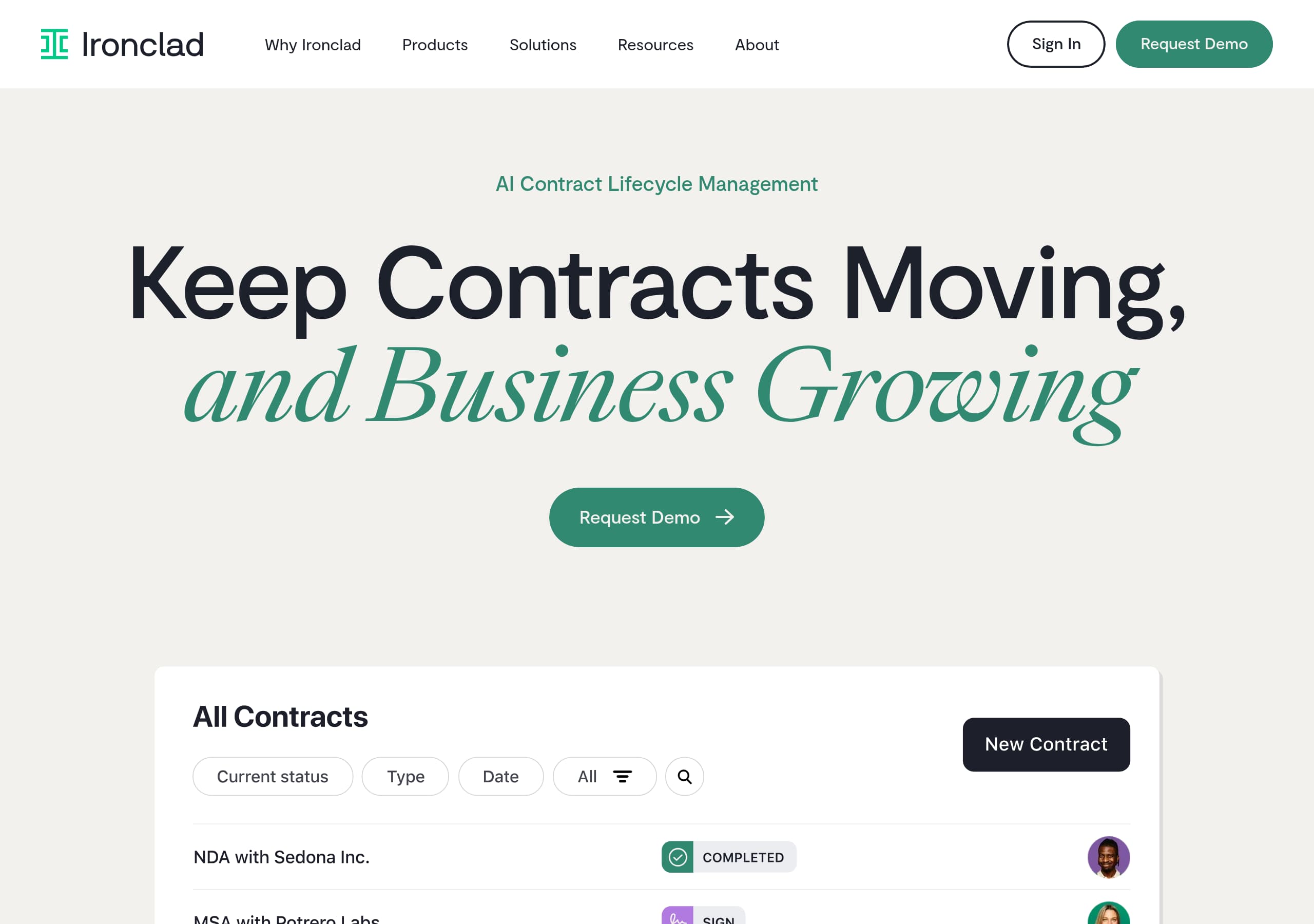
Ironclad’s homepage communicates the category and outcome quickly with a single-sentence hero, “AI Contract Lifecycle Management” plus “Keep Contracts Moving, and Business Growing,” and reinforces it with a persistent “Request Demo” CTA.
The site leans into enterprise credibility by foregrounding analyst validation, including “Named a Leader by Gartner” and “The Forrester Wave,” and links to gated reports with clear “GET THE REPORT” CTAs.
Ironclad segments messaging by department (Legal Ops, General Counsel, Procurement, IT, Sales), which helps multiple buying personas self-select without forcing them into a generic product narrative.
AI positioning is concrete and productized, with three distinct AI buckets (Automation, Insights, AI Assistant) and a named agent, “Jurist,” which reduces ambiguity compared to generic “AI-powered” claims.
Conversion is optimized for high-ACV sales by using demos and report downloads instead of self-serve signup, but this also adds friction for smaller teams that want immediate pricing transparency and trial access.
Trust is strengthened with a visible legal disclaimer (“Ironclad is not a law firm”) and footer links to Security, Status, Privacy, and accessibility, signaling governance expectations for contract data.
Home
Ironclad’s homepage wins by stating the category immediately and pairing it with an outcome-driven promise, then supporting that promise with credible, enterprise-oriented proof points. The hero stack is direct: “AI Contract Lifecycle Management” plus “Keep Contracts Moving, and Business Growing”, with a primary “Request Demo” CTA that matches an enterprise sales motion.
What is especially effective is the way the page moves from promise to evidence without burying users in jargon:
- A secondary line, “Faster deals, fewer surprises, and measurable value,” frames benefits in business language, not legal theory.
- The page introduces “All things contracts, all in one place” and a clear lifecycle list (Create, Review, Sign, Store, Analyze, Fulfill), which helps non-legal stakeholders understand scope.
- Department tiles (Legal Ops, General Counsel, Procurement, IT, Sales) function like guided entry points, each with a specific payoff and “LEARN MORE” link, reducing cognitive load for mixed audiences.
The homepage also shows disciplined use of credibility anchors near the top: it calls out being “Named a Leader by Gartner” and “positioned in the Leaders category” for Forrester, each with a “GET THE REPORT” CTA. That placement matters because CLM decisions often require third-party validation for executive and procurement buy-in.
One gap is that some “measurable value” elements appear as metric labels (Acceleration, Adoption, Optimization, Efficiency) without visible numbers in the provided excerpt, which can feel unfinished if the design does not fill them in. Still, the page structure, dual CTAs (demo and reports), and tight narrative from lifecycle to AI to proof make the homepage highly scannable for enterprise buyers evaluating Ironclad (ironcladapp.com).
Pricing
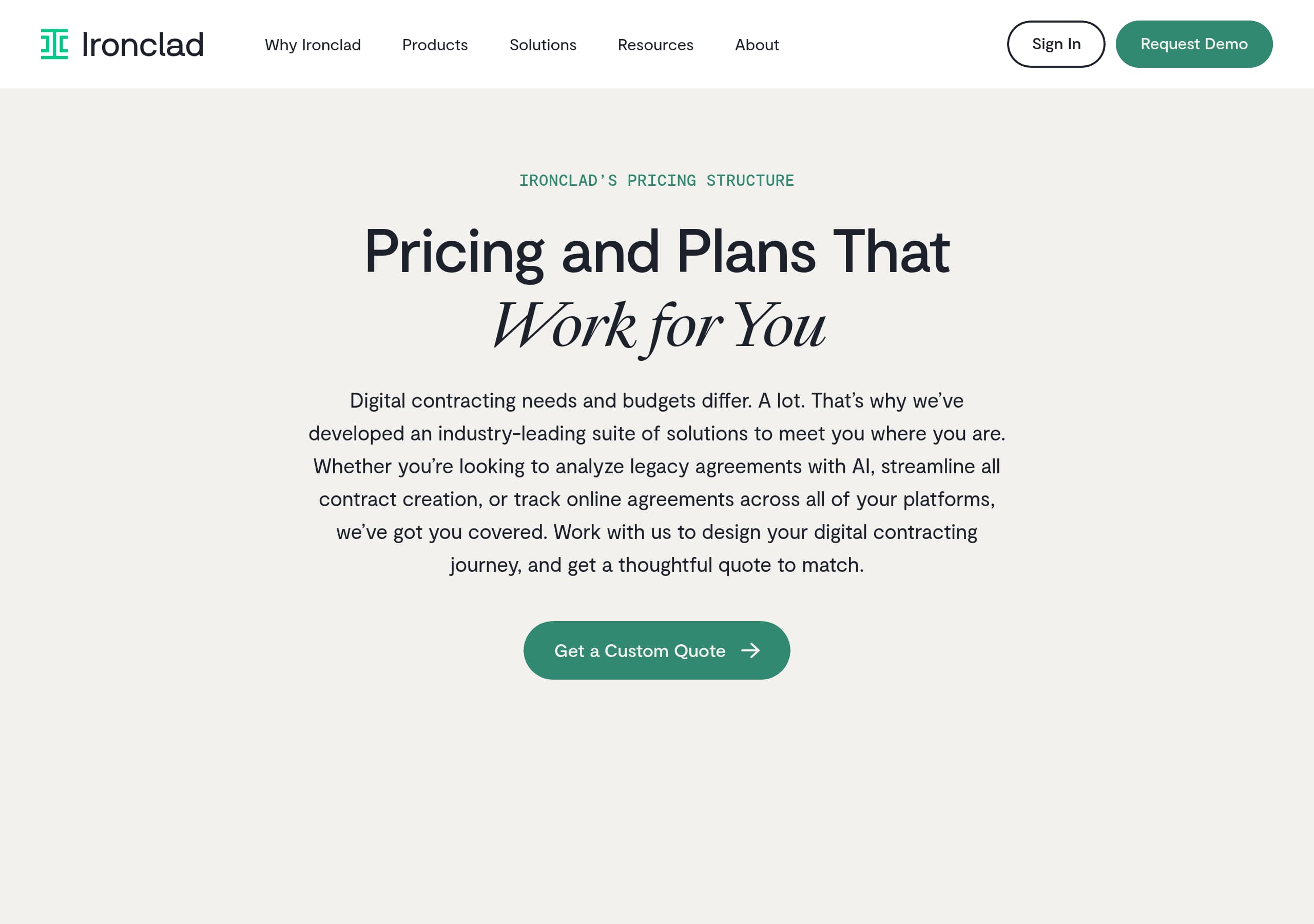
Ironclad’s pricing experience is intentionally sales-led, which aligns with enterprise CLM buying, but it trades away transparency for speed-to-sales qualification. In the provided site structure and footer, “Pricing” exists as a destination, yet the dominant conversion action throughout the experience remains “Request Demo”, signaling that pricing is likely customized around seats, workflows, integrations, and implementation.
From a conversion perspective, this can work well for Ironclad’s market because CLM total cost often depends on governance and rollout complexity:
- The navigation and page architecture emphasize “Implementation Success” and “Enterprise Class,” implying pricing is bundled with services, rollout support, and compliance expectations.
- The site repeatedly uses gated assets like “GET THE REPORT” (Gartner, Forrester, Hackett), which helps capture evaluator intent before presenting commercial terms.
However, the pricing posture also creates predictable friction for mid-market researchers who arrive with “price-first” intent. Without clear packaging (for example, tiers, starting price ranges, or a comparison table), users may not know whether Ironclad is a fit until they speak with sales. That tends to increase bounce risk from competitive comparisons against Icertis, DocuSign CLM, or Agiloft, where buyers might find more immediate pricing signals.
A strong design pattern to mitigate this, if visible on the pricing page screenshot, would be:
- A simple “How pricing works” explainer (what changes price: users, templates, integrations, volume), plus procurement-friendly details like billing cadence.
- A clear statement of what every plan includes (security baseline, audit logs, SSO options) to reduce perceived risk.
As it stands, Ironclad’s pricing strategy appears optimized for enterprise evaluation flows: push qualified prospects into demo requests, while providing high-authority third-party reports as proof for stakeholders involved in approving budget.
Features
Ironclad’s feature presentation is effective because it combines an end-to-end lifecycle model with a clear AI taxonomy, making it easier for buyers to map capabilities to their contracting process. The site avoids a generic “AI-powered CLM” pitch by naming concrete product areas and placing them in a contracting workflow.
Two visible feature frameworks do the heavy lifting:
-
Lifecycle coverage: “Contract Lifecycle Support for every stage of contracting” with the sequence Create, Review, Sign, Store, Analyze, Fulfill. This communicates breadth without requiring a deep product tour, and it matches how teams evaluate CLM completeness.
-
AI capability buckets: “AI designed for contracts and built for impact,” broken into Automation, Insights, and AI Assistant. Each bucket has a “LEARN MORE” link, indicating dedicated pages for deeper evaluation.
The most differentiated AI feature is the named assistant: “AI Assistant: Jurist”, described as “agentic” and “purpose-built for legal contract review,” plus “Draft, review, negotiate, and research with Jurist.” Naming the assistant creates a concrete mental model and suggests a productized experience rather than a chat widget bolted onto search.
Beyond core features, Ironclad strengthens its functional story with integration language: “Connect with the tools you already use,” plus specific examples such as Salesforce, Coupa, and Ramp. That is a crucial feature category for CLM because contracts touch CRM, procurement, and finance systems.
What is not fully visible in the excerpt is depth on governance features (permissions, audit trails, clause libraries, approval routing), or how “Enterprise Class” manifests technically. Those details likely exist on subpages like Enterprise Class, Security, and Platform Overview. Even so, the homepage feature framing is crisp, scannable, and anchored in recognizable workflows, which is the right approach for a complex product like Ironclad (ironcladapp.com).
Signup
Ironclad’s signup experience is designed around high-intent lead capture rather than self-serve onboarding. The primary action across the homepage and navigation is “Request Demo”, and secondary conversions push users toward gated assets (for example, “GET THE REPORT” for Gartner and Forrester). This is a deliberate choice for an enterprise CLM product where implementation, integrations, and security requirements usually require a guided sales process.
From a funnel design perspective, the site presents multiple entry points that likely feed the same qualification workflow:
- “Request Demo” appears in the header and again near the bottom as “Get your personalized demo today.”
- “Download Now” appears for the “2025 State of AI in Legal report,” capturing evaluators who are not ready to talk to sales.
- Developer-oriented navigation (Clickwrap API, CLM API, Rivet Integrations) suggests technical evaluators can self-educate before booking time.
The biggest benefit of this approach is alignment with enterprise buying committees. Legal ops can request a demo, IT can review APIs, and procurement can review analyst reports, all before commercial negotiation. It also reduces the risk of a poor first-run experience that can happen when a complex CLM is offered as a generic trial.
The tradeoff is immediacy: prospects who want to test document ingestion, clause redlining, or the Jurist AI assistant without speaking to sales may drop into competitor trials. If the demo form is long (common in enterprise SaaS), completion rates can suffer.
A strong next-step optimization would be offering a lighter-weight path alongside demos, such as a “Watch demo video” option (the site has a Demo Video Library) or a short “interactive product tour,” while keeping Request Demo as the primary conversion for revenue-quality leads.
Trust
Ironclad builds trust through three observable layers: analyst credibility, enterprise-operational positioning, and governance-forward legal and privacy signals. For a contract lifecycle management platform, this matters because buyers are entrusting sensitive counterparty data and approval workflows that can affect revenue recognition and risk exposure.
First, the site uses third-party validation prominently, including Gartner Magic Quadrant and Forrester Wave leader placement, each paired with a “GET THE REPORT” CTA. This functions as trust-by-proxy for stakeholders who rely on standardized evaluation frameworks.
Second, Ironclad’s navigation consistently reinforces maturity signals: “Implementation Success,” “Enterprise Class,” “Partners,” “Community,” and “For Developers.” Those labels imply the company supports rollout, integrations, and ongoing enablement, not just product features. The presence of a “Status” link in the footer is another operational trust indicator, suggesting incident transparency and reliability norms.
Third, the site includes an explicit legal disclaimer: “Ironclad is not a law firm” and “does not constitute or contain legal advice,” plus it clarifies that using site resources does not create an attorney-client relationship. This is a trust-positive move because it sets boundaries around AI and content, which is especially relevant with the positioning of Jurist and AI agents.
What is less visible in the excerpt is detailed security and compliance content (for example, SOC 2, ISO 27001, SSO, audit logs), though the footer includes a direct “Security” link and privacy controls like “Your Privacy Choices” and “Do Not Sell My Information.”
Overall, Ironclad’s trust posture is strong for top-of-funnel evaluation: it gives multiple stakeholder groups something credible to cite. The next step to become best-in-class would be surfacing more security specifics above the footer, especially for IT-led evaluations that want concrete controls early.
Footer
Ironclad’s footer is built for enterprise due diligence: it surfaces legal, privacy, security, and support destinations that procurement and IT teams look for during evaluation. Instead of only repeating marketing links, it functions like a compliance and navigation hub, which is appropriate for a CLM vendor.
Several footer elements stand out as practical trust and usability signals:
- Corporate and legal links are clearly present: Terms of Service, Privacy Policy, Accessibility Statement, Cookies, and region-specific notices like CA Privacy Notice.
- Privacy controls are explicit with “Your Privacy Choices” and “Do Not Sell My Information,” which aligns with regulatory expectations.
- Operational and support pathways are easy to find: Support, Status, and “Support Portal,” reducing uncertainty about what happens post-purchase.
The footer also mirrors the site’s information architecture, repeating major sections such as Why Ironclad, Products (CLM Overview, Integrations, AI Assistant: Jurist), Solutions by Department, Resources, Customer Resources (Academy, Community, Help Center), and For Developers (ClickWrap API Documentation, CLM API Documentation, Rivet). That duplication is useful because enterprise buyers often scroll to find documentation and governance links quickly.
A subtle but important element is the disclaimer shown near the bottom of the page content: “Ironclad is not a law firm…” This type of statement reinforces responsible positioning around educational resources and AI features. Coupled with the footer’s privacy and terms links, it helps reduce perceived legal ambiguity.
If there is one opportunity, it is to make the most critical enterprise assurances even more scannable directly in the footer, such as a short line that summarizes security posture and links to “Security” (which is present). Still, as shown, the footer supports enterprise procurement checklists, clarifies legal boundaries, and provides fast access to support and status, all of which strengthen the conversion path for Ironclad (ironcladapp.com).
Detected tech stack
Tools and technologies we detected on Ironclad's site. Detection is best-effort and may be incomplete.
Scores
Our framework scores for Ironclad's website in terms of clarity, conversion, and trust. See our methodology for how we calculate these.
How clear the value prop and structure are.
How conversion-friendly signup and pricing are.
How well trust and compliance are surfaced.
FAQ
Ironclad’s homepage states the product category immediately, “AI Contract Lifecycle Management,” and pairs it with a business outcome, “Keep Contracts Moving, and Business Growing.” It keeps the primary CTA consistent with “Request Demo,” then backs credibility with analyst validation (Gartner Magic Quadrant, Forrester Wave, Hackett). Department-based pathways (Legal Ops, Procurement, IT, Sales) help multiple stakeholders find relevant value quickly.
Ironclad uses a sales-led pricing approach. The site includes a “Pricing” destination, but the dominant conversion action across the experience is “Request Demo,” indicating pricing is likely customized based on factors like deployment needs, integrations, and implementation scope. This aligns with enterprise CLM buying, but it offers less immediate transparency for visitors who want self-serve pricing tiers or a free trial.
Ironclad separates AI into clear product buckets: Automation, Insights, and AI Assistant. It also names its assistant, “Jurist,” and describes it as agentic and purpose-built for legal contract review, with tasks like drafting, reviewing, negotiating, and research. This structure makes the AI story feel productized, not just a generic “AI-powered” claim, and it gives evaluators clear pages to explore.
Ironclad combines third-party analyst recognition with customer testimonials. The site calls out being named a Leader by Gartner and placed in the Leaders category in the Forrester Wave, with “GET THE REPORT” CTAs. Testimonials focus on operational outcomes and adoption, such as making contracting “easy and enjoyable to collaborate” and being user friendly for both lawyers and non-lawyers.
Ironclad includes procurement-friendly links in the footer, including Security, Status, Terms of Service, Privacy Policy, and privacy controls like “Your Privacy Choices.” It also publishes a clear disclaimer stating “Ironclad is not a law firm” and that site resources are not legal advice. These elements help set governance expectations, especially important for a contract lifecycle management platform handling sensitive data.

The world's best-performing SaaS businesses share surprisingly similar patterns. We help you learn and apply them through our human-designed methodology, with AI-assisted research.