
Key takeaways
Here are the key insights from our website breakdown analysis of Icertis.
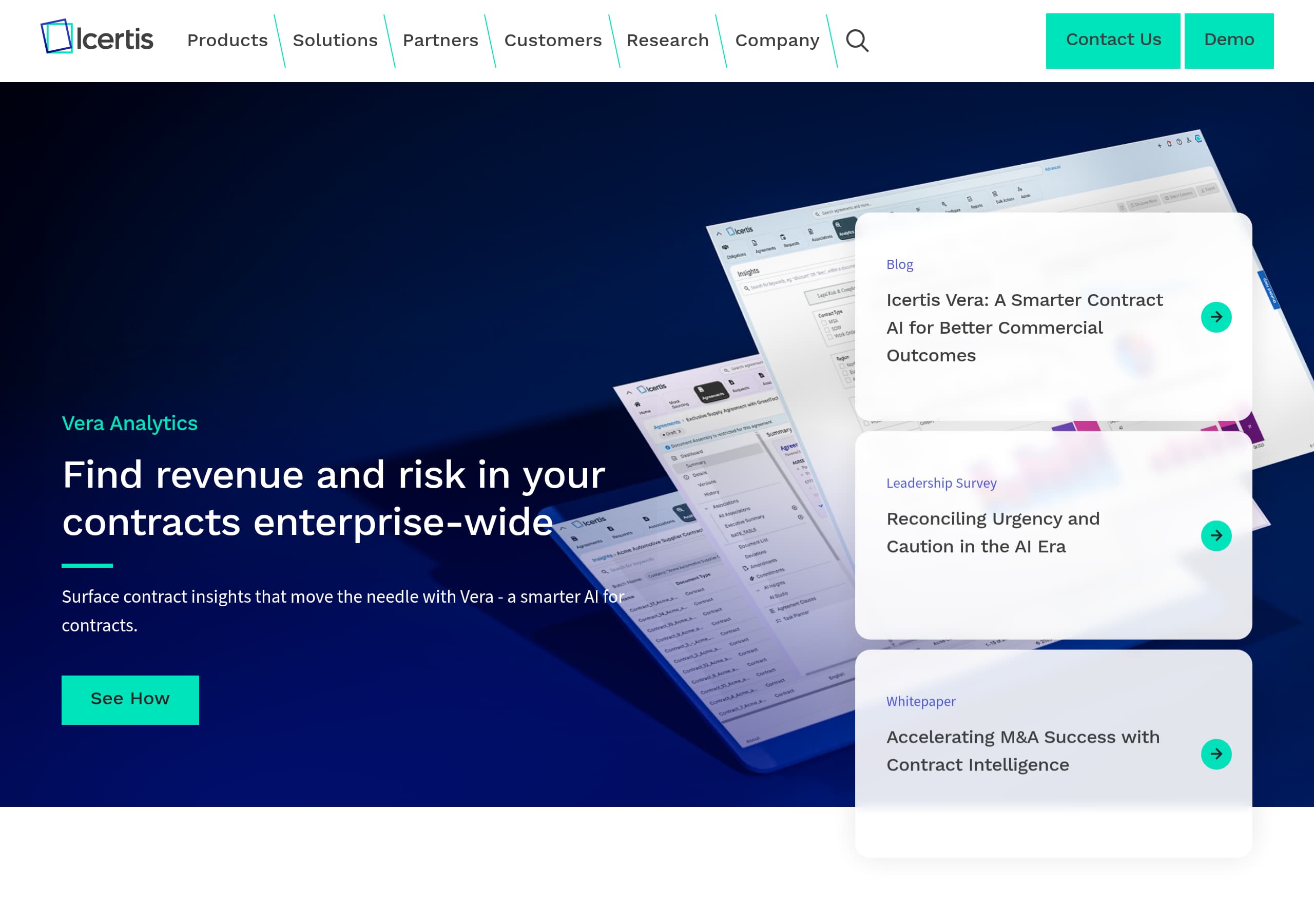
Icertis makes its enterprise positioning unambiguous with a hero that pairs “Icertis Contract Intelligence” messaging with a primary “Explore Platform” path and repeated “Get a Demo” CTAs, which fits a high-consideration CLM sale.
The site converts through guided navigation, not self-serve: product areas are segmented into Contract Analytics, Contract Operations, and Contract Performance, and the interface repeatedly routes users to “Learn More” and demo requests instead of pricing.
Social proof is a core persuasion layer, anchored by “Trusted by a Third of Fortune 100” plus a detailed Microsoft case study that includes a named stakeholder and a quantified scale (220,000 employees).
Icertis differentiates on AI packaging, using the Vera brand (Vera Copilot, Vera Analytics, Vera AI Foundation, multiple “Agent” modules) to make advanced capabilities understandable to enterprise buyers.
Integration credibility is baked into product value: the homepage explicitly calls out Microsoft, SAP, and Salesforce in the primary feature narrative, reinforcing fit for existing enterprise stacks.
Trust is supported structurally via a dedicated Trust Center link and a footer heavy with legal and policy items, but security specifics are not surfaced in the provided homepage excerpt, leaving reassurance mostly to enterprise signals and governance language.
Home
Icertis’s homepage succeeds because it tells an enterprise CLM story in a single pass: what it is (contract intelligence), how it is delivered (AI plus workflows), and how a buyer should proceed (Explore Platform or Get a Demo).
What the hero communicates
The core framing is “Icertis Contract Intelligence” with the promise to “Realize the Full Potential of Every Business Relationship.” That headline is reinforced by a benefits line that names outcomes, “drive revenue, savings, efficiency, and compliance,” which is more specific than generic “manage contracts.” The primary CTA pattern is clearly non-transactional: “Explore Platform” appears as a main route, while the persistent header includes “Demo” and “Contact.” This matches enterprise evaluation behavior where procurement, legal, and IT need multiple touchpoints.
How the page guides different audiences
The top navigation is dense but organized around enterprise mental models: Products (platform overview, integrations, Engage, Operate, Analyze), Solutions (industry and departmental), Partners (Microsoft, SAP, Accenture, Deloitte, KPMG, PwC), Customers, Research, Company. That information architecture reduces ambiguity for multi-stakeholder visitors who land with different intents.
How value is made tangible
The feature narrative is packaged into three pillars: Contract Analytics, Contract Operations, and Contract Performance. Each pillar ties to a concrete promise, like “analyze contracts in nearly any format” and “deep integrations with Microsoft, SAP, Salesforce.” The page also repeats Vera branding, such as Vera Analytics and Vera Copilot, to make AI feel like a product suite, not a vague claim. One small clarity risk is the volume of branded terms (Vera, OmniModel, agents), which can require extra scanning before a buyer maps names to outcomes.
Pricing
Icertis effectively signals that pricing is not self-serve, which is consistent with enterprise Contract Lifecycle Management procurement, but it also means the site must compensate with stronger pre-demo qualification content. In the provided navigation and homepage excerpt, there is no visible “Pricing” item, and the dominant conversion paths are “Get a Demo”, “Contact,” and “Explore Platform.”
What this implies about the commercial model
The absence of a pricing page in the primary navigation suggests custom enterprise pricing based on scope: number of users, contract volume, modules (analytics, operations, performance), integrations (Microsoft, SAP, Salesforce), and potentially industry requirements. This is reinforced by the way Icertis presents its platform as multiple components, including Vera Analytics Standard, Vera Analytics Advanced, and several “Agent” offerings, which often map to packaging tiers even if tiers are not publicly listed.
How the site replaces a pricing table
Instead of pricing transparency, the site leans on quantified business outcomes language: “eliminate revenue leakage,” “optimize spend,” “improve contracting efficiency,” “reduce risk and compliance exposure.” These become the economic justification that a buyer can take into internal ROI discussions before engaging sales. The strongest supporting asset is the “Trusted by a Third of Fortune 100” claim and the Microsoft case study scale, which makes higher price points feel plausible.
Conversion implications and improvement opportunities
For conversion, the current structure works best when the demo flow is fast and the research library is strong. To reduce drop-off from price-seeking visitors, Icertis could add a lightweight “How pricing works” explainer near demo CTAs: common packaging dimensions, typical implementation approach, and what is included in a first deployment. That would preserve enterprise flexibility while reducing pricing uncertainty.
Features
Icertis presents features as outcome-oriented platform pillars, which is effective for enterprise buyers who care about lifecycle coverage and integration fit more than isolated point features. The structure also clarifies where AI lives in the product, by packaging it into Vera-branded capabilities and “agentic workflows.”
Clear platform decomposition
The platform is organized into three core pillars: Contract Analytics, Contract Operations, and Contract Performance. Each pillar has a concise promise:
- Analytics: “surface risk and revenue opportunities,” analyze contracts “in nearly any format,” and find value “Day 1.”
- Operations: manage from “creation to expiration,” accelerate authoring and approvals with AI assistance.
- Performance: “monitor and action obligations and entitlements,” with AI agents taking action so intent is realized. This is a strong lifecycle map for CLM and reduces the “what does it actually do” confusion.
AI is productized, not abstract
Instead of a single AI banner, Icertis names specific AI components: Vera Copilot (natural language insights and search), Vera AI Foundation (enterprise-grade AI and agentic workflows), plus analytics variants like Vera Analytics Standard and Vera Analytics Advanced in the product navigation. This is a practical UI pattern: naming modules implies deployable units that can be evaluated.
Integration readiness as a feature
The homepage explicitly calls out “deep integrations with Microsoft, SAP, Salesforce,” and the navigation has a dedicated Integrations area. That is important because CLM systems often fail when they are siloed from CRM, ERP, and procurement workflows.
Where feature communication could tighten
Because there are many branded terms (Vera, OmniModel, agents, foundation), the page risks cognitive load. Adding a simple “3-step value flow” visual, such as ingest contracts, extract obligations, automate actions, would make the feature set easier to remember. Still, Icertis’s feature presentation is coherent, lifecycle-based, and clearly enterprise-focused.
Signup
Icertis optimizes for sales-led onboarding rather than self-serve signup, and the website’s UI makes that decision consistent across the experience. The primary action is not “Start free trial”; it is “Get a Demo” and “Contact,” which aligns with enterprise CLM deployments that require scoping, integrations, and governance.
What the site is signaling
The header includes Demo and Contact, and the page repeats demo prompts like “Get a Demo” in the research area. CTAs inside feature sections are mostly “Learn More” and “Explore Platform,” which keeps visitors in an evaluation loop until they are ready to talk. This is a deliberate funnel design for committees where legal operations, procurement, and IT each need different proof.
How onboarding likely works (based on the site flow)
From the provided content, the expected path is:
- Visitor explores platform pillars (Analytics, Operations, Performance) and industry solutions.
- Visitor consumes validation content, such as analyst reports, white papers, webinars, and customer stories.
- Visitor requests a demo through the Request a Demo CTA. This is a common high-ACV motion, and it is supported by the large navigation taxonomy and research center.
What could improve conversion without changing the model
Because there is no public pricing or trial, the demo request experience must minimize friction. The site would benefit from pre-emptive expectation-setting near demo CTAs: what the demo covers, typical duration, who should attend, and what info is needed (systems like SAP or Salesforce, contract volume, regions). Adding a lightweight “Talk to sales” alternative for those not ready for a formal demo can also capture mid-intent leads.
What the current UX does well
The strongest element is consistency: the entire site reinforces enterprise evaluation rather than tempting users into a dead-end self-serve path that does not exist. That alignment generally increases lead quality and reduces mismatch.
Trust
Icertis builds trust primarily through enterprise signals, governance language, and dedicated trust infrastructure, rather than through detailed security claims on the homepage. In the excerpt, trust is implied by brand associations and a visible Trust Center entry in the footer, which is the right structural move for an enterprise platform.
Structural trust elements that matter
The footer includes links like Trust Center, Privacy Statement, Disclaimer, and Cookie Policy. That is a baseline expectation for vendors selling into regulated environments. The site also emphasizes integrations and alliances with major ecosystem players, including Microsoft and SAP, which reduces perceived implementation risk for enterprise IT teams.
Compliance and risk are part of the value proposition
The value section explicitly frames risk reduction: “Reduce risk and compliance exposure,” “centralize clauses, templates, and playbooks,” and “monitor contractual and regulatory risk in real time.” This is important because CLM buyers often start with compliance drivers, not productivity.
Trust through third-party validation
Analyst reports and awards are used as trust scaffolding: Gartner Peer Insights Customers’ Choice, Forrester Wave leader, IDC MarketScape leader. This type of proof supports procurement processes that require third-party confirmation.
Where trust communication could go further
From the provided homepage content, the site does not surface specific security standards or controls inline, such as SOC 2, ISO 27001, encryption, data residency, or uptime commitments. If those exist in the Trust Center, adding a small “Security and compliance” strip near the demo CTA, for example “Visit Trust Center,” would reduce buyer anxiety earlier in the journey.
Net assessment
Icertis is doing the right things for enterprise trust, especially with analyst validation, large customer references, and a visible Trust Center. The main improvement is bringing a few concrete assurances higher on the page so security teams do not have to hunt for them.
Footer
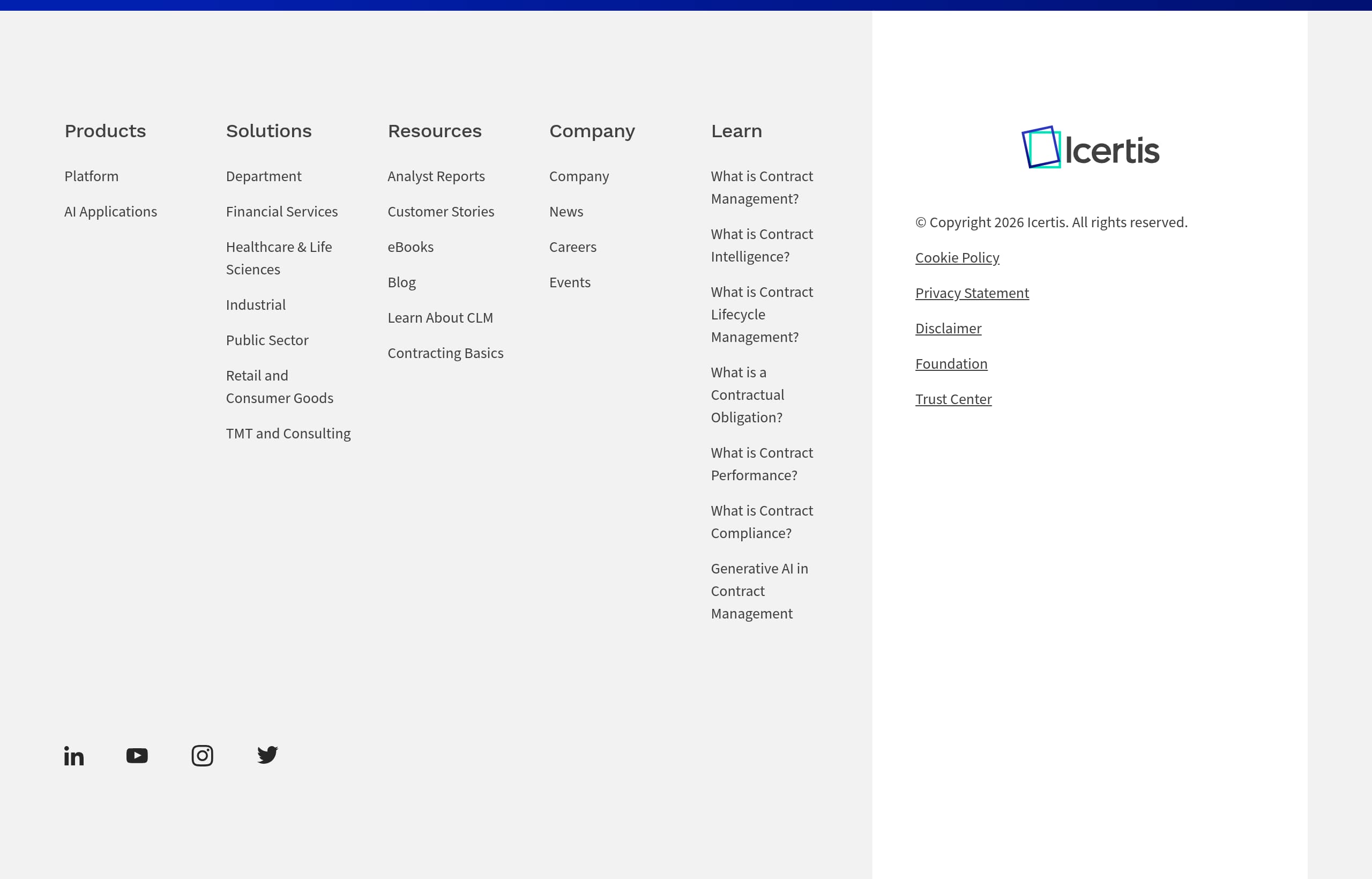
The Icertis footer is built for enterprise diligence: it prioritizes governance links, educational resources, and clear corporate navigation, which supports late-stage evaluation and procurement requirements. Based on the screenshot and excerpt, the footer is dense, but it is organized into columns that mirror the top navigation.
What is included and why it converts
The footer repeats major site categories, including Products, Solutions by industry, Resources (Analyst Reports, Customer Stories, eBooks, Blog, contracting basics), and Company links (News, Careers, Events). This helps users who reach the bottom of long pages re-orient without scrolling back to the header, a subtle but important usability pattern for content-heavy SaaS sites.
Legal and trust hygiene
The presence of Cookie Policy, Privacy Statement, and Disclaimer is expected for enterprise vendors. The explicit Trust Center link is a high-signal addition because it gives security and compliance teams a direct path to validation content. The footer also includes “© Copyright 2026 Icertis,” which indicates the site is actively maintained.
International and experience details
A notable UI element is the language or region handoff notice: “You are now leaving the FR/DE Icertis website and going to .com. Ok Cancel.” This is a practical trust pattern because it prevents disorientation when switching locales. It also implies multi-region site governance, which is relevant for global enterprises.
What could be improved
Because the footer is information-rich, it can become a link farm. Two tactical improvements would increase usefulness: (1) prioritize the most conversion-critical links such as “Request a Demo” and “Contact Us” as visually distinct buttons, and (2) surface a compact set of trust badges or certifications if available in the Trust Center.
Overall, the footer supports enterprise buying by making compliance navigation, research depth, and corporate legitimacy easy to access from any page.
Detected tech stack
Tools and technologies we detected on Icertis's site. Detection is best-effort and may be incomplete.
Scores
Our framework scores for Icertis's website in terms of clarity, conversion, and trust. See our methodology for how we calculate these.
How clear the value prop and structure are.
How conversion-friendly signup and pricing are.
How well trust and compliance are surfaced.
FAQ
The Icertis homepage leads with “Icertis Contract Intelligence” and the promise to “Realize the Full Potential of Every Business Relationship.” It quickly ties the platform to measurable outcomes, including revenue, savings, efficiency, and compliance. Primary actions focus on evaluation, with “Explore Platform” and prominent Demo and Contact options in the header, which matches an enterprise buying motion.
In the provided site excerpt, Icertis does not surface a pricing page in the main navigation and instead pushes visitors toward “Get a Demo” and “Contact.” This strongly suggests custom, sales-led pricing typical of enterprise contract lifecycle management platforms. The site supports that approach by offering analyst reports, customer stories, and platform pillar pages that help buyers build an internal business case before discussing commercial terms.
Icertis organizes the platform into three pillars: Contract Analytics, Contract Operations, and Contract Performance. Analytics focuses on surfacing risk and revenue opportunities across stored contracts, Operations covers creation-to-expiration workflows and authoring assistance, and Performance emphasizes monitoring and acting on obligations and entitlements. The site also productizes AI via Vera-branded components like Vera Copilot and Vera AI Foundation.
Icertis combines multiple forms of proof: a headline claim, “Trusted by a Third of Fortune 100,” analyst validation (Gartner Peer Insights Customers’ Choice, Forrester Wave leader, IDC MarketScape leader), and detailed customer stories. The Microsoft case study is especially concrete, citing 220,000 employees and including a named legal operations leader with a direct quote about simplifying contracting workflows.
The site includes a dedicated Trust Center link in the footer alongside standard legal pages like Privacy Statement and Cookie Policy. While the homepage messaging emphasizes reducing risk and compliance exposure through clause and playbook governance, the most formal trust documentation is likely centralized in the Trust Center. This structure fits enterprise procurement, where security teams need a single destination for assurance materials.

The world's best-performing SaaS businesses share surprisingly similar patterns. We help you learn and apply them through our human-designed methodology, with AI-assisted research.