
Key takeaways
Here are the key insights from our website breakdown analysis of Stonly.
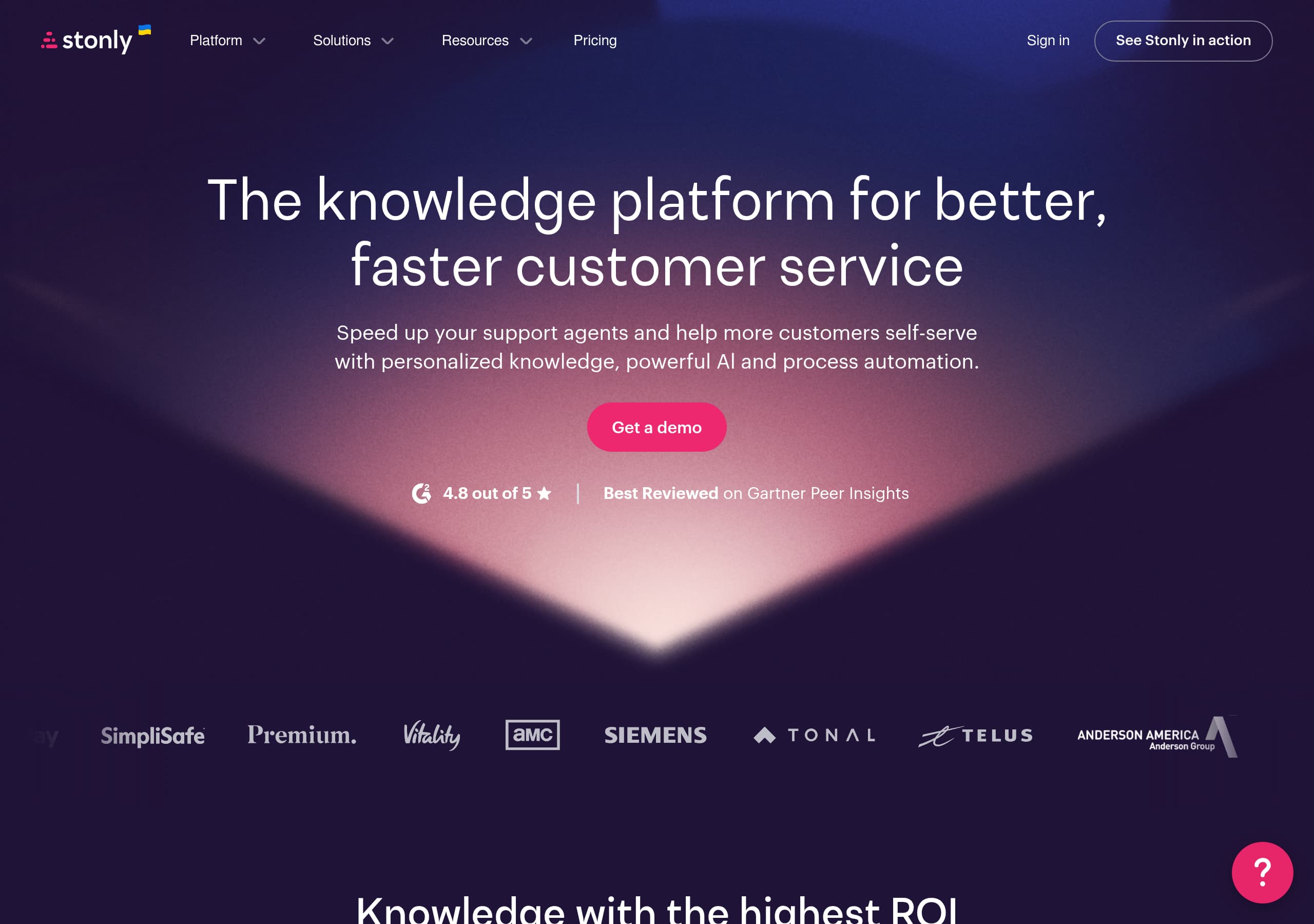
Stonly’s homepage clarifies the product in one line, positioning it as a knowledge platform for customer service that combines personalized knowledge, AI, and process automation, then reinforces it with a single primary CTA, “Get a demo.”
The site sells outcomes with numbers and roles, including “80% Decrease in support tickets,” “20% Reduction in resolution time,” and named customer quotes, which makes the value proposition easier to justify internally.
Stonly differentiates from generic knowledge bases by repeatedly emphasizing interactive guides and in-workflow agent guidance, not just articles, which aligns with the “complex processes correctly every time” promise.
Integration credibility is a conversion lever: the homepage explicitly lists Zendesk, Freshdesk, Salesforce, and ServiceNow, reducing perceived implementation risk for support ops buyers.
The AI story is anchored in knowledge quality, with claims like “verified, structured knowledge” and an “API preserves your guide structure,” which helps the AI positioning feel operational, not hype-driven.
Pricing appears designed for sales-led conversion, steering visitors to a demo rather than self-serve checkout, which fits enterprise support and contact center procurement but may reduce conversion for SMBs seeking instant transparency.
Home
Stonly’s homepage succeeds because it states the category and outcome immediately, then supports it with quantified proof and clear next steps. The hero headline, “The knowledge platform for better, faster customer service,” is paired with a concrete subheader about personalized knowledge, AI, and process automation, plus a single dominant CTA, “Get a demo.” This combination reduces interpretation work for customer support leaders evaluating knowledge management tools.
The structure reads like a customer service playbook:
- A credibility strip appears early with “4.8 out of 5 Best Reviewed on Gartner Peer Insights,” which functions as an external validator before feature claims.
- Outcome metrics are repeated in a carousel style pattern, including “80% Decrease in support tickets” and “20% Reduction in resolution time,” each tied to a named role and quote, which makes the results feel operational rather than marketing-only.
- A numbered section (“1 2 3”) frames the product story as a process, starting with creating “articles and interactive guides” that work “10x better than a standard knowledge base.”
Stonly also uses integration specificity as a friction reducer. The homepage explicitly shows “See how Stonly integrates with: Zendesk, Freshdesk, Salesforce, ServiceNow, and “Other platforms,” which answers a key buyer question without forcing a navigation jump.
Finally, the AI positioning is grounded in knowledge governance. Instead of generic AI copy, Stonly mentions Conversational AI Bot, AI Agent Assist, and an API that “preserves your guide structure so LLMs perform better,” which signals that the AI layer depends on verified content and workflows, not just a chat widget.
Pricing
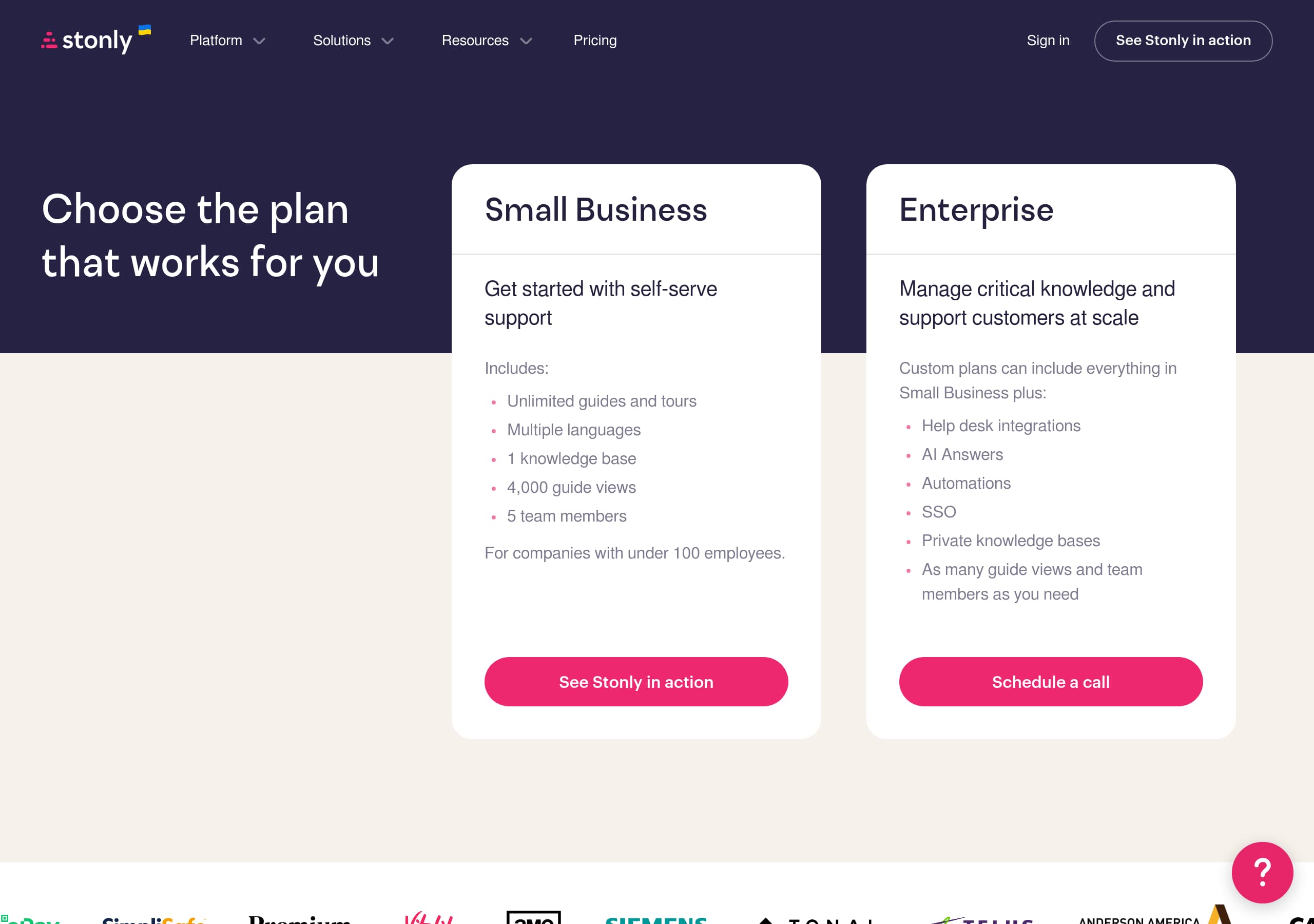
Stonly’s pricing approach appears optimized for sales-led conversion and qualification, not instant self-serve checkout. From the pricing screenshot and navigation context (Pricing in the top menu, plus repeated “Get a demo” CTAs), the site prioritizes moving serious buyers into a demo conversation, which fits the product’s positioning for customer service, contact centers, and multi-tool environments.
What this does well for conversion:
- The site sets expectations that Stonly is a platform, not a lightweight plugin, by surrounding pricing access with platform-level language like “Knowledge Management For Customer Service” and extensive capability lists. This supports higher willingness to pay.
- It reinforces ROI language near the top of the funnel, including “Knowledge with the highest ROI,” so pricing is framed against outcomes like fewer tickets and faster resolution.
- The presence of multiple modules in navigation (Interactive Guides, Knowledge Base, AI Answers, The Widget, Checklists, Contact Forms) implies packaging flexibility, which is common for enterprise pricing and makes a demo a logical next step.
Where pricing could be clearer for evaluators:
- If the pricing page is primarily a lead capture or tier comparison without explicit numbers (as suggested by the overall demo-first pattern), some SMB buyers will bounce because they cannot quickly estimate budget.
- Because integrations are a core decision factor, pricing benefits from explicitly stating what is included per tier for Zendesk integration, Salesforce integration, or ServiceNow integration, rather than leaving it to sales.
Net result: Stonly’s pricing experience likely converts well for enterprise and mid-market support ops buyers who expect procurement steps, but it risks losing demand from teams that prefer transparent, card-on-file trials.
Features
Stonly’s features section is built to communicate breadth and operational maturity, not just a few headline capabilities. The site lists a large “Everything you need to manage knowledge at scale” inventory, including Versioning, Access Rights, Workflow Editor, Scheduled Publishing, Content Health, SEO Optimization, and Custom Reporting. This reads like a knowledge operations checklist, which is persuasive for teams migrating from ad hoc documentation.
Two feature patterns stand out:
- Stonly splits value by audience and workflow. There are explicit modules for Support Agent Knowledge and Customer Self-Service, each with outcome metrics like “42 Faster Resolution Time” and “72 Fewer Agent Errors” for agents, plus “80 Decrease In Support Tickets” and “65 Higher First Touch Resolution” for self-service. Even if the units are not shown in the excerpt, the segmentation helps buyers map features to KPIs.
- Product capability is framed as more than articles. Stonly repeatedly highlights interactive guides and step-by-step knowledge “right where agents need it,” positioning it closer to guided decision trees than a static knowledge base.
The AI feature story is integrated rather than bolted on. The page calls out Conversational AI Bot for customer-facing answers and AI Agent Assist for ticket summarization, path suggestions, and response generation. It also adds a technical differentiator: an API that “preserves your guide structure so LLMs perform better,” which implies the underlying content model is structured.
One improvement opportunity is simplifying scanning. The long feature list signals robustness, but without grouping (Governance, Authoring, Analytics, Localization) it can overwhelm. Still, for enterprise buyers, the visible presence of governance controls like access rights, review flows, and analytics makes Stonly feel deployable at scale.
Signup
Stonly’s signup experience is clearly sales-led: the dominant next step across the site is “Get a demo,” plus a secondary “See Stonly in action” in the header. This aligns with the product’s likely implementation path, integrations into Zendesk or Salesforce, and multi-stakeholder buying committees. It also reduces the risk of a low-quality trial experience for a knowledge platform that depends on content, workflows, and data.
From a conversion design standpoint, Stonly makes a few deliberate choices:
- The primary CTA is consistent across the homepage and supporting sections, so visitors do not have to decide between competing actions. This “single primary action” pattern is common in enterprise SaaS.
- The site pre-qualifies prospects with use-case navigation, including “Customer Knowledge Base,” “AI Chatbot,” “Self-Serve Troubleshooting,” and “Support Agent Decision Trees.” That helps the demo request come with context, which can shorten sales cycles.
- Integration mentions (Zendesk, Freshdesk, Salesforce, ServiceNow) work as signup accelerators because they answer “Will this fit our stack?” before a form is started.
The tradeoff is that teams who want to test quickly may not see an obvious product-led path. There is a “Sign in” link, but the excerpt does not show a “Start free trial” CTA or self-serve workspace creation. If the demo form is the only route, Stonly should make the demo promise concrete, for example “30-minute walkthrough tailored to your helpdesk,” or “bring 3 tickets, leave with a working guide.”
Overall, Stonly’s signup flow likely performs best for mid-market and enterprise support organizations that expect a guided evaluation. It may underperform for smaller teams that prefer immediate sandbox access and transparent onboarding steps.
Trust
Stonly builds trust primarily through outcomes, third-party validation, and operational feature depth, rather than leading with security badges. The page uses credibility markers like “4.8 out of 5 Best Reviewed on Gartner Peer Insights” and the phrase “Knowledge with the highest ROI,” then backs it with quantified customer results such as “71% self-serve success rate” and “92% accuracy in responses.” These numbers, presented near AI messaging, help reduce skepticism around AI answer quality.
Trust is also implied through governance and scale features that sophisticated buyers look for:
- Knowledge control: Versioning, Access Rights, Workflow Editor, and Review Flows suggest auditable publishing and restricted content permissions.
- Analytics and feedback loops: User-level Analytics, Pageview Analytics, Feedback, and Custom Reporting indicate the platform supports continuous improvement, not set-and-forget documentation.
- Localization readiness: Auto-Translate appears in the feature list, signaling suitability for global support teams.
Stonly’s AI trust positioning is notably cautious and structured. Phrases like “verified, structured knowledge” and an API that “preserves your guide structure so LLMs perform better” imply the company is aware of hallucination risk and is trying to control inputs. Mentioning both Conversational AI Bot and AI Agent Assist also clarifies that AI is used in multiple contexts, customer-facing and agent-facing.
What is less visible in the provided excerpt is classic security and compliance information (SOC 2, ISO 27001, GDPR details, data residency). Those may exist elsewhere, but they are not prominent here. For enterprise procurement, adding a visible “Security” link near navigation or in-page trust section can reduce late-stage friction. As shown, Stonly’s trust posture is strong on proof and governance, lighter on explicit compliance signaling.
Footer
Stonly’s footer is structured to support both conversion and due diligence. It includes clear company navigation (About us, Jobs), product navigation (Platform, Solutions, Resources), and legal links, which helps buyers, security reviewers, and implementers find what they need without returning to the header. The presence of “© 2026 Stonly. All rights reserved.” plus Terms & Conditions, Privacy Policy, and Legal Notice provides baseline legitimacy and procurement readiness.
From the screenshot and excerpt, the footer also reinforces information architecture:
- Platform capabilities are listed explicitly, including Interactive Guides, Knowledge Base, AI Answers, The Widget, Checklists, Contact Forms, Guided Tours, and Surveys. This acts like a secondary sitemap for skimmers who scroll.
- Integrations are repeated as first-class items: Zendesk Integration, Salesforce Integration, Freshworks Integration, and ServiceNow Integration. Repeating these in the footer is a smart pattern because integration fit is often confirmed late in the page.
- Use cases and industries are enumerated, including Customer Knowledge Base, AI Chatbot, Self-Serve Troubleshooting, Support Agent Decision Trees, plus industries like Contact Centers, Insurance, Marketplaces, Banks & Financial, and Retail. This supports SEO and helps visitors self-identify.
A strong footer should also reduce trust friction. While legal links are present, there is no visible mention in the excerpt of a security page, status page, or compliance documentation. If Stonly serves regulated industries like banking and insurance (both listed), adding a direct “Security” or “Trust Center” link in the footer would better match that buyer expectation.
Overall, the footer is robust and conversion-aware: it behaves like a comprehensive directory, reinforces integrations and use cases, and supports evaluation workflows, while leaving a small gap around explicit security documentation discoverability.
Detected tech stack
Tools and technologies we detected on Stonly's site. Detection is best-effort and may be incomplete.
Frontend
Scores
Our framework scores for Stonly's website in terms of clarity, conversion, and trust. See our methodology for how we calculate these.
How clear the value prop and structure are.
How conversion-friendly signup and pricing are.
How well trust and compliance are surfaced.
FAQ
Stonly’s homepage leads with a clear category statement, “The knowledge platform for better, faster customer service,” and immediately supports it with proof points like a 4.8/5 Gartner Peer Insights rating and quantified outcomes (ticket reduction, resolution time, training time). It also reduces evaluation friction by naming key integrations like Zendesk, Freshdesk, Salesforce, and ServiceNow and keeping the primary CTA focused on “Get a demo.”
Stonly’s pricing experience appears oriented toward sales-led evaluation rather than instant self-serve purchase. The site consistently emphasizes “Get a demo,” which suggests pricing is likely tiered and dependent on needs like integrations, AI capabilities, and knowledge management scale. This approach fits mid-market and enterprise support teams but can be less convenient for buyers who want immediate, transparent pricing numbers before booking a call.
Stonly repeatedly positions itself beyond static articles by highlighting interactive guides and step-by-step knowledge that helps agents “follow complex processes correctly every time.” The site also connects knowledge to AI, emphasizing verified, structured knowledge and an API that preserves guide structure for better LLM performance. This framing differentiates Stonly from traditional knowledge base tools that focus mainly on publishing and search.
Stonly highlights two AI layers: a Conversational AI Bot for customer-facing answers and AI Agent Assist for internal support workflows. The site claims capabilities like ticket summarization, suggesting the right path to resolution, and generating responses. It also stresses that AI answers are backed by verified, structured knowledge, plus an API that preserves guide structure so external AI providers can perform better.
Stonly explicitly calls out integrations with Zendesk, Freshdesk, Salesforce, and ServiceNow, plus “Other platforms.” These are shown as part of the core product story, not buried in documentation, which helps buyers quickly confirm stack compatibility. The footer repeats key integration pages (Zendesk Integration, Salesforce Integration, Freshworks Integration, ServiceNow Integration), reinforcing that integrations are central to adoption.

The world's best-performing SaaS businesses share surprisingly similar patterns. We help you learn and apply them through our human-designed methodology, with AI-assisted research.