
Key takeaways
Here are the key insights from our website breakdown analysis of HubSpot.
HubSpot positions the HubSpot Customer Platform as an all-in-one, AI-powered suite, then reinforces it with two primary CTAs (“Get a demo” and “Get started free”) to capture both enterprise and self-serve buyers.
The navigation and on-page structure map cleanly to buyer intent: products (Marketing Hub, Sales Hub, Service Hub, Content Hub, Data Hub, Commerce Hub), solutions by use case, and team size (SMB vs enterprise).
Quantified outcomes are used repeatedly (e.g., 129% more leads, 36% more deals, 37% ticket closure; “288,000 customers in 135+ countries”; “Voted #1 in 526 G2 Reports”), making claims easy to cite and remember.
HubSpot’s AI narrative is concretized with named capabilities (Breeze, Breeze Agents) and specific performance language (e.g., “resolve over 65% of customer inquiries”), which reduces ambiguity around “AI-powered.”
Trust is built with layered proof: integration depth (“2,000+ integrations”), enterprise-style resources (case studies, product updates), and a footer packed with education, partner programs, and support pathways.
Home
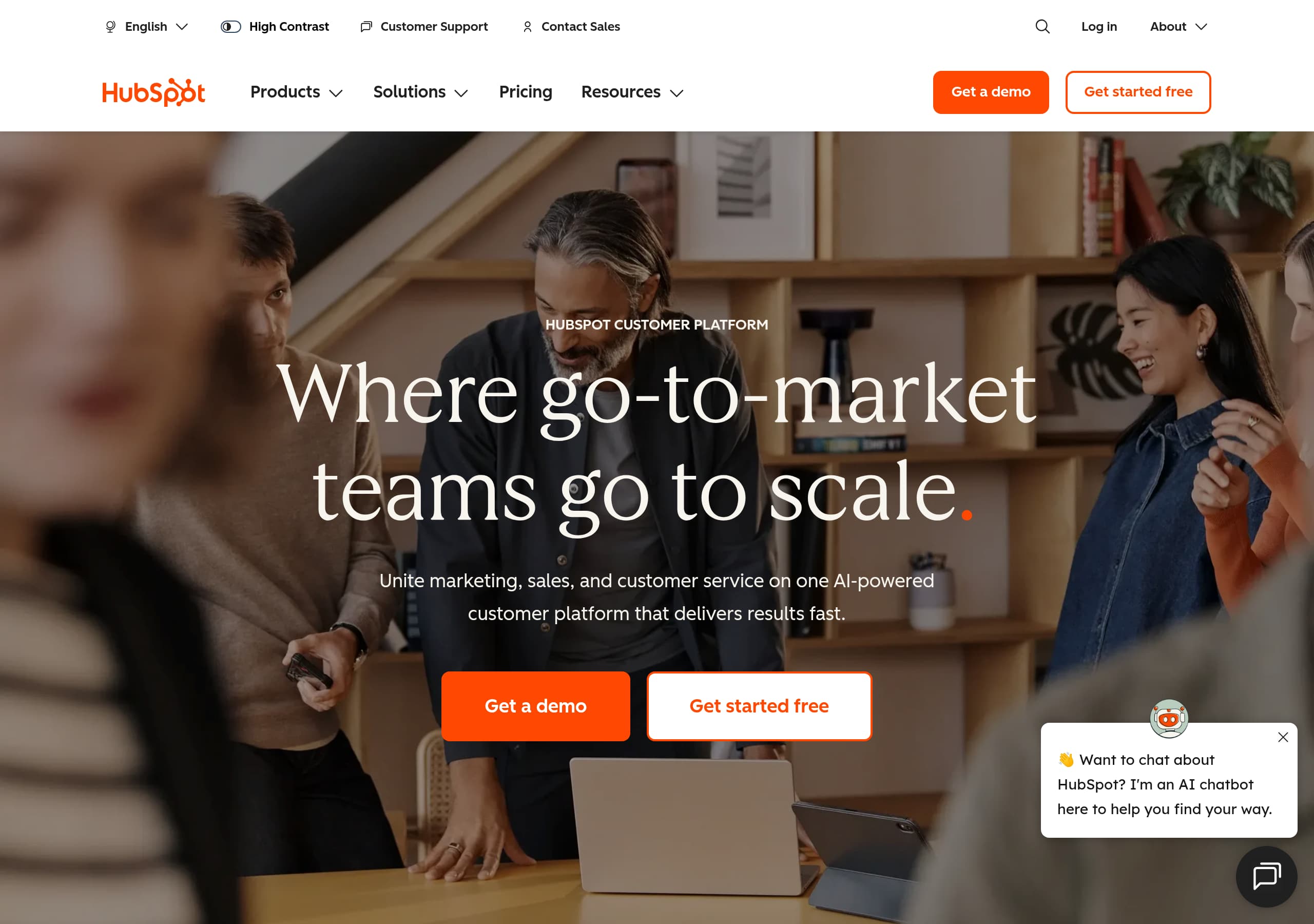
HubSpot’s homepage makes the HubSpot Customer Platform legible in seconds by pairing a single, outcome-led line with two conversion paths.
- The hero message focuses on unifying marketing, sales, and service “on one AI-powered customer platform,” which matches common go-to-market team structure.
- Two primary CTAs—Get a demo and Get started free—support both enterprise evaluation and self-serve adoption without forcing a choice of pricing tier first.
The page quickly substantiates breadth with a platform breakdown: Smart CRM (as “single source of truth”), the core hubs (Marketing Hub, Sales Hub, Service Hub, Content Hub, Data Hub, Commerce Hub), and the AI layer (Breeze and Breeze Agents).
Quantified scale (“288,000 customers in 135+ countries”) and a “Powered by AI” narrative appear above the fold, while the use-case navigation (“Generate leads,” “Close deals,” “Scale support”) keeps the story anchored to outcomes rather than features.
Pricing
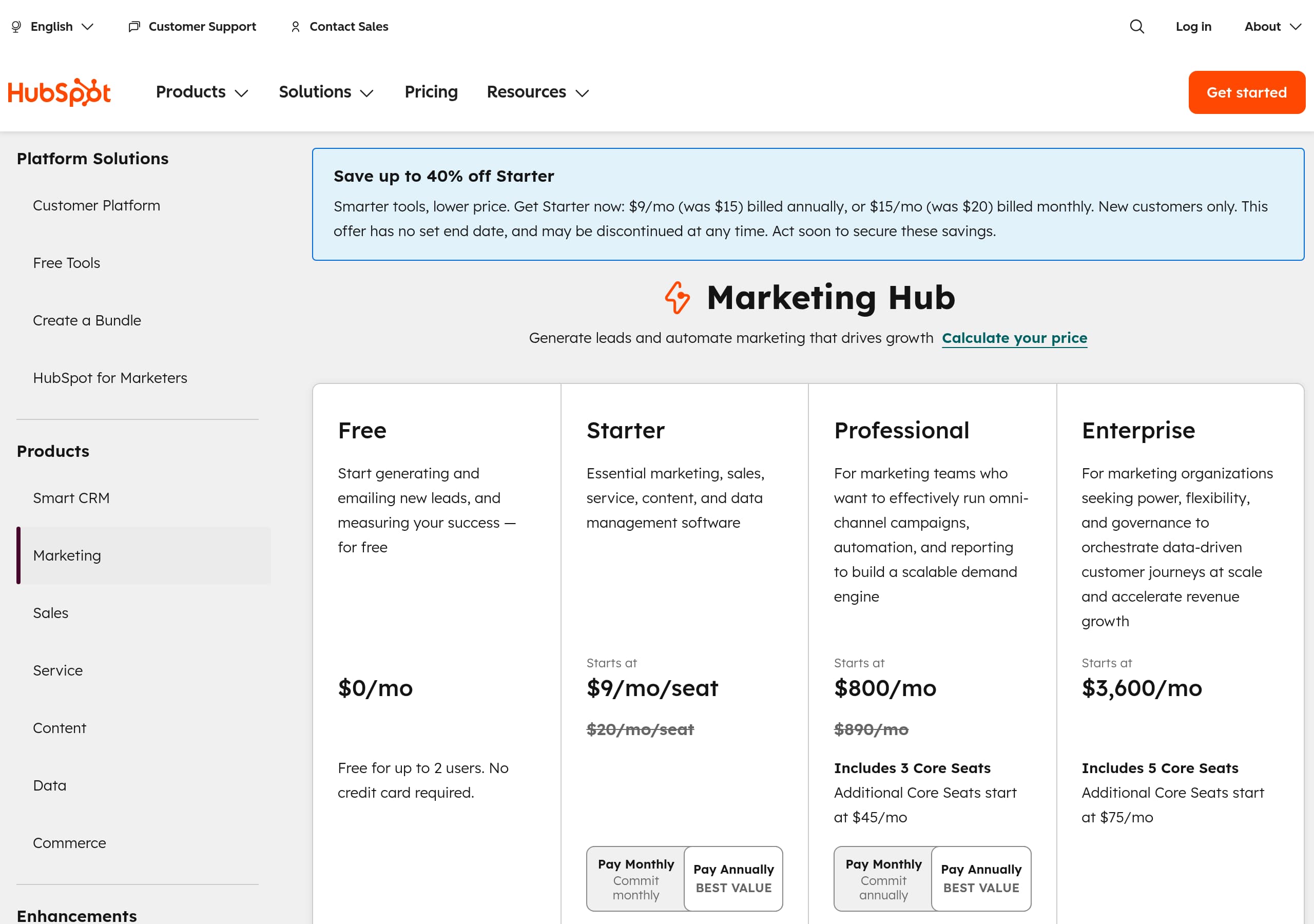
HubSpot’s pricing experience is optimized for a suite by structuring evaluation around product families and upgrade paths rather than a single flat plan.
- The top navigation exposes “Free and premium plans” for each hub, setting expectation that buyers can start with free tools and expand into paid tiers.
- Packaging like the Small Business Bundle reduces decision fatigue by offering “the Starter edition of each product” at one price, a common friction point for multi-hub purchases.
In practice, HubSpot uses the site-wide dual CTA pattern—Get a demo vs Get started free—to route buyers into either sales-assisted quotes (enterprise) or self-serve onboarding.
For a product that competes with Salesforce, Zoho CRM, and Pipedrive + add-ons, the key pricing win is clarity on scope: CRM + marketing + service + content + data + commerce are framed as modular, but consistently connected through Smart CRM and platform AI (Breeze).
Features
HubSpot’s feature presentation works because it is organized by buyer mental models: teams, outcomes, and modules that snap together.
- The product grid names the full suite—Marketing Hub, Sales Hub, Service Hub, Content Hub, Data Hub, and Commerce Hub—and each item includes a one-line outcome (e.g., “personalize content,” “accelerate revenue growth,” “customer health scores”).
- The platform story is anchored by Smart CRM as the “single source of truth,” which explains how modules share data instead of behaving like separate apps.
AI is treated as a platform capability via Breeze and Breeze Agents, with clear agent categories (Customer Agent, Prospecting Agent, Data Agent) and concrete tasks.
An integration claim—“2,000+ integrations”—functions as a feature amplifier: it implies HubSpot fits existing stacks (email, calendars, support tools) without migration being the first hurdle. The result is a suite that feels navigable, not bloated.
Signup
HubSpot reduces signup friction by consistently offering a self-serve entry point alongside sales-led evaluation.
- The persistent pairing of Get started free with Get a demo routes visitors into the right motion without forcing them through a single funnel.
- The existence of “Free HubSpot CRM” and multiple “Free and premium plans” cues a low-risk starting point, especially for startups and small businesses.
The site also supports onboarding readiness through adjacent resources that help users activate after signup: templates, free tools (e.g., Website Grader, Meeting Scheduler), and education (courses and certifications). That ecosystem reduces the “now what?” moment that often follows account creation.
For higher-consideration buyers, HubSpot adds alternative conversion paths—Contact Sales, Customer Support, and partner programs—so procurement-heavy teams can engage without pretending to be self-serve. This dual-path design is particularly effective for a multi-product platform like the HubSpot Customer Platform.
Trust
HubSpot builds trust with a mix of scale signals, third-party validation, and operational readiness cues embedded directly in navigation and page structure.
- Scale is explicit: “288,000 customers in 135+ countries.”
- Independent authority is highlighted with “#1 in 526 G2 Reports,” a recognizable review marketplace for B2B software.
Operational trust is supported by visible enterprise pathways: Customer Support, Contact Sales, case studies, product updates (“semi-annual product showcase”), and extensive documentation-style resources (Knowledge Base, developer tools). The “Works with the tools you already use” message plus “2,000+ integrations” reduces perceived lock-in and migration risk.
AI trust is handled comparatively well because the site provides bounded claims (e.g., resolving “65% of inquiries”) and named components (Breeze, Breeze Agents) rather than vague “AI inside” language.
While the excerpt doesn’t show explicit security/compliance badges, the overall trust stack is strong for GTM teams evaluating a platform switch.
Footer
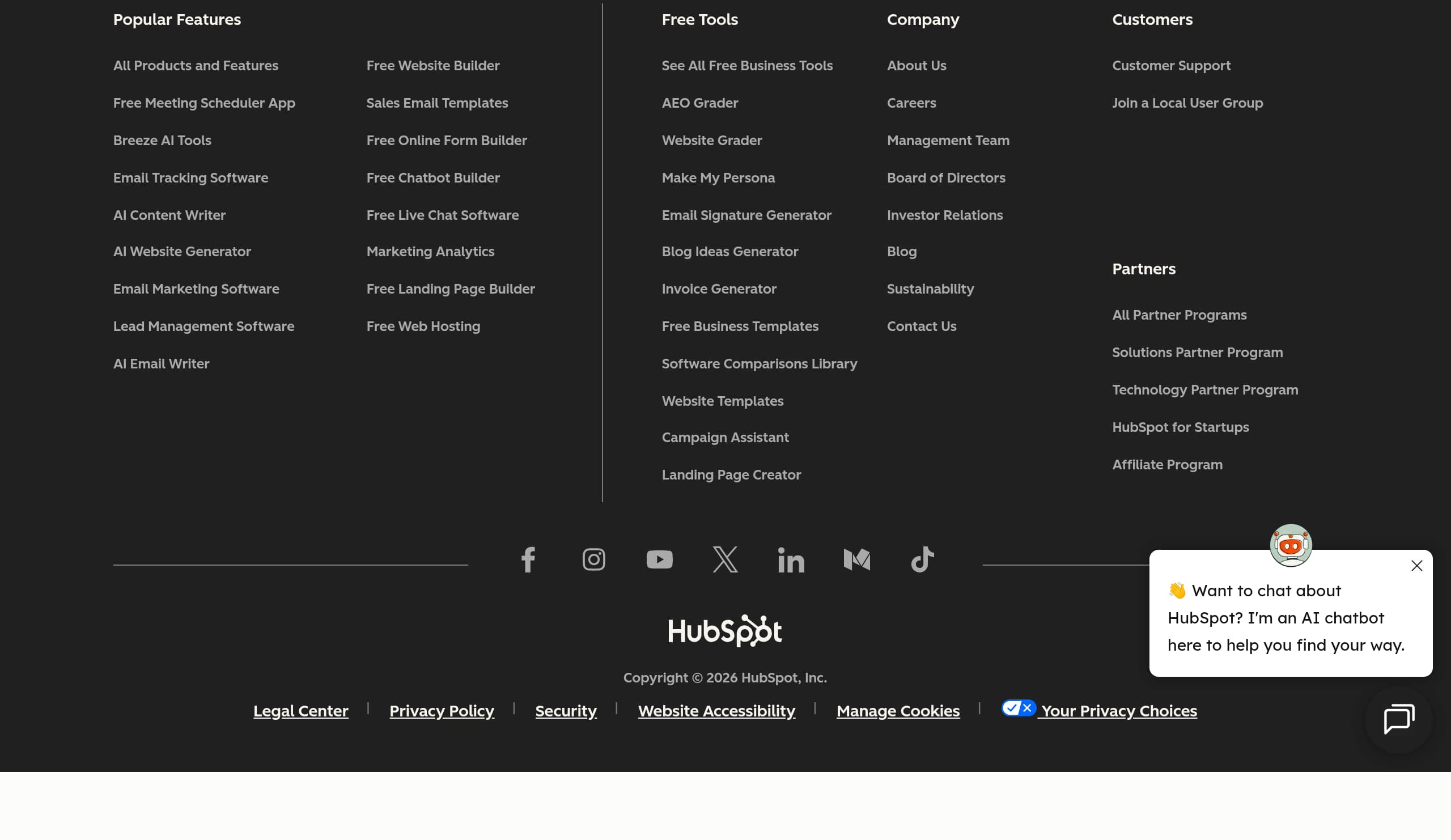
HubSpot’s footer functions as a high-intent navigation hub that supports evaluation, implementation, and long-term success.
- It surfaces Products (the HubSpot Customer Platform, Free HubSpot CRM, each hub) so visitors can re-orient without returning to top navigation.
- It emphasizes Resources breadth—blogs, free courses & certifications, ebooks/guides, Knowledge Base—serving both buyers and new users.
Trust and ecosystem depth show up through partner infrastructure: Solutions Partner Program, Technology Partner Program, Affiliate Partner Program, and education-focused programs (including Startup Partner Program). This signals that HubSpot expects complex deployments and has an enablement network.
Services like Onboarding, Customer Training, Migration, and consulting offerings reduce perceived adoption risk for teams switching from alternatives like Salesforce or fragmented point tools.
Finally, corporate links (About Us, Careers, Investor Relations, Management Team) add legitimacy for enterprise procurement teams that vet vendor stability.
Detected tech stack
Tools and technologies we detected on HubSpot's site. Detection is best-effort and may be incomplete.
Scores
Our framework scores for HubSpot's website in terms of clarity, conversion, and trust. See our methodology for how we calculate these.
How clear the value prop and structure are.
How conversion-friendly signup and pricing are.
How well trust and compliance are surfaced.

The world's best-performing SaaS businesses share surprisingly similar patterns. We help you learn and apply them through our human-designed methodology, with AI-assisted research.