
Key takeaways
Here are the key insights from our website breakdown analysis of Klaviyo.
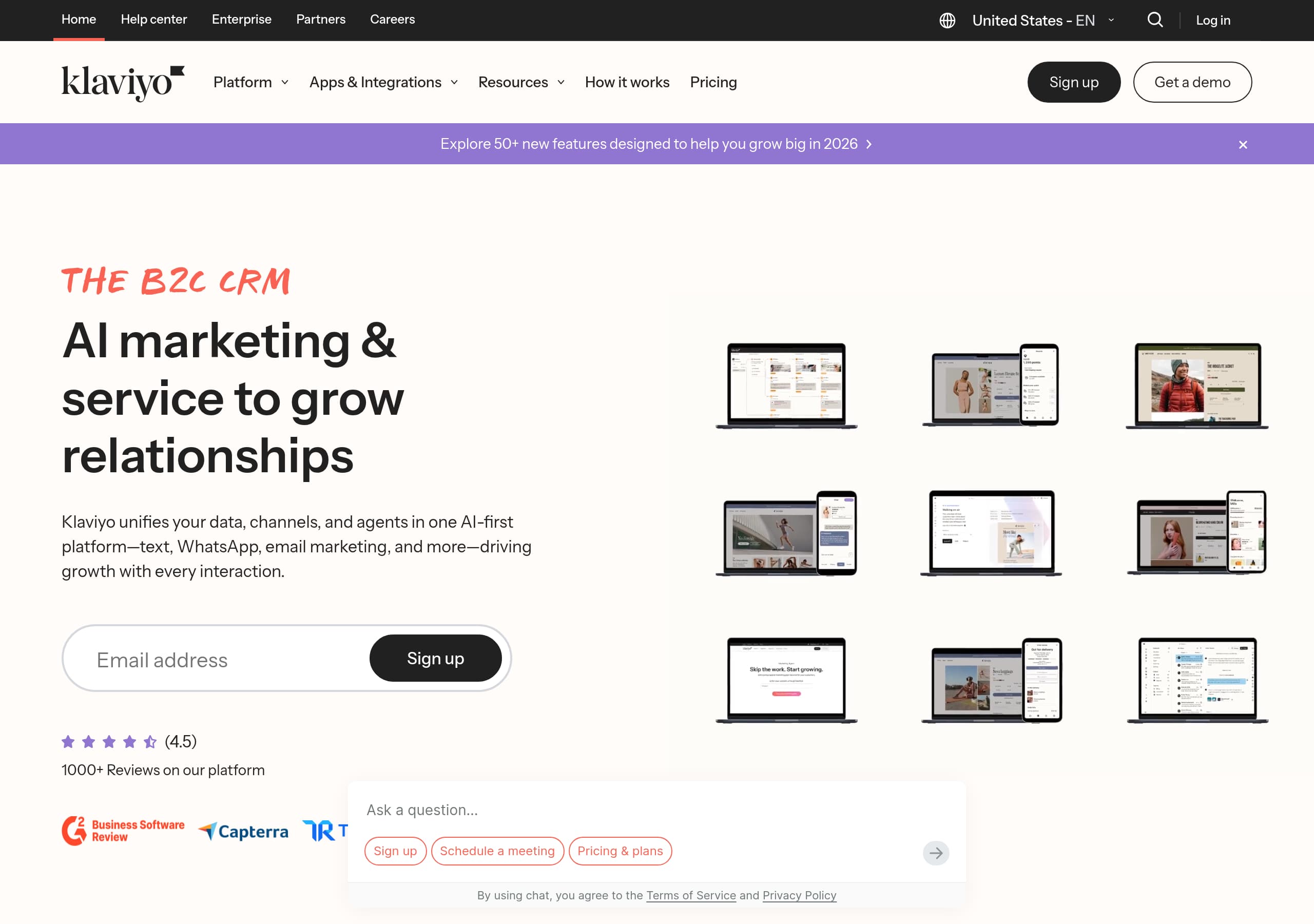
Klaviyo’s homepage clarifies its positioning quickly by combining a category label ("The B2C CRM") with an outcomes-based promise ("unifies your data, channels, and agents") and a clear primary CTA to "Sign up".
The navigation is built for buyers at different stages, with distinct paths for Platform, Solutions, Channels, and Top Products + Features, which reduces time-to-relevance for ecommerce, retail, and B2C teams.
Klaviyo uses AI as a concrete product surface, not a vague claim, by naming K:AI plus role-based agents (Marketing Agent and Customer Agent) and pairing them with dedicated CTAs like "Try Marketing Agent now".
Social proof is anchored in scale ("Powering 193,000+ relationship-driven brands") and reinforced with multiple attributed testimonials, which helps validate both market adoption and real-world outcomes.
Conversion is supported by consistent dual CTAs ("Sign up" and "Get a demo") across the header and hero, letting self-serve and enterprise buyers choose their preferred motion without extra steps.
Trust is treated as a first-class information need through a dedicated Trust centre, plus explicit Security links in the footer, which is especially important for CRM, messaging, and data platform positioning.
Home
Klaviyo’s homepage wins by making the category and scope explicit in the first viewport: “The B2C CRM” plus “AI marketing and service through WhatsApp and more” tells visitors this is not just email software.
What the hero communicates (and why it converts)
The hero sentence stacks three concrete pillars: data, channels, and agents: “Klaviyo unifies your data, channels, and agents in one AI-first platform, text, WhatsApp, email marketing, and more.” That structure reduces ambiguity for ecommerce and B2C teams comparing Klaviyo vs. Mailchimp, Attentive, Brevo, or Salesforce.
You also get immediate action choices:
- Primary CTA: “Sign up” for self-serve
- Secondary exploration: “Try Marketing Agent now” and “Learn about AI agents” for AI-led interest
Navigation that matches how B2C teams shop
The top nav is segmented into Platform Overview, Solutions, Channels, and Top Products + Features. This is a strong UI pattern because it maps to real buyer questions, for example “Do you support WhatsApp?” vs “Do you have a CDP?” vs “What is your helpdesk?” The presence of “NEW” labels on Omnichannel Marketing, RCS Marketing, WhatsApp marketing, Social marketing, and multiple service components adds recency and encourages re-evaluation.
Proof and context placed near the fold
Right after positioning, the page includes “Powering 193,000+ relationship-driven brands”, then breaks the platform into four pillars: Marketing, Service, Analytics, Data Platform. The page also promotes high-intent content like the “2026 Marketing Benchmarks Report,” which supports evaluation without forcing a demo first.
Pricing
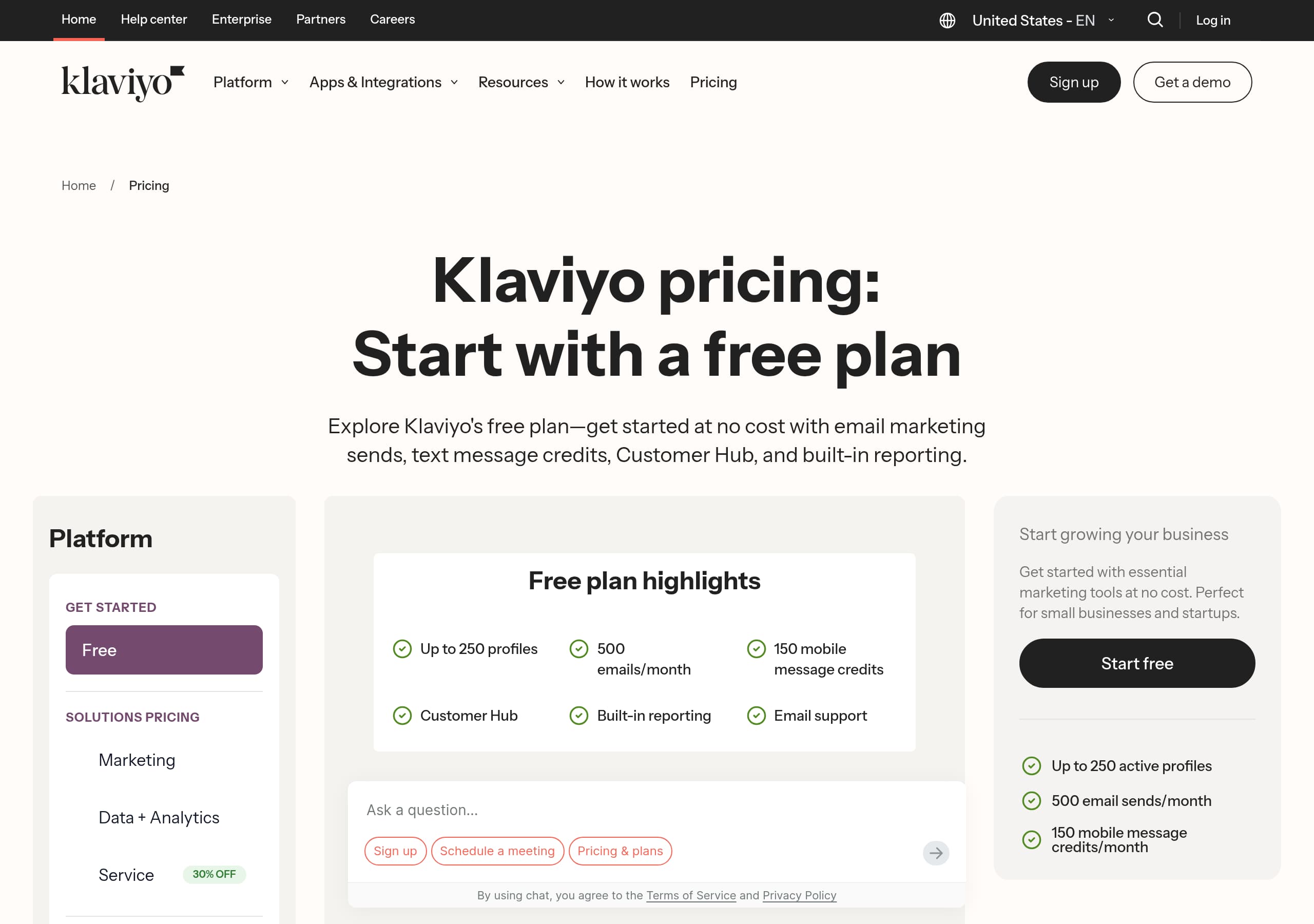
Klaviyo’s pricing presentation is designed to move users from curiosity to a plan decision by tying costs to the same objects the product emphasizes elsewhere—channels, profiles, and platform modules—while keeping the path to purchase close to the top navigation.
What the pricing page needs to accomplish for Klaviyo
Because Klaviyo positions as a B2C CRM with multiple product lines (Marketing, Service, Analytics, Data Platform), pricing must answer two questions quickly: what is the entry point, and what changes as you add channels like Email, SMS, and WhatsApp. The site supports this by keeping “Pricing” in the global header and reinforcing “See pricing” from the homepage, which is important for comparison-driven searches like “Klaviyo vs Mailchimp price.”
Conversion mechanics visible in the UI
From the provided pricing screenshot, the page layout prioritizes selection and estimation rather than a long sales narrative. The structure appears to guide visitors through plan options and usage considerations, which fits a messaging platform where cost commonly scales with contacts, messages, or profiles. This is a good match for self-serve because it reduces reliance on sales just to understand ballpark cost.
Tactically, the strongest pricing patterns for this product category are present or implied:
- A clear route to start: “Sign up” remains a primary action across the site
- A route for complex needs: “Get a demo” supports enterprise and multi-brand requirements
- Strong product modularity: pricing can align to platform modules like Klaviyo Marketing or Klaviyo Service
Where pricing could be even clearer
Given the breadth of the platform, the page should keep emphasizing what is included by default vs add-ons (for example, whether AI agents are bundled or tiered). Klaviyo’s navigation already segments products well, so mirroring that segmentation in pricing tables or toggles is the most direct way to reduce confusion and improve checkout readiness.
Features
Klaviyo’s feature presentation works because it organizes a broad platform into clear product “pillars” and then drills into specific, named capabilities that match how B2C teams actually execute campaigns and support.
Clear platform architecture, not a feature dump
The homepage breaks the platform into four major products with one-sentence outcomes:
- Klaviyo Marketing: “Marketing that carries the conversation”
- Klaviyo Service: “Service that solves and sells”
- Klaviyo Analytics: “Know what’s working and fix what’s not, without the noise”
- Klaviyo Data Platform: unify data for a “360-degree view”
This hierarchy matters because it prevents the common SaaS problem where email, SMS, CDP, and helpdesk features blur together. Instead, visitors can self-identify the module they need.
AI is described as productized roles
Klaviyo AI is branded as K:AI, and the site names specific agents: Marketing Agent and Customer Agent. The copy explains what each does in operational terms, for example the Marketing Agent “analyses your site, learns your brand, and creates content in minutes,” and the Customer Agent “serves customers 24/7” with answers and product suggestions. That concreteness reduces skepticism around “AI marketing platform” claims.
Channel coverage is explicit and modern
Under Channels, the menu calls out Email, SMS, RCS Marketing, Mobile app marketing, WhatsApp marketing, and Social marketing. The presence of RCS and WhatsApp is a competitive signal against email-first platforms, and it aligns with the repeated “omnichannel” framing.
Integration breadth as a feature multiplier
The site emphasizes the Klaviyo App Marketplace and “Integrate with 350+ apps,” which is a core feature for B2C CRM because data unification is only believable when integrations are prominent. The Developers section with API docs reinforces that this is not a closed system.
Signup
Klaviyo’s signup experience is positioned as low-friction by consistently offering self-serve entry points, while still supporting sales-led evaluation through a parallel demo motion.
Dual-path conversion is implemented consistently
Across the header and hero, Klaviyo repeats “Sign up” and “Get a demo”. This matters because Klaviyo serves at least two buyer types:
- Growth marketers and ecommerce operators who want to start immediately
- Enterprise teams who need security review, procurement, and solution design
By keeping both CTAs visible, the site avoids forcing enterprise visitors into a self-serve flow they will abandon, and avoids blocking SMB visitors behind a form.
Signup is reinforced by adjacent “next step” CTAs
Rather than only pushing account creation, the homepage includes intermediate CTAs like “Try Marketing Agent now” and “Learn more” on product cards (Customer Hub, Klaviyo Helpdesk). This is a smart sequencing pattern: visitors can validate a specific feature before committing to signup, which reduces anxiety when the platform scope is large.
Onboarding expectations are set through information architecture
Even without showing the full form flow in the provided screenshots, the navigation suggests how onboarding will work:
- Integrations are emphasized early with 350+ apps, implying a connect-your-store-first setup
- Developers and API docs are linked, implying support for custom events and data
- Resources like Academy, Help centre, and Onboarding and support are surfaced in the main nav, which reduces perceived implementation risk
What would make the signup story even clearer
Because the product spans marketing and service, a first-run selector that asks intent (Email, SMS, WhatsApp, Service, Analytics) would further reduce time-to-value. Klaviyo already does the hard part by naming modules and channels precisely; the final improvement is making that specificity visible inside the first 1 to 2 onboarding steps so users land in the right workflow immediately.
Trust
Klaviyo builds trust primarily through transparent security navigation and by signaling maturity as a data-centric platform, which is essential for a B2C CRM that unifies identities, messaging, and behavioral data.
Trust is discoverable, not buried
The global navigation includes a dedicated Trust centre link described as “Trust and security information.” In SaaS evaluations, the ability to find security documentation in one click is a major procurement requirement, especially for teams integrating customer profiles, segmentation, and messaging across multiple channels.
Compliance and governance are positioned as part of the platform
The footer and platform navigation reference “Klaviyo and GDPR,” which directly addresses a common buyer question for UK and EU visitors. This is a practical trust signal because it frames privacy as part of the product ecosystem, not just a legal document.
Platform claims are supported by operational signals
Several observable elements reinforce that this is an established vendor:
- A large customer count claim, “Powering 193,000+ relationship-driven brands”
- A structured product suite (Marketing, Service, Analytics, Data Platform) that implies organizational depth
- A visible partner ecosystem (Partner directory, Enterprise, Professional services)
Where trust could be strengthened on primary pages
The homepage emphasizes outcomes and AI agents, but it is lighter on immediate, above-the-fold assurance markers. For example, if the hero area also linked to the Trust centre or surfaced 2 to 3 concrete trust artifacts (data processing terms, security certifications, or uptime reporting) it would reduce friction for security-conscious buyers.
Why this trust approach still works
Klaviyo’s trust design is effective because it focuses on fast access to security documentation and privacy-relevant navigation, while letting marketing-led visitors keep their momentum. For a product that competes with Salesforce and other enterprise stacks, making Trust centre and GDPR resources highly visible is a solid baseline for buyer confidence.
Footer
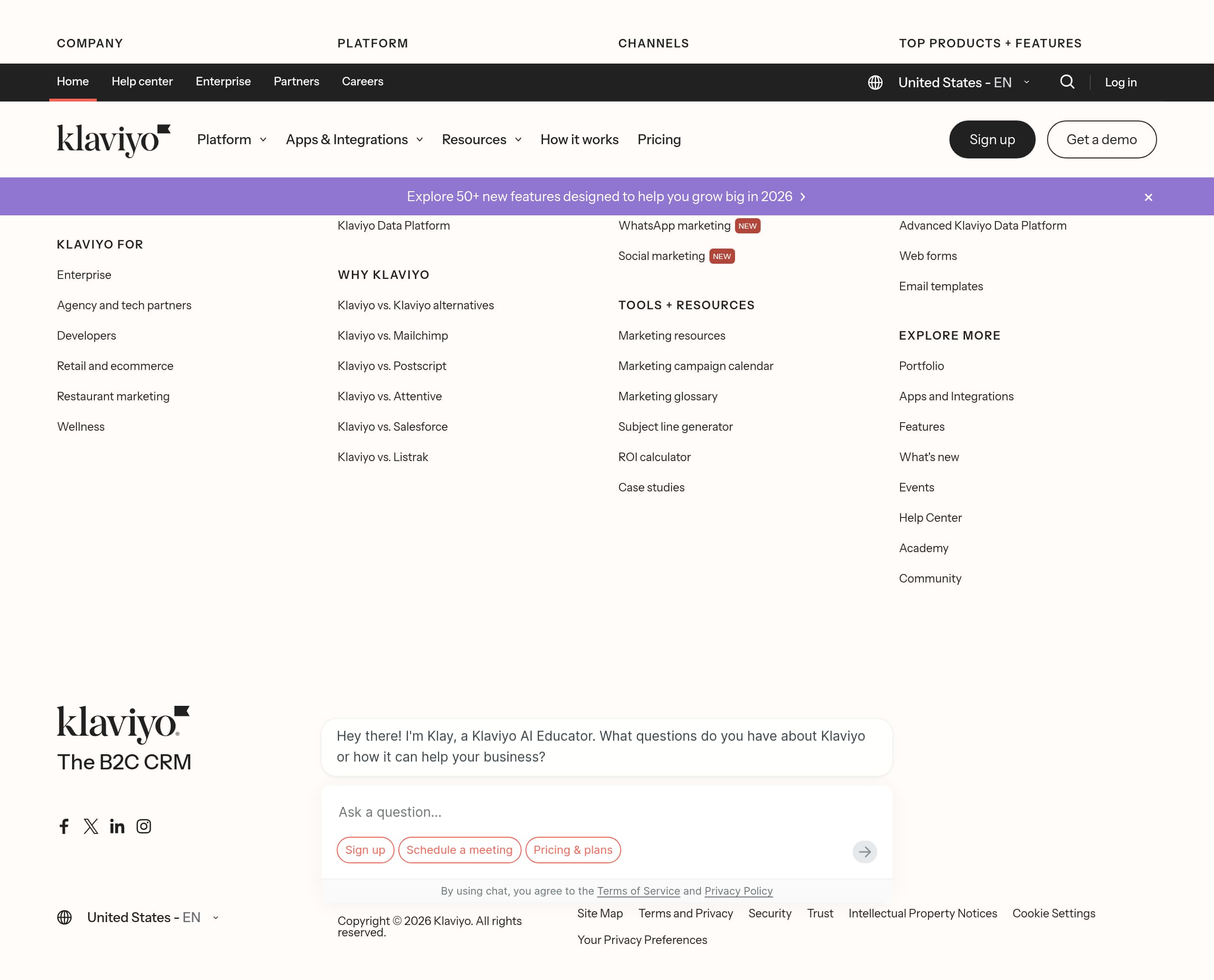
Klaviyo’s footer is doing real conversion and trust work, not just legal housekeeping, by acting like a site map for multiple audiences: buyers, partners, developers, and compliance reviewers.
Strong information scent and segmentation
The footer groups links into clear clusters, including Company (About, Newsroom, Investor relations, Careers), Platform modules (B2C CRM overview, Klaviyo AI, Marketing, Service, Analytics, Data Platform), Channels (Email, SMS, RCS, Mobile app, WhatsApp, Social), and comparison pages like “Klaviyo vs Mailchimp” and “Klaviyo vs Salesforce”. That last set is particularly SEO-effective because it matches high-intent queries and keeps visitors inside Klaviyo’s narrative during evaluation.
Trust and governance are reinforced at the bottom
The footer includes Terms and Privacy, Security, and Trust, plus “Intellectual Property Notices.” This is a clear, procurement-friendly pattern: legal and security reviewers can self-serve without contacting sales. The presence of a Sitemap is also useful for discoverability and crawling.
Audience expansion beyond ecommerce SMB
The footer surfaces “Klaviyo for Agency and tech partners,” “Developers,” and “Enterprise,” and it lists verticals like Retail and ecommerce, Restaurants, and Wellness. This expands the perceived applicability beyond the default “Shopify email tool” stereotype and supports agency-led implementations.
Localization and regional confidence
A region selector is visible (United Kingdom, United States, France, Germany, Spain, Italy, Australia, Singapore). For a messaging platform that touches SMS and WhatsApp, regional context matters, so exposing locale choices in the footer helps set expectations around availability and compliance.
What could be improved
Because the footer is link-dense, the primary actions could be more prominent within the footer area, for example repeating “Sign up” or “Get a demo” as a final step. Even so, the footer’s comparison pages, security links, and developer resources make it a high-utility endpoint for both SEO and user journeys.
Detected tech stack
Tools and technologies we detected on Klaviyo's site. Detection is best-effort and may be incomplete.
Scores
Our framework scores for Klaviyo's website in terms of clarity, conversion, and trust. See our methodology for how we calculate these.
How clear the value prop and structure are.
How conversion-friendly signup and pricing are.
How well trust and compliance are surfaced.
FAQ
Klaviyo leads with a strong category label, “The B2C CRM,” then immediately explains scope: it “unifies your data, channels, and agents” across text, WhatsApp, and email. The page supports this with consistent CTAs (“Sign up” and “Get a demo”) and a simple platform breakdown into Marketing, Service, Analytics, and Data Platform. Visitors can quickly map Klaviyo to their needs without reading long paragraphs.
Klaviyo keeps “Pricing” accessible from the global navigation and reinforces it with “See pricing” on the homepage, which supports comparison-driven shoppers. The pricing UI (from the screenshot) is structured to guide plan selection and usage considerations, which fits a multi-channel platform. It also maintains two conversion paths: self-serve signup for quick starts and demo requests for complex or enterprise evaluations.
Klaviyo names its AI layer as K:AI and describes specific agent roles: Marketing Agent and Customer Agent. The copy explains what they do in practical terms, like analyzing a site, learning a brand, creating content, and serving customers 24/7. The site also pairs AI sections with direct CTAs such as “Try Marketing Agent now,” which makes AI feel like a product feature users can evaluate.
Klaviyo uses a combination of scale and attribution. The homepage states “Powering 193,000+ relationship-driven brands,” then reinforces credibility with multiple customer testimonials that include names and companies, such as ICONIC London, Oatsome, and Avant. The quotes reference concrete benefits like segmentation, analytics, personalization, and automated journeys, which maps directly to the product’s core positioning.
Klaviyo makes security information discoverable through a dedicated Trust centre link labeled for “Trust and security information.” The footer also includes Security plus Terms and Privacy, and the site references “Klaviyo and GDPR,” which is especially relevant for UK and EU buyers. This structure supports self-serve security review and procurement workflows without requiring a sales conversation first.

The world's best-performing SaaS businesses share surprisingly similar patterns. We help you learn and apply them through our human-designed methodology, with AI-assisted research.