
Key takeaways
Here are the key insights from our website breakdown analysis of Amplitude.
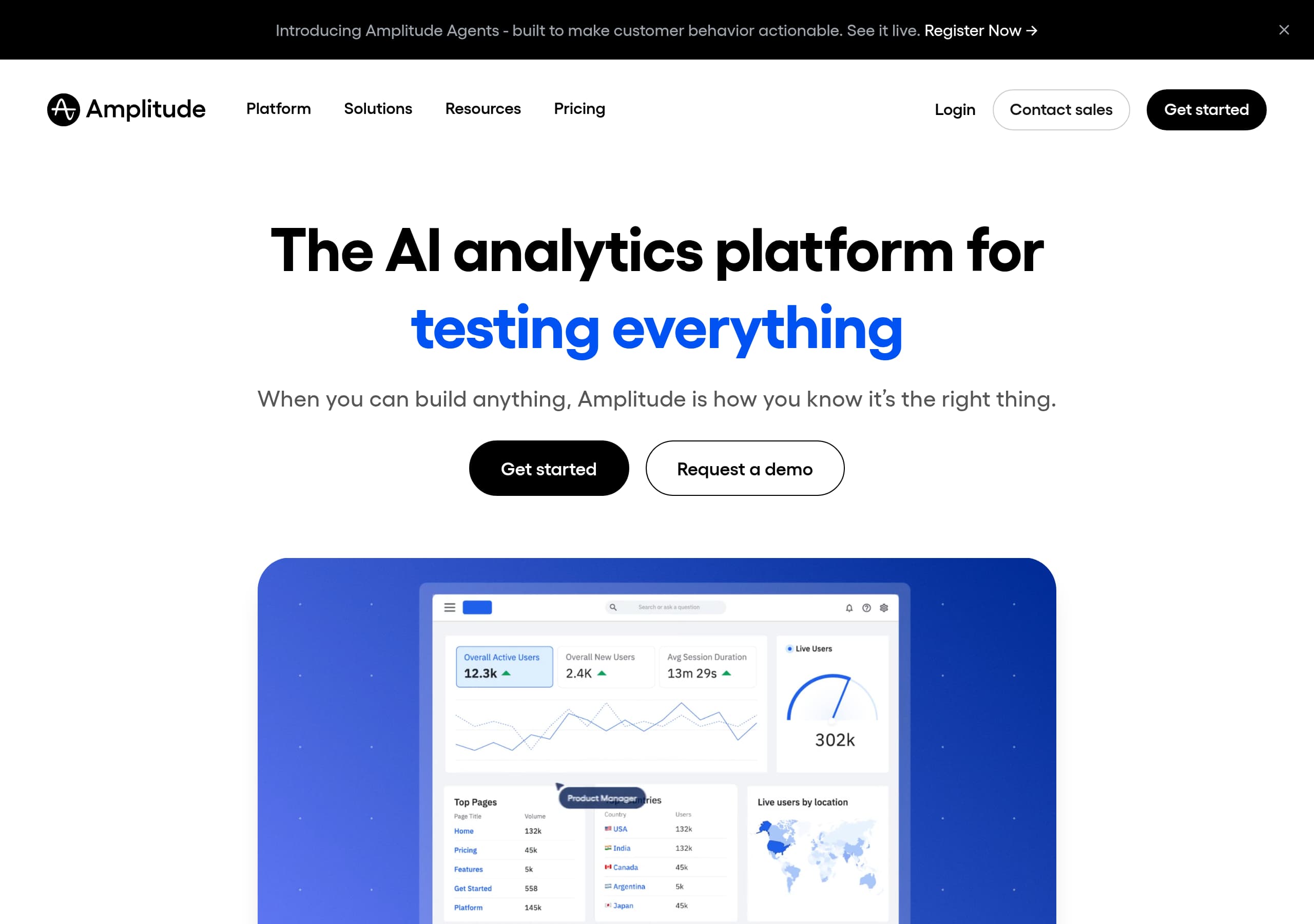
Amplitude’s homepage leads with a clear category position, “The AI analytics platform,” then immediately offers two conversion paths, Get started and Request a demo, which fits both self-serve teams and enterprise buyers.
The navigation and on-page structure reinforce a consolidated platform story across Insights, Action, Data, and Platform AI, reducing “point-solution” confusion while still letting visitors dive into specific modules like Session Replay and Feature Experimentation.
Pricing is optimized for conversion with a tangible free entry point, “Start for free with up to 10K monthly tracked users,” paired with a parallel enterprise motion via custom demos.
Social proof is unusually dense and specific: “Market Leader with 2,500+ reviews,” multiple case studies, named customer quotes, and outcome metrics like “27% conversion lift” and “40% activation increase,” which helps multiple personas validate fit.
Amplitude’s AI positioning is not abstract; it is packaged into named products (AI Agents, AI Visibility, AI Feedback, Amplitude MCP) that map to distinct jobs-to-be-done, making the AI story easier to evaluate and buy.
Trust is strengthened by dedicated Security & Privacy and Data Governance surfaces plus enterprise-grade resource signals (Forrester Wave mention, Gartner Hype Cycle mention), but the site could improve by summarizing compliance and governance claims more explicitly above the fold on key conversion pages.
Home
Amplitude’s homepage is designed to answer one question quickly: “What is this, and how do I buy it?” It does that with a category-level headline, “The AI analytics platform”, and immediate dual CTAs, Get started and Request a demo, which cleanly separates self-serve evaluation from sales-led buying.
What the hero communicates (and why it converts)
- The hero frames a broad promise (“faster answers, testing everything, non-stop optimization”) and then anchors it with a credibility line: “When you can build anything, Amplitude is how you know it’s the right thing.” This clarifies Amplitude’s role as the decision layer for digital products.
- Directly underneath, the trust block stacks multiple proof points: “Trusted by industry leaders” plus “Market Leader with 2,500+ reviews”, reducing perceived risk before the user scrolls into details.
How the page scaffolds the platform story
The information architecture is notably platform-first. The page introduces AI as a product suite: AI Agents, AI Visibility, AI Feedback, and Amplitude MCP, each with “Learn more.” That packaging turns “AI” into evaluable modules rather than marketing haze.
Below that, the homepage maps capabilities into three outcomes, Clearer insights, Faster action, and More trustworthy data, then attaches concrete products to each (Product Analytics, Web Analytics, Session Replay; Feature Experimentation, Web Experimentation, Guides and Surveys; Data Governance, Integrations). This reduces cognitive load because visitors can self-identify which “lane” they need.
What could be clearer
The page lists many products and audiences (Product, Marketing, Data, Engineering, Executive). A small improvement would be an explicit “start here” chooser near the hero, so first-time visitors do not have to infer the best module from a long menu of options.
Pricing
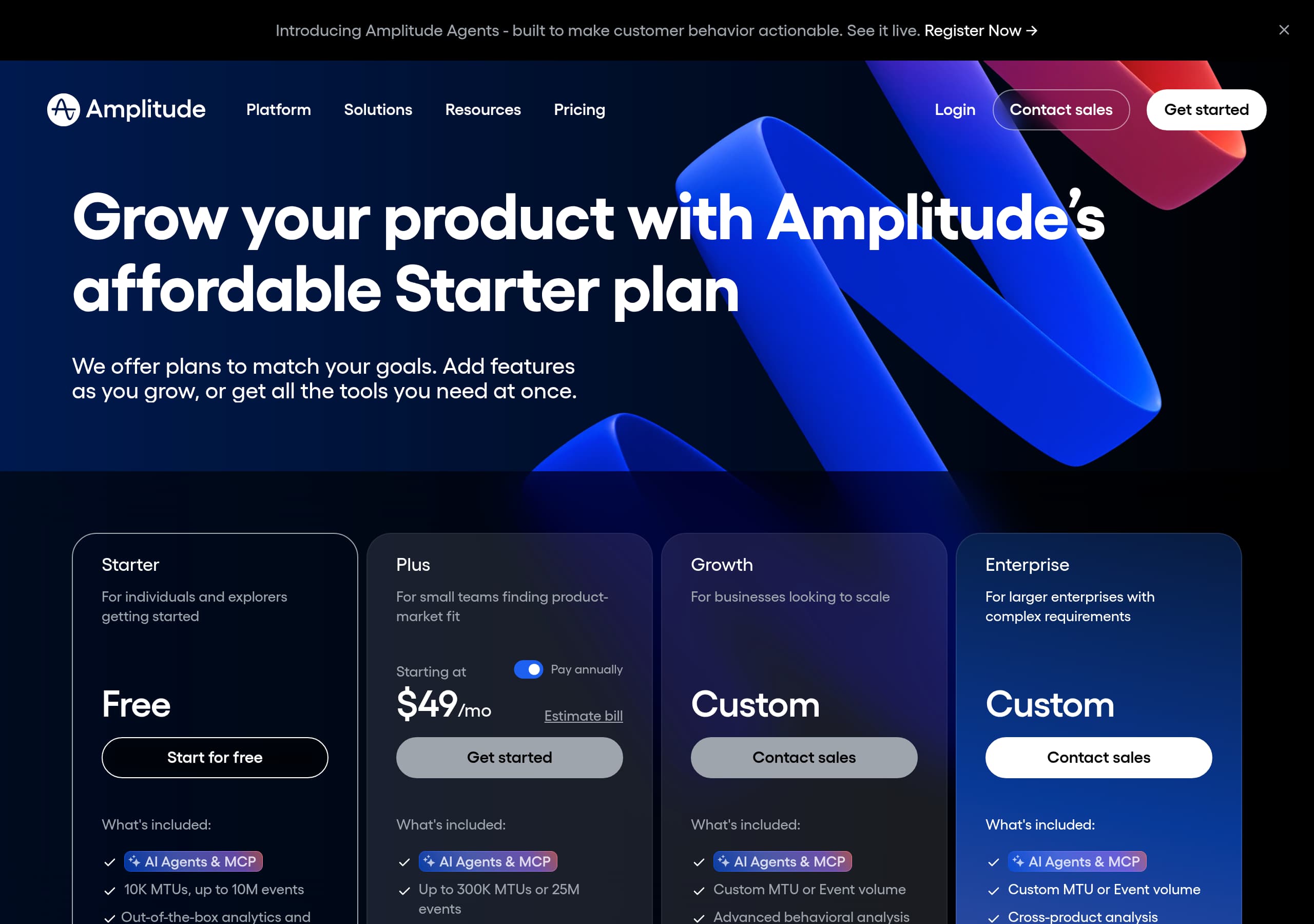
Amplitude’s pricing presentation emphasizes speed to value over exhaustive plan comparison. The most conversion-relevant detail is explicit and numeric: “Start for free with up to 10K monthly tracked users,” paired with a parallel CTA to “Get a demo,” which supports both PLG trials and enterprise procurement.
What the pricing posture signals
Amplitude positions itself as a platform that can start small and expand. Even when the site does not foreground every plan detail in the excerpt, it repeatedly reinforces the same buying motion:
- Try for free for immediate instrumentation and exploration.
- Request a demo for teams that need security review, data architecture alignment, or multi-product rollout.
This approach is effective for analytics platforms because pricing complexity often depends on tracking volume, data governance needs, and team count. By anchoring the entry tier with a measurable cap, Amplitude makes the first step concrete and reduces “contact sales” anxiety.
Conversion mechanics that help
- The copy ties price to outcomes, not features: “Connect every action to impact,” then the free and demo options.
- The navigation supports self-education before purchase, with paths to Compare (Adobe, Google Analytics, Mixpanel, Pendo, Optimizely, Fullstory, LaunchDarkly, Heap) and tracking guides, which typically reduce pricing objections by clarifying what replaces what.
Where pricing clarity could improve
For enterprise evaluators, the pricing page experience is strongest when it answers three questions in-page: what is metered, what is included per tier, and what triggers upgrades. Amplitude already hints at the meter via monthly tracked users. The next level would be a more explicit “what counts as a tracked user,” plus examples for common scenarios (B2B SaaS, ecommerce). That kind of specificity reduces sales cycle friction without undermining the demo motion.
Overall, the pricing approach is conversion-friendly because it offers an immediate path to product value while preserving flexibility for custom, platform-wide deals.
Features
Amplitude’s features section works because it organizes a broad product suite into a simple mental model: insight, action, and data reliability. Instead of listing every module as a flat menu, the site repeatedly maps products to outcomes like Clearer insights, Faster action, and More trustworthy data, which helps buyers understand why each feature exists.
Feature packaging that supports evaluation
The platform is presented as multiple named products, each with its own “Learn more” link:
- Under insights: Product Analytics, Web Analytics, Session Replay, Heatmaps.
- Under action: Feature Experimentation, Web Experimentation, Guides and Surveys, Feature Management.
- Under data: Data Governance, Integrations, Security & Privacy, Warehouse-native Amplitude.
This packaging is a strong UI pattern for complex SaaS because it mirrors how teams buy: product analytics, experimentation, and replay are often separate budget lines. Amplitude’s site shows them as interoperable parts of one platform.
AI features are treated as product lines
The AI suite is not buried as “AI inside”; it is positioned as first-class: AI Agents (sense, analyze, optimize 24/7), AI Feedback (turn customer feedback into action), AI Visibility (how LLMs talk about your brand), and Amplitude MCP (prompt insights in tools like Claude and Cursor). That specificity helps buyers judge fit based on workflow.
Cross-team positioning without losing focus
The “Win together” section explicitly claims consolidation benefits: “shatter silos,” “shrink your tech stacks,” “unite your whole organization behind data.” It then routes by team—Product, Marketing, Data, Engineering, Executive—with role-specific promises like “get trusted insights about user engagement to build better products.”
Where the feature story could be tighter
Because the menu includes many modules and solutions, some visitors will still ask, “Which two products do I need first?” A simple recommended starter bundle (for example, Product Analytics plus Session Replay) would reduce decision fatigue while keeping the platform breadth.
Net: the site’s feature design is strong because it stays outcome-led while remaining concrete about what modules exist and how they connect.
Signup
Amplitude’s signup experience is positioned as a low-friction alternative to sales-first analytics platforms, while still giving enterprise buyers an immediate off-ramp to a demo. The repeated CTA pairing, Try for free and Request a demo, is a deliberate funnel design that respects different procurement realities.
What the site does well for signup conversion
- The free option is anchored by a numeric limit, “up to 10K monthly tracked users”, which sets expectations and reduces uncertainty about whether “free” is a real starting point.
- The site supports “before you sign up” enablement through extensive learning routes: Developer Hub, tracking guides, templates, benchmarks, and the Prompt Library. This matters because analytics signup is not just creating an account; it is an instrumentation project.
Reducing time-to-first-value for technical and non-technical users
The navigation includes Integrations and “connect to hundreds of partners,” plus Warehouse-native Amplitude. That suggests multiple paths to activation:
- instrument events directly,
- connect existing tools,
- or leverage a data warehouse foundation.
For non-technical evaluators, products like Guides and Surveys and Session Replay offer visible wins without needing advanced modeling, which improves the odds that a trial turns into adoption.
Enterprise route is always available
“Contact sales” and “Get a demo” are consistently accessible, which is crucial for teams with security and compliance gates. The presence of Professional Services and Amplitude Academy & Training indicates Amplitude expects structured onboarding for larger accounts.
What could be improved
From a pure signup-UX standpoint, the website copy could do more to preview what happens immediately after clicking “Try for free,” for example: whether you choose a workspace, install an SDK, connect a data source, or start with templates. A short, explicit “3-step” preview near the CTA would reduce anxiety and increase click-through.
Overall, the signup motion is conversion-friendly because it combines self-serve access with strong enablement content and an obvious enterprise pathway, without forcing every visitor into a sales conversation.
Trust
Amplitude builds trust through a layered approach: governance and security are explicit top-level navigation items, third-party research is cited, and the platform is framed as enterprise-ready via integrations, warehouse-native deployment options, and services. The trust story is strong, but it is spread across multiple surfaces, so consolidating key assurances near conversion points could make it even stronger.
Trust signals that are clearly present
- Dedicated sections for Security & Privacy and Data Governance appear in the primary product navigation, which is a meaningful UI signal. Companies do not elevate these to the top navigation unless they matter to buyer evaluation.
- The copy repeatedly emphasizes data reliability, for example “Complete data you can trust” and “controls and guardrails to keep your data clean, accurate, and organized.” This positions Amplitude not only as an insights tool, but also as a system of record for behavioral analytics.
Analyst and research reinforcement
Trust is strengthened by resources that enterprise teams can cite internally: Forrester Wave: Digital Analytics Solutions, Q3 2025 (with “highest scores possible in 21 criteria” stated on-page) and a Gartner Hype Cycle mention. There is also a Forrester Consulting commissioned study referenced in footnotes, which signals formal ROI positioning.
Platform architecture trust cues
“Warehouse-native Amplitude” suggests compatibility with modern data architectures and governance expectations. The site also highlights “connect to hundreds of partners,” which reduces vendor lock-in fears because Amplitude can fit within an existing stack.
Gap to close
What is missing in the visible excerpt is a compact, scannable trust summary near CTAs, for example: compliance standards, data residency options, encryption basics, SSO, and audit logging. Those claims likely exist on the Security & Privacy page, but surfacing 3 to 5 bullets near “Try for free” and “Get a demo” would reduce last-mile friction.
Net: Amplitude’s trust posture is credible because governance is productized, analyst validation is present, and the architecture supports enterprise deployment patterns, but it could benefit from more “at-a-glance” security specifics on high-intent pages.
Footer
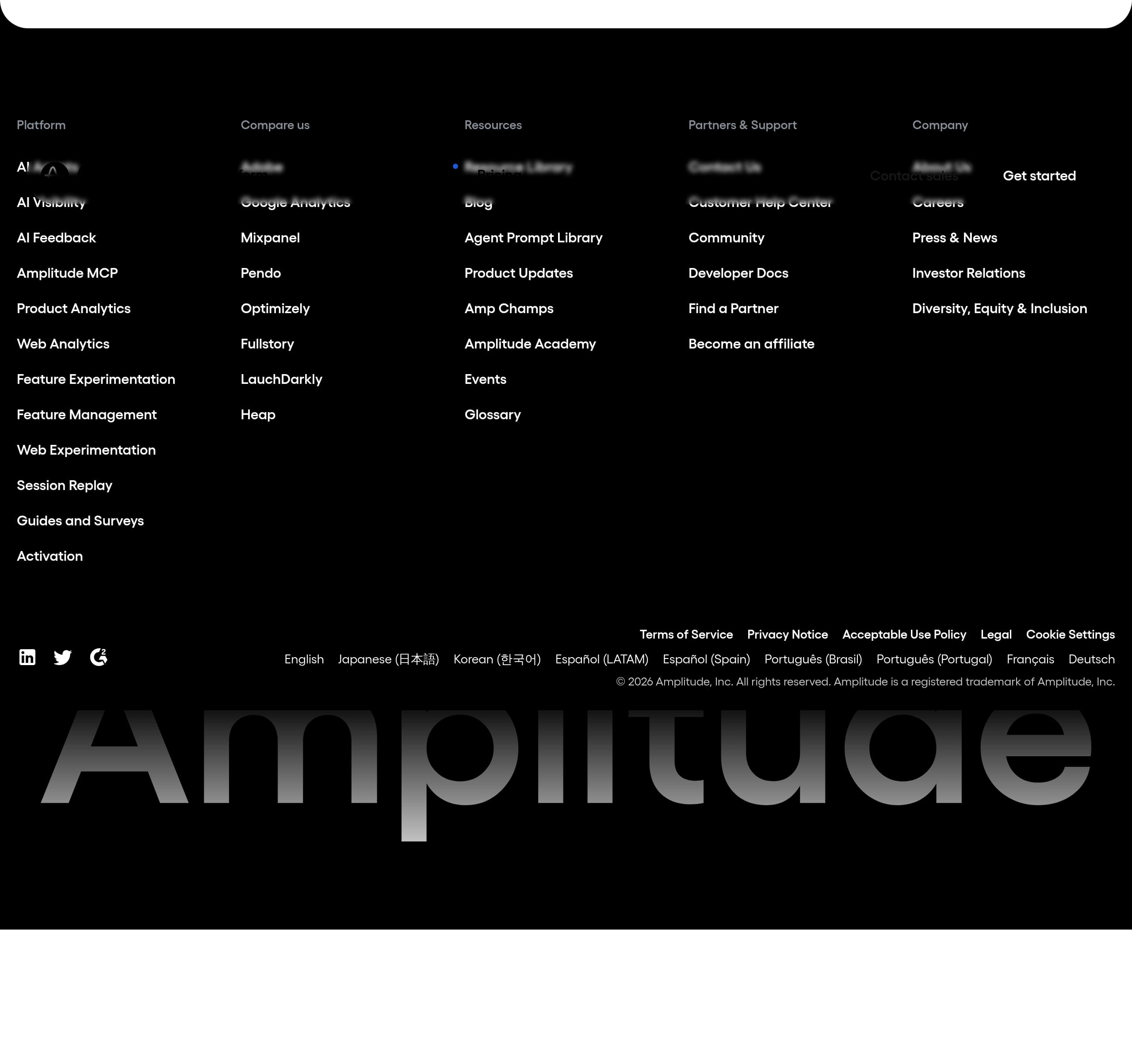
Amplitude’s footer is built like an enterprise SaaS directory: it prioritizes findability for complex buyers, reinforces legitimacy with corporate links, and supports global audiences with explicit language selectors. For SEO and user navigation, it is a strong pattern because it exposes the product surface area without forcing users back into the main menu.
Information architecture and navigability
The footer groups links into clear buckets that mirror the top navigation:
- Platform and products: AI Agents, AI Visibility, AI Feedback, Amplitude MCP, Product Analytics, Web Analytics, Feature Experimentation, Session Replay, Guides and Surveys, Activation.
- Comparisons: Compare us against Adobe, Google Analytics, Mixpanel, Pendo, Optimizely, Fullstory, LaunchDarkly, Heap.
- Resources: Resource Library, Blog, Prompt Library, Product Updates, Academy, Events, Glossary.
- Partners and support: Find a Partner, Become an affiliate, Community, Customer Help Center, Developer Docs.
This is helpful because Amplitude sells to multiple stakeholders. A product manager might click Product Analytics, an engineer might go to Developer Docs, and a procurement team might jump straight to legal.
Trust and compliance cues in the footer
The footer includes the core legal framework: Terms of Service, Privacy Notice, Acceptable Use Policy, Legal, and Cookie Settings. The presence of these items, plus a clear corporate identity line (“© 2026 Amplitude, Inc.” and trademark note), strengthens brand legitimacy.
Internationalization support
A visible language selector lists multiple locales (Japanese, Korean, Spanish variants, Portuguese variants, French, German). This is a subtle trust factor for global enterprises because it implies international customer support and market presence.
What could be improved
For conversion, the footer could include one persistent high-intent CTA (for example, “Try for free” or “Get a demo”) alongside contact options. The current footer is comprehensive, but it is mostly navigational. Adding a concise security link highlight (SOC 2, ISO, or similar if applicable on the site) would also help procurement teams who scroll looking for compliance.
Overall, the footer is strong for discovery, comparisons, and governance, which aligns with Amplitude’s platform breadth and enterprise buying cycles.
Detected tech stack
Tools and technologies we detected on Amplitude's site. Detection is best-effort and may be incomplete.
Scores
Our framework scores for Amplitude's website in terms of clarity, conversion, and trust. See our methodology for how we calculate these.
How clear the value prop and structure are.
How conversion-friendly signup and pricing are.
How well trust and compliance are surfaced.
FAQ
Amplitude’s homepage quickly establishes category and scope with “The AI analytics platform,” then offers two clear next steps: “Get started” and “Request a demo.” It also packages AI into named modules (AI Agents, AI Visibility, AI Feedback, Amplitude MCP) and maps the broader suite into outcomes like “Clearer insights,” “Faster action,” and “More trustworthy data,” which makes a large platform easier to evaluate.
Amplitude anchors pricing around an explicit free entry point and a parallel enterprise route. The site states you can “Start for free with up to 10K monthly tracked users,” which reduces uncertainty about whether a trial is meaningful. Next to that, it consistently offers a “Get a demo” option for teams that need custom requirements, security review, or broader platform evaluation.
Amplitude promotes self-serve signup with “Try for free,” and supports onboarding through extensive enablement links like the Developer Hub, tracking guides, templates, and training via Amplitude Academy. The navigation also highlights integrations and warehouse-native options, suggesting multiple implementation paths. The site could further improve clarity by previewing the immediate post-signup steps, such as choosing a data source or starting from templates.
Amplitude uses several stacked proof types: a review-volume claim (“Market Leader with 2,500+ reviews”), multiple case studies, and named customer quotes with role titles. It also includes outcome metrics such as 27% conversion lift and 40% activation increases. On the enterprise side, it references analyst and research assets like the Forrester Wave for Digital Analytics Solutions and a Gartner Hype Cycle mention.
Amplitude treats AI as a product suite rather than a vague add-on. The site names specific AI products—AI Agents, AI Visibility, AI Feedback, and Amplitude MCP—each with its own description and “Learn more” path. This packaging makes it easier for buyers to understand use cases, such as automating analysis, turning feedback into action, or monitoring how LLMs talk about a brand in AI search contexts.

The world's best-performing SaaS businesses share surprisingly similar patterns. We help you learn and apply them through our human-designed methodology, with AI-assisted research.