
Key takeaways
Here are the key insights from our website breakdown analysis of Wix.
Wix compresses the time-to-value by combining an AI website builder with a classic drag-and-drop editor, repeatedly reinforcing “Start for free. No credit card required.” alongside primary Get Started CTAs.
The navigation is segmented by outcomes (eCommerce, Scheduling, Restaurant, Portfolio) and by buyer type (Wix Studio for agencies, Developers, Enterprise), which reduces cognitive load for mixed-intent traffic.
Wix sells breadth without feeling bloated by using repeated modular “Open / Learn more” cards that frame features as add-ons you can enable later, not commitments you must choose upfront.
Credibility is built through specific infrastructure claims (multi-cloud hosting, 99.99% uptime, enterprise-grade security) and always-on support positioning (24/7 Help Center and chat).
SEO is repositioned as “SEO tools and AI visibility,” explicitly naming Google and LLMs like ChatGPT, which matches current buyer intent around search plus generative discovery.
Home
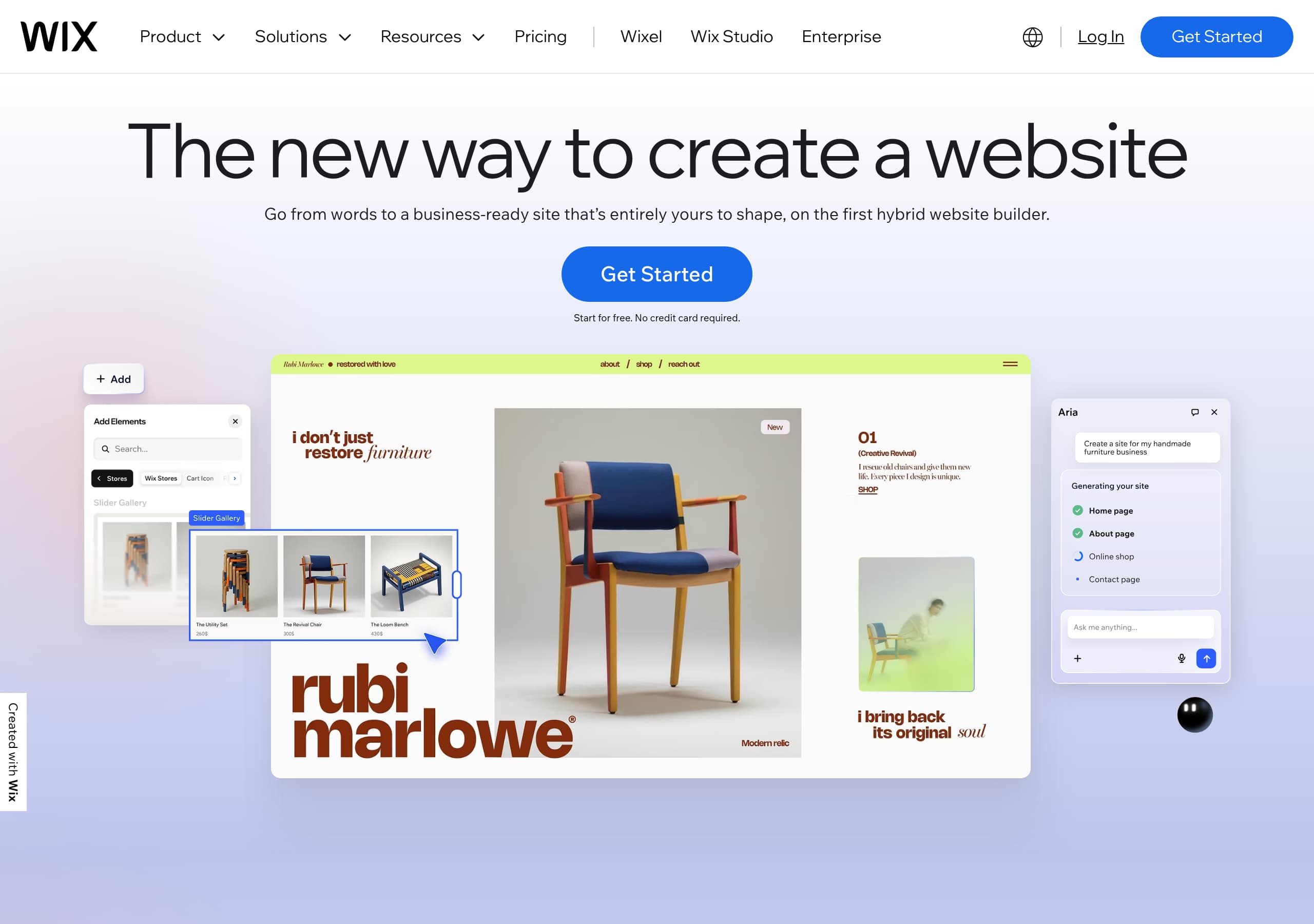
Wix’s homepage leads with a clear value proposition: build a “business-ready site” quickly using a “hybrid website builder” that mixes AI generation with manual editing. The primary CTA is repeated (“Get Started”), paired with a strong friction reducer: “Start for free. No credit card required.”
The page uses a tight feature ladder to satisfy different skill levels:
- AI website builder for instant drafts (“Describe what you want…in minutes”).
- 2000+ templates as an alternative entry point.
- A drag-and-drop editor positioned as “pixel-level precision” for advanced control.
A named assistant (“Aria”) humanizes the AI and implies guided success (“ask…bounce ideas,” “hand it off entirely”). The navigation also segments by use case (eCommerce, Scheduling, Restaurant, Portfolio) and buyer type (Wix Studio, Enterprise), which keeps mixed-intent traffic from getting stuck on one generic pitch.
Pricing
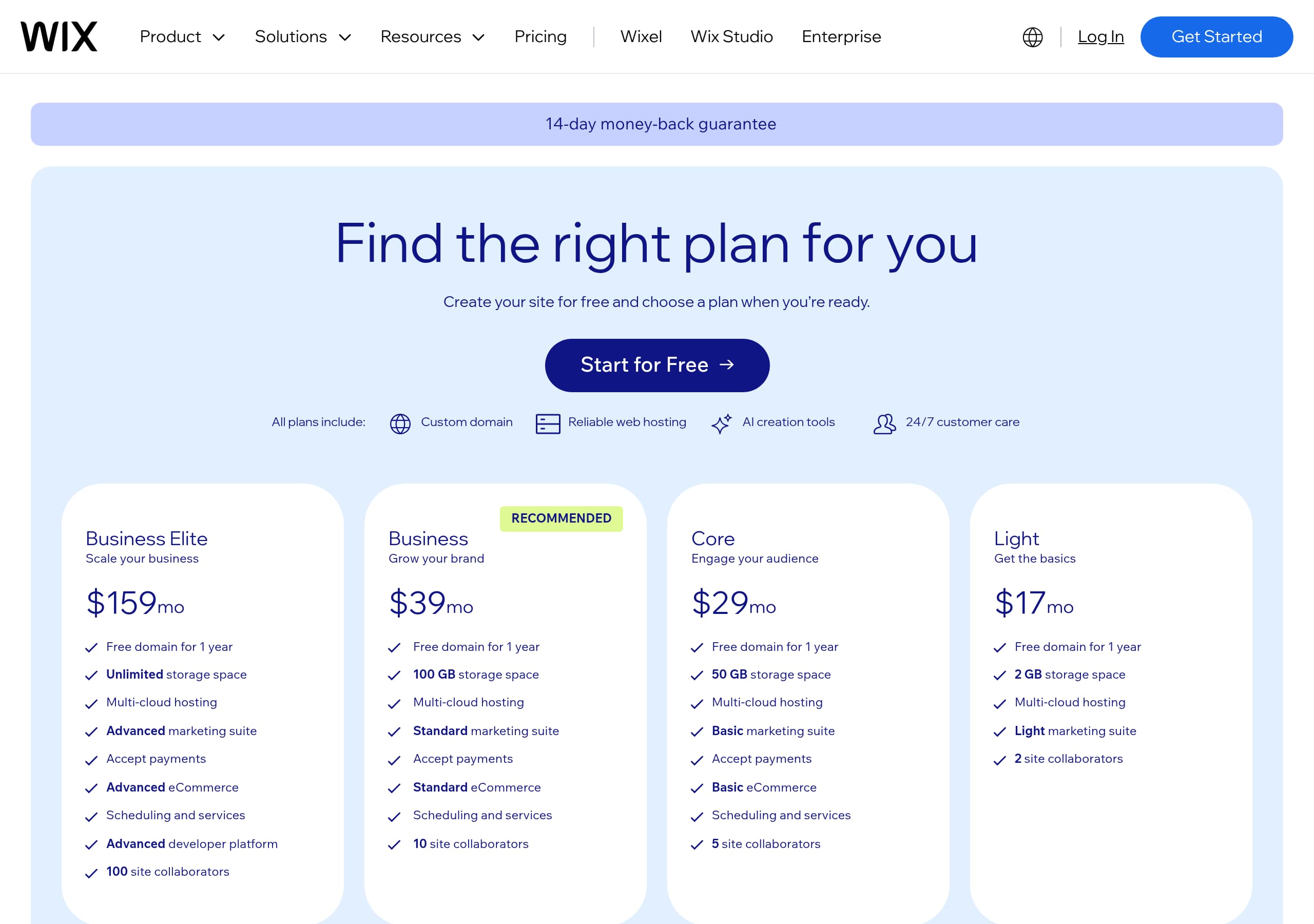
Wix’s pricing presentation (as shown in the screenshot) is optimized around quick plan comparison and repeated upgrade nudges rather than deep configuration. The layout relies on a horizontal set of plan cards with a highlighted option, which is a common pricing UX pattern to steer decision-making.
What improves conversion is how pricing is tied to tangible unlocks referenced on the homepage:
- Connecting a custom domain (including the “free for one year” incentive on annual Premium plans).
- Business features like payments, eCommerce, and marketing tools that map to plan tiers.
The key risk on website-builder pricing is ambiguity (what do I lose on free?). Wix mitigates this by consistently anchoring on “Start for free” and making Premium feel like a later step after publishing and branding needs become real. To further strengthen clarity, Wix benefits from keeping plan labels outcome-based (personal vs business) and ensuring every card has one dominant CTA.
Features
Wix’s features are organized like a product suite rather than a single editor, which matches how small businesses evaluate platforms. The page presents creation tools first (AI website builder, templates, drag-and-drop), then expands into business modules you can add “as you go.”
The feature grid stays concrete and operational:
- eCommerce: “manage orders, shipping.”
- Scheduling: “accept bookings, get paid, manage staff.”
- Events: “sell tickets, manage RSVPs.”
- Marketing: “SEO tools and AI visibility,” ads, social posting, AI email.
A notable differentiation is explicit “AI visibility” language, including “see how your site appears on LLMs like ChatGPT,” which updates the SEO pitch for 2026 discovery behavior.
The “Run your business from one dashboard” cluster (Payments, CRM, automations, analytics, mobile app) reinforces that Wix competes not only with site builders, but also with lightweight CRM and marketing stacks used by solo operators.
Signup
Wix’s conversion path is designed to feel low-commitment: the hero repeats “Start for free” and explicitly states “No credit card required,” which typically increases first-click signup rates for website builders. The page also offers multiple entry points—AI generation, template selection, or starting from scratch—so users don’t have to decide on one “correct” workflow.
Onboarding is implicitly structured as a guided sequence described in the “How to create a website for free” steps:
- Pick a platform (Wix), plan, start creating.
- Choose AI or a template, then customize.
- Connect a domain, optimize SEO, publish, promote.
This doubles as a checklist that reduces drop-off by clarifying “what happens next.” The Aria assistant acts as in-flow help for complex tasks, which is a support-as-onboarding pattern.
To maximize completion, Wix benefits from keeping the first session focused on publishing a draft site, then upselling Premium when the user hits branding/domain limits.
Trust
Wix emphasizes platform-grade reliability and safety with specific, auditable-sounding claims rather than vague reassurance. The infrastructure section states 99.99% uptime via “multi-cloud hosting,” plus “enterprise-grade security,” which targets the primary fear of non-technical buyers: downtime and hacks.
Trust is reinforced through performance and compliance-adjacent cues:
- “Engineered for top speed” (fast loading).
- “Designed for accessibility” (inclusive, lower legal/UX risk).
- “Secured by industry experts” (authority framing).
Support availability is another major trust layer: “We’re here for you 24/7,” with clear routes—Help Center, 24/7 chat (Helpmate), and “Hire a pro.” This is especially relevant for SMBs who can’t afford agency retainers.
Finally, Wix ties trust to business readiness: domains, payments, CRM, and analytics appear as first-party tools, reducing dependency on third-party plugins common in WordPress setups.
Footer
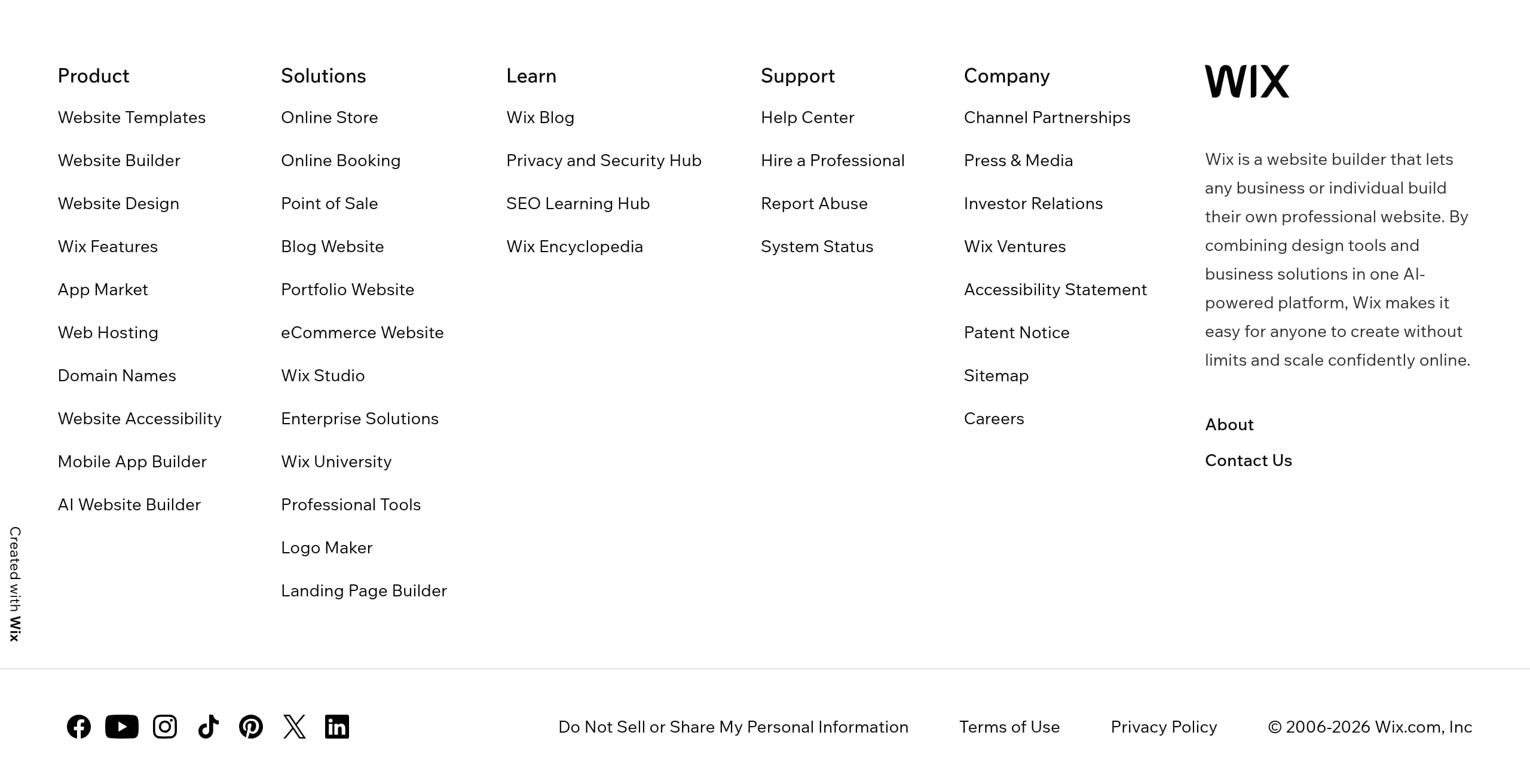
Wix’s footer (per screenshot) acts as a full site directory and credibility hub, which is useful given how broad the product is. It surfaces multiple navigation clusters—product areas, resources, and support—so users arriving from SEO can quickly re-route to the right solution page.
Effective footer patterns visible here include:
- Deep links to Help Center and support options, reinforcing the 24/7 assistance message.
- Links to Wix Blog and inspiration content, which supports ongoing evaluation and improves topical authority for SEO.
- Business-utility links (pricing, tools) that shorten the path to conversion for bottom-of-funnel visitors.
For trust and compliance, a strong footer typically includes legal and policy access (terms/privacy/cookies) and company context. Wix’s design uses a dense, multi-column layout consistent with large SaaS platforms, signaling scale.
Overall, the footer reduces bounce by giving “next steps” for every persona—creator, business owner, agency—without forcing a return to the main navigation.
Detected tech stack
Tools and technologies we detected on Wix's site. Detection is best-effort and may be incomplete.
Scores
Our framework scores for Wix's website in terms of clarity, conversion, and trust. See our methodology for how we calculate these.
How clear the value prop and structure are.
How conversion-friendly signup and pricing are.
How well trust and compliance are surfaced.

The world's best-performing SaaS businesses share surprisingly similar patterns. We help you learn and apply them through our human-designed methodology, with AI-assisted research.