
Key takeaways
Here are the key insights from our website breakdown analysis of Vercel.
Vercel’s homepage clarifies positioning quickly by pairing the headline “Build and deploy on the AI Cloud” with concrete product navigation for AI Cloud, Core Platform, and Security, so both builders and buyers can self-qualify fast.
Conversion intent is reinforced with repeated, consistent CTAs like “Start Deploying” and “Get a Demo,” which supports both self-serve developers and enterprise stakeholders without forcing a single path.
The site earns credibility through specific, outcome-oriented proof points (for example “build times went from 7m to 40s” and “95% reduction in page load times”), which are more persuasive than generic testimonial quotes.
Feature communication is structured as a platform map, not a single product pitch: AI Gateway, AI SDK, Fluid Compute, Observability, BotID, and Web Application Firewall are presented as modular building blocks tied to use cases.
Vercel reduces perceived implementation risk by repeatedly anchoring to Git-based deployment and familiar frameworks (Next.js, React, Svelte, Nuxt, Astro), plus explicit promises like previews for every push and automatic HTTPS.
Trust is strengthened by giving security its own top-level presence (DDoS Protection, Firewall, Web Application Firewall, Bot Management, BotID), which signals maturity and procurement readiness instead of treating security as a footnote.
The footer and global navigation are unusually dense but well categorized, making Vercel easy to evaluate as an ecosystem (docs, academy, marketplace, solution partners) while still keeping primary CTAs visible higher on the page.
Home
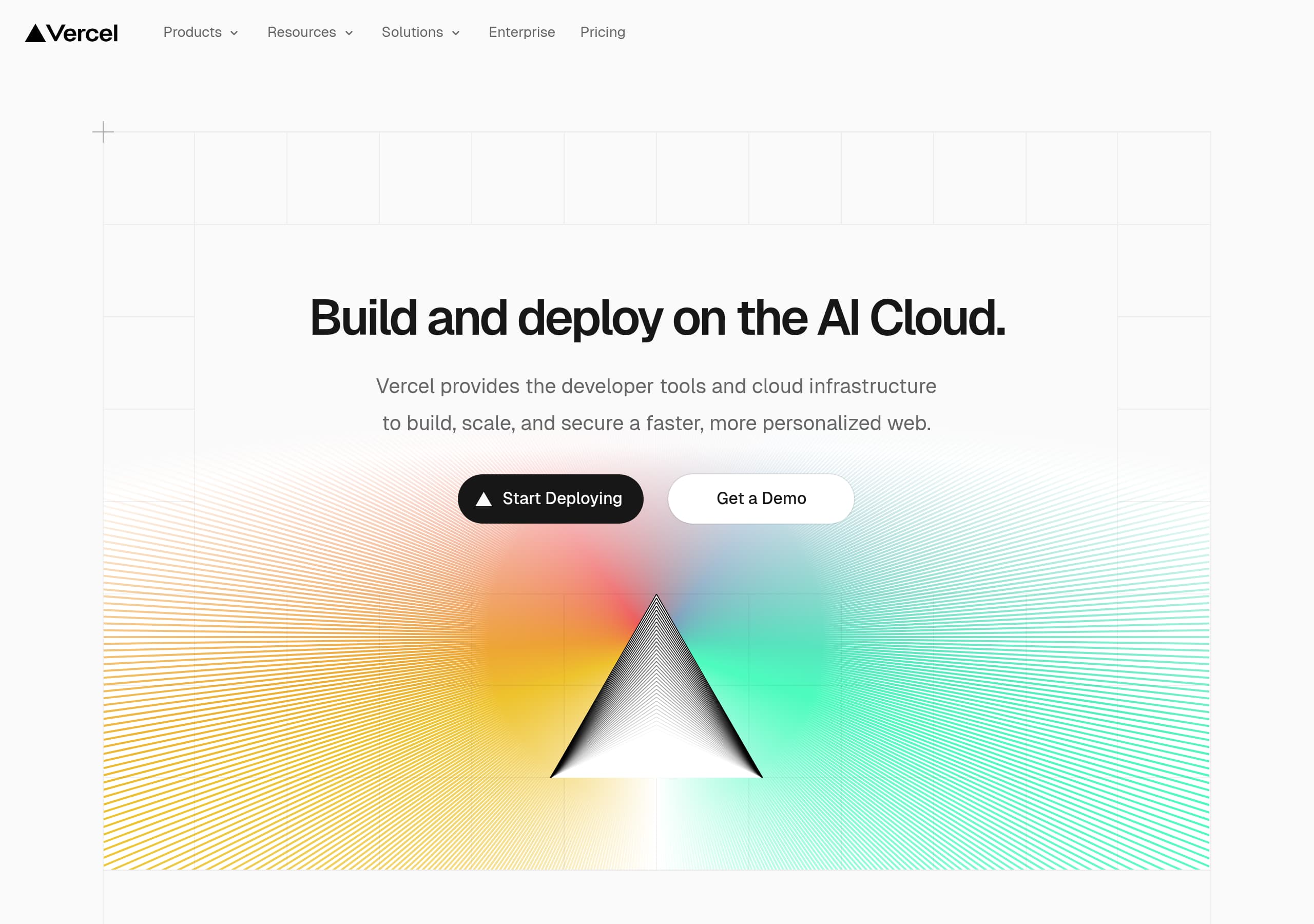
Vercel’s homepage works because it positions the product as an end-to-end platform in the first screen, then lets visitors self-navigate into AI, delivery, compute, and security without reading long copy.
What’s happening above the fold
The hero line, “Build and deploy on the AI Cloud”, is immediately reinforced by repeating subcopy about “developer tools and cloud infrastructure to build, scale, and secure a faster, more personalized web.” That repetition reduces ambiguity, even if a visitor lands mid-page from search. The page also uses dual CTAs that map to two intents: “Start Deploying” for self-serve and “Get a Demo” for enterprise evaluation.
Information architecture that matches how teams buy
The top navigation is organized into Products (AI Cloud, Core Platform, Security), Solutions (AI Apps, Marketing Sites, Multi-tenant Platforms), and Users (Platform Engineers, Design Engineers). This is a strong pattern for a platform that sells to both ICs and leadership: it creates multiple “entry ramps” while still anchoring everything to Vercel. Concrete product labels like AI Gateway, Fluid Compute, and Observability provide specificity and help visitors understand this is more than simple hosting.
Specific proof and tangible artifacts
The homepage includes quick performance outcomes like “build times went from 7m to 40s” and “95% reduction in page load times,” which is a high-signal trust element because it is time-based and easy to grasp. It also shows developer-native elements like a code snippet for streaming text via the AI SDK and a “Top models” list with dated context (“Top models on Mar 2, 2026”), which makes the developer experience feel real rather than marketing-only.
Pricing
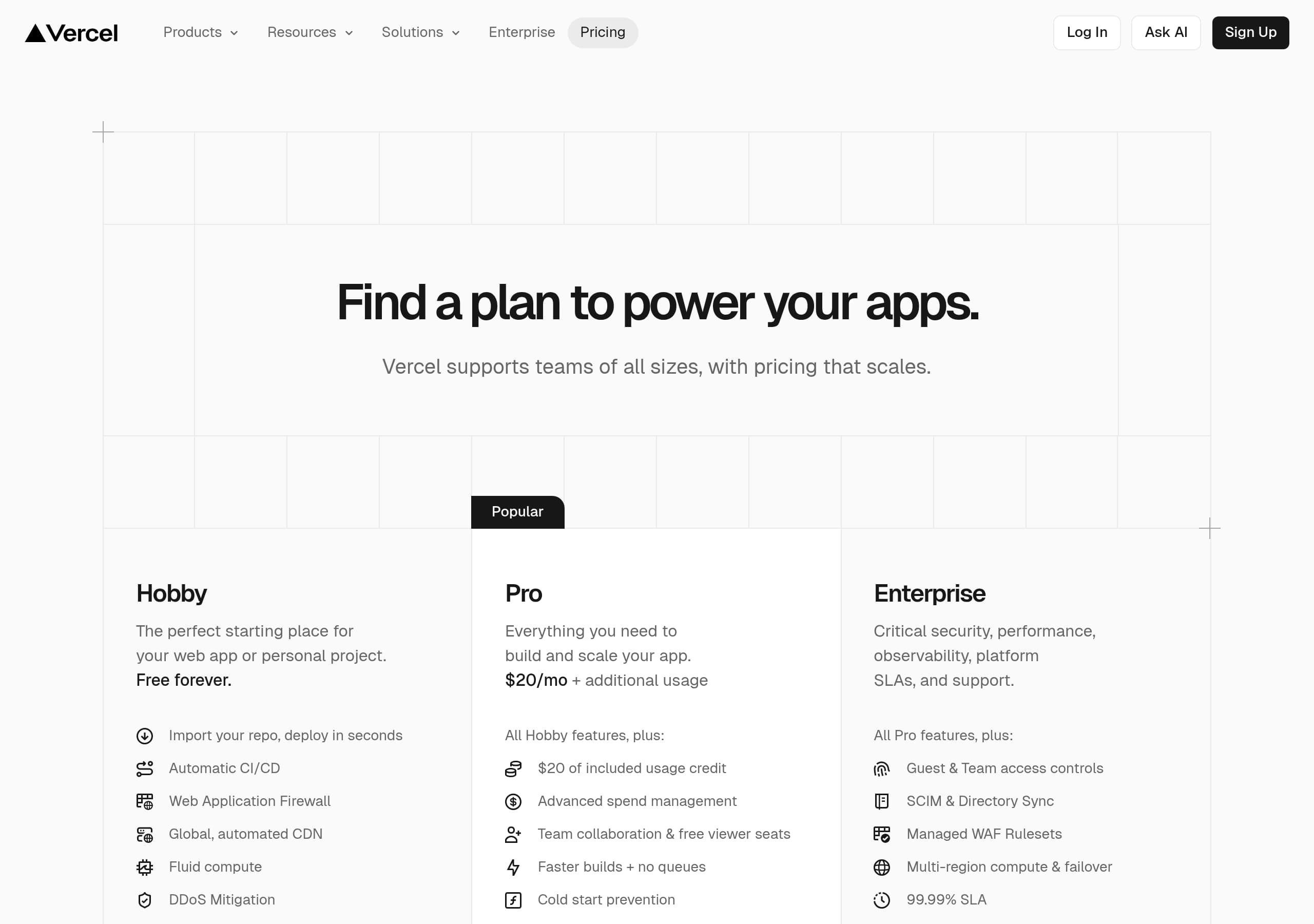
Vercel’s pricing presentation is designed to support fast self-serve decisions while still reserving room for enterprise complexity, which is important for a platform spanning hosting, compute, security, and AI.
Pricing page goal: quick qualification
From the screenshot context and site patterns, Vercel’s pricing page typically needs to answer two questions: “Can I start free?” and “What do I get if I am serious?” The navigation and CTAs seen across the site suggest the pricing experience is optimized for two motions: a developer starting with self-serve and a buyer who needs sales-assisted evaluation (mirrored by “Get a Demo” and “Talk to an Expert”). That split reduces friction because visitors are not forced into contacting sales to understand basic tiers.
What the site does well structurally
Even without enumerating every line item, the page context indicates Vercel anchors around platform primitives like CI/CD, Content Delivery, Fluid Compute, and Observability, plus security add-ons such as Web Application Firewall and BotID. This matters because buyers often map pricing to capabilities, not abstract tier names. Expectation-setting is reinforced elsewhere with operational promises like automatic HTTPS and “Previews for every push,” which function as “included-by-default” value.
Conversion tactics to keep
- Keep pricing tied to outcomes and usage, particularly for compute, where Vercel explicitly calls out “Active CPU pricing.”
- Ensure any Enterprise tier calls to action are adjacent to procurement-grade features (security, isolation, performance), so the upgrade feels justified.
- Maintain consistency with homepage CTAs, especially “Start Deploying”, so users do not feel they are switching funnels when they click Pricing.
Overall, the pricing approach supports a broad audience while keeping the platform’s modular scope legible.
Features
Vercel’s feature communication succeeds because it frames the platform as a set of composable products mapped to real workloads, then supports each with a concrete artifact like a code snippet, a workflow concept, or an operational promise.
Feature set is organized like a platform map
The site groups capabilities into clear pillars: AI Cloud (v0, AI SDK, AI Gateway, Vercel Agent, Sandbox), Core Platform (CI/CD, Content Delivery, Fluid Compute, Observability), and Security (Bot Management, BotID, DDoS Protection, Web Application Firewall). This is not a generic “features grid,” it is a taxonomy that matches how modern teams evaluate vendors: by category ownership and risk.
Specific, observable elements that increase comprehension
Vercel does not just name AI products, it shows developer-adjacent details, for example a TypeScript import for streamText and a model identifier like “openai/gpt-5.2.” The AI Gateway section implies “one endpoint, all your models”, which is a crisp integration promise. On the infrastructure side, “From code to infrastructure in one git push” and “Deploy once, deliver everywhere” establish a clear mental model: push code, Vercel provisions and distributes.
Use-case driven feature framing
The site includes Solutions like AI Apps, Composable Commerce, Marketing Sites, and Multi-tenant Platforms, with short benefit statements such as “Streamline content creation and publishing with built-in previews” and “Serve millions securely across isolated environments.” This ties features to outcomes and also to buyer archetypes.
Gaps worth addressing
Because there are many named products, Vercel risks overwhelming new visitors. A simple comparative table that maps “AI SDK vs AI Gateway vs v0 vs Agent” could reduce confusion while keeping the modular narrative. Still, the current presentation is strong because it stays concrete, shows artifacts, and connects features to jobs-to-be-done.
Signup
Vercel’s signup path is positioned as an immediate, developer-first action, and the site repeatedly reduces anxiety by promising a fast first win: “Deploy your first app in seconds.”
Conversion entry points are consistent
Across the excerpt, the primary CTA “Start Deploying” appears multiple times, alongside secondary paths like “Get a Demo,” “Talk to an Expert,” and “Get an Enterprise Trial.” This is a pragmatic approach for a product used by individuals and bought by organizations. The consistency of CTA labeling helps users build confidence that they will not be bait-and-switched into a sales form when they want to deploy.
Onboarding promises are concrete
The homepage copy provides a clear onboarding blueprint:
- “Deploy automatically from git or with our CLI” gives two setup modes.
- “Previews for every push” implies the user will see value before production.
- “Automatic HTTPS for all your domains” removes a common setup hurdle.
- “Wide range support for the most popular frameworks” is reinforced with explicit template links (Next.js, React, Astro, Svelte, Nuxt, Python).
These claims reduce cognitive load because users can picture the sequence: connect repo, deploy, get preview, add domain.
What would make the signup flow even stronger
Given the number of products (AI Gateway, Observability, Security add-ons), the best next step after signup is a guided choice: “What are you deploying?” with 3 to 5 options matching Solutions (AI app, marketing site, commerce, multi-tenant). The site already has templates and use cases, so aligning the first-run experience to that taxonomy would improve activation.
As presented, Vercel’s signup messaging emphasizes speed, familiar developer workflows, and a low-friction start, which is exactly what a deployment platform needs to convert.
Trust
Vercel builds trust by treating security and reliability as first-class products with explicit labels, not as a single “secure” claim buried in the footer.
Security is a primary navigation category
The global nav lists Security with distinct items: Bot Management, BotID (Invisible CAPTCHA), DDoS Protection, Firewall, and Web Application Firewall with “Granular, custom protection.” This structure matters because it signals organizational maturity: security is not an add-on afterthought, it is part of the platform surface area.
Trust messaging is concrete, not vague
The homepage repeats the promise to “build, scale, and secure,” and then supports it with specific controls and operational features. Even the AI stack is framed with governance implications, for example AI Gateway as a single endpoint to access “hundreds of AI models,” which implies centralization and easier policy enforcement than ad hoc SDK sprawl.
Reliability and operational confidence
While the provided excerpt does not show a full SLA statement, it does include language like “Fast, scalable, and reliable” for Content Delivery and “Deploy once, deliver everywhere,” which implies a global edge network. The UI also references “Loading status…” and shows an activity visualization (“Nodes on the globe are sending out small pulses”), which subtly reinforces that this is a live, global platform.
Opportunities to strengthen procurement trust
- If the pricing page includes Enterprise tiers, placing visible links to security documentation, compliance pages, and incident history near Enterprise CTAs would tighten the trust loop.
- Where model usage is shown (Top models list), adding a link to governance or logging in Observability would connect AI capability to auditability.
Overall, Vercel’s trust posture is strong because the site exposes security capabilities as named, navigable products with clear intent.
Footer
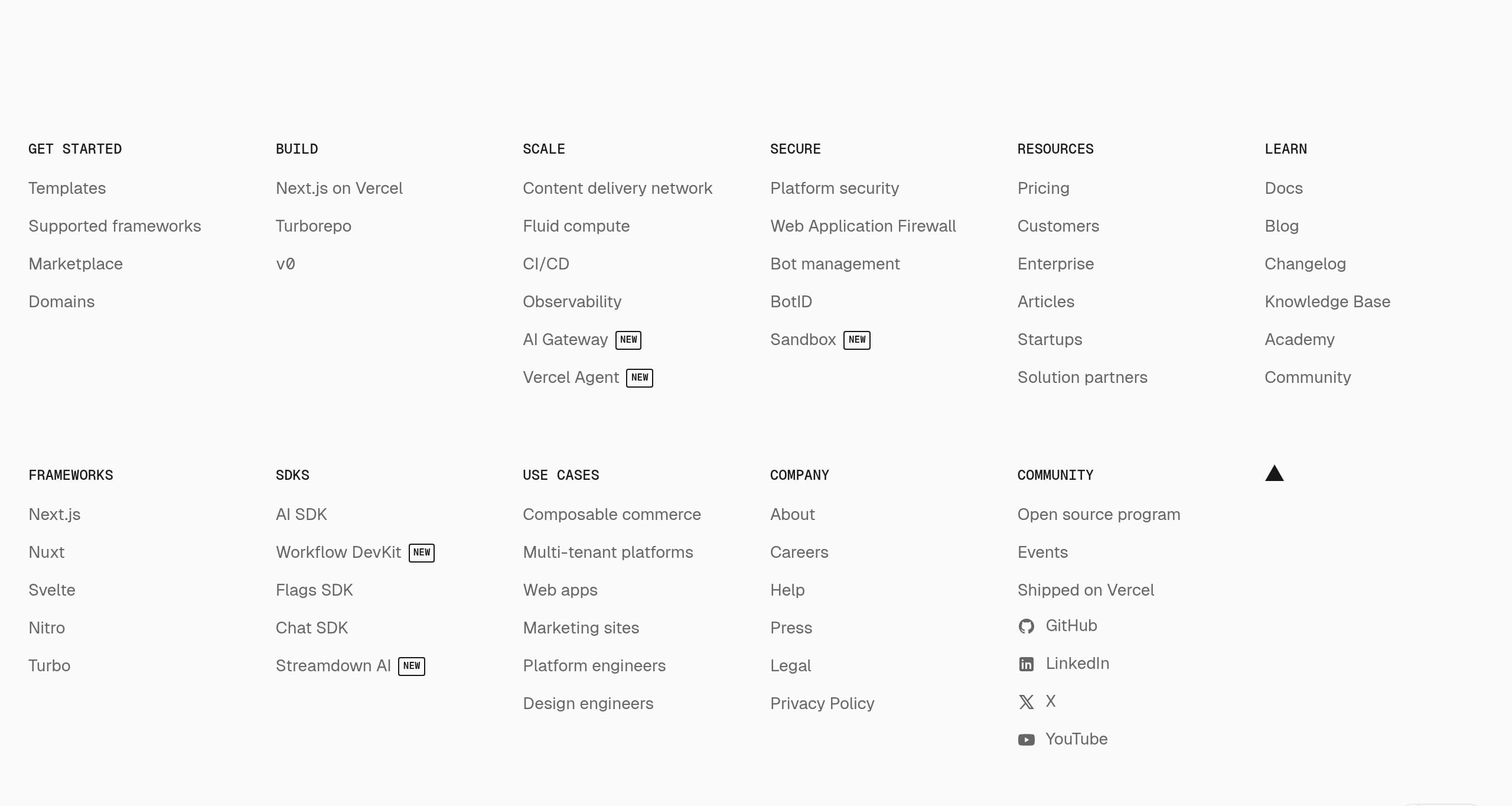
Vercel’s footer is designed as a “site directory” for a complex platform, and it functions well as a secondary conversion and trust surface for visitors who scroll to validate documentation, support, and company legitimacy.
Dense but well-categorized navigation
The footer groups links into logical buckets that mirror top navigation: Products, Use Cases, Resources, Company, and Community. It includes direct routes to Docs, Changelog, Knowledge Base, Academy, and Community, which are high-trust destinations for technical buyers. For a developer platform, having Docs and Changelog one click away is a meaningful trust signal because it suggests ongoing shipping and transparent updates.
Ecosystem and governance signals
The footer highlights Open Source and key ecosystem projects like Next.js, Nuxt, Svelte, and Turborepo, plus a “Shipped on Vercel” note. It also includes standard company validation links: About, Careers, Press, Legal, Privacy Policy. Those elements reduce buyer risk, especially for enterprise stakeholders who look for corporate stability markers.
UX touches that improve credibility
A visible theme selector (“Select a display theme: system light dark”) signals attention to accessibility and developer-centric polish. Social links to GitHub, LinkedIn, X, and YouTube provide additional verification paths. The footer also includes “Loading status…” which implies a live status component or integration, a subtle reliability affordance if it links to uptime.
Improvements to consider
Because the footer is extremely link-heavy, adding a small “Most used” subset (Docs, Pricing, Status, Security, Contact Sales) could improve scan speed. Still, the current design is appropriate for Vercel’s breadth because it prioritizes findability over minimalism.
Net: the footer strengthens trust and reduces evaluation friction by making proof, documentation, and governance links easy to reach.
Scores
Our framework scores for Vercel's website in terms of clarity, conversion, and trust. See our methodology for how we calculate these.
How clear the value prop and structure are.
How conversion-friendly signup and pricing are.
How well trust and compliance are surfaced.

The world's best-performing SaaS businesses share surprisingly similar patterns. We help you learn and apply them through our human-designed methodology, with AI-assisted research.