
Key takeaways
Here are the key insights from our website breakdown analysis of Contentful.
Contentful’s homepage communicates an enterprise DXP story quickly by pairing a punchy value proposition with concrete outcomes like “99.99% Uptime” and “4.6B delivery requests,” which reduces ambiguity for buyers evaluating scale.
The site is optimized for multiple buyer types, routing marketers, developers, and enterprise stakeholders through clear navigation paths (Products, Solutions, Developers, Partners) and role-based sections like “Growth Marketing,” “Product,” and “Developers.”
Conversion is driven by high-intent CTAs such as “Contact sales,” “Chat with sales,” and product exploration CTAs like “Explore Contentful Platform,” but it is less oriented toward self-serve signup on the marketing surface.
Social proof is unusually specific, combining recognizable logos (Atlassian, AWS, Notion, Docusign) with named testimonials (KFC Global, Docusign, Audible) and measurable claims like “5 min release cycles down from 2 weeks.”
The feature narrative leans into composable architecture and AI: modular content, native AI for generation and localization, and no-code personalization, which aligns the product story with current “content operations” pain points.
Trust is reinforced through visible reliability cues (99.99% uptime, Black Friday scale reference), plus footer access to Security and System status, which supports procurement and technical validation.
The footer is built for enterprise evaluation journeys, providing deep paths into Documentation, Training, Professional services, Partners, and legal controls like Cookie Preferences and “Your Privacy Choices.”
Home
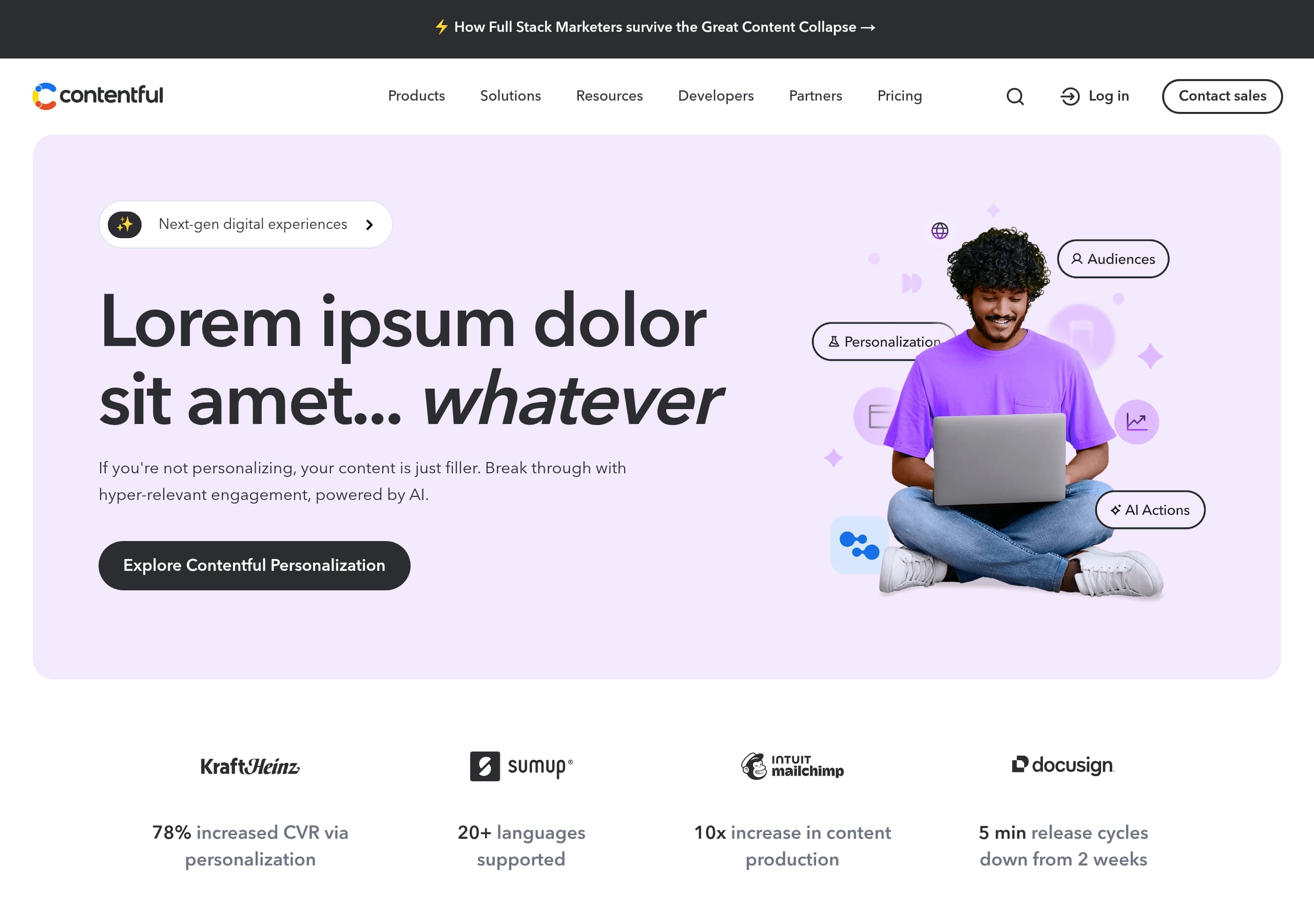
Contentful’s homepage succeeds by combining a high-level promise with proof of scale and performance in the first scroll, so enterprise visitors can quickly answer, “Is this built for my complexity?” The hero message, “Content that scales. Experiences that convert.” sets an outcome frame, then the page immediately reinforces it with personalization positioning like “If you’re not personalizing, your content is just filler” and a CTA to “Explore Contentful Personalization.”
A few homepage patterns are especially conversion-aware:
- Dual-track navigation supports both exploration and purchase: persistent top nav includes Products, Solutions, Developers, Partners, and Pricing, while the top-right utilities push Contact sales and Log in.
- The page uses outcome metrics as credibility anchors: examples include “78% increased CVR via personalization,” “10x increase in content production,” “5 min release cycles down from 2 weeks,” plus platform-wide signals like “4.6B Delivery requests” and “99.99% Uptime.”
- Messaging repeatedly translates composable CMS concepts into workflow relief, for example “Stop wasting time on a wild copy+paste goose chase” and “one source,” which makes the platform benefits tangible.
Contentful also does a good job of communicating product breadth without overwhelming visitors. Instead of leading with a dense feature list, it sequences from personalization value, to modular content, to AI, to role-based value blocks (Growth Marketing, Product, Developers). This creates buyer-specific relevance without forcing visitors to self-segment through a long quiz.
One clarity drawback is the occasional campaign-style tone, for example “Great Content Collapse” and a “Next-gen digital experiences” block that reads like placeholder copy in the excerpt. Still, the primary narrative stays consistent: composable, modular architecture, AI-native personalization, and cross-channel delivery across websites, apps, email, and more.
Pricing
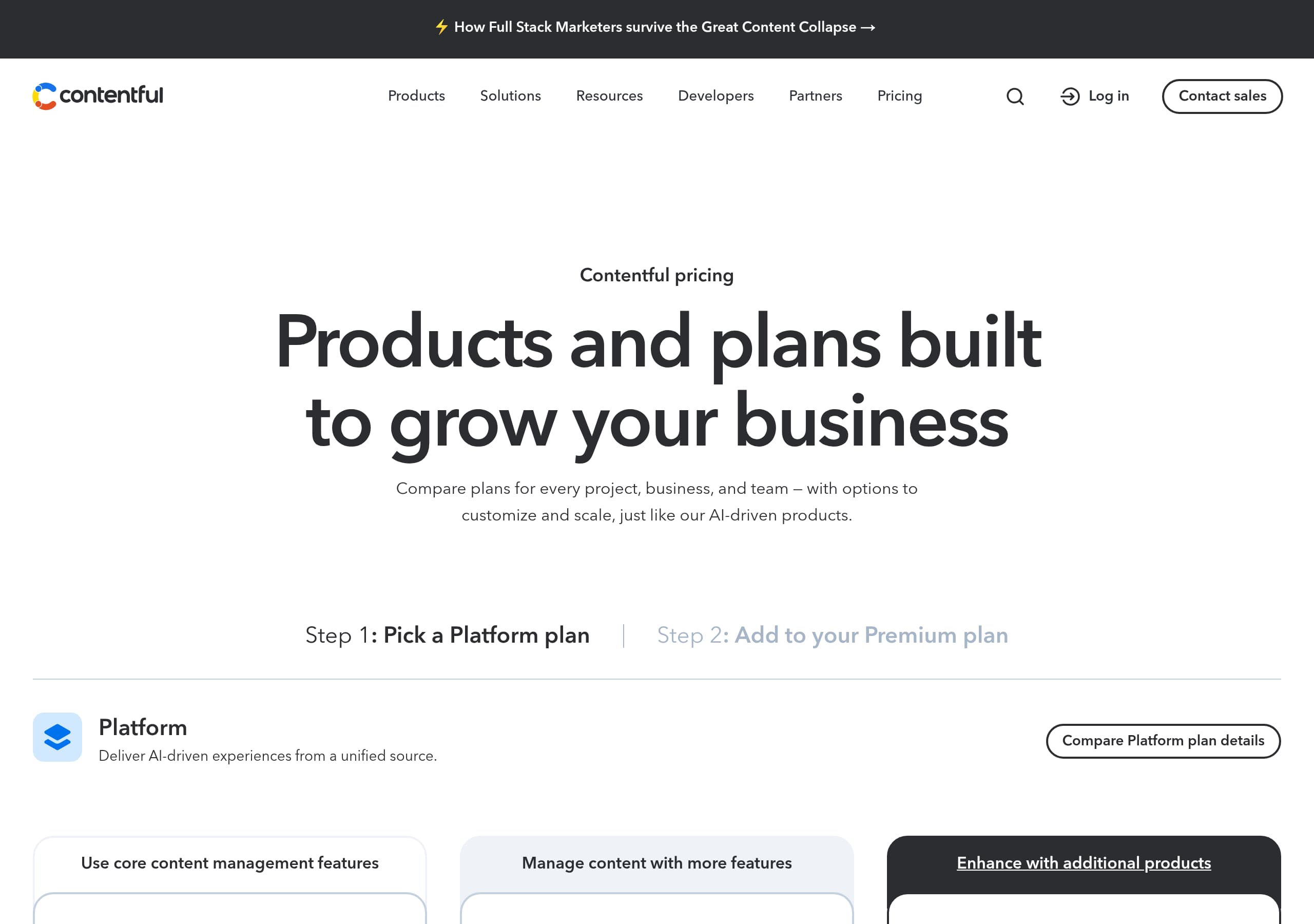
Contentful’s pricing experience appears designed for enterprise evaluation rather than fast self-serve checkout, and the site supports that with prominent sales-led pathways. In the global navigation, “Pricing” is a first-class item, but the on-page CTAs across the site emphasize Contact sales and “Chat with sales,” suggesting pricing is used to qualify interest and move visitors into a conversation.
From the pricing screenshot context, the page layout looks like a structured plan comparison rather than a single “starting at” number, which fits Contentful’s positioning as a platform that spans personalization, orchestration, ecosystem integrations, and services. That approach typically serves teams that need to align on requirements like environments, roles, localization, and governance. The tradeoff is that it can reduce conversions for smaller teams looking for immediate transparent pricing and a simple checkout.
What Contentful does well, based on the site’s surrounding messaging:
- It supports value justification with hard numbers used throughout the site, such as 99.99% uptime, “4.6B delivery requests,” and cycle-time improvements. When a pricing page is paired with these claims, it helps buyers map cost to risk reduction and revenue upside.
- It creates multiple “routes to purchase”: Pricing in nav, plus “Work with a partner,” plus Professional Services, which is important when implementation is a key part of total cost.
Opportunities to improve pricing conversion without undermining enterprise strategy:
- Add a stronger self-serve entry point from pricing for smaller teams (even if limited), then upsell advanced modules like personalization and analytics.
- Make packaging more scannable by explicitly naming what belongs to Platform vs Personalization vs Ecosystem, since the Products menu lists many capabilities.
Overall, pricing seems aligned to an enterprise DXP motion, but less optimized for instant signup.
Features
Contentful’s feature presentation is built around workflows and outcomes rather than a static checklist, which fits a composable platform that serves multiple teams. The Products menu itself acts like a feature map: Platform, Personalization, AI Actions, Analytics (Beta), Studio, Extensibility, Marketplace, AI Suggestions, Segmentation, Experimentation, Insights, Data connections, Front-end hosting, Localization and Translation, and Automation and Workflows. This menu communicates breadth while letting visitors drill into a specific capability.
On the homepage, features are grouped into benefit-led modules:
- “Modular content, max impact” frames the core composable, modular architecture: build components once, reuse across channels, brands, and regions.
- “AI that’s actually on-brand” positions native AI as brand-safe content generation and localization, not generic text output, reinforced by language like “sounds like you” and “within your brand guidelines.”
- “Personalization made simple” highlights no-code tools so marketers can “tweak, test, and tailor experiences in real time,” explicitly stating “No developer assistance needed.”
The page also introduces measurement as a differentiator: “Measure and optimize performance at the component level” and “granular view of your insights.” That is important because many CMS and DXP competitors emphasize creation and delivery, but fewer connect content structure to performance feedback loops inside the same workflow.
Role-based feature framing improves relevance:
- Growth Marketing: no-code personalization, real-time experimentation, centralized content.
- Developers: “flexible APIs & integrations” and “Build custom solutions.”
- Enterprise: Professional Services and Customer Success, which are presented as part of the product experience, not an afterthought.
A potential clarity gap is feature sprawl: with so many product lines (Personalization, Studio, Ecosystem, Analytics Beta), Contentful should continue to emphasize the “one source” platform idea and show how modules connect. Still, the site consistently anchors features to speed, reuse, personalization, and optimization.
Signup
Contentful’s marketing site is optimized more for sales-led onboarding than instant self-serve signup, and you can see that in the dominant CTAs and page structure. The header includes Contact sales and Log in, and the primary end-of-page CTA is “Chat with sales,” with supporting paths like “Work with a partner.” There is also a developer-oriented prompt, “Ready to start building? Get under the hood and see what’s possible with Contentful,” which routes technical users toward Documentation rather than a generic trial form.
This signup posture matches the product’s scope: Contentful is positioning not just a CMS, but a platform including personalization, experimentation, analytics, extensibility, marketplace apps, localization, automation, and services. For many organizations, the “signup” is less about creating an account and more about aligning on architecture, integrations, governance, and support.
What works well for conversion in this model:
- Multiple high-intent entry points reduce friction for different buyer journeys: Chat with sales, Contact sales, Partners, and Professional Services.
- The site pre-empts onboarding anxiety by emphasizing enablement resources: Documentation, Training, Professional services, Help Center, and a Developer Showcase.
- Role-based sections on the homepage act as a lightweight “qualification” step, helping visitors identify whether they are Growth Marketing, Product, or Developers before they commit.
What could improve the signup experience for mixed audiences:
- Offer a clearer self-serve quickstart CTA near the hero for developers and small teams, even if enterprise features require an upgrade.
- Make “what happens after Contact sales” more explicit, for example a discovery call, solution mapping, a pilot, partner involvement, since the site already suggests an implementation ecosystem.
Overall, Contentful reduces perceived risk with strong proof and support pathways, but it is intentionally not a pure product-led signup flow.
Trust
Contentful builds trust through reliability signals, operational transparency links, and enterprise support pathways, rather than relying only on generic security claims. The homepage prominently states 99.99% Uptime and pairs it with a peak-load credibility marker: “4.6B Delivery requests powered by Contentful across retail during Black Friday 2025.” That combination matters for DXP and CMS buyers, because the biggest fear is downtime during high-traffic campaigns.
Trust is also reinforced through customer evidence that implies complex deployments: examples include KFC Global references to kiosks and digital menu boards, and Docusign’s quote about scaling personalized experiences to global audiences. These are indirect but meaningful signals of governance, localization, and integration maturity.
The site provides multiple “risk reducers” that procurement teams look for:
- Professional Services messaging promises “24/7 support and 99.99% uptime SLA,” which frames trust as a contractual commitment, not only marketing language.
- Footer links include Security and System status, which are practical trust artifacts. A visible system status link implies the company is willing to be publicly accountable for uptime and incidents.
- A dedicated Partner ecosystem pitch (“Work with a partner” and Partner navigation) reduces implementation risk for teams that cannot build everything in-house.
What is less visible in the provided excerpt is explicit compliance detail (for example SOC 2, ISO 27001, GDPR specifics) in the main body content. The presence of a Security page link suggests that information exists, but it is not front-loaded on the homepage.
A tactical improvement would be to add a small trust strip near the hero or near pricing that points to the Security page and status page with short labels like “Security overview” and “Status dashboard.” Still, Contentful’s approach is strong because it uses scale proofs, SLA language, and operational links that buyers recognize as concrete trust markers.
Footer
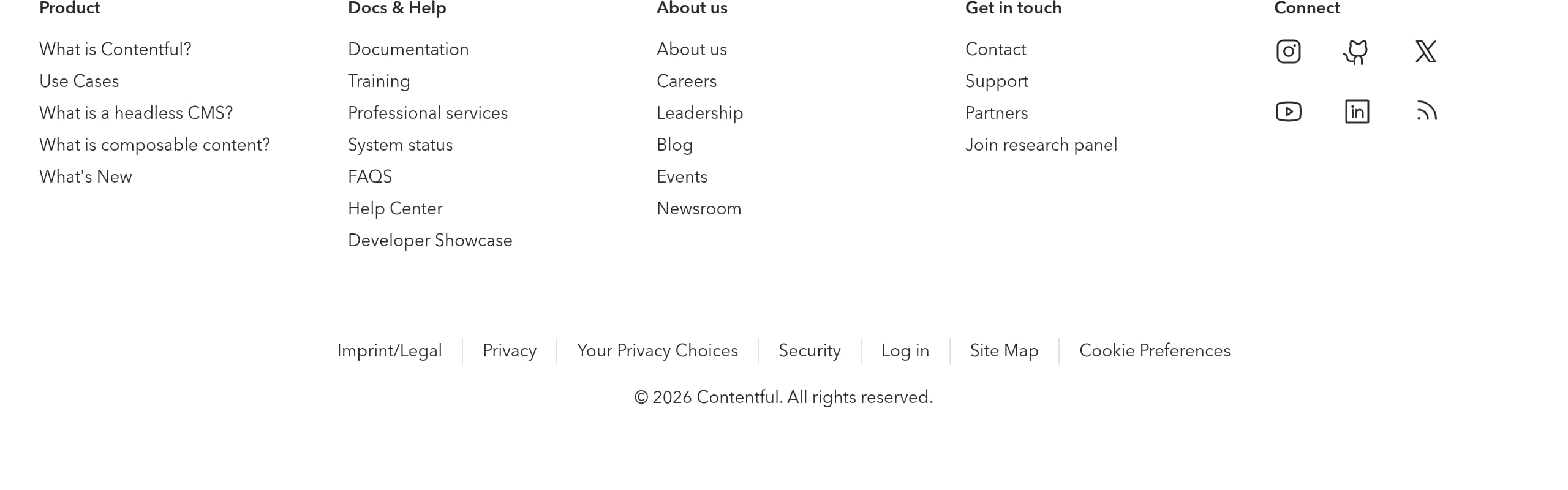
Contentful’s footer is built for enterprise evaluation and ongoing customer enablement, not just basic legal navigation. It is dense, well-structured, and intentionally redundant in the ways large sites need to be: key groups like Product, Docs & Help, About us, and Get in touch are easy to scan, and the same clusters appear more than once, which supports users who arrive at the footer from different scroll depths.
Strong footer elements that improve conversion and retention:
- It offers direct paths into buyer education, including “What is Contentful?”, “What is a headless CMS?”, and “What is composable content?” These are high-intent queries for SEO and for stakeholders doing internal research.
- The Docs & Help cluster is robust: Documentation, Training, Professional services, System status, FAQs, Help Center, and Developer Showcase. This makes the footer function like a secondary navigation bar for technical validation.
- The presence of “Support,” “Partners,” and “Join research panel” signals a mature organization with feedback loops and multiple engagement models.
From a trust and compliance perspective, the footer includes Imprint/Legal, Privacy, Cookie Preferences, and “Your Privacy Choices,” plus a prominent Security link and Log in. These are practical cues that the company is ready for procurement scrutiny and user consent requirements.
One subtle advantage is how the footer supports multiple conversion paths without being pushy. It does not only repeat “Contact sales,” it provides routes like “Professional services” and “Partner” exploration, which aligns with Contentful’s implementation-heavy use cases.
If there is a weakness, it is discoverability for first-time visitors: the number of links can be overwhelming, and “Pricing” is not highlighted here the way it is in the header. Still, as a credibility artifact, the footer communicates operational maturity, documentation depth, and legal readiness, which is exactly what enterprise CMS and DXP buyers expect.
Detected tech stack
Tools and technologies we detected on Contentful's site. Detection is best-effort and may be incomplete.
Scores
Our framework scores for Contentful's website in terms of clarity, conversion, and trust. See our methodology for how we calculate these.
How clear the value prop and structure are.
How conversion-friendly signup and pricing are.
How well trust and compliance are surfaced.
FAQ
Contentful’s homepage combines a short, outcome-led headline (“Content that scales. Experiences that convert.”) with concrete proof points like 99.99% uptime and billions of delivery requests. It also routes different audiences through clear paths, including Products, Solutions, Developers, and Partners. Named testimonials from KFC Global, Docusign, and Audible add credibility for large, multi-channel deployments.
Contentful positions pricing as part of a sales-led evaluation rather than a simple checkout. Pricing is accessible in the top navigation, and the site repeatedly drives visitors toward “Contact sales” and “Chat with sales.” This matches a platform that spans content management, personalization, analytics, extensibility, and services, where packaging and requirements often need alignment across stakeholders.
Contentful emphasizes sales conversations and guided adoption over instant signup. Primary CTAs include Contact sales and Chat with sales, plus options to Work with a partner. For builders, the site encourages onboarding through documentation and learning resources, such as Documentation, Training, Help Center, and a Developer Showcase. This approach supports complex implementations and enterprise governance needs.
Contentful uses multiple forms of social proof: a logo strip with brands like Atlassian, AWS, Notion, and Docusign, plus quantified outcomes such as increased conversion rate and faster release cycles. It also includes named customer quotes with titles and companies, including KFC Global, Docusign, and Audible. Case studies add another layer with conversion and CTR improvements.
Contentful includes reliability and support cues directly in marketing copy, such as 99.99% uptime and an uptime SLA mentioned alongside Professional Services. For deeper validation, the footer links to Security and System status. These links are important for procurement and technical teams that need documentation, operational transparency, and assurance before adopting Contentful broadly.

The world's best-performing SaaS businesses share surprisingly similar patterns. We help you learn and apply them through our human-designed methodology, with AI-assisted research.