

Key takeaways
Here are the key insights from our website breakdown analysis of Stripe.
Stripe’s homepage wins by pairing a single, scalable promise (“Financial infrastructure to grow your revenue”) with immediate action CTAs (“Start now”, “Contact sales”, “Sign up with Google”) that fit both self-serve and enterprise buyers.
The site uses hard operational proof (e.g., US$1.4tn volume in 2024, 99.999% historical uptime, 500M+ API requests/day) to reduce perceived integration and reliability risk for technical and finance stakeholders.
Stripe segments by buyer type and use case (enterprises, startups, platforms, agentic commerce) without forcing a hard fork, keeping the primary narrative cohesive while offering multiple relevant paths.
Pricing is framed as transparent and usage-aligned (“Integrated per-transaction pricing with no hidden fees”), with a clear bridge to complex/custom deals via “Contact sales” rather than overloading the page with edge-case detail.
Social proof is presented as enterprise-grade and implementation-specific, using recognizable brands plus quantified outcomes and product stacks (e.g., “Products used: Payments, Terminal, Connect, Radar, Stripe Sigma”).
Developer confidence is built through explicit integration options (no-code, pre-integrated platforms, custom APIs/SDKs) and throughput claims (10K+ API req/s, 150K+ tx/min), signaling both speed to launch and long-term scale.
Home
Stripe’s homepage is optimized to reassure scale and flexibility in the first screen, then prove it with numbers and recognizable pathways for different business models. The hero repeats a single-sentence value proposition—“Financial infrastructure to grow your revenue”—and immediately expands it with three concrete jobs: accept payments, offer financial services, and implement custom revenue models (covering payments, fintech embedding, and billing/monetization).
Conversion intent is captured with clearly separated CTAs: a self-serve “Get started / Start now” path plus “Contact sales” for custom packages, and a fast identity shortcut via “Sign up with Google.” This is a classic dual-motion layout that avoids forcing enterprises into a self-serve funnel while still making signup feel instant for SMBs.
Mid-page, Stripe shifts from promise to proof using a “backbone of global commerce” block that includes specific, auditable metrics: 135+ currencies and payment methods, US$1.4tn processed in 2024, 99.999% historical uptime, and 200M+ active subscriptions on Stripe Billing. These numbers do most of the persuasion work for risk-averse buyers.
The rest of the homepage is organized like a platform index:
- Segmented modules (“Stripe for enterprises”, “Stripe for startups”, “Stripe for platforms”) that match common ICPs.
- A forward-looking narrative (“agentic commerce”, stablecoins/crypto) that positions Stripe as an innovation leader.
- A developer credibility section referencing docs, GitHub, and scale stats (e.g., 500M+ API requests/day).
The key UX pattern is progressive disclosure: the page stays readable while offering many “Read the story/guide” exits for deeper evaluation without breaking the main storyline.
Pricing
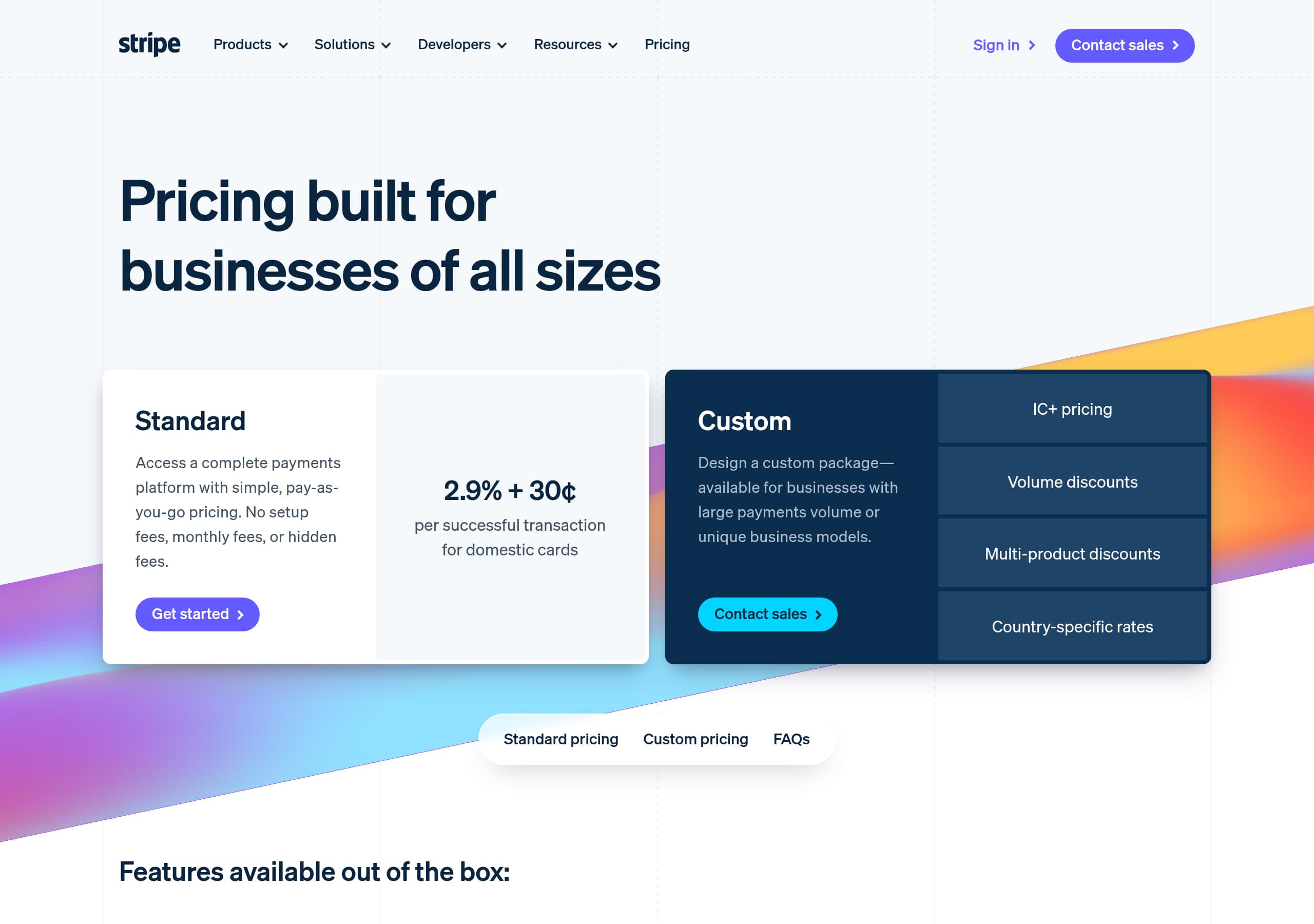
Stripe’s pricing presentation is designed to feel predictable at first glance while acknowledging that real-world payments and revenue stacks can be complex. The homepage teaser reinforces the positioning: “Integrated per-transaction pricing with no hidden fees,” then links into “Pricing details,” which is a strong trust move because it pre-empts the common fintech concern of opaque add-ons.
Visually (based on the provided pricing screenshot) the page leans into structured, scannable modules—tabs/rows and product groupings—rather than a single universal plan. That matches Stripe’s product reality: Payments, Billing, Connect, Terminal, Tax, Radar, etc., each with different pricing mechanics. This reduces confusion because visitors can anchor on the exact product they need instead of reverse-engineering a bundle.
A notable pattern is the pairing of self-serve clarity with enterprise escalation:
- Self-serve visitors are directed to straightforward, usage-aligned pricing (per transaction / per unit).
- Larger buyers are offered “Contact sales” and “custom package” language, which normalizes negotiation for high volume, multi-entity, or platform scenarios.
The excerpt also shows an example of metered pricing behavior (e.g., “Tokens €0.01 per 1,000 units” with a usage meter). This is an important signal: Stripe is aligning pricing with modern API consumption models, which resonates with AI, agentic commerce, and developer-led teams.
What makes this effective conversion-wise is the sequencing:
- Promise of no hidden fees,
- Clear entry points by product/use case,
- A final safety valve for edge cases via sales.
The result is lower abandonment for SMBs and fewer dead-end questions for enterprise evaluators.
Features
Stripe’s feature presentation works because it’s organized as a modular financial operating system rather than a single payments checklist. The homepage explicitly frames “Flexible solutions for every business model” and then immediately lists multiple adjacent capabilities—payments optimization, billing models, agentic commerce monetization, card issuing, stablecoins/crypto movement, and embedded platform payments. This breadth matches Stripe’s target: companies that expect their revenue model to evolve.
A key strength is how features are tied to business outcomes, not just product names:
- “Accept and optimise payments globally – online and in person” maps to Payments + Terminal.
- “Enable any billing model” maps to Billing, usage-based billing, subscriptions, invoicing.
- “Embed payments in your platform” maps to Connect and platform monetization.
- “Access borderless money movement with stablecoins and crypto” positions Stripe Crypto and modern rails.
The page also uses forward-looking feature messaging (“Agentic Commerce Protocol (ACP)”) to claim leadership in emerging channels where AI agents initiate purchases. That’s not merely a feature; it’s a strategic category bet, and presenting it alongside core payments reduces the perception that it’s experimental.
For technical validation, Stripe complements feature breadth with platform capability stats: 500M+ API requests/day, 10K+ API requests/second, 150K+ transactions/minute. Those numbers convert “it can scale” into something concrete.
In terms of UI patterns, Stripe employs progressive expansion via links (“Read the guide,” “Learn how,” “Explore no-code,” “Get started”) rather than dumping a massive product grid above the fold. The full product index still exists (Payments, Billing, Radar, Tax, Identity, etc.) but it’s placed where evaluators expect it—near the bottom navigation—keeping the main narrative clean.
Overall, Stripe’s features are presented as composable building blocks with clear mapping from capability → product → outcome.
Signup
Stripe’s signup motion is optimized for speed while keeping an enterprise escape hatch visible at all times. The hero supports instant conversion with “Start now” and reduces friction further with “Sign up with Google,” which is a high-impact choice for developer-led adoption because it eliminates password setup and lowers time-to-dashboard.
The site also sets an explicit expectation for onboarding speed: “Get up and running with Stripe in as little as 10 minutes.” That single line functions like a micro-SLA for activation and can materially increase trial starts, especially for founders and engineers evaluating multiple payment providers.
Stripe’s onboarding messaging is structured around integration paths rather than generic “create account” steps:
- “Don’t code?” → configure billing, take in-person payments, or share a payment link from the Stripe Dashboard, no code required.
- “Use a pre-integrated platform” → directory of platforms that integrate Stripe with website builders.
- “Build your own integration” → SDKs, APIs, MCP server, and AI developer tools.
This is effective because it routes users based on capability (no-code vs developer) and context (existing platform vs custom app), which reduces early churn caused by choosing the wrong setup. It also signals that Stripe supports both quick wins (Payment Links, Dashboard setup) and deep customization (APIs, orchestration across processors).
For higher-intent, higher-complexity buyers, “Contact sales” appears repeatedly (top nav and end-of-page CTA). That prevents a common enterprise failure mode where teams start self-serve, hit compliance/contract requirements, and stall.
The end-of-page CTA block is clear and action-oriented: “Create an account instantly, or contact us to design a custom package.” That language neatly frames two legitimate paths rather than implying one is secondary.
Net result: Stripe’s signup is designed for fast activation, persona-based routing, and low dead-end risk.
Trust
Stripe builds trust with a layered approach: reliability metrics, compliance-oriented navigation, and visible ecosystem support—all placed where risk-aware buyers look. The “backbone of global commerce” block is a trust centerpiece, using specific operational claims: 99.999% historical uptime, US$1.4tn processed in 2024, and 135+ currencies and payment methods supported. These are not vague statements; they’re measurable indicators that de-risk vendor selection.
A second trust layer is performance under stress. The “150K+ users have their best day ever on Stripe” module references Black Friday through Cyber Monday volume (US$40bn) while maintaining 99.9999% uptime. Pairing peak-event performance with uptime is particularly persuasive for e-commerce and marketplaces that fear revenue loss during high-traffic moments.
Third, Stripe emphasizes implementation confidence through:
- “Professional services” for complex integrations/migrations.
- “Stripe-certified experts” via consulting partners.
- “Support plans” with tiered assistance.
This triad signals that Stripe can support both DIY teams and organizations needing formal delivery and SLAs. It also reduces the perceived risk of being “stuck” after purchase.
From the screenshots (trust/security page), Stripe appears to use formal trust UI patterns—security headings, compliance language, and structured sections—consistent with enterprise SaaS expectations. The footer navigation further reinforces governance with links like “Privacy and terms,” “Prohibited and restricted businesses,” “Licences,” and cookie settings.
Additionally, developer trust is supported by explicit transparency links: API status, API changelog, documentation, and SDK libraries. These artifacts matter because they indicate operational maturity and change management discipline.
Overall, Stripe’s trust messaging is strongest where it is most concrete: uptime, scale, support structure, and regulatory readiness.
Footer
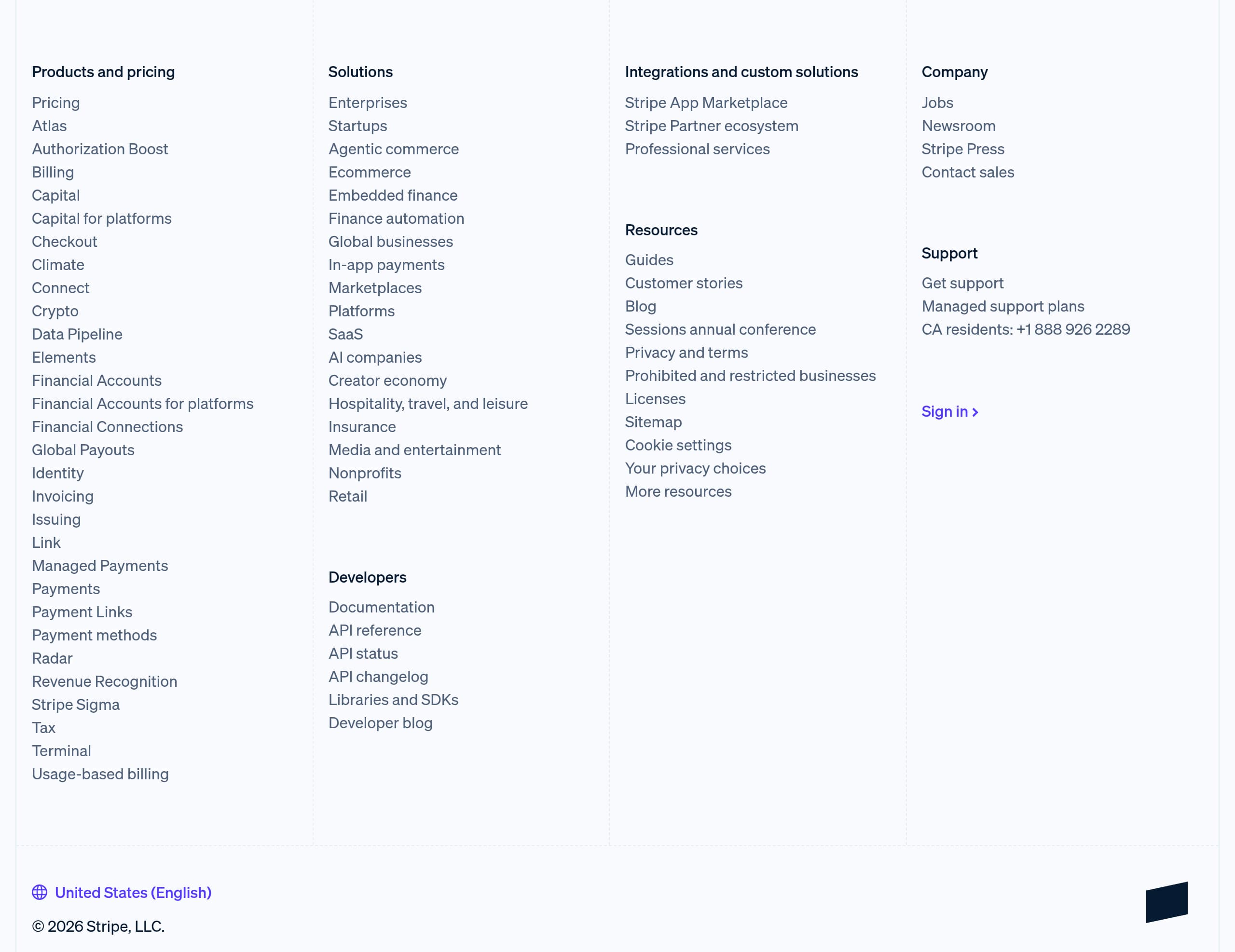
Stripe’s footer functions as a full-site directory for multiple personas—buyers, developers, partners, and compliance reviewers—without feeling like an afterthought. It’s comprehensive and intentionally redundant: products appear as a long-form index (e.g., Payments, Billing, Checkout, Connect, Radar, Tax, Terminal, Identity, Issuing, Stripe Sigma), while solutions are grouped by audience and industry (Enterprises, Startups, SaaS, Marketplaces, Retail, AI companies, Creator economy). This helps both SEO and navigation, because it mirrors how people search and how procurement teams evaluate.
Two specific footer strengths stand out:
-
Developer-centric completeness. The “Developers” column includes Documentation, API reference, API status, API changelog, Libraries and SDKs, and a Developer blog. The presence of status + changelog links is a credibility signal: it implies operational transparency and predictable versioning.
-
Compliance and governance visibility. The footer includes “Privacy and terms,” “Prohibited and restricted businesses,” “Licences,” “Sitemap,” and “Cookie settings.” Payments providers are scrutinized for regulatory posture; surfacing these links reduces friction for legal/compliance stakeholders who often join late in the buying process.
The footer also supports ecosystem expansion with “Stripe App Marketplace,” “Stripe Partner ecosystem,” and “Professional services,” which reinforces that Stripe is a platform with implementers—not just a tool you integrate once.
A final UX detail: the locale selector (e.g., “Finland (English)”) signals global readiness, matching the earlier claim of 135+ currencies and international scale.
In conversion terms, the footer keeps “Contact sales,” “Support,” and “Get support” accessible, which is important for enterprise evaluation and for troubleshooting during implementation. Overall, it’s a navigation hub, trust artifact, and SEO surface area rolled into one.
Detected tech stack
Tools and technologies we detected on Stripe's site. Detection is best-effort and may be incomplete.
Frontend
Scores
Our framework scores for Stripe's website in terms of clarity, conversion, and trust. See our methodology for how we calculate these.
How clear the value prop and structure are.
How conversion-friendly signup and pricing are.
How well trust and compliance are surfaced.
FAQ
Stripe leads with a single, scalable value proposition (“Financial infrastructure to grow your revenue”) and immediately supports both self-serve and enterprise motions with “Start now,” “Sign up with Google,” and “Contact sales.” It then proves credibility using hard metrics (US$1.4tn processed in 2024, 99.999% historical uptime, 135+ currencies) and routes visitors by audience (enterprises, startups, platforms) without forcing an early decision.
Stripe frames pricing as transparent and usage-aligned with the promise of “integrated per-transaction pricing with no hidden fees,” then directs users to detailed pricing by product. The experience supports self-serve evaluation while keeping “Contact sales” available for custom packages, high-volume rates, or complex platform setups. The site also signals modern metered models (e.g., token-based usage) to fit API-driven and AI-era consumption patterns.
Stripe uses quantified case studies and names recognizable customers across segments. Examples include “50% of Fortune 100 companies,” and stories that list concrete scale indicators (countries, locations, revenue volume) plus the exact Stripe products used (Payments, Terminal, Connect, Radar, Stripe Sigma). Executive quotes reinforce implementation benefits like reduced engineering effort and faster launches, making adoption feel repeatable for similar buyers.
Stripe reduces signup friction with prominent “Start now” CTAs and “Sign up with Google.” It sets an activation expectation (“get up and running… in as little as 10 minutes”) and then routes users into the right integration path: no-code setup in the Stripe Dashboard, pre-integrated platforms via a directory, or custom builds using SDKs and APIs. “Contact sales” remains available for enterprise onboarding needs.
Stripe highlights measurable reliability and scale, including 99.999% historical uptime, 500M+ API requests per day, and high peak-event performance (e.g., US$40bn processed over Black Friday to Cyber Monday with 99.9999% uptime). It also surfaces operational transparency links like API status and API changelog, and provides structured support options such as professional services, Stripe-certified partners, and tiered support plans.

The world's best-performing SaaS businesses share surprisingly similar patterns. We help you learn and apply them through our human-designed methodology, with AI-assisted research.