
Key takeaways
Here are the key insights from our website breakdown analysis of Revolut.
Revolut.com leads with a product-first hero that pushes users directly into the app funnel, using prominent “Get the app” CTAs and mobile UI imagery to reduce ambiguity about the next step.
The Pricing page sells the upgrade path clearly by showing multiple plans side-by-side and emphasizing the most popular tier, which makes comparison fast and nudges higher-intent users to paid plans.
Revolut uses compliance and safety messaging as conversion support rather than as standalone content, placing regulatory and risk language near decision points where users hesitate.
Navigation and footer structure are built for scale: large link clusters for Personal, Business, Company, and Help content signal breadth (banking, cards, crypto, travel) without cluttering the hero.
The site balances broad “financial super app” positioning with specific, scannable use cases (spending, saving, investing, travel), which helps different audiences self-select quickly.
Home
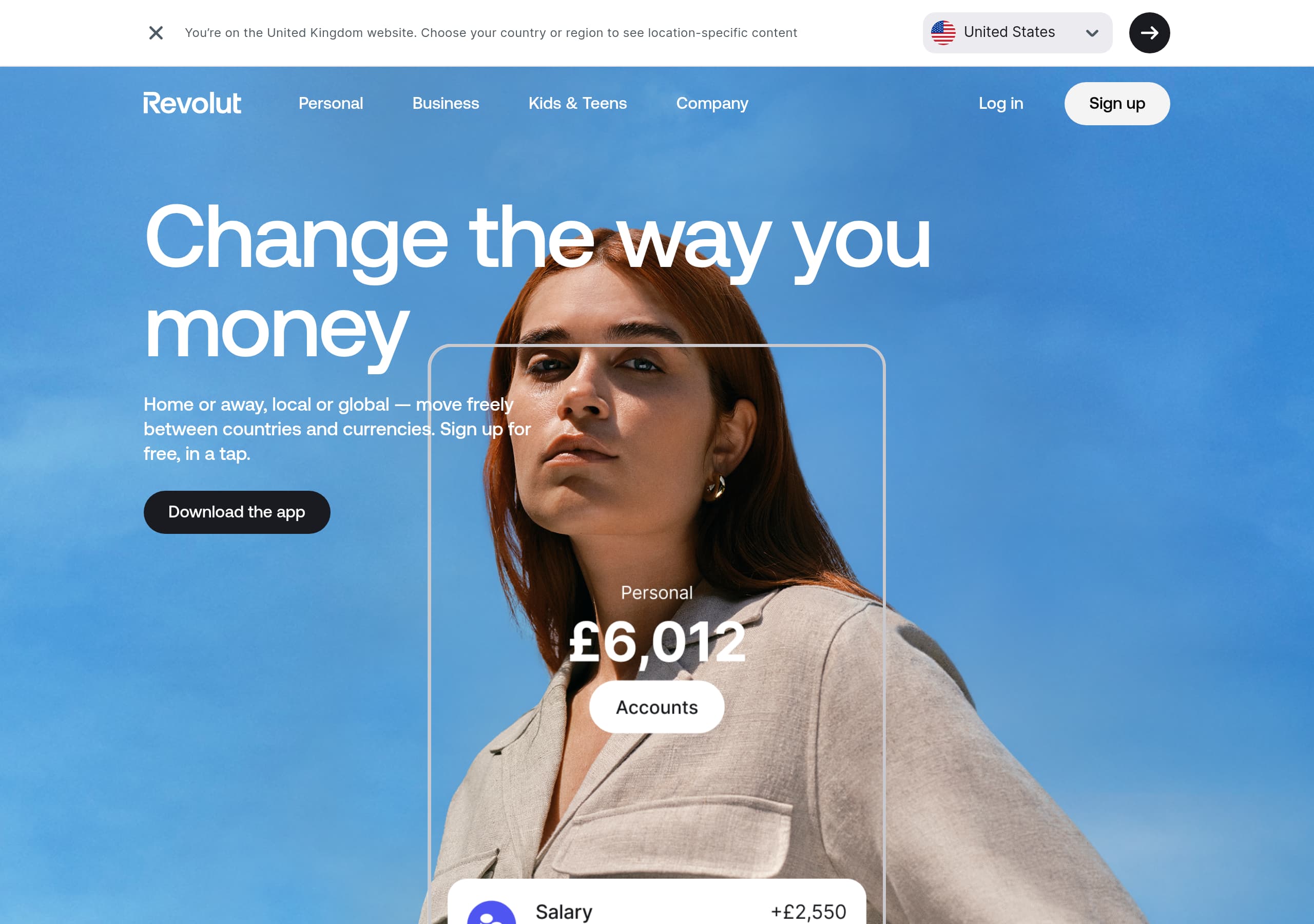
Revolut.com’s homepage is built to drive app installs by making the primary CTA unambiguous and visually tied to the product. The hero uses a large phone UI mock and short headline/value line, which communicates “this is an app-led financial product” in seconds.
Key conversion choices visible in the layout:
- A dominant Get the app button (with a secondary action nearby) keeps the decision set small.
- Product UI imagery acts as proof-of-function: visitors see cards, balances, and flows instead of abstract claims.
The page also handles broad positioning (“all-in-one money app”) by letting users self-select via navigation (Personal vs Business) rather than forcing a long explainer in the hero. This is effective for mixed-intent traffic: high-intent users can download immediately, while cautious users can scroll for features, pricing, and trust cues. The overall hierarchy—short copy, strong CTA, app visual—reduces time-to-understanding and supports paid and organic acquisition.
Pricing
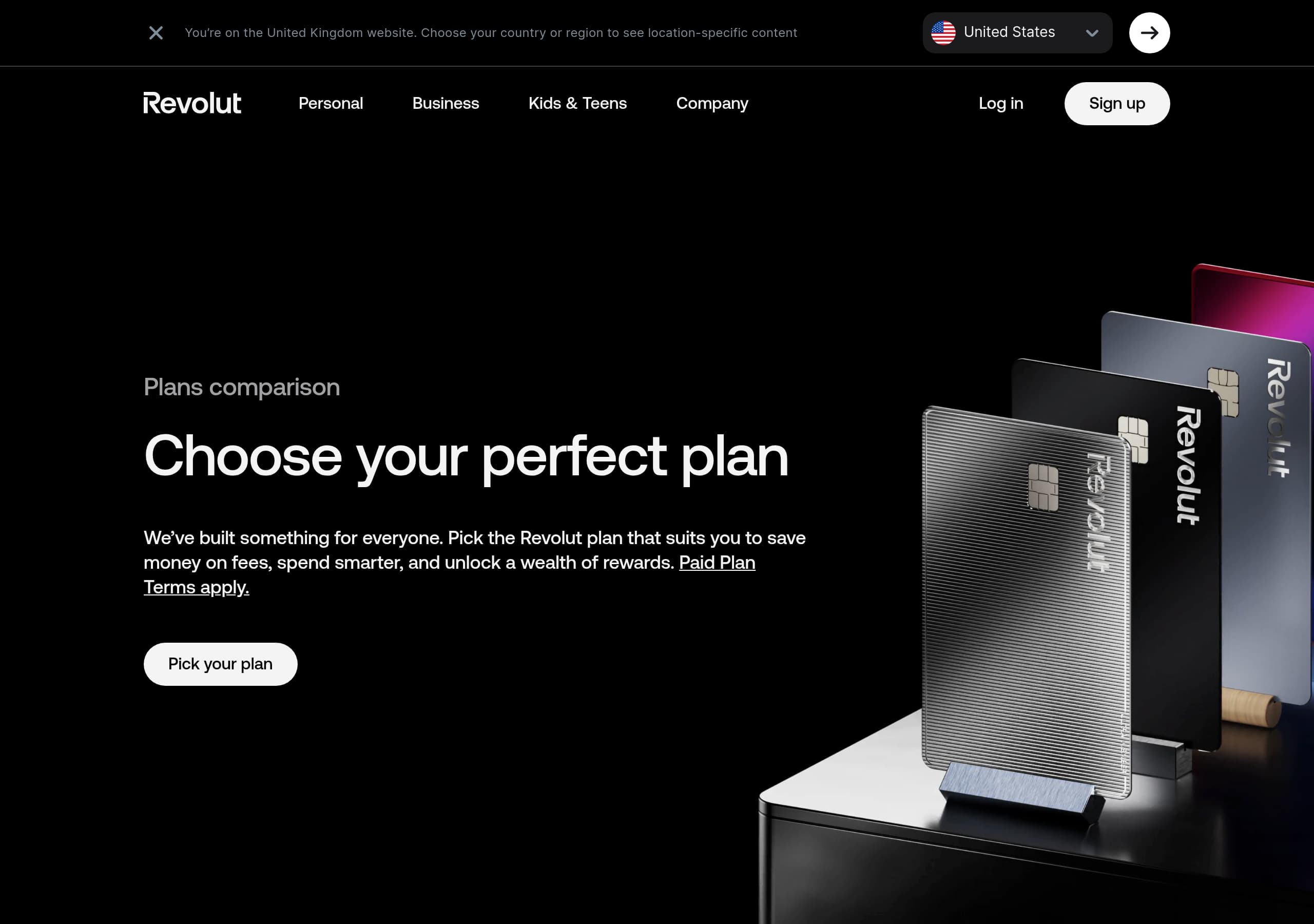
Revolut.com’s Pricing page is optimized for quick comparison and upgrade nudges using a standard SaaS tier grid. Plans are presented side-by-side with clear names and per-month pricing, and one tier is visually emphasized as most popular, a pattern that typically lifts mid-tier selection.
What works tactically:
- The plan cards create a predictable scan path: users compare price first, then benefits.
- Clear CTAs on each tier reduce friction; you don’t have to hunt for the next step.
- Benefits are framed as thresholds (more limits/perks at higher tiers), which fits a product with many use cases.
Because Revolut spans spending, travel, and investing, a tier layout prevents the “endless feature list” problem. The pricing UI also supports segmentation: free entry for low-risk adoption, then visible paid options for users who already value perks. This structure improves conversion by turning a complex product into a simple choice architecture.
Features
Revolut.com communicates breadth without overwhelming users by grouping capabilities into scannable modules and routing detail into deeper pages. The homepage structure suggests a “financial super app” positioning, but it relies on feature clusters (spend, save, invest, travel/business) rather than a single dense list.
Why this feature presentation converts:
- Scannability: tile/section blocks let visitors find their use case quickly (e.g., cards, budgeting, travel perks).
- Feature visuals (app screens) reduce skepticism because users can see workflows, not just marketing claims.
- The navigation separates Personal vs Business, which prevents mixing audiences and keeps copy relevant.
This is especially effective for Revolut because it competes across categories (traditional banks, Wise for FX, PayPal/Cash App for transfers, and neobanks for everyday spending). A modular feature layout lets Revolut highlight differentiators at the top level while leaving compliance details and edge cases to dedicated pages.
Signup
Revolut.com minimizes signup friction by treating onboarding as an app-first flow: the main CTA pushes users to Get the app rather than fill a long web form. This is a practical choice for KYC-enabled fintech because identity verification and card provisioning are typically smoother inside a mobile app.
Conversion-friendly elements implied by the homepage CTA structure:
- A single dominant action reduces indecision and supports mobile-first traffic.
- Repeated CTAs across sections keep users from needing to scroll back to convert.
- By moving signup into the app, Revolut can guide users through verification, permissions, and security steps in a controlled environment.
The trade-off is that some desktop users may want a web-first account creation path; Revolut counters this by making the next step explicit (install/open app) rather than hiding it behind ambiguous “Sign up” language. For a global consumer product, this keeps the funnel short while still enabling compliance-heavy onboarding behind the scenes.
Trust
Revolut.com supports trust through a combination of regulated-brand cues, clear plan structure, and accessible legal/support pathways. In fintech, trust is less about persuasive copy and more about visible signals that the company is legitimate, contactable, and compliant.
Trust mechanisms reinforced by the site structure:
- Pricing tiers and detailed plan pages indicate a stable product with defined terms (reducing “hidden fees” anxiety).
- The footer and navigation expose Help and Legal destinations, which is a common pattern for regulated services.
- Product UI imagery implies real functionality (accounts, cards, controls) rather than vague promises.
Revolut also benefits from being a known category leader; the site design emphasizes consistency and polish, which correlates with perceived security. Where possible, placing regulatory disclosures and risk statements near investing/crypto modules prevents trust breaks. Overall, the trust approach is “visible infrastructure”—easy-to-find policies, support, and structured information—rather than long reassurance paragraphs.
Footer
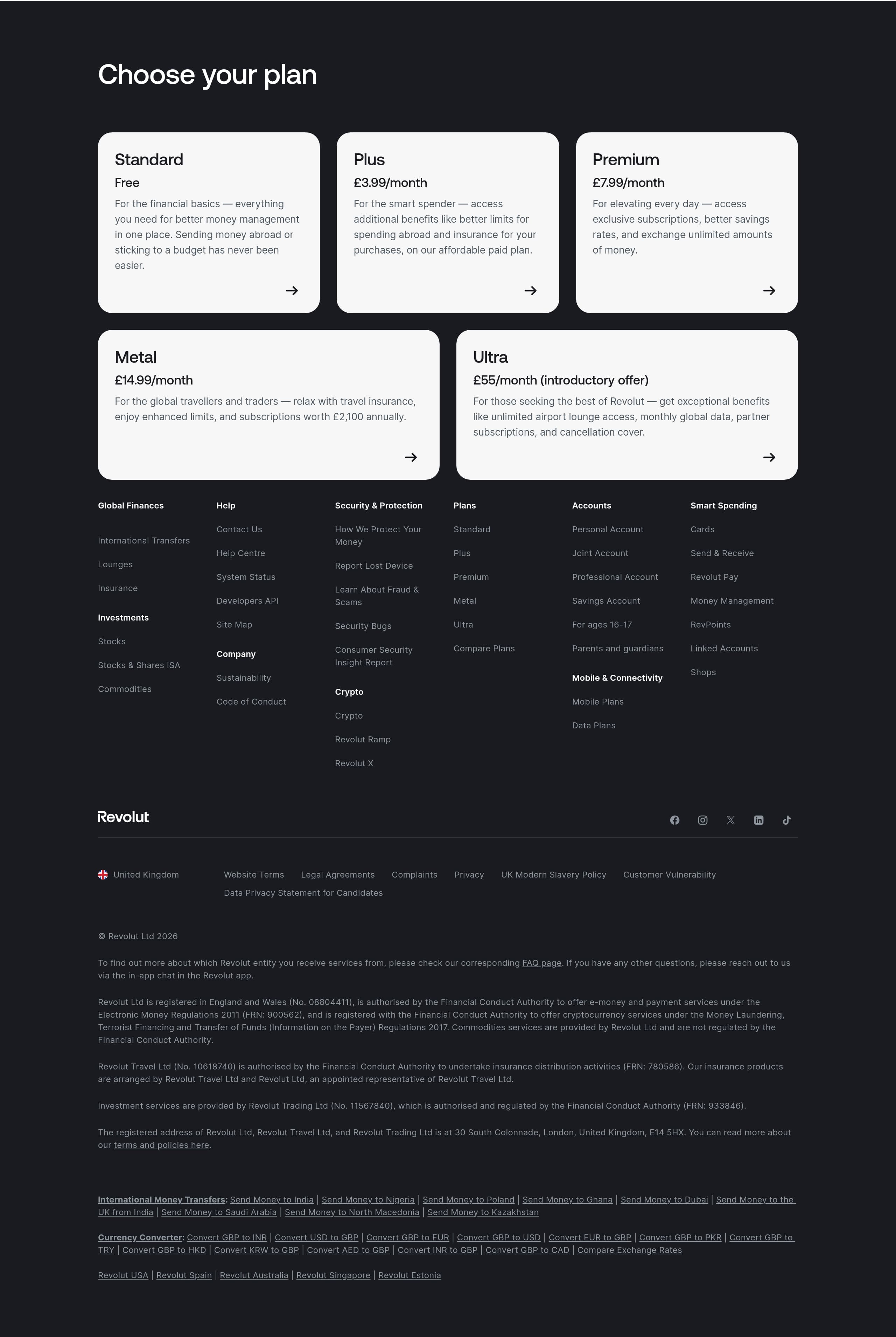
Revolut.com’s footer is intentionally dense and segmented, functioning as both a trust artifact and a navigation index. In the footer screenshot, links are grouped into multiple columns covering Personal, Business, Company, Help, and Legal areas, which signals operational maturity and makes it easy to find critical information.
Why this footer design performs:
- It improves SEO internal linking by exposing many crawlable destinations (features, pricing, support, company pages).
- It reduces compliance friction by making privacy/terms and other legal resources easy to access without cluttering primary pages.
- It supports multi-audience routing (consumer vs business) with clear taxonomy, lowering bounce for mismatched intent.
For a global fintech like Revolut, the footer’s breadth is a credibility cue: users expect disclosures, regional considerations, and support options. The structured layout avoids the “wall of links” problem by keeping categories distinct and readable, which is especially important on mobile where footer usability often breaks down.
Detected tech stack
Tools and technologies we detected on Revolut's site. Detection is best-effort and may be incomplete.
Scores
Our framework scores for Revolut's website in terms of clarity, conversion, and trust. See our methodology for how we calculate these.
How clear the value prop and structure are.
How conversion-friendly signup and pricing are.
How well trust and compliance are surfaced.

The world's best-performing SaaS businesses share surprisingly similar patterns. We help you learn and apply them through our human-designed methodology, with AI-assisted research.