

Key takeaways
Here are the key insights from our website breakdown analysis of Shopify.
Shopify uses a single, high-level value proposition (“All-in-One Commerce Platform”) and immediately pairs it with a low-friction primary CTA (“Start for free”), reducing decision overhead for first-time visitors.
The homepage systematically expands the use case from solo sellers to enterprise (including Shopify Plus), which widens the addressable audience without changing the core promise of “one platform behind it all.”
Proof is quantified and specific—$1T+ in merchant sales, 15% higher checkout conversion, 150M+ high-intent shoppers, 50ms global performance—which makes claims feel verifiable rather than marketing-heavy.
Shopify frames features as end-to-end workflows (sell, market, manage, ship, finance) and repeatedly anchors them to named products like Shopify Checkout, Shopify POS, Shopify Markets, and Shopify Shipping.
The site converts skepticism into confidence via recognizable merchant examples (Gymshark, Mattel) plus developer credibility (Hydrogen, shopify.dev, APIs), reinforcing both brand and platform depth.
Home
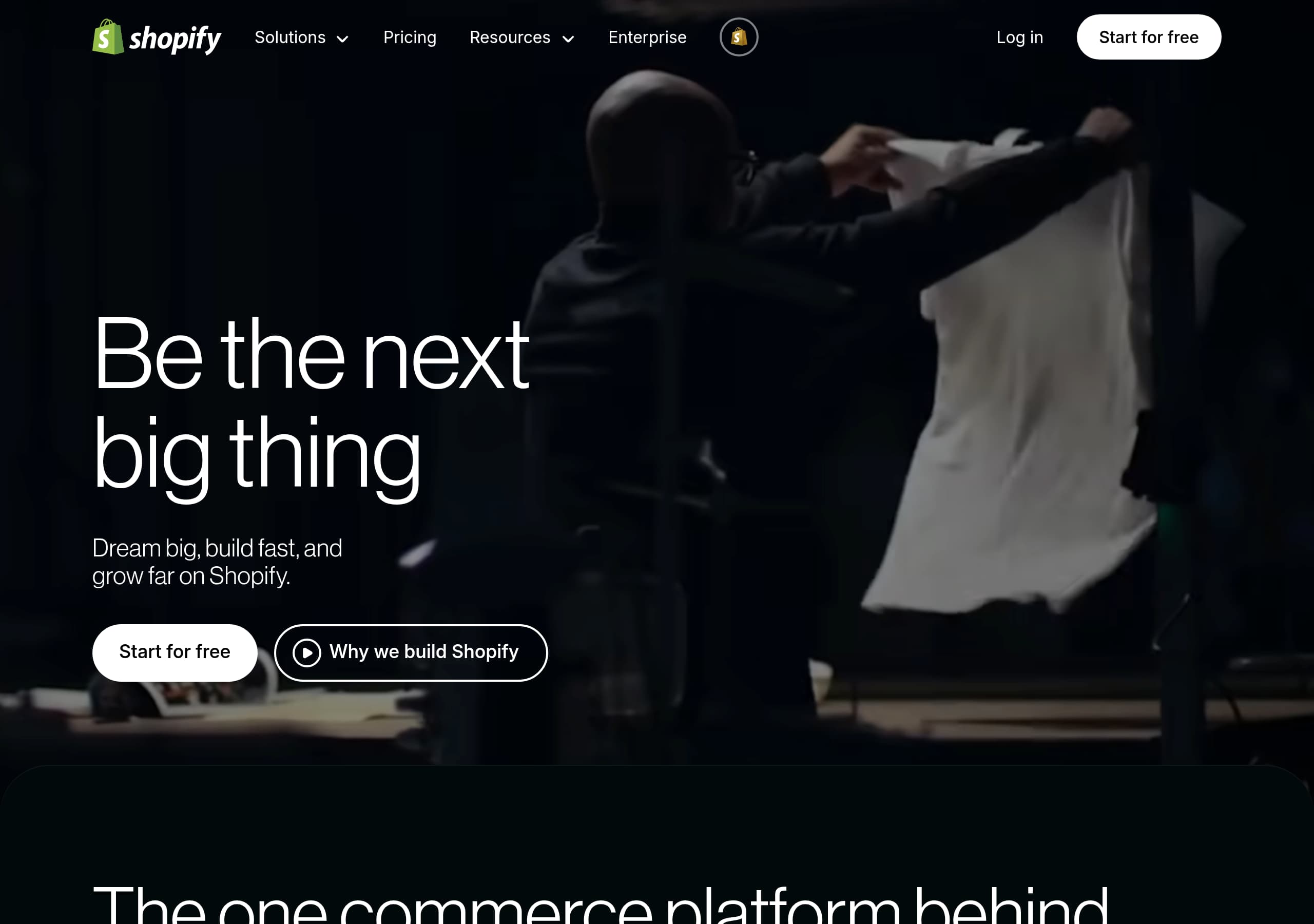
Shopify’s homepage leads with an action-first CTA (“Start for free”) and a broad but legible positioning: “The All-in-One Commerce Platform for Businesses.” The hero copy (“Dream big, build fast, and grow far on Shopify.”) sets an outcome frame, while the nav instantly segments intent into Start / Sell / Market / Manage, which matches how merchants think.
The page then validates the platform with concrete scope statements (“Sell online and in person… locally and globally… direct and wholesale”) and keeps the messaging skimmable through short, parallel lines.
Notable conversion elements:
- A visible logo wall (merchant domains like glossier.com, brooklinen.com) to signal variety.
- A quantified scale claim: $1T+ in sales on Shopify.
- A simple “Pick a plan that fits” transition that keeps visitors moving without forcing early plan choice.
The result is a clear “start now, grow later” story that supports both first-time sellers and Shopify Plus buyers.
Pricing
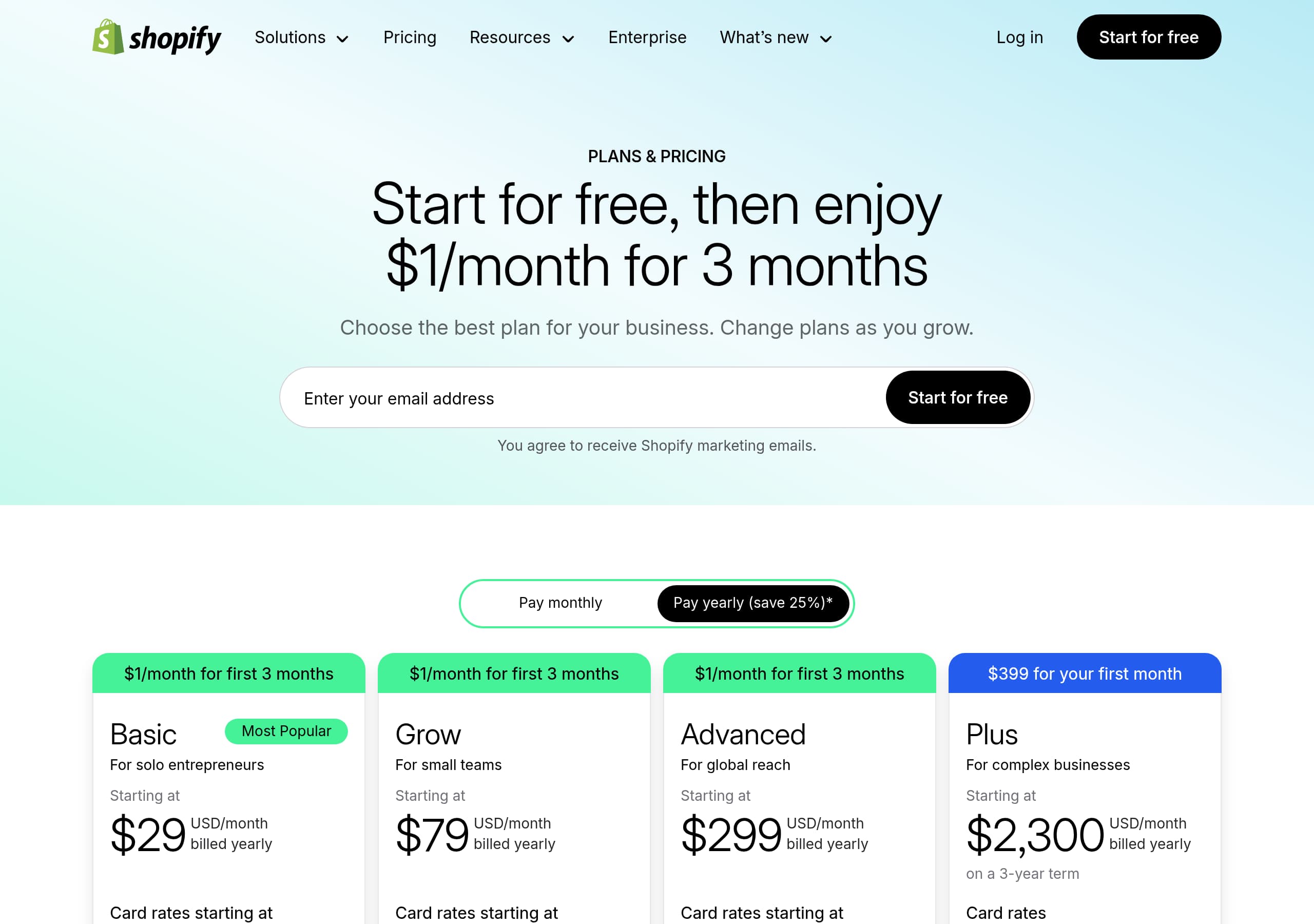
Shopify’s pricing presentation (as shown in the screenshot) is designed to reduce comparison fatigue with a clean, card-based layout and a dominant plan selector that encourages quick scanning. The strongest conversion pattern is that pricing is treated as a step in evaluation, not a gate: Shopify repeatedly uses “Start for free” across the site, so visitors can begin setup before committing to a long-term plan.
What works tactically:
- Pricing is visually grouped into a small number of tiers, making the choice set feel manageable.
- Tier cards emphasize merchant outcomes (selling online/in person, scaling) rather than technical specs alone.
- The page design uses clear hierarchy (plan name → price → primary CTA) to preserve CTA clarity.
For a product that competes with WooCommerce, BigCommerce, and Wix, this approach keeps the “why Shopify” argument tied to speed, conversion (checkout), and ecosystem depth instead of purely undercutting on price.
Features
Shopify’s feature architecture is presented as end-to-end commerce workflows, not a grab bag of tools. The navigation and page sections map to merchant jobs: build (Online Store Editor, themes), sell (Shopify POS, multichannel), convert (Shopify Checkout), expand (Shopify Markets, Shopify Shipping), and operate (Shopify Admin, analytics).
Feature messaging is strengthened by named entities, which improves memorability:
- Shopify Checkout is positioned as “world-class” and “optimized to close more sales.”
- Shopify Audiences is tied to a measurable claim: “Cut acquisition costs as much as 50%.”
- Shopify App Store is quantified at 13,000+ apps, framing extensibility as a platform advantage.
For technical buyers, Shopify adds a developer lane (APIs, Hydrogen, extend checkout, shopify.dev), signaling that Shopify can serve both template-based SMB builds and custom storefront teams without switching platforms.
Signup
Shopify minimizes signup friction by making “Start for free” the dominant CTA and by explaining time-to-value in a simple 3-step onboarding preview. The page spells out the setup sequence as: 01 Add your first product, 02 Customize your store, 03 Set up payments, which reduces uncertainty about what happens after clicking.
This is effective because it:
- Sets clear expectations for a first session, lowering abandonment risk.
- Frames onboarding around merchant outputs (product, store, payments) rather than configuration tasks.
- Keeps the evaluation path open even for advanced buyers (Shopify Plus, B2B) by not forcing immediate plan selection.
The site also supports multiple entry points (Start, Pricing, Solutions) while preserving a consistent primary action. For comparison shoppers considering alternatives like WooCommerce, the onboarding framing implicitly promises a faster path than assembling hosting, plugins, and payment setup separately—without explicitly attacking competitors.
Trust
Shopify builds trust using performance, scale, and operational credibility rather than generic security badges. The trust narrative includes measurable infrastructure claims: Shopify places stores within 50 milliseconds of shoppers globally and can handle “epic product drops,” which directly addresses uptime anxiety for launches.
It adds authority with platform investment signals:
- A stated workforce: 4000+ developers.
- A predictable shipping cadence: “Every 6 months… 150+ new features” via Shopify Editions.
Financial trust is reinforced through Shopify Capital with clear constraints:
- “$5B loaned out so far.”
- Loans up to $2M and 0% equity.
Checkout trust is quantified with the 15% higher conversion claim and the reference to an external consulting study (April 2023). Together, these signals address reliability, innovation, and business risk—key trust factors for merchants processing payments and operating across channels.
Detected tech stack
Tools and technologies we detected on Shopify's site. Detection is best-effort and may be incomplete.
Scores
Our framework scores for Shopify's website in terms of clarity, conversion, and trust. See our methodology for how we calculate these.
How clear the value prop and structure are.
How conversion-friendly signup and pricing are.
How well trust and compliance are surfaced.

The world's best-performing SaaS businesses share surprisingly similar patterns. We help you learn and apply them through our human-designed methodology, with AI-assisted research.
