
Key takeaways
Here are the key insights from our website breakdown analysis of ClickFunnels.
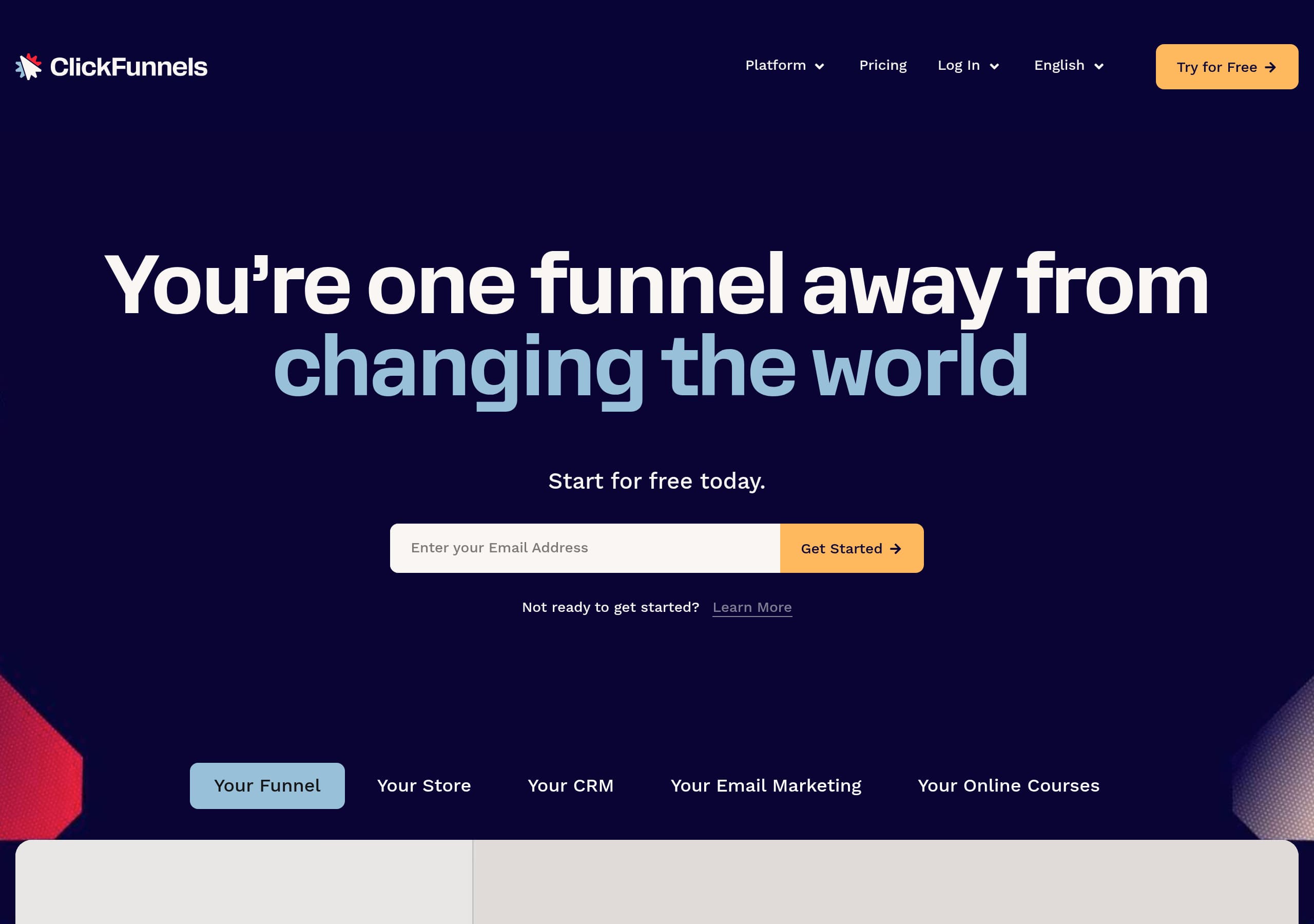
ClickFunnels leads with a direct promise and a low-friction CTA, pairing “You’re one funnel away from changing the world” with repeated Try for Free and an email-only field to minimize hesitation.
The homepage clarifies the product scope by framing ClickFunnels as an all-in-one platform, then reinforcing it with five parallel blocks, Your Funnel, Your Store, Your CRM, Your Email Marketing, and Your Online Courses, each with its own CTA.
ClickFunnels uses strong narrative social proof, stacking multiple named testimonials plus visible counters like 100K+ ClickFunnels Users and 1M+ Sales Funnels Created to validate adoption and outcomes without relying on vague claims.
The features presentation is conversion-oriented, listing funnel-critical components like Smart Checkout, A/B Testing, and app modules (Courses, Community, Email, Automations) in a scannable grid that maps to buyer jobs.
Pricing and signup are consistently routed through “Try for Free” rather than pushing immediate purchase, which supports list capture and trial starts, but may add one extra step for users who want instant plan-level details.
Trust is built more through “creator success” proof and brand maturity signals (multi-language navigation, Classic vs new product paths, status links) than through explicit security and compliance badges on the primary marketing pages.
Home
ClickFunnels makes the homepage do one job: push visitors into a free start while anchoring the product around funnels as the core mental model. The hero combines a bold positioning line, “You’re one funnel away from changing the world,” with an immediate email field and Get Started button, then repeats Try for Free in the top navigation, keeping the primary action visible.
A notable clarity pattern is how ClickFunnels expands beyond “funnel builder” without losing focus. Right under the hero, it introduces five parallel value blocks: Your Funnel, Your Store, Your CRM, Your Email Marketing, and Your Online Courses. Each block has a one-paragraph benefit statement and its own Try for Free CTA, which lets different audiences (creators, ecommerce sellers, coaches) self-select. The copy stays outcome-driven, for example “convert your online visitors into paying customers,” and avoids deep technical jargon.
The homepage also reinforces a “future forward” narrative by calling out “The funnel builder that started it all just got better” and linking to “Learn more,” which functions as a secondary CTA for evaluators who are not ready to trial. Structurally, the page uses repeated CTA modules (“Ready to get started? Enter your Email Address”) to re-capture intent after long scroll sections.
Where ClickFunnels is especially effective is in pairing simple promises with concrete modules. The top feature strip includes ClickFunnels Editor, Smart Checkout, and A/B Testing, which are instantly legible as conversion levers. Combined with the “Funnels for Creators” section and the “funnel mindset” ladder, the homepage reads like a guided path rather than a generic SaaS landing page.
Pricing
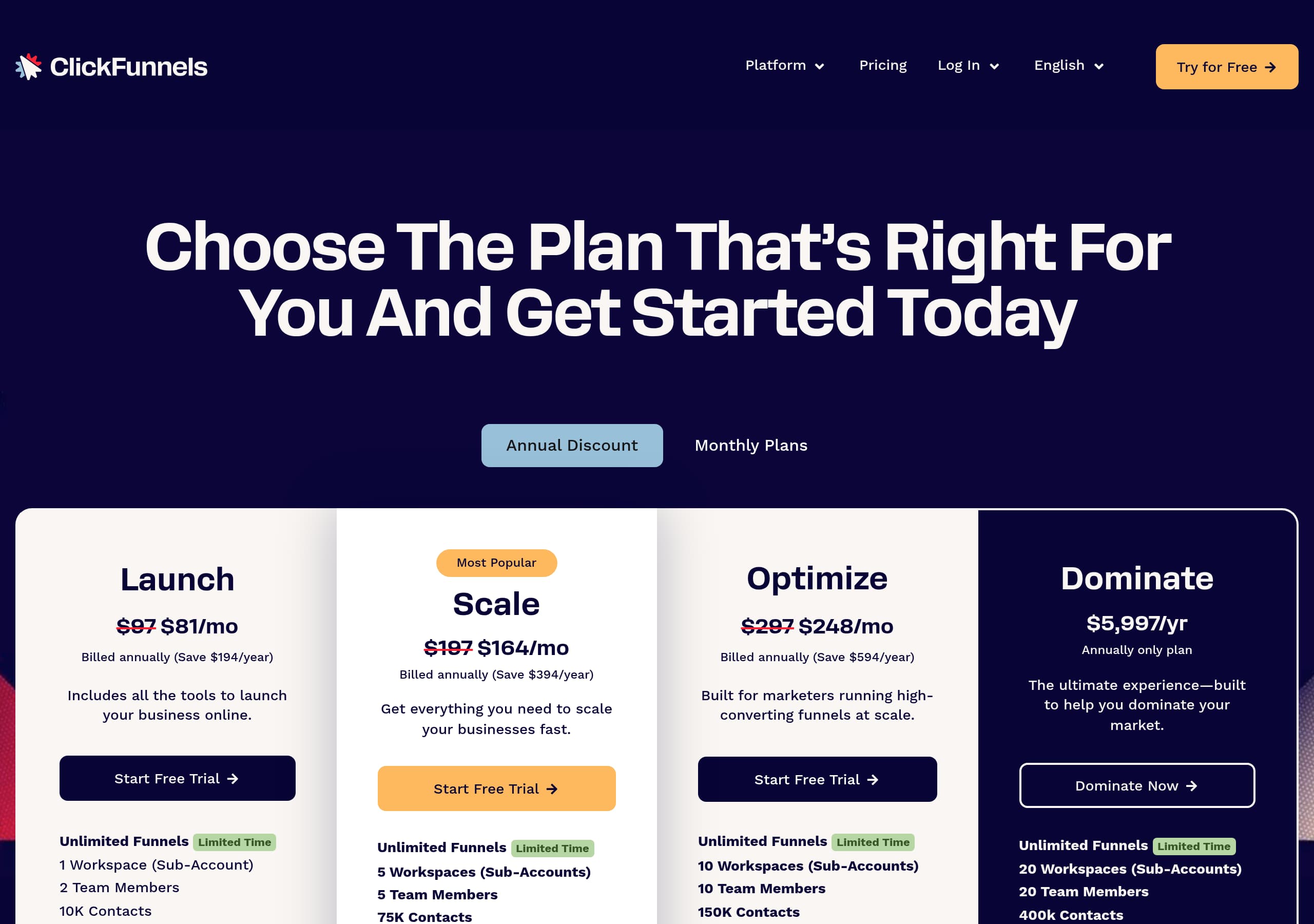
ClickFunnels uses pricing to funnel users into a trial-first decision instead of forcing an immediate plan choice, which aligns with its repeated Try for Free positioning across the site. From the screenshot, the pricing page appears structured around tiered plans with a clear hierarchy, plus prominent CTA buttons that keep the action consistent with the rest of the experience.
What works is the way ClickFunnels frames value in terms of included platform breadth, not just funnel count. On the homepage excerpt it repeatedly claims “Included for free in every plan” for apps like Landing Pages, Courses, Community, Email, Automations, and Analytics. That message matters on pricing because it reduces the fear of choosing the “wrong” tier: visitors can assume core apps are not paywalled and focus on scale differences. In practice, this is a strong bundle positioning tactic that competes directly with piecemeal stacks (page builder plus email tool plus course platform).
A conversion-friendly detail is the consistent routing to trial CTAs rather than “Contact sales,” and the presence of navigation that includes Pricing plus Log In plus “ClickFunnels Classic,” which supports both new buyers and existing customers. If the pricing layout uses multiple CTAs per tier, the best practice is already present on the brand side: single primary CTA language site-wide (“Try for Free”).
The biggest opportunity is to tighten plan differentiation messaging on-page. ClickFunnels lists many modules, so pricing can become hard to compare without a short “best for” line per tier and a small number of highlighted gates (for example limits, advanced features, or support). Clear plan comparison cues, visible billing toggle (monthly vs annual), and explicit trial terms near the CTA are the details that usually determine whether a visitor commits on the pricing page.
Features
ClickFunnels presents features in a way that mirrors how buyers think about revenue, not how engineers think about modules. The top-level feature entry points are “Funnels” and “Sales Funnels,” followed by three instantly legible conversion tools: ClickFunnels Editor, Smart Checkout, and A/B Testing. That ordering matters because it tells visitors, “You can build pages, you can take payments, and you can optimize,” which is the core loop for funnel-driven growth.
Deeper on the page, ClickFunnels switches to an “Our Apps” style grid with many discrete capabilities: Landing Pages, Survey Workflows, Countdown Funnels, Courses, Community, Store, Email, Automations, Message Hub, Appointments, Opportunities, Analytics, Discounts, Payments AI, Short Links, and Affiliate Center. The UI pattern of repeated “Learn More” links suggests a hub-and-spoke information architecture, helpful for SEO and for scanning. The phrase “Included for free in every plan” is a strong feature bundling claim that reduces the mental math of add-ons.
A differentiating feature story here is the breadth of business functions housed inside one platform: ecommerce store, email marketing, CRM pipelines, appointments, and community, in addition to funnels. The homepage reinforces this with the five “Your X” blocks, which function like a feature taxonomy by job-to-be-done.
Where ClickFunnels could improve feature comprehension is prioritization and proof. With 15+ apps listed, users can struggle to see what is primary versus optional. A tighter “top 5 used apps” callout, a short “works together” diagram, or a concrete example funnel flow (landing page to checkout to follow-up email) would make the all-in-one platform promise feel more tangible and reduce the perception of a crowded toolbox.
Signup
ClickFunnels optimizes signup for speed by asking for an email address directly on the homepage, then pushing users into a free start with a single primary action. The hero includes an inline field labeled “Enter your Email Address” with a Get Started button, and the site repeats “Start for free today” and Try for Free across multiple sections. This is a classic low-friction pattern: capture the minimum viable identifier first, then complete account details later.
The navigation reinforces this flow. “Try for Free” is present alongside “Log In,” and there is a “Not ready to get started? Learn More” secondary path that keeps evaluators on-site without forcing a commitment. The presence of “ClickFunnels Classic” in the header suggests ClickFunnels supports more than one product experience, so pushing new users into a single, consistent trial CTA is a way to reduce routing confusion.
From a conversion standpoint, the strength is consistency: the same CTA text appears on the hero, in each “Your Funnel/Store/CRM” module, and again near the bottom (“Ready to get started?”). This repetition is useful on long pages because it creates multiple entry points after feature education and social proof.
The main risk with email-first CTAs is expectation setting. Visitors want to know what happens after clicking, whether it is a full trial signup, a challenge registration, or an email capture. The page also promotes “One Funnel Away Challenge, Join FREE,” which is compelling but could create ambiguity about whether the CTA starts a software trial or the challenge funnel. A clear next step microcopy under the button (for example “Create your account in 2 minutes”) and a short note about trial terms would make the Try for Free promise feel more concrete.
Trust
ClickFunnels builds trust primarily through market maturity and outcome proof rather than through explicit security and compliance messaging on the main marketing surfaces. The excerpt shows multiple “Verified ClickFunnels User” labels, plus adoption counters like 100K+ ClickFunnels Users and 1M+ Sales Funnels Created. For a product in the funnel builder category, this kind of social validation often does more conversion work than technical compliance text, especially for creators and small businesses.
There are also subtle operational trust cues in the global navigation and footer. ClickFunnels links to “ClickFunnels Status” and “ClickFunnels Classic Status,” which signals the company maintains public uptime reporting and separates legacy infrastructure from the newer platform. That is a meaningful trust detail for teams running paid traffic and time-sensitive launches.
The site also supports multiple languages (English and 日本語 visible in the header), which implies a broader user base and a more mature product operation. The large, comprehensive product link list in the footer (API & Webhooks, API Docs, Integrations, Pricing, Help Center) reinforces that ClickFunnels is not a thin landing-page tool, it is a platform with developer and support surface area.
What is less visible in the provided content is explicit security posture. There are no observable trust badges for payments, data processing, or compliance frameworks in the excerpt, even though ClickFunnels includes “Payments AI” and checkout functionality. For users evaluating alternatives like Kajabi, Leadpages, Unbounce, or Shopify plus apps, missing details like data handling, SSO, or standard compliance statements can slow decisions. Adding a small, scannable security and privacy block near pricing and checkout features would complement the strong creator-led social proof already present.
Footer
The ClickFunnels footer functions as both a sitemap and a credibility artifact, and it is unusually dense in a way that benefits SEO and user self-service. From the screenshot and excerpt, the footer includes multiple product deep links (Sales Funnels, Websites, Ecommerce Store, Landing Pages, Blog, Customer Center, Email Marketing, Workflows, Smart Checkout, Online Courses, Membership Sites, A/B Testing, Analytics, CRM, Community), plus platform-level links like Integrations, API & Webhooks, and API Docs.
This structure supports two visitor modes: buyers who want reassurance that key capabilities exist, and existing users who need direct access to help and login. The footer includes “ClickFunnels Login” and “ClickFunnels Classic Login,” mirroring the header’s Classic toggle. That reduces frustration for returning users who might otherwise land on the marketing site and get stuck.
Trust and governance links are clearly present: Legal, Privacy Policy, and “Your Privacy Choices.” Including “Accessibility Options” is a notable signal that the company is addressing usability compliance and broader user needs. The company address is listed (225 Reformation Pkwy, STE 204, Canton, GA 30114) alongside “ClickFunnels.com, an Etison Product” and a visible copyright range (2019-2026). These details help with legitimacy, especially in a category that attracts many short-lived tools.
One improvement opportunity is to make the footer feel less overwhelming. The current density is great for crawl depth and power users, but it can be hard for new evaluators to parse. Grouping into labeled columns (Build, Sell, Automate, Support, Developers, Company) and highlighting 3 to 5 most visited links would preserve breadth while improving scanability. Still, as-is, the footer strongly reinforces platform breadth and operational maturity.
Detected tech stack
Tools and technologies we detected on ClickFunnels's site. Detection is best-effort and may be incomplete.
Scores
Our framework scores for ClickFunnels's website in terms of clarity, conversion, and trust. See our methodology for how we calculate these.
How clear the value prop and structure are.
How conversion-friendly signup and pricing are.
How well trust and compliance are surfaced.
FAQ
ClickFunnels keeps the homepage focused on one primary action: “Try for Free.” The hero includes an email field plus a “Get Started” button, and that same CTA is repeated throughout the page. It also clarifies product scope with five parallel blocks, “Your Funnel,” “Your Store,” “Your CRM,” “Your Email Marketing,” and “Your Online Courses,” each with its own benefit statement and CTA.
ClickFunnels routes pricing intent toward a trial-first motion, keeping “Try for Free” as the dominant CTA style rather than pushing immediate purchase. The product messaging emphasizes that apps are “Included for free in every plan,” which reduces fear of missing key modules. The pricing layout appears tiered and scannable, but plan differentiation needs to be very explicit because the platform includes many features.
ClickFunnels relies on stacked testimonials with named individuals labeled “Verified ClickFunnels User,” plus visible adoption counters such as “100K+ ClickFunnels Users” and “1M+ Sales Funnels Created.” The quotes focus on outcomes tied directly to funnels, like faster launches, community growth, and major revenue gains. This approach is persuasive for creators and small businesses evaluating whether funnels can work for them.
ClickFunnels highlights core conversion features like the ClickFunnels Editor (drag and drop building), Smart Checkout, and A/B Testing near the top of the experience. It then expands into an app grid that includes Landing Pages, Courses, Community, Store, Email, Automations, Analytics, Appointments, Opportunities, Discounts, and Affiliate Center. The overall framing positions ClickFunnels as a funnel-first, all-in-one platform.
ClickFunnels starts signup with an email-only capture in the hero section, then prompts users to “Get Started” and “Try for Free.” This minimizes friction and gives multiple entry points across the page. The presence of “One Funnel Away Challenge, Join FREE” alongside trial CTAs suggests multiple onboarding paths, so adding clearer next-step microcopy would help users understand whether they are starting a software trial or registering for the challenge.

The world's best-performing SaaS businesses share surprisingly similar patterns. We help you learn and apply them through our human-designed methodology, with AI-assisted research.