
Key takeaways
Here are the key insights from our website breakdown analysis of Tettra.
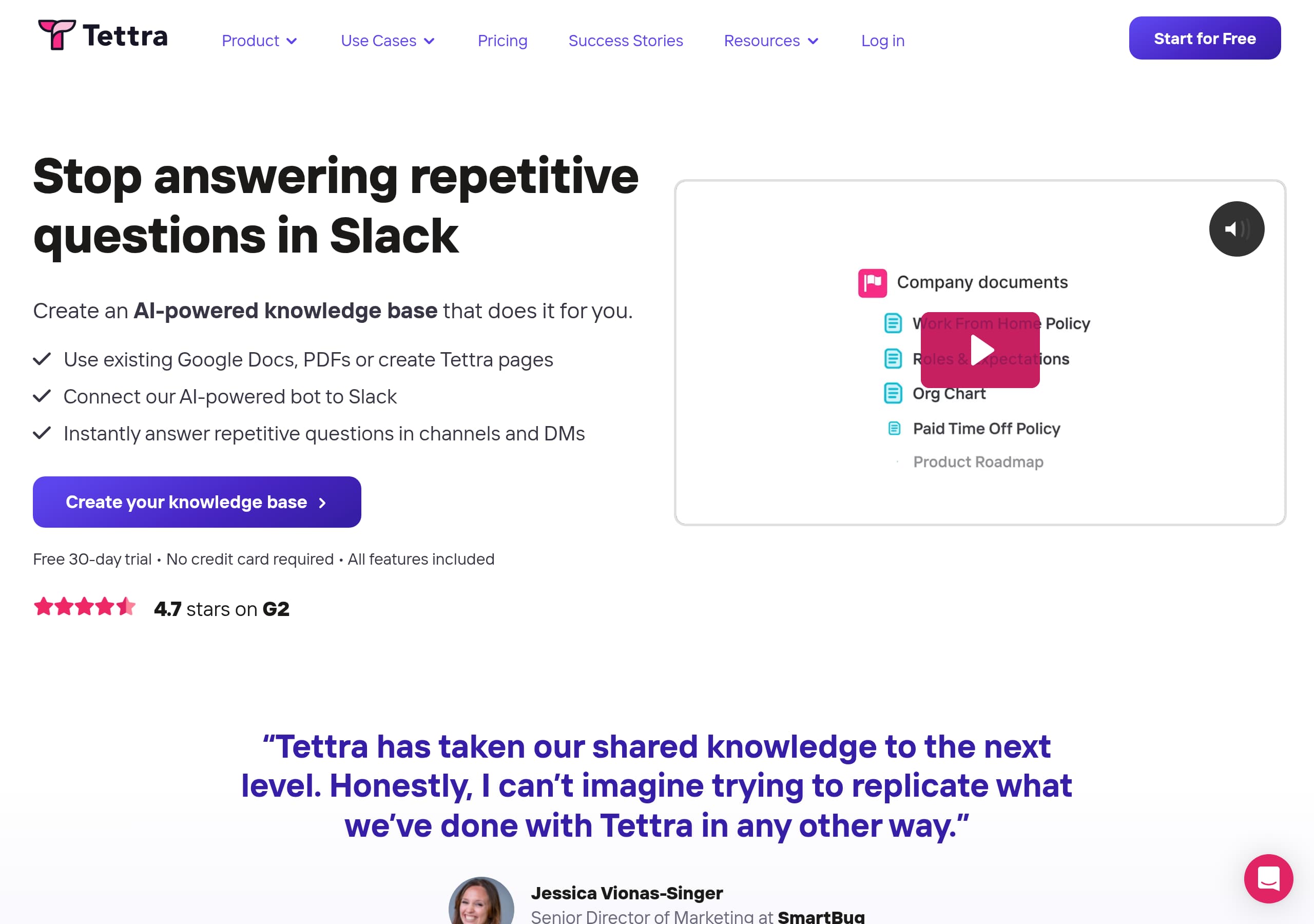
Tettra’s homepage nails a pain-first message with an exact scenario buyers recognize, “Stop answering repetitive questions in Slack,” and follows with a simple 3-step story that explains how the product works.
The primary conversion path is consistently reinforced with dual CTAs, “Start for Free” and “Request a Demo,” which cleanly separates self-serve teams from sales-led buyers without confusing the page.
Integration-led positioning is a strong differentiator: Tettra repeatedly anchors value in Slack, and backs it up with specific content sources like Google Docs and PDFs, which reduces migration anxiety.
Social proof is credible and easy to scan, combining a visible G2 rating (4.7 stars) with named, role-specific testimonials (for example, SmartBug’s Senior Director of Marketing), which supports multiple buyer personas.
Pricing conversion is helped by a clear risk reversal, “Free 30-day trial, no credit card required, all features included,” but Tettra can improve decision confidence by making plan limits and AI/Slack inclusions more explicit above the fold.
Trust signals are present but unevenly distributed: the footer surfaces a “Security Overview” link and a “Status” link with 99.99%, but the core pages could do more to communicate security posture at the moment of signup.
Tettra’s site structure is built for SEO and evaluation, with comparison and educational resources (for example, “Best Confluence Alternatives”) that capture high-intent searches and route them back to product CTAs.
Home
Tettra’s homepage is effective because it starts with a specific, high-frequency pain and then demonstrates an easy mental model for how the product solves it. The hero headline, “Stop answering repetitive questions in Slack,” is immediately concrete, and the subhead “Create an AI-powered knowledge base that does it for you” frames Tettra as automation, not just documentation.
The page quickly communicates the workflow with three crisp steps that map to real adoption concerns: use existing Google Docs, PDFs, or create Tettra pages, connect the AI-powered bot to Slack, and instantly answer repetitive questions in channels and DMs. That sequencing reduces the common objection, “We do not have time to migrate,” by leading with importing existing content, then showing where value appears, inside Slack.
Conversion is supported by clear CTAs and risk reversal: “Get started” and “Create your knowledge base” appear alongside Free 30-day trial, No credit card required, and All features included. The page also uses early proof, including 4.7 stars on G2 and a named quote attributed to Jessica Vionas-Singer at SmartBug, which signals real organizational usage.
Below the fold, Tettra organizes product understanding into three blocks that match buyer language: Internal Knowledge Base, Questions & Answers (with the AI bot “Kai”), and Knowledge Management (with verification and suggested edits). Each block has a “More about…” link, which is a strong UX pattern for keeping the homepage skimmable while still giving evaluators deeper detail.
One improvement opportunity: the hero focuses heavily on Slack, which is a strength, but it may under-communicate value for teams that use Microsoft Teams or other chat tools. Even a small line clarifying the broader knowledge management system use case could prevent premature self-disqualification.
Pricing
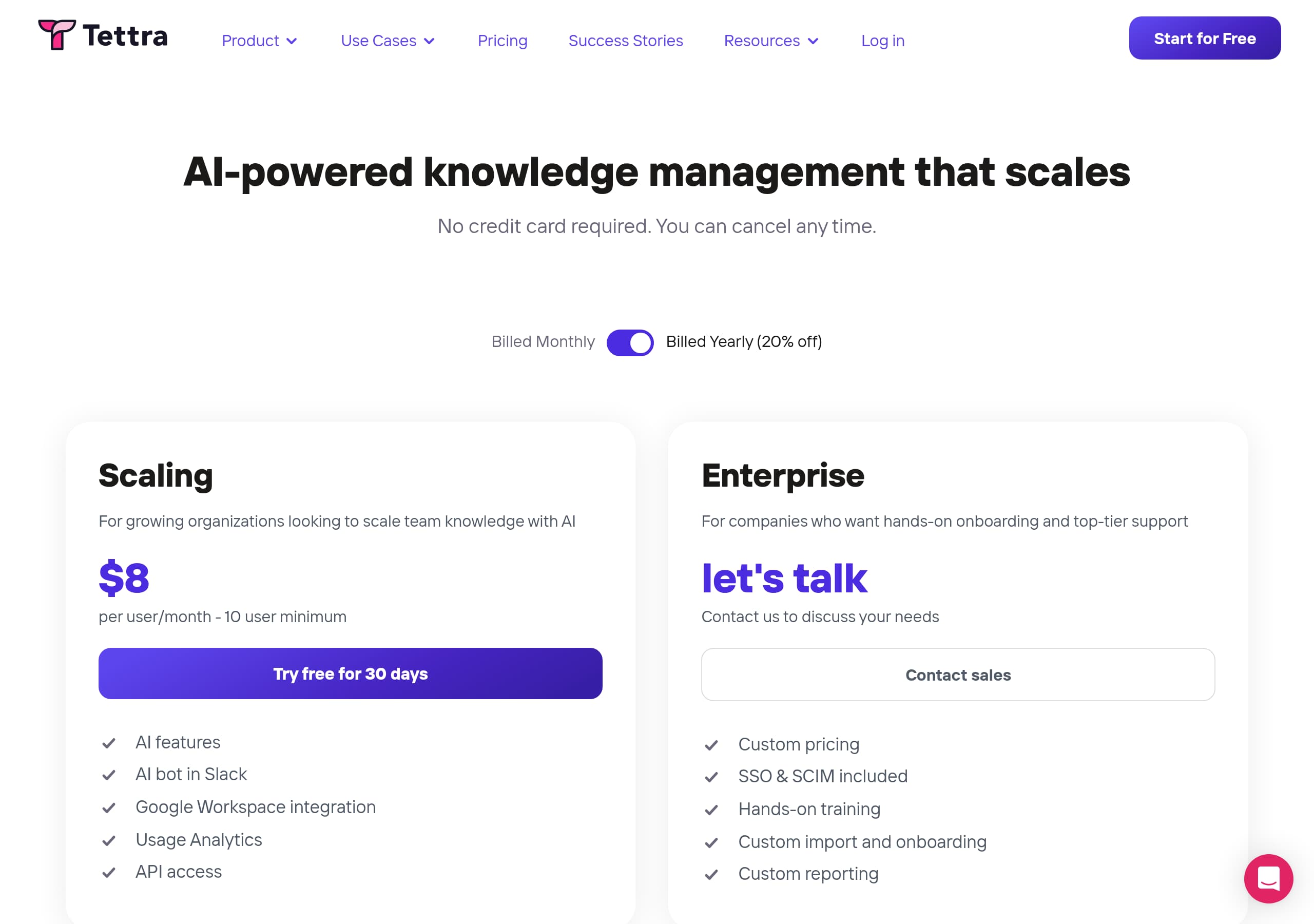
Tettra’s pricing experience is conversion-friendly because it is aligned with the site’s main promise—faster answers with less interruption—and it maintains a low-friction entry point via a free trial. The homepage consistently reinforces the offer language, “Free 30-day trial,” “No credit card required,” and “All features included,” which sets expectations that pricing will be straightforward and that evaluation does not require procurement.
From the pricing screenshot, the layout reads like a typical SaaS plan comparison, with multiple tiers presented side-by-side and a clear primary action per plan. That pattern helps evaluators quickly map their team size and needs to a plan, and it supports both small-team self-serve and larger teams that may need a sales conversation. The site-wide top navigation also keeps “Pricing” in the primary menu, reducing hunting behavior and improving intent capture.
What Tettra does especially well is keeping the pricing conversation tied to outcomes rather than abstract features. The product messaging around reducing repetitive Slack questions, using existing Google Docs and PDFs, and answering in channels and DMs gives the pricing table context: “this is what you are paying for.”
Where pricing could be sharper is in removing ambiguity around AI and integrations. Since the hero is explicitly “AI-powered” and Slack-connected, visitors will look for explicit confirmation in pricing: which plans include AI Knowledge Management, whether the Slack bot “Kai” is included in all tiers, and what the limits are (for example, seats, knowledge sources, or query volume). If these details exist lower on the page, bringing 2 to 3 of them into the visible plan grid would reduce back-and-forth.
A second opportunity is decision support: add a short “compare plans” section that lists 5 to 7 differentiators in plain language, such as Slack Integration, permissions, verification workflows, and admin controls. That would make the pricing page feel less like a table and more like a guided choice.
Features
Tettra’s feature presentation works because it is organized around jobs-to-be-done, not a long, undifferentiated checklist. The homepage breaks capabilities into three clear pillars: Internal Knowledge Base, Questions & Answers, and Knowledge Management. This structure maps to a buyer’s evaluation sequence: first, “Can we store our knowledge?”, second, “Can people get answers fast?”, and third, “How do we keep it accurate over time?”
The Internal Knowledge Base block explicitly addresses migration friction by highlighting multiple starting points: Tettra’s own editor plus importing from Google Docs, Notion, and local files like PDFs. That is a practical, adoption-driven detail that makes the product feel implementable for teams that already have scattered documentation.
The Questions & Answers block uses a named agent, “Kai,” and explains behavior in a testable way: when someone asks a question in Tettra or Slack, Kai searches your content and provides an answer instantly, and if it cannot find one, it helps locate the right person. This is a strong fallback workflow pattern because it reduces the fear of AI “hallucinating” or failing silently.
The Knowledge Management block introduces ongoing governance: subject matter experts can verify important pages, identify gaps, and approve suggested edits. This is crucial differentiation versus “wiki-only” tools because it addresses decay, not just creation. The language, “Missing or outdated information makes finding answers impossible,” is blunt and accurate, which strengthens perceived expertise.
A tactical enhancement would be to add more feature-proof artifacts, such as annotated screenshots for the editor, the Slack answer experience, and the verification queue. Right now, Tettra uses descriptive copy and “More about…” links, which is good for depth, but a few UI-level previews would help evaluators visualize daily use.
Finally, the navigation includes “All Features,” “AI Knowledge Management,” and “Slack Integration,” which suggests a deeper feature library. Keeping those pages tightly connected with consistent CTAs would maintain momentum for high-intent readers.
Signup
Tettra’s signup motion is optimized for low friction by making the primary offer self-evident and low risk: “Start for Free” is consistently visible in the header, and the hero reinforces the exact trial terms, Free 30-day trial, No credit card required, All features included. That combination reduces the two most common blockers: financial commitment and uncertainty about feature gating.
The homepage CTA language is also concrete. Instead of only “Sign up,” Tettra repeatedly uses “Create your knowledge base,” which sets an expectation of what happens immediately after signup. This is a subtle but effective copy pattern because it frames the next step as progress, not paperwork.
Tettra also supports a parallel enterprise path via “Request a Demo.” This matters because knowledge management often touches security review, permissions, and onboarding support. Keeping both CTAs present helps teams self-select without forcing a single funnel.
What is not fully visible from the excerpt and screenshots is the actual onboarding flow depth. However, based on the homepage narrative, the ideal onboarding would mirror the 3-step promise: import content (Google Docs, PDFs, Notion), connect Slack Integration, then start asking questions. If Tettra’s product does this, it is aligned. If not, any mismatch would create churn quickly because expectations are clear.
To improve signup conversion further, Tettra could add one small “What you will do in the first 10 minutes” panel near the CTA, listing 3 steps in the same language as the hero. That reduces anxiety for evaluators who want to know what setup entails.
Another opportunity is to clarify team vs. individual start. Since the core use case involves Slack channels and DMs, visitors may wonder whether they must invite teammates immediately or can try solo. A single sentence under the CTA, for example “Start alone, invite your team later,” would remove uncertainty.
Overall, Tettra’s signup messaging is consistent and outcome-oriented, with dual CTAs supporting both self-serve and sales-led onboarding.
Trust
Tettra communicates trust through a mix of platform signals, third-party validation, and operational transparency, but the trust content is more visible in navigation and the footer than in the main conversion moments. On the positive side, Tettra surfaces 4.7 stars on G2 near the top of the page, which acts as immediate credibility for a category where buyers fear poor adoption or stale content.
Operational trust is reinforced by the footer and site chrome: a “Status” link is visible alongside “99.99%,” which signals uptime expectations and gives buyers a place to verify incidents. This is especially relevant because Tettra is positioned as a daily workflow tool inside Slack, so downtime directly impacts internal support and responsiveness.
Tettra also includes a “Security Overview” link in the footer. That is a good baseline pattern for SaaS evaluation, giving security-conscious buyers a dedicated destination. However, because the hero and feature blocks emphasize connecting Slack and indexing internal docs, visitors will also want reassurance about access controls, data handling, and admin governance. If those details exist only behind the Security Overview page, the homepage could still benefit from a small trust strip.
A practical improvement would be a compact set of trust badges or statements near the primary CTA, limited to what Tettra can substantiate, such as “Security Overview,” “Status page,” and possibly “SSO” or “permissions” only if present on the security page. The goal is not to overwhelm, but to address the moment when a buyer thinks, “Are we safe connecting this to Slack and our docs?”
Another trust enhancer would be clearer guidance on how the AI bot “Kai” generates answers—for example, that it searches existing knowledge and provides citations, if that is true in-product. Buyers of AI Internal Knowledge Base tools increasingly look for answer provenance.
Overall, Tettra demonstrates trustworthy intent via transparency links and credible reviews, but it could raise its trust score by moving 2 to 3 security assurances closer to the high-intent CTAs.
Footer
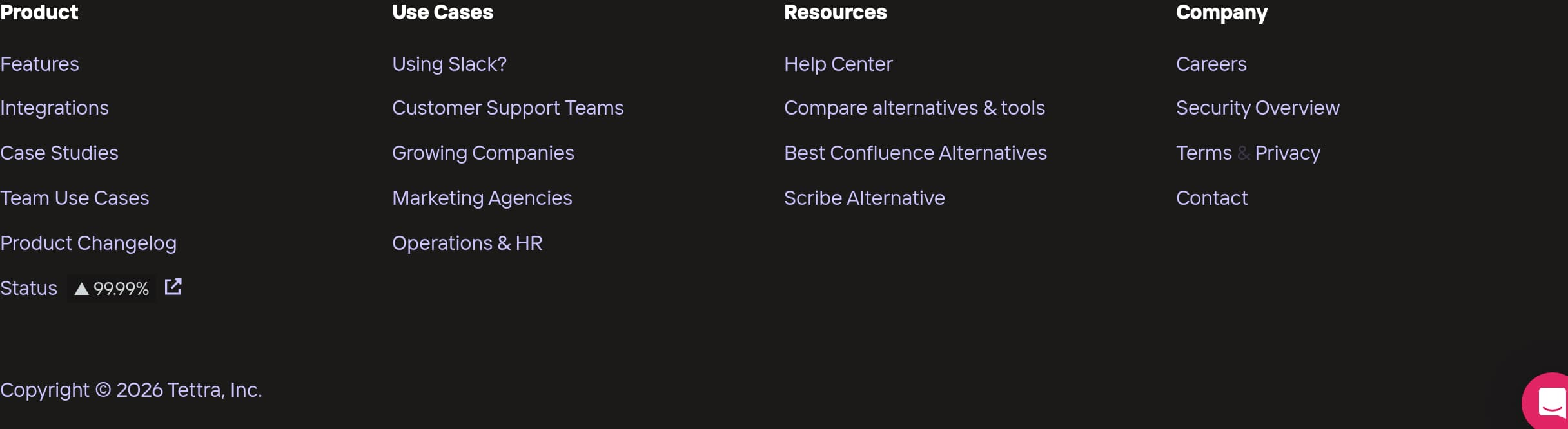
Tettra’s footer is doing real work; it is not just legal filler. It reinforces evaluation paths, trust, and discoverability through a dense but organized set of links. From the screenshot and excerpt, the footer includes navigation to Product Features, Integrations, Case Studies, Use Cases, and “Product Changelog,” which supports both buyers and existing customers who want to validate momentum.
A notable trust pattern is the presence of “Status,” with “99.99%” displayed nearby. Even without more context, that is a strong operational signal because it shows Tettra expects to be monitored and is willing to expose reliability information. The footer also includes “Security Overview,” “Terms & Privacy,” and “Contact,” which are essential for procurement and due diligence.
The footer’s resources section is also SEO-oriented in a way that supports conversion. Links like “Compare alternatives & tools,” “Best Confluence Alternatives,” and “Scribe Alternative” indicate Tettra is actively capturing comparison intent and routing it into product education. This is a smart strategy for a knowledge management product competing against Confluence and other documentation tools.
The structure appears segmented into columns, which improves scanability, and it repeats key top-level entities such as “Use Cases” and “Resources.” This redundancy is helpful because it gives late-stage evaluators a way to navigate without scrolling back to the top.
Two areas could be improved. First, the footer is link-heavy, which can feel overwhelming. Adding short one-line descriptors under the most important trust links—for example, what “Security Overview” contains—could reduce friction. Second, the footer could include an explicit support entry point such as “Help Center” or “Support” prominently, although “Help Center” appears in the main navigation.
Overall, Tettra’s footer strengthens E-E-A-T by surfacing operational transparency, security documentation, and comparison content, while keeping core product and conversion routes accessible.
Detected tech stack
Tools and technologies we detected on Tettra's site. Detection is best-effort and may be incomplete.
Scores
Our framework scores for Tettra's website in terms of clarity, conversion, and trust. See our methodology for how we calculate these.
How clear the value prop and structure are.
How conversion-friendly signup and pricing are.
How well trust and compliance are surfaced.
FAQ
Tettra’s homepage leads with a specific pain, “Stop answering repetitive questions in Slack,” then explains the solution in a simple 3-step flow: build a knowledge base from existing docs, connect an AI bot to Slack, and answer questions in channels and DMs. It reinforces conversion with “Start for Free” and a clear risk reversal: a 30-day trial with no credit card required, plus a visible G2 rating.
Tettra anchors pricing around a self-serve trial: the site states “Free 30-day trial,” “No credit card required,” and “All features included.” The pricing layout is presented in tiered plans with a primary CTA per plan, which supports quick comparison. To reduce uncertainty, buyers will typically look for explicit plan-level clarity on AI features and Slack integration, given how prominently those are positioned.
Yes, Slack is central to Tettra’s positioning. The homepage headline explicitly references Slack, and the main workflow describes connecting an AI-powered bot to Slack to answer repetitive questions in channels and DMs. The navigation also highlights “Slack Integration” as a product area. This integration-led messaging makes it easy for Slack-heavy teams to self-qualify quickly.
Tettra highlights three main capability areas: an Internal Knowledge Base (including creating pages and using existing Google Docs, Notion, and PDFs), an Internal Q&A layer where the AI bot “Kai” searches content to answer questions, and Knowledge Management workflows focused on keeping content accurate. The site emphasizes verification by subject matter experts and approving suggested edits to prevent outdated information.
Tettra uses third-party and operational trust cues rather than heavy compliance claims on the homepage. It shows a 4.7-star G2 rating and named customer testimonials. In the footer, it links to a “Security Overview” page and a “Status” page, with “99.99%” displayed near that link. These elements help buyers validate credibility, reliability, and due diligence pathways.

The world's best-performing SaaS businesses share surprisingly similar patterns. We help you learn and apply them through our human-designed methodology, with AI-assisted research.