
Key takeaways
Here are the key insights from our website breakdown analysis of n8n.
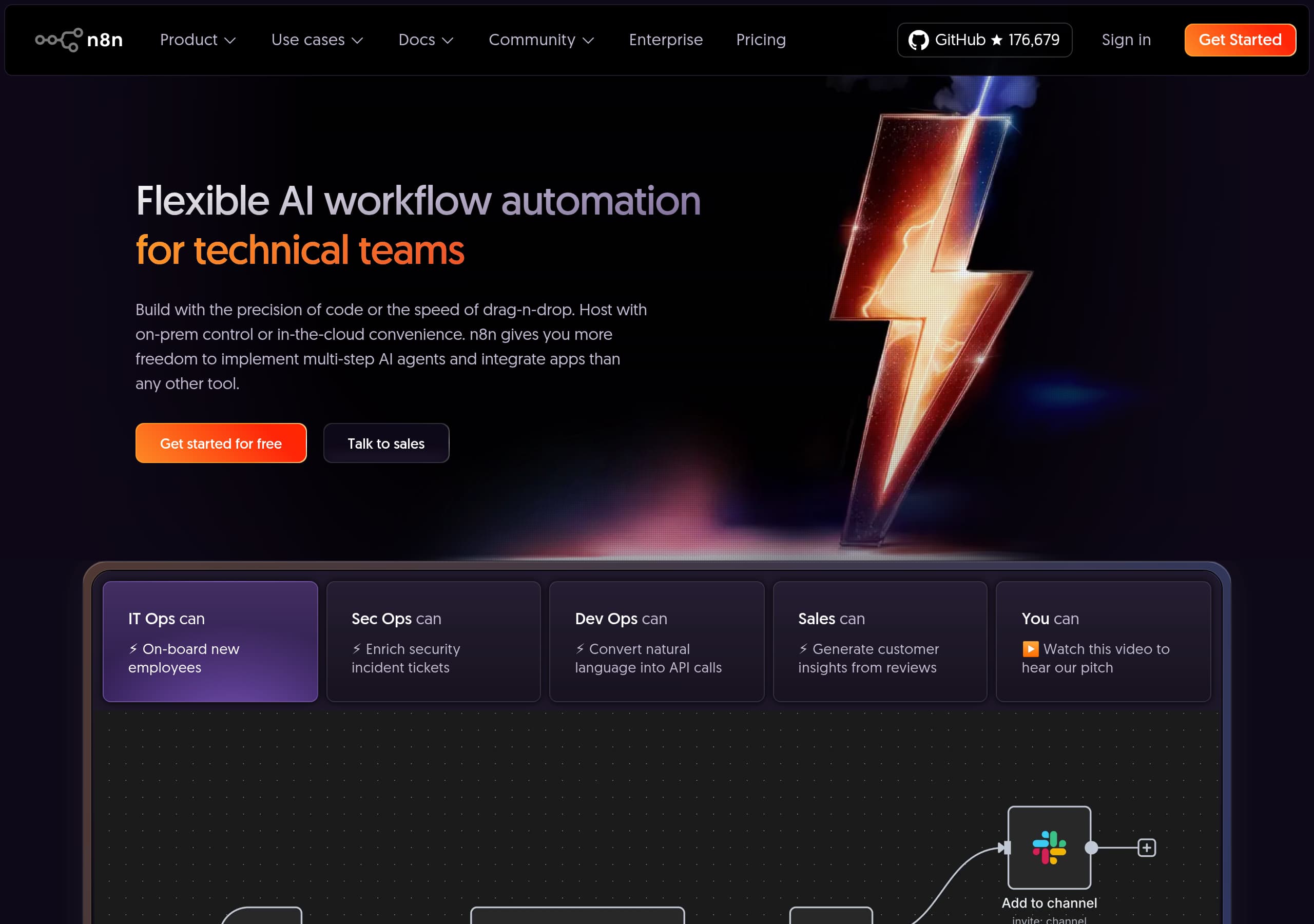
n8n’s homepage nails the positioning for its core ICP with the hero line “Flexible AI workflow automation for technical teams,” then immediately contrasts code precision with drag-and-drop speed to reduce ambiguity.
Conversion is strengthened by dual above-the-fold CTAs, “Get started for free” and “Talk to sales,” which cleanly route self-serve users and enterprise evaluators without forcing a single path.
Trust is unusually strong for an automation tool because n8n foregrounds open-source credibility with “Top 50 GitHub,” “176.7k stars,” and a “4.9/5 stars on G2” callout directly on the homepage.
The product story is structured around concrete, high-intent use cases (IT Ops, Sec Ops, Dev Ops, Sales) that help visitors self-identify quickly and imagine multi-step outcomes, not just single automations.
n8n differentiates on deployment control with prominent self-hosting language, including “Self-host everything, including AI models” and “air-gapped,” which supports security-minded buyers and regulated teams.
The site reinforces time-to-value with scale signals like “500+ integrations,” “1700+ templates,” and template and integration directories, which lowers perceived build effort for new users.
Home
The homepage wins by stating who n8n is for and what makes it different in a single hero block: “Flexible AI workflow automation for technical teams,” paired with a crisp tradeoff frame, “precision of code” vs “speed of drag-and-drop.” The immediate placement of two CTAs, Get started for free and Talk to sales, prevents decision paralysis by supporting both self-serve and enterprise intent.
Several on-page elements make the positioning concrete instead of aspirational:
- A role-based use case strip (IT Ops, Sec Ops, Dev Ops, Sales) shows examples like onboarding employees and converting natural language into API calls. This is use-case specificity that helps visitors map n8n to their job-to-be-done.
- An explicit scale and adoption block, “Top 50 GitHub,” “176.7k stars,” “4.9/5 stars on G2,” and “200k+ community members,” functions as above-the-fold credibility for a category full of lookalike tools.
- The AI narrative is grounded in workflow outcomes: “Build multi-step agents calling custom tools,” “Create agentic systems on a single screen,” and “Integrate any LLM.” The language consistently emphasizes multi-step automation rather than single-trigger zaps.
The layout also balances product-led and buyer-led evaluation. A “Watch this video to hear our pitch” option serves evaluators who want a quick overview, while the “Browse all integrations” and templates references suggest fast experimentation. Finally, prominent self-hosting language, “Host with on-prem control or in-the-cloud convenience,” establishes deployment flexibility early, which is a key differentiator versus SaaS-only competitors like Zapier and Make.
Pricing
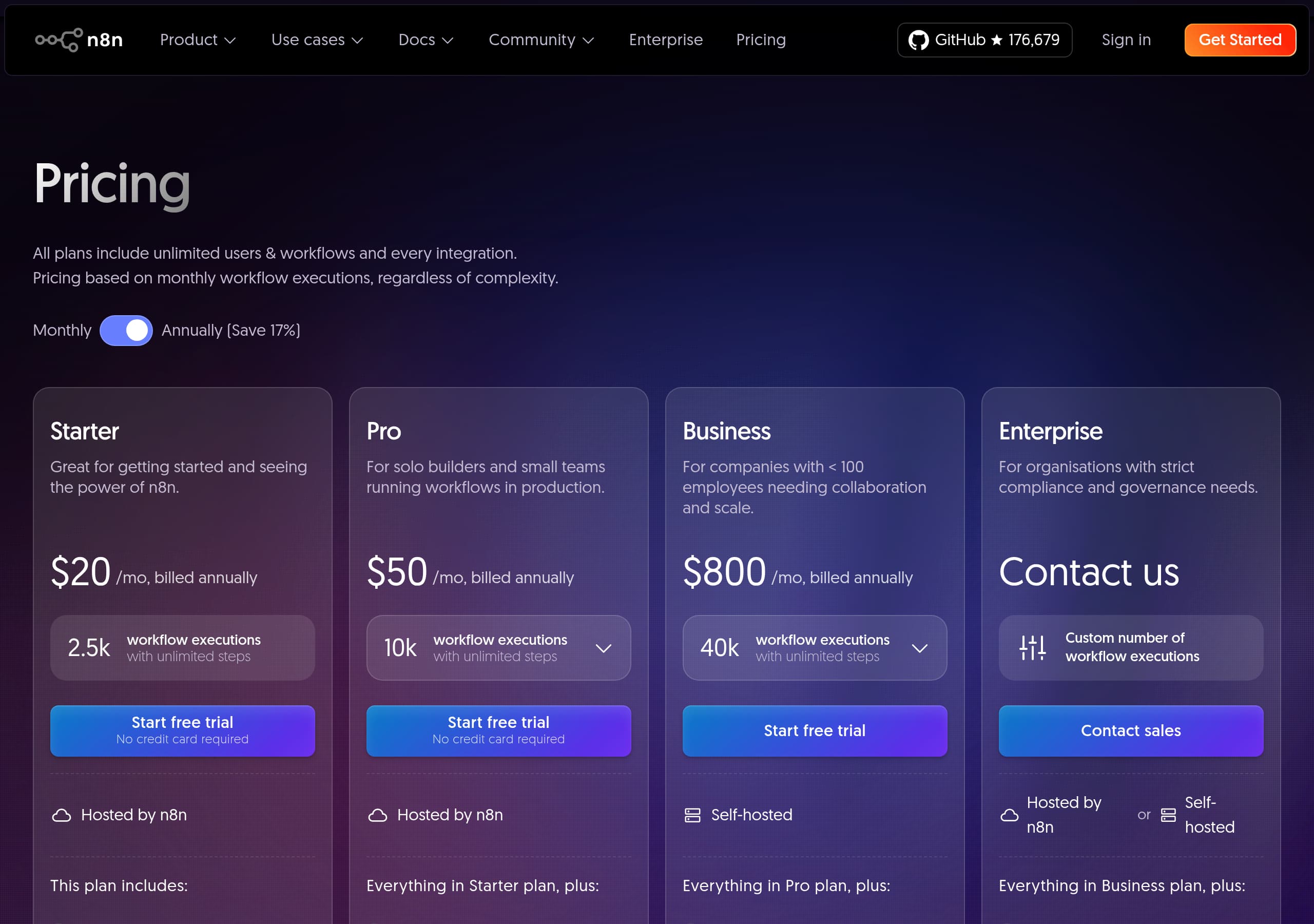
n8n’s pricing presentation (as shown in the pricing screenshot) is oriented around choosing a deployment option and buying motion, which matches how workflow automation is evaluated in real teams. The most important conversion lever is that pricing is not isolated from the product’s core differentiator: self-host vs cloud. Visitors can quickly align cost with governance needs instead of guessing whether enterprise requirements will be blocked.
What works well from a conversion and evaluation standpoint:
- The site already pre-qualifies traffic on the homepage with “Get started for free” and “Talk to sales,” so the pricing experience can serve two intents: self-serve builders validating cost, and buyers needing procurement-ready detail. This two-track funnel reduces drop-off.
- n8n reinforces that enterprise is not only a higher tier, it is a different operational posture. Copy elsewhere on the site calls out “air-gapped,” SSO (SAML, LDAP), and RBAC, which makes enterprise pricing feel tied to specific controls, not arbitrary packaging.
- Strong “what you can do” framing (templates, integrations, AI agent building) increases willingness to pay because it highlights build speed and breadth before visitors anchor on price.
Where pricing could become even more decision-friendly is by making the unit of value unmistakable on first scan, for example whether plans scale by executions, active workflows, seats, or environments. Because n8n is used across IT Ops, Sec Ops, and Dev Ops, buyers often need to estimate growth across multiple teams. Adding a short “How billing scales” explainer near the plan grid and repeating free vs paid boundaries (limits, collaboration, governance) would reduce back-and-forth with Sales and shorten time-to-checkout.
Overall, the pricing approach aligns with n8n’s positioning: technical evaluation first, then clear upgrade paths for security, collaboration, and scale.
Features
n8n’s feature communication is effective because it consistently ties capabilities to how technical teams actually build and iterate. Instead of presenting a generic node library pitch, the site highlights workflows as an engineering artifact: multi-step agents, branching, debugging, and deployment control. The strongest differentiator is framed as a choice, not a compromise: code when you need it, UI when you don’t.
The feature sections include concrete, engineer-relevant details that reduce uncertainty:
- Language flexibility: “Write JavaScript or Python,” plus “Add libraries from npm or Python,” signals extensibility beyond prebuilt connectors.
- Practical ingestion shortcuts: “Paste cURL requests into your workflow” is a high-signal detail for API-heavy teams and backend prototyping.
- Workflow control: “Merge workflow branches, don’t just split them” communicates more advanced orchestration than linear automations.
- Iteration and debugging: “Re-run single steps,” “Replay or mock data,” and “logs in line with your code” sell fast feedback loops, a key reason engineers resist traditional no-code tools.
AI is presented as an implementation surface rather than a buzzword. Copy like “Build multi-step agents calling custom tools” and “Integrate any LLM” implies n8n sits above model choice and focuses on orchestration. The “Chat with your own data” example uses specific channels (Slack, Teams, SMS, voice, embedded chat) and a sample Q&A that references systems like Salesforce, Zoom, ServiceNow, and Asana. That concreteness helps visitors imagine end-to-end automation, not just retrieval.
Finally, “1700+ templates” and “500+ integrations” are positioned as accelerators, not the core value. That ordering matters: it frames n8n as a workflow automation platform with optional shortcuts, rather than a connector catalog.
Signup
n8n’s signup motion is designed to minimize friction for builders while preserving a clear enterprise path. The homepage repeatedly funnels users into two actions: Get started for free for product-led adoption, and Talk to sales for procurement-driven evaluation. This dual-path design is especially appropriate for n8n because it supports both a hosted cloud experience and self-hosting, and those choices often correlate with company size and security posture.
From the on-page content, several elements reduce time-to-first-success:
- Strong time-to-value scaffolding: “Use 1700+ templates to jump-start your project” and prominent directories for integrations and templates suggest that new users can start from a working workflow, not a blank canvas.
- “Watch this video to hear our pitch” supports users who are not ready to click into a product yet, keeping them engaged while lowering perceived risk.
- Role-based prompts (IT Ops, Sec Ops, Dev Ops, Sales) act like pre-onboarding, helping users choose an initial workflow goal before they ever create an account.
n8n also mitigates a common automation-product issue: confusion about where work happens. By placing “Self-host everything, including AI models,” “Deploy with Docker,” and “Hosted version also available” directly in the product narrative, it clarifies that onboarding can mean either spinning up infrastructure or using cloud. That transparency improves expectation setting and reduces churn caused by mismatched assumptions.
The main opportunity is to make the first-run path explicit on-site: a simple three-step “Choose Cloud or Self-host, pick a template, connect your first app” module near the primary CTA would turn the implicit onboarding story into a concrete plan. Still, the current funnel is conversion-friendly because it aligns signup prompts with n8n’s real evaluation behaviors: try a workflow quickly, then scale into governance.
Trust
n8n builds trust by making security and deployment control part of the core product narrative, not an afterthought. The site repeatedly emphasizes on-prem control, including “Self-host everything, including AI models,” “Deploy with Docker,” and “Run n8n air-gapped.” For security-conscious teams, that is a direct answer to the biggest objection in AI automation: where data flows and who can access it.
The enterprise section is particularly concrete, listing specific controls rather than vague assurances:
- Security: “Fully on-prem option,” “SSO SAML, and LDAP,” “encrypted secret stores,” “version control,” and “advanced RBAC permissions.” These are recognizable requirements for IT and security buyers.
- Performance and observability: “Audit logs and log streaming to 3rd party,” “workflow history,” “custom variables,” and “external storage.” This supports operational readiness, not just compliance.
- Collaboration and governance: “Git Control,” “isolated environments,” and “multi-user workflows.” This implies a mature SDLC posture where workflows are promoted across environments.
Trust is also reinforced structurally through open-source transparency. The navigation includes GitHub and the homepage calls out source availability, which is a strong verifiability signal versus closed competitors. Pairing that with third-party proof, “4.9/5 stars on G2,” further reduces perceived risk.
One gap, based on the visible excerpt and footer links, is that the trust story is more capability-focused than certification-focused. The footer includes “Security,” “Privacy,” and “Report a vulnerability,” which is good hygiene, but buyers looking for compliance may still hunt for a dedicated page that summarizes controls, threat model, and any attestations in a single scannable table. Even without that, n8n’s emphasis on self-hosting and air-gapped deployment is a strong, differentiated trust pillar for regulated industries and internal tooling teams.
Footer
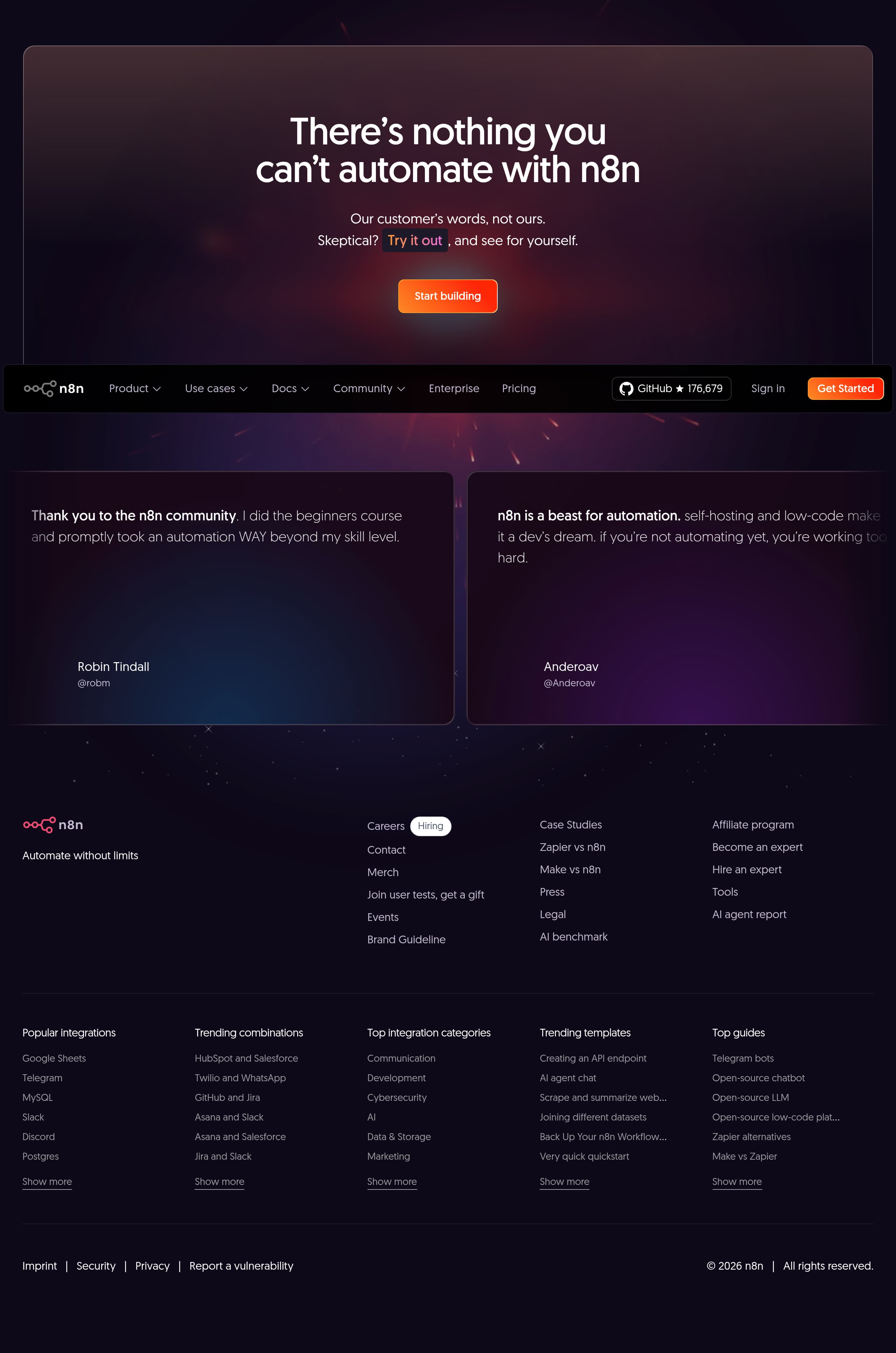
The n8n footer (per the screenshot and excerpt) is built like a navigation hub for multiple audiences, which is appropriate for a product that spans open-source, community, and enterprise. It provides dense discoverability without feeling like a dumping ground, and it includes the legal and security essentials that buyers and security reviewers look for.
Notable strengths:
- Audience segmentation: links for “Enterprise,” “Pricing,” “Support,” “Docs,” “Self-host,” “Community,” and “Hire an expert” support different intents—evaluation, implementation, and services. This is task-oriented navigation rather than generic site sections.
- Competitive and educational SEO: comparisons like “Zapier vs n8n” and “Make vs n8n,” plus guides such as “Zapier alternatives,” “AI agents,” and “AI coding assistants,” indicate a deliberate category capture strategy.
- High-volume discovery modules: “Popular integrations,” “Top integration categories,” “Trending combinations,” and “Trending templates” convert the footer into an index. This helps long-tail search and gives users an immediate next click when they scroll.
Trust and compliance hygiene is present and easy to find: “Imprint | Security | Privacy | Report a vulnerability” appear as clear footer utilities, and the copyright line is current (“© 2026 n8n”). Those elements matter during vendor review because security teams often scroll straight to the bottom looking for privacy and vulnerability reporting.
A tactical improvement would be to reduce cognitive load by grouping the very long integration and template lists behind accordions or “View all” links by default, especially on mobile. Still, the current footer accomplishes its job well: it acts as both a sitemap and a conversion recovery area, giving visitors multiple paths back into docs, pricing, or getting started depending on readiness.
Detected tech stack
Tools and technologies we detected on n8n's site. Detection is best-effort and may be incomplete.
Scores
Our framework scores for n8n's website in terms of clarity, conversion, and trust. See our methodology for how we calculate these.
How clear the value prop and structure are.
How conversion-friendly signup and pricing are.
How well trust and compliance are surfaced.
FAQ
n8n’s homepage quickly defines the product and audience with “Flexible AI workflow automation for technical teams,” then differentiates with “precision of code” versus “speed of drag-and-drop.” It supports two buying motions with visible CTAs, “Get started for free” and “Talk to sales.” It also includes strong proof points like Top 50 GitHub, 176.7k stars, a 4.9/5 G2 rating, and community size to reduce evaluation risk.
n8n’s pricing experience aligns with its deployment options and buyer intent: self-serve users are pushed toward “Get started for free,” while enterprise buyers have a clear “Talk to sales” path. Across the site, plan value is reinforced by enterprise controls such as SSO (SAML, LDAP), RBAC, audit logs, and air-gapped deployment. This helps teams connect price to governance and operational requirements, not just feature counts.
n8n highlights self-hosting and data control repeatedly, including “Self-host everything, including AI models,” Docker deployment, and the ability to run air-gapped. It lists enterprise-ready security and governance features like encrypted secret stores, SSO, advanced RBAC permissions, audit logs, and isolated environments. Open-source transparency via GitHub and third-party validation like G2 ratings and named case studies further strengthen trust.
n8n emphasizes a hybrid build model, “Code when you need it, UI when you don’t,” with support for JavaScript and Python and adding libraries from npm or Python. It calls out practical workflow engineering features like pasting cURL requests, merging workflow branches, rerunning single steps, replaying or mocking data, and debugging with inline logs. It also promotes 500+ integrations and 1700+ templates to accelerate adoption.
n8n reduces time-to-value by promoting templates, integrations, and role-based use cases (IT Ops, Sec Ops, Dev Ops, Sales) that guide first projects. The homepage offers both a video pitch and direct CTAs for immediate building. It also sets expectations about where onboarding happens by clearly stating both hosted availability and self-hosting options like Docker, which helps teams choose the right path upfront.

The world's best-performing SaaS businesses share surprisingly similar patterns. We help you learn and apply them through our human-designed methodology, with AI-assisted research.