
Key takeaways
Here are the key insights from our website breakdown analysis of Phenom.
Phenom’s homepage leads with an enterprise-grade narrative, “Phenom Applied AI | Talent Intelligence Platform,” then immediately reinforces it with a concrete CTA, “Book Demo,” which fits a high-ACV HR tech buying journey.
The site strengthens clarity by turning “Applied AI” into a repeatable structure: Infrastructure, Engines, Ontologies, XAI, Experiences, Use Cases, and Agents, which helps technical and HR stakeholders map concepts to product areas.
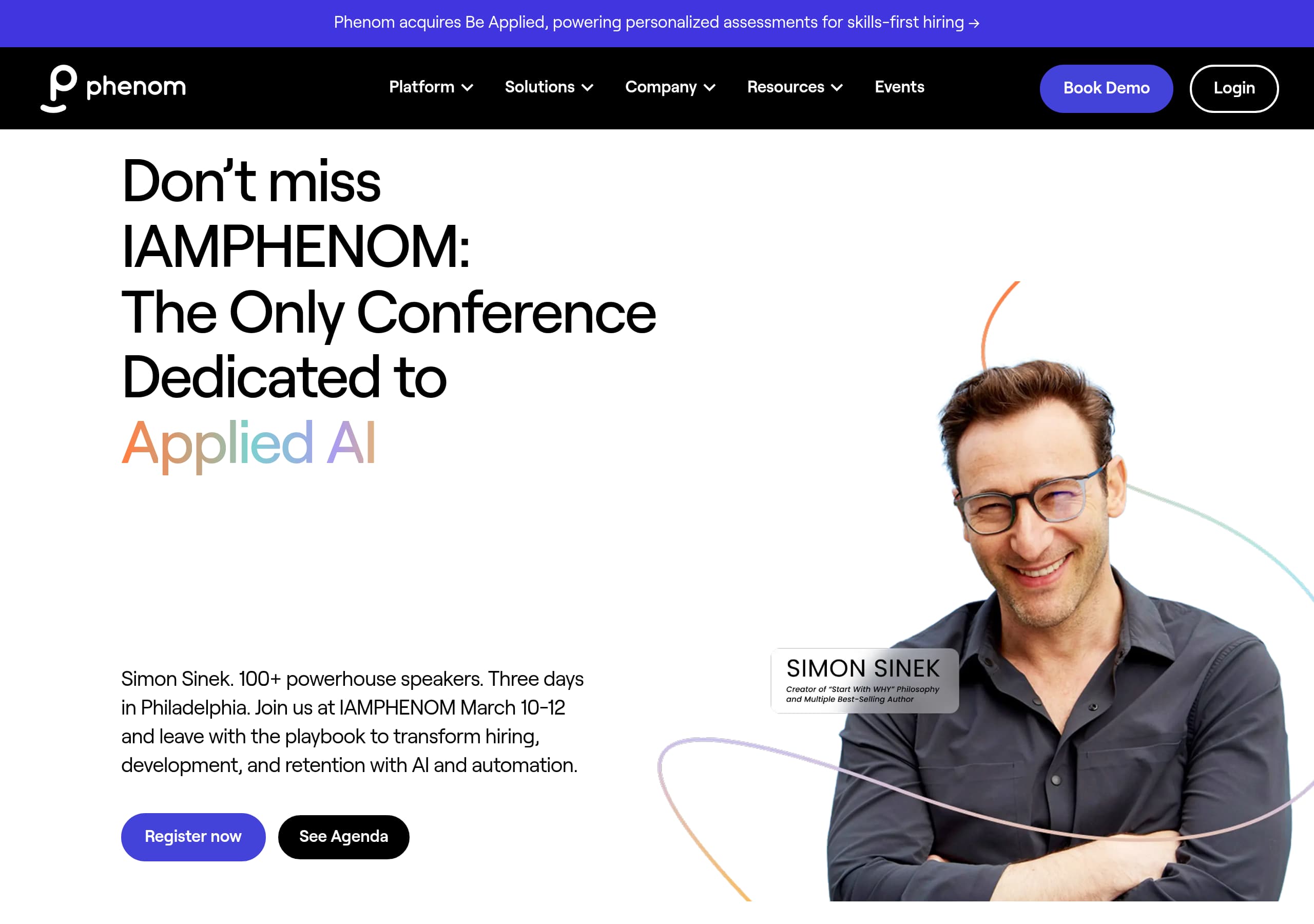
Conversion is optimized for multiple intent levels through dual pathways, “Book Demo” for buyers and “Read the report” for researchers, plus event CTAs (IAMPHENOM) that capture high-intent enterprise audiences.
Phenom uses quantifiable outcomes as primary social proof, including “20K+ hours saved,” “129% increase in internal applicants,” and “40% faster time to hire,” making results legible without needing long case studies upfront.
Trust is supported with a dedicated security and compliance posture, listing recognizable frameworks like GDPR, ISO, SOC II, CSA, and OWASP, and explicitly stating AI is “compliant & safe” with validity and reliability maintained.
The navigation and footer architecture are built for enterprise discovery, with routes by experience (candidates, recruiters, HRIT) and by industry, which reduces ambiguity for complex buying committees.
Home
Phenom’s homepage works because it frames the product as an enterprise platform first, then substantiates the AI angle with concrete use cases and outcomes instead of vague positioning. The hero line, “Phenom Applied AI | Talent Intelligence Platform”, paired with a persistent “Book Demo” CTA, signals a high-consideration, sales-led motion that fits HR platform procurement.
A few specific homepage patterns reduce ambiguity for mixed stakeholders (TA leaders, HRIT, talent ops):
- A scannable benefits block, “With Applied AI, you can,” translates AI into operational outcomes like “Automate Hiring, Onboarding & Retention” and “Eliminate Manual Busywork”, which are easier to evaluate than model-level claims.
- Differentiation is created with higher-order promises such as “Predict with Deep Reasoning” and “Explain Your Application of AI is Compliant & Safe,” which address the two most common enterprise objections: efficacy and governance.
- The page introduces a system taxonomy, “Infrastructure, Engines, Ontologies, XAI, Experiences, Use Cases, Agents,” which functions like an information scent for product deep dives and helps HRIT audiences see architecture-level thinking.
The homepage also mixes demand capture with thought leadership. In addition to demo, it features a benchmark report CTA (“State of AI & Automation for HR: 2026 Benchmarks Report”) and a large event module for IAMPHENOM with “Register now” and “See Agenda.” This is effective because it offers multiple conversion paths without forcing immediate sales contact. Finally, outcomes are showcased as near-hero proof, including “20K+ hours saved” and “40% faster time to hire,” reinforcing that Applied AI is positioned as measurable workflow change, not novelty.
Pricing
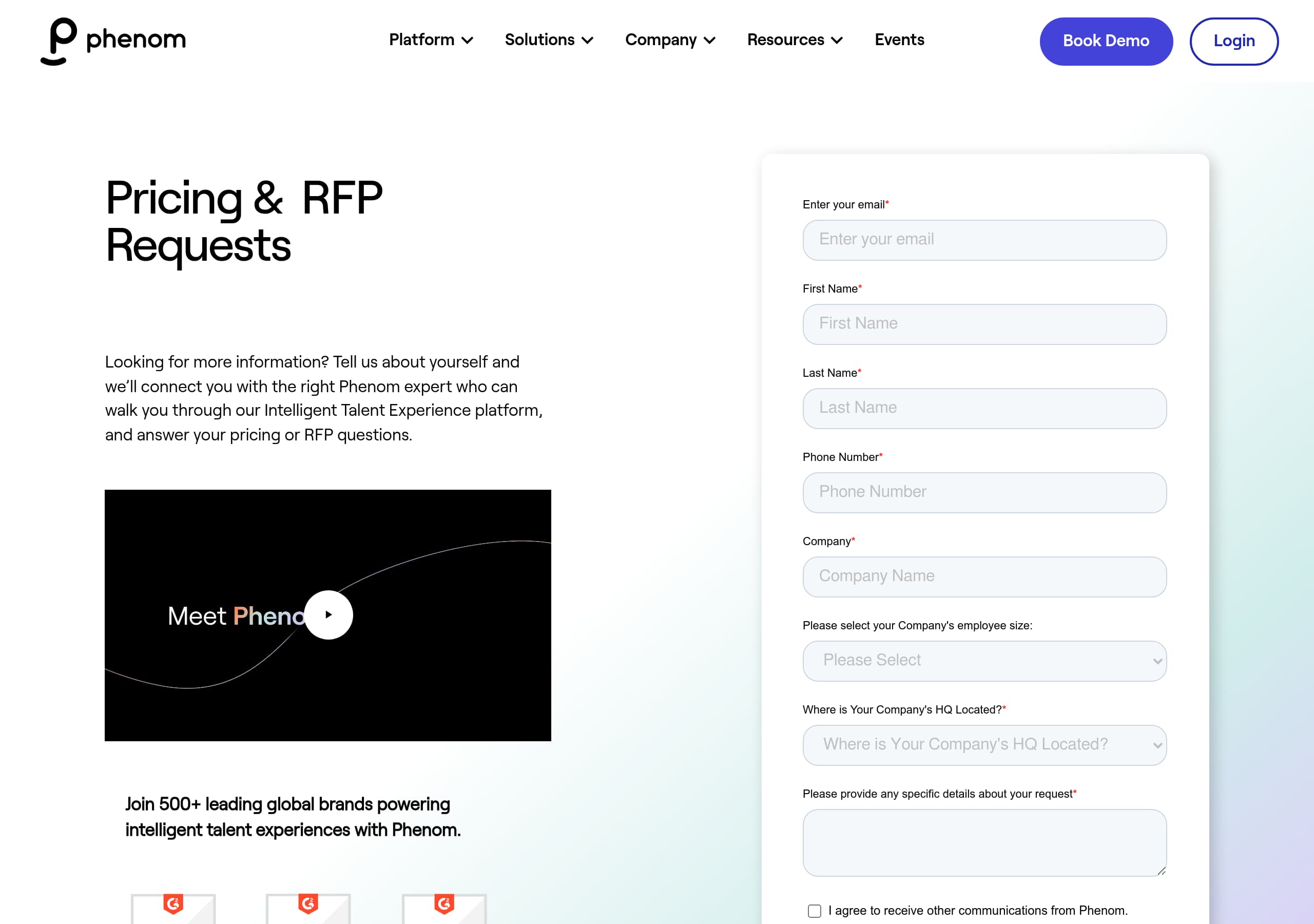
Phenom’s pricing approach is intentionally enterprise-oriented: the primary pathway is “Pricing & RFP Requests,” not a self-serve checkout. This is consistent with a Talent Intelligence Platform that is likely sold as a configurable suite across Talent Acquisition, Talent Management, and HRIT, where packaging depends on integrations, scope, and services. The practical takeaway is that Phenom optimizes pricing pages for qualification and deal acceleration, not for instant purchase.
From the pricing screenshot and modal navigation, the site emphasizes:
- A controlled entry point through “Request demo” and “Pricing & RFP Requests”, which sets expectations that pricing is quote-based.
- Packaging cues that imply modularity, such as “Phenom for Talent Acquisition,” “Phenom for Talent Management,” and “Phenom for HRIT,” each with benefit bullets like “Streamline recruiting workflows” and “Create an integrated HR ecosystem.” These act as pseudo-tiers that help buyers self-identify needs before contacting sales.
- Integration and compliance content adjacent to buying, including a “Featured Integrations” area and “Comprehensive Security & Compliance,” which reduces friction during procurement.
What this does well for conversion is reduce premature price anchoring while still providing structure. Buyers get a clear sense that the platform spans experiences (candidates, recruiters, managers) and can be expanded by use case (high-volume hiring, onboarding, skills). A potential improvement is adding more pricing transparency artifacts that do not reveal exact numbers, for example a “typical implementation factors” checklist, expected timeline ranges, or what is included in an RFP response. As presented, Phenom’s pricing flow is optimized for enterprise buyers who need stakeholder alignment and procurement readiness more than a quick credit-card decision.
Features
Phenom presents features through an enterprise platform lens, organizing capabilities into experiences, stakeholders, and AI building blocks rather than a flat checklist. The core message is that Phenom Applied AI delivers “hyper-personalized experiences throughout the talent journey,” then backs it with structured modules: “Infrastructure, Engines, Ontologies, XAI, Experiences, Use Cases, Agents.” This is a feature story designed for both HR leadership and HRIT evaluators.
Feature communication is strongest where it ties platform components to workflow outcomes:
- “Meet the AI Agents for HR” frames automation as role-specific, with “agents built for specific industry needs, job roles, and use cases,” and “co-pilots for each HR stakeholder.” This clarifies that AI is operationalized inside recruiting and talent management tasks.
- The modal product exploration lists suite-level solutions such as “Phenom for Talent Acquisition” and “Phenom for Talent Management,” each with benefits like “Create personalized content at scale” and “Scale your succession plans.” These are feature-to-value translations that reduce cognitive load.
- Use case navigation (“High-Volume Hiring,” “Skills,” “Automation,” “Agentic AI,” “Generative AI”) provides multiple entry points depending on a buyer’s maturity and problem framing.
The site also signals differentiation with governance-focused feature framing, including XAI (explainable AI) in the platform taxonomy and explicit statements about maintaining AI validity and reliability. A notable opportunity is adding more concrete UI evidence in feature sections, such as short product tour clips, annotated screenshots, or “how it works” steps (for example, a 3-step flow for automated scheduling or internal talent marketplace matching). As written, Phenom’s feature story is strong for platform buyers, but it can become even stronger with more interaction-level proof to complement the architectural model.
Signup
Phenom’s conversion flow is built around sales-led engagement, not end-user self-serve signup, which is appropriate for an enterprise Talent Intelligence Platform. The most prominent CTAs in the excerpt and navigation are “Book Demo” and “Request demo”, with secondary CTAs like “Read the report” and event registration (“Register now”). This creates a funnel that captures both buying intent and research intent while keeping the core conversion action consistent.
Key onboarding and lead capture characteristics visible from the site structure:
- Multiple intent doors: demo for evaluation, benchmark report for early-stage research, and conference agenda/registration for community-driven demand. This reduces bounce risk when visitors are not ready to talk to sales.
- Segmented navigation by audience (“Candidates,” “Recruiters,” “Managers,” “HRIT”), which acts like a pre-qualification mechanism, helping visitors self-identify before submitting a form.
- “Talk with AI Agent” appears in Resources navigation, suggesting a conversational entry point. Even if it is content-focused, it reinforces the brand promise of AI-assisted experiences.
Where signup could be clearer is around what happens after the click. The excerpt does not show form fields, expected response time, or whether there is a sandbox or product tour gated behind email. For enterprise conversions, adding explicit microcopy such as “30-minute demo,” “see relevant workflows,” or “we respond within X business days” typically improves completion rates. If pricing is quote-based, it also helps to explain the RFP process and what information is needed (ATS/HCM systems, number of employees, regions).
Overall, Phenom’s signup approach is consistent and coherent: it prioritizes demo-led onboarding, supports it with high-value content, and uses audience segmentation to match enterprise stakeholder journeys.
Trust
Phenom builds trust by addressing two enterprise risk categories head-on: AI governance and security compliance. On the AI side, the homepage explicitly states, “Explain Your Application of AI is Compliant & Safe”, and claims they “maintain the validity and reliability of our AI models” so customers can trust they are using “safe, fair, and ethical AI.” This is stronger than generic “responsible AI” claims because it emphasizes explainability and model quality maintenance.
On the security and compliance side, the site lists a dense set of recognizable frameworks under “Comprehensive Security & Compliance,” including GDPR, ISO, SOC II, CSA, and OWASP, plus items like DR/BCP and vulnerability disclosure links in the footer area. The presence of these acronyms signals procurement readiness, especially for global employers and regulated industries.
Additional trust reinforcers are woven into the information architecture:
- A dedicated “AI Ethics” section in the Company navigation, which indicates governance content exists beyond marketing copy.
- “Security & Compliance” is surfaced as a first-class destination, not buried, which reduces friction for buyers who need to involve InfoSec early.
- Platform taxonomy includes XAI and “Ontologies,” which implies structured data and explainability, both relevant in HR decision contexts.
A practical opportunity is to make trust more auditable on core pages by adding links near the compliance badges to the supporting artifacts: security whitepaper, SOC II report request instructions, DPA, and data residency options. Similarly, AI governance could be strengthened with a visible summary of what is monitored (bias, drift, performance) and how explanations are delivered to users. Even without those details in the excerpt, Phenom’s trust posture is above average because it combines explicit AI safety messaging with enterprise compliance signaling and clear pathways to deeper documentation.
Footer
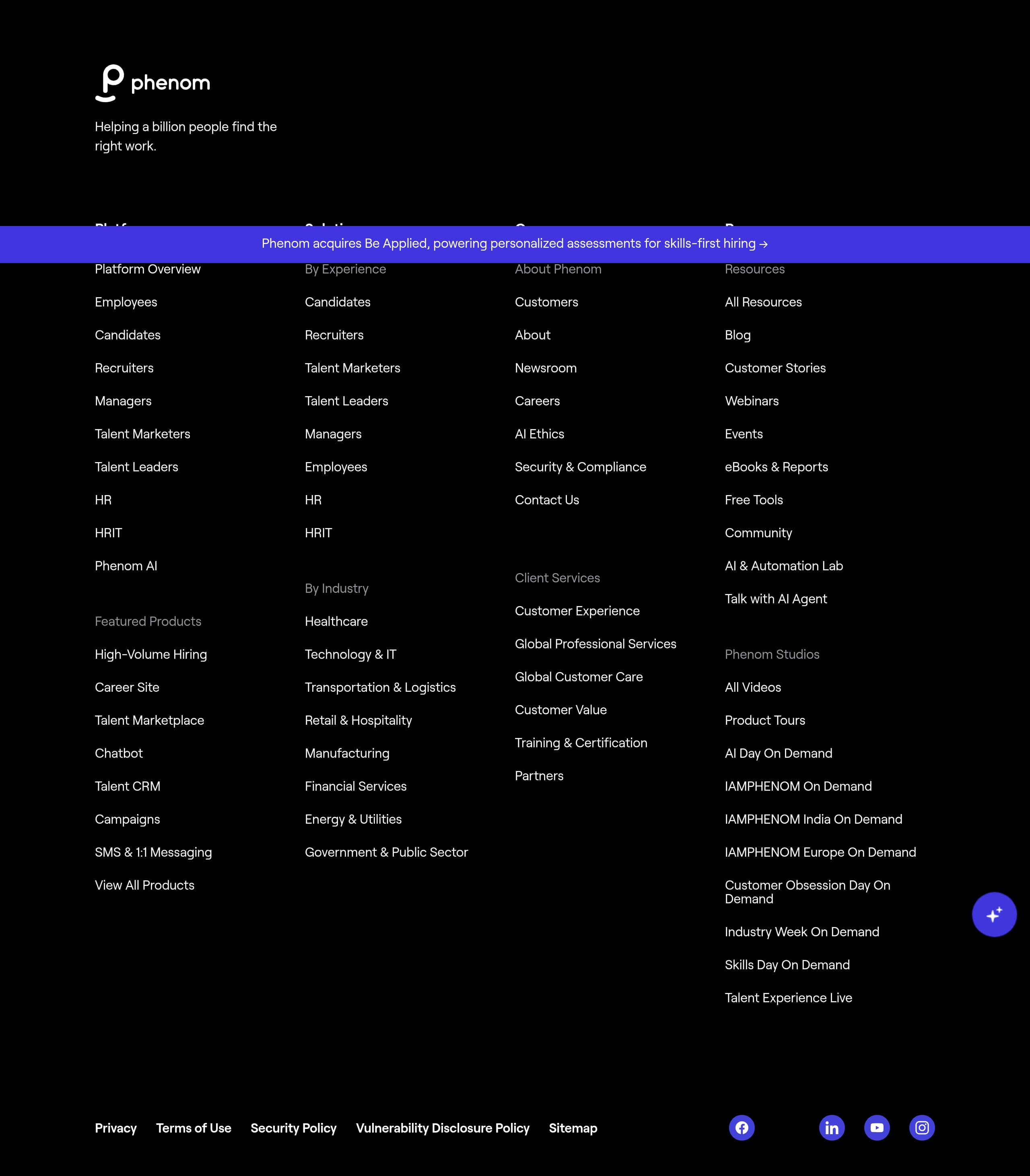
Phenom’s footer is designed as an enterprise site map, and it functions well as a secondary navigation hub for large buying committees. Instead of a minimal legal footer, it repeats core pathways: Platform, Solutions, Company, Customer Experience, Partners, and a deep Resources catalog. This is useful when stakeholders arrive from different entry pages and need to validate breadth, services, and governance.
Specific footer elements that improve usability and trust:
- Deep resource discovery: “Customer Stories,” “Webinars,” “Events,” “eBooks & Reports,” “Free Tools,” “Community,” and “Phenom Studios,” plus multiple “On Demand” event hubs (IAMPHENOM, Industry Week, Skills Day). This reinforces ongoing thought leadership and customer enablement.
- Clear enterprise support model: “Client Services,” “Global Professional Services,” “Global Customer Care,” and “Training & Certification” indicate post-sale capabilities, which matters for platform implementations.
- Governance and legal hygiene: visible links for Privacy, Terms of Use, Security Policy, and Vulnerability Disclosure Policy, along with “Security & Compliance” and “AI Ethics” in the Company section.
The footer also includes segmentation links by experience (Candidates, Recruiters, Talent Marketers, Talent Leaders, Managers, Employees, HR, HRIT) and by industry (Healthcare, Retail, Manufacturing, Financial Services, Government). This mirrors how Phenom sells, and it helps visitors confirm relevance quickly.
One potential issue is density. The footer contains many columns and repeated navigation blocks, which can be overwhelming and may dilute focus on primary conversion actions. A refinement could be a clearer hierarchy: keep Request demo and Contact Us persistent, then group the rest into expandable sections for faster scanning. Overall, Phenom’s footer is strong for enterprise buyers because it communicates breadth, services, and compliance maturity, and it provides a reliable route to documentation when procurement and HRIT questions arise late in the funnel.
Detected tech stack
Tools and technologies we detected on Phenom's site. Detection is best-effort and may be incomplete.
Scores
Our framework scores for Phenom's website in terms of clarity, conversion, and trust. See our methodology for how we calculate these.
How clear the value prop and structure are.
How conversion-friendly signup and pricing are.
How well trust and compliance are surfaced.
FAQ
Phenom is positioned as “Phenom Applied AI | Talent Intelligence Platform,” aimed at enterprise organizations managing hiring, internal mobility, development, and retention. The site organizes content by stakeholder, candidates, recruiters, managers, employees, and HRIT, and by industry, such as healthcare, retail, and manufacturing. The primary CTA is “Book Demo,” indicating it is built for sales-led evaluation rather than self-serve SMB onboarding.
Phenom does not present fixed public pricing in the provided page content. Instead, it routes buyers through “Pricing & RFP Requests” and “Request demo,” which fits enterprise packaging and procurement. The site uses suite-style groupings, such as Phenom for Talent Acquisition, Talent Management, and HRIT, to help buyers identify scope before requesting a quote or engaging in an RFP process.
The homepage combines a clear category label, “Talent Intelligence Platform,” with repeated operational outcomes like “Automate Hiring, Onboarding & Retention” and “Eliminate Manual Busywork.” It also addresses enterprise objections directly with “Explain Your Application of AI is Compliant & Safe.” Finally, it backs claims with quantified results such as “20K+ hours saved” and “40% faster time to hire,” which increases credibility quickly.
Phenom highlights metric-driven proof tiles tied to named customers, including Thermo Fisher Scientific and DHL Group, with outcomes like “20K+ hours saved” and “40% faster time to hire.” It also promotes benchmark reports like “State of AI & Automation for HR: 2026 Benchmarks Report,” which supports authority building. Resources like customer stories, webinars, and on-demand events add depth for buyers who need validation.
Phenom explicitly claims its AI is “compliant & safe” and emphasizes maintaining AI model validity and reliability. It also lists “Comprehensive Security & Compliance” frameworks, including GDPR, ISO, SOC II, CSA, and OWASP. The footer includes governance and legal links such as Privacy, Terms of Use, Security Policy, and a Vulnerability Disclosure Policy, which supports procurement and security review.

The world's best-performing SaaS businesses share surprisingly similar patterns. We help you learn and apply them through our human-designed methodology, with AI-assisted research.