
Key takeaways
Here are the key insights from our website breakdown analysis of Drift.
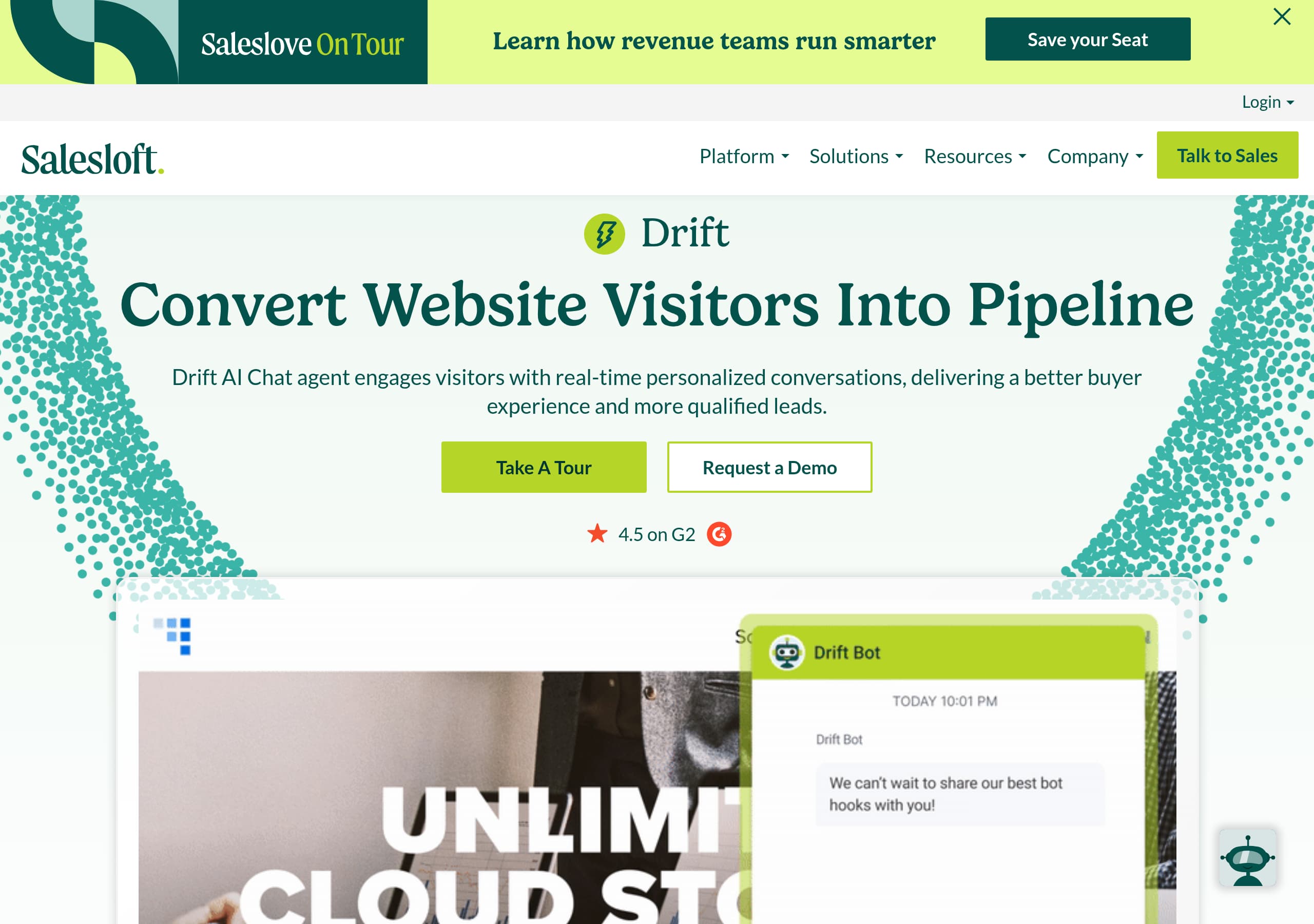
Drift’s homepage states the outcome clearly with “Convert Website Visitors Into Pipeline” and reinforces it with an AI-specific subheadline, making the product category and value obvious within seconds.
Conversion is driven by consistent dual CTAs, “Take A Tour” and “Request a Demo,” repeated from the hero through the closing section, maintaining a single primary next step without introducing competing paths like self-serve signup.
The page sells using a problem-to-solution structure through four labeled challenges, helping Drift justify conversational AI with concrete use cases like meeting booking, live rep chat, routing, and ROI attribution.
Social proof is unusually strong because it combines a visible “4.5 on G2” badge near the hero with multiple named testimonials and job titles, making credibility claims easy to scan and verify.
Drift is positioned as part of the Salesloft Platform, and the site uses integration language like “routes into the seller’s Rhythm workflow,” which is effective for revenue teams but can slightly blur Drift’s standalone identity.
Trust is supported more through “Trust” navigation and enterprise platform framing than through explicit security badges on the Drift page itself, so security confidence depends on users exploring deeper pages like privacy and compliance.
Home
Drift’s homepage communicates a single, revenue-tied promise quickly: “Convert Website Visitors Into Pipeline”. The hero immediately clarifies the mechanism with “Drift AI Chat agent engages visitors with real-time personalized conversations,” then anchors action with two high-intent CTAs, “Take A Tour” and “Request a Demo”.
The structure is optimized for B2B evaluation rather than casual browsing:
- A short, scannable hero: headline, AI chat agent explanation, then a visible “4.5 on G2” rating to reduce risk before users scroll.
- A narrative aligned to revenue teams: “Faster revenue growth starts here,” followed by a sentence that explicitly spans marketers and sellers, tying “earlier buyer engagement” to “driving efficiency across the entire revenue motion.”
What stands out is the deliberate problem framing. The page uses four sequential blocks labeled “Challenge #1” through “Challenge #4” (unmet expectations, lack of visibility, lengthy cycles, unknown conversion). Each challenge includes a concrete behavior or outcome, for example “provide accurate and instant answers,” “deanonymize site visitors,” and “attribute success to pipeline and revenue.” This approach gives Drift clear jobs-to-be-done and makes it easier for a buyer to map Drift to their funnel.
Brand architecture is also visible. Navigation and lower-page sections place Drift within the broader Salesloft ecosystem (Cadence, Rhythm, Deals, Forecast), which can strengthen enterprise credibility but may introduce mild category overlap. Overall, the homepage is strong at stating who it is for, what it does, and what to do next, with minimal cognitive load and frequent repetition of the same conversion actions.
Pricing
Drift’s pricing experience is positioned as a guided, sales-assisted motion rather than self-serve. In the primary navigation, pricing is presented as “Pricing: Discover Salesloft packages & what’s included”, which signals that Drift is now packaged within the broader Salesloft Platform. That is helpful for enterprise buyers who expect bundling, but it reduces immediate clarity for someone specifically searching for Drift-only tiers.
From a conversion standpoint, the page excerpt emphasizes exploration over transactional detail. You see repeated CTAs like “Request a Demo” and “Talk to Sales,” while pricing itself is framed as “packages,” not a visible tier grid. This is a common pattern for revenue platforms where implementation, routing logic, and integrations can vary by customer size.
Tactically, the site does three things that support a sales-led pricing approach:
- Keeps the user in a consistent evaluation loop—tour first, then demo. “Take A Tour” appears repeatedly, serving as a lower-commitment step before a sales conversation.
- Uses packaging language across the platform: “Revenue Orchestration Platform,” “Enterprise Data Platform,” and “AI Agents,” implying pricing is tied to modules.
- Reinforces integration value as part of what you buy, for example “Connect your existing tools for seamless revenue workflows” via an Integrations Marketplace.
The main tradeoff is that pricing intent is not satisfied on-page for users who want quick numbers, limits, or plan comparisons. If the pricing page follows the pattern the excerpt suggests, improving scannability would mean adding explicit “what’s included” bullets for Drift AI Chat agent, routing, reporting, and integrations, even if final quotes remain sales-provided. As-is, pricing supports enterprise conversion, but it is less friendly for SMB self-serve discovery.
Features
Drift’s feature presentation is organized around “challenge resolution” first, then a tighter feature list, which is a good fit for buyers comparing conversational AI vendors. The four challenge blocks act like feature categories: instant answers, deanonymization, routing into workflow, and conversion attribution. Each block explains a specific mechanism, for example “letting buyers book meetings or chat live with a rep,” and “scores their engagement in real time.”
The explicit “Key Features” section then narrows the scope into a scannable list: Live Chat, ROI Reporting, and Fastlane. Even in the excerpt, these items are written as outcomes, not modules:
- Live Chat: “Skip the forms. Engage buyers in real-time conversations and move them through the funnel faster.”
- ROI Reporting: “Track engagement metrics… attribute success to pipeline and revenue.”
- Fastlane: “uses your tech stack data to identify and qualify high-value buyers in real time,” so qualified visitors can “skip the form queue and connect immediately.”
Two UI and information-architecture details are worth noting. First, Live Chat appears twice in the excerpted list, which suggests either a duplication bug or a repeated card pattern. That can subtly reduce perceived polish in a category where competitors often show very crisp feature grids. Second, Drift is repeatedly described as an AI chat agent rather than a generic chatbot, which helps it stand apart from basic chat widgets.
The features story is also tightly integrated with Salesloft workflows, specifically the claim that qualified buyers are routed into the seller’s Rhythm workflow as a prioritized action. That is a strong differentiator for Salesloft customers, since it implies closed-loop follow-up.
Overall: Drift’s features are communicated in a way that maps directly to funnel stages and revenue metrics, with clear emphasis on qualification, routing, and attribution.
Signup
Drift’s conversion flow is clearly sales-led: the primary actions are “Request a Demo”, “Talk to Sales,” and a lower-friction “Take A Tour” or “Take A Self-Guided Tour.” There is no visible “Start free trial” or immediate account creation path in the provided page content, signaling Drift is optimized for mid-market and enterprise buying motions.
From a UX perspective, this is implemented with consistent CTA placement and repetition. The hero includes two prominent CTAs, and the bottom-of-page close repeats the same intent: “Ready to drive more pipeline from your website? See Salesloft Drift in action,” followed by Request a Demo. That repetition reduces decision fatigue and keeps the visitor moving toward a single endpoint.
The site also supports multiple buyer readiness levels:
- “Take A Tour” and “Take A Self-Guided Tour” work as evaluation paths for visitors who are not yet ready to speak with sales.
- “Request a Demo” addresses higher-intent buyers who want a tailored walkthrough.
- “Login” appears in the global navigation for existing users, including “Log in to Drift,” which prevents current customers from getting stuck in marketing pages.
One notable element is the ecosystem login routing: the header includes “Log in to Salesloft” and “Log in to Drift Platform,” reflecting the product’s integration into the Salesloft umbrella. That can be reassuring for existing customers but slightly confusing for net-new prospects if they are unsure which environment they will ultimately use.
To improve signup clarity without changing the sales model, Drift could add a short “What happens after you request a demo?” micro-explainer near the CTA—for example steps like discovery, routing design, and integration review. As shown, the site provides strong CTA consistency and clear next steps, but it intentionally avoids self-serve onboarding.
Trust
Drift’s trust posture is communicated more through enterprise signals and site architecture than through prominent, page-level security claims. In the top navigation under Resources, there is a dedicated “Trust” destination described as “commitment to data privacy, security & compliance,” plus supporting enterprise utilities like “Platform Status” and “Product Release Notes.” This is a mature trust pattern because it separates marketing promises from operational transparency.
On the Drift page itself, trust is reinforced indirectly via three mechanisms:
- Third-party validation: the visible G2 rating (4.5) provides early proof that the product is used and reviewed.
- Outcome-based accountability: “ROI Reporting” and language like “attribute success to pipeline and revenue” signals measurement and traceability, reducing the fear of a black-box chatbot.
- Platform framing: repeated references to “secure, compliant platform,” “governance,” “Scale AI Controls,” and “Security” in the broader Salesloft Platform section suggest enterprise-grade requirements are considered, even if details are not expanded on this page.
The clearest trust builder for enterprise buyers is the integration and data-model narrative: “unify revenue data,” “orchestrates and integrates at scale,” and “supported by AI workflows and agents.” These statements imply centralized control and standardized workflows across CRM, email, calendar, and more, which matters when chat captures buyer intent signals.
The main gap is that the Drift page excerpt does not show explicit security badges, compliance standards, or data-handling specifics inline (for example SOC 2, GDPR, retention policies, SSO options). Buyers likely need to click into the Trust section to confirm. For high-consideration products handling website visitor data, bringing one or two concrete compliance signals closer to the Drift CTA would increase trust at the moment of conversion.
Footer
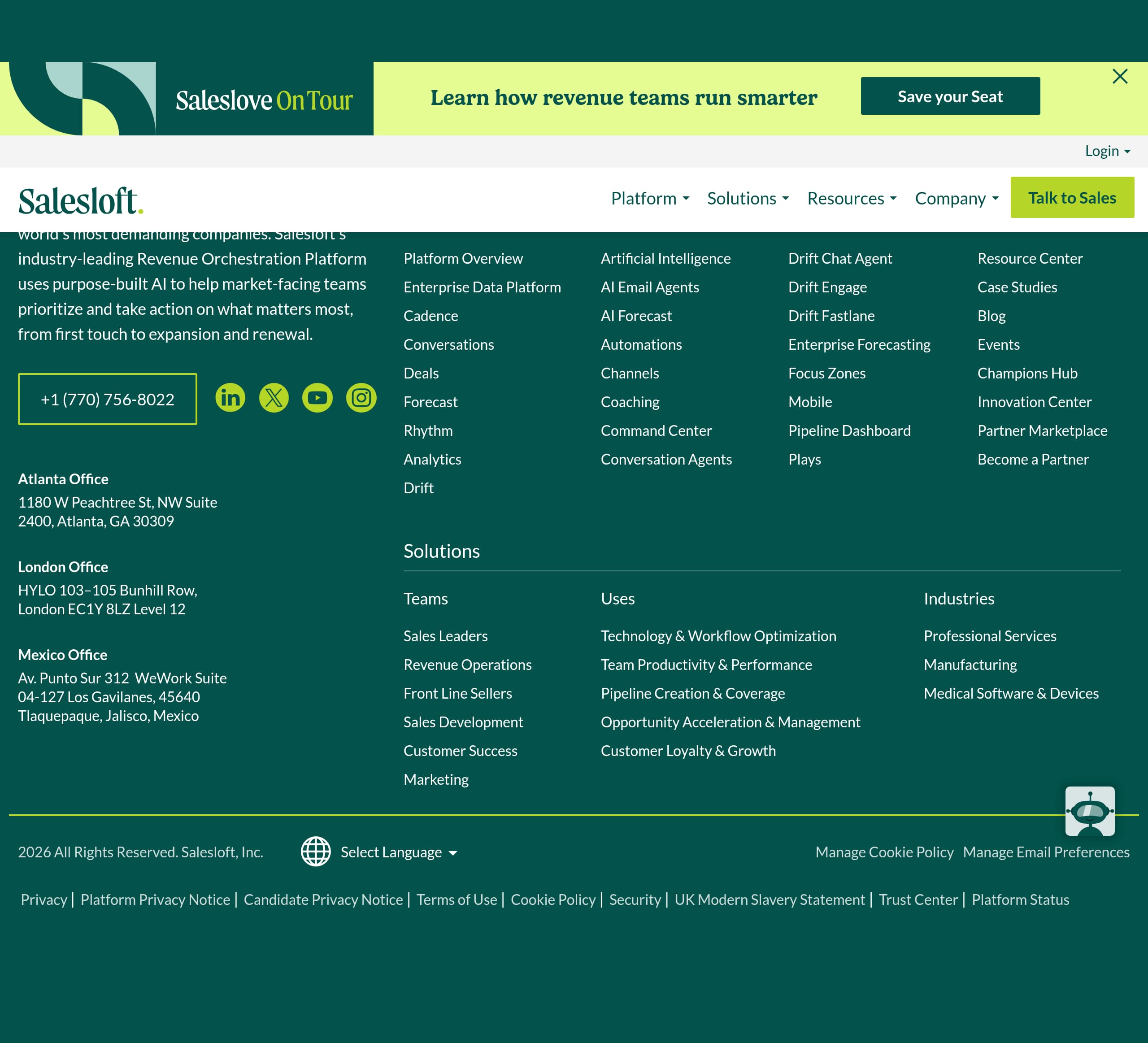
The footer supports both enterprise credibility and SEO by acting as a structured sitemap for the broader Salesloft Platform, while still giving Drift a clear place in the product lineup. In the provided footer screenshot and excerpt, the footer includes multiple product and solution entry points such as Platform Overview, “Enterprise Data Platform,” and specific modules including Drift, Cadence, Conversations, Deals, Forecast, Rhythm, and Analytics.
A notable design choice is that the footer doubles as a navigation hub for different buyer types. It segments content into categories that match how revenue organizations shop:
- Product and platform modules (Drift, Forecast, Deals).
- Solutions by team, such as Revenue Operations, Sales Leaders, Marketing, Customer Success.
- Resources and support, including “Customer Education,” “Professional Services,” “Get Support,” “Platform Status,” and “Release Notes.”
For trust and legitimacy, the footer provides real-world corporate signals: phone number and multiple office locations (Atlanta, London, Mexico Office) with street addresses. This is a practical trust builder for enterprise procurement because it demonstrates an established company presence and makes it easier to verify the vendor.
From an SEO perspective, the footer’s internal linking is extensive. It surfaces high-intent pages like the integrations marketplace, AI agents, and tours. That can help search engines understand entity relationships—for example, Drift as part of Salesloft’s Revenue Orchestration Platform. The risk is cognitive overload, since the footer contains many links and repeated platform blocks. A tighter hierarchy—for example, grouping Drift-specific items (chat agent, ROI reporting, Fastlane) under a Drift mini-column—could improve scannability.
Overall, the footer is built for enterprise buyers who need support pathways and vendor validation, and it reinforces platform breadth, operational transparency, and company legitimacy.
Scores
Our framework scores for Drift's website in terms of clarity, conversion, and trust. See our methodology for how we calculate these.
How clear the value prop and structure are.
How conversion-friendly signup and pricing are.
How well trust and compliance are surfaced.
FAQ
Drift’s homepage leads with an outcome headline, “Convert Website Visitors Into Pipeline,” then immediately explains the mechanism using an AI chat agent. It reinforces credibility early with a visible “4.5 on G2” marker and uses a clear problem framework (four “Challenge #” sections) to connect conversational AI to specific jobs like qualification, routing, and attribution. The CTAs stay consistent with “Take A Tour” and “Request a Demo.”
Pricing is positioned as part of the broader Salesloft packaging, with navigation language like “Discover Salesloft packages & what’s included.” In the provided content, Drift does not show a self-serve pricing table or a checkout flow. Instead, the site pushes a sales-led path through “Request a Demo” and “Talk to Sales,” which is typical for enterprise revenue platforms where features, integrations, and governance needs vary by customer.
Drift emphasizes Live Chat, ROI Reporting, and Fastlane. Live Chat focuses on skipping forms and engaging visitors in real time. ROI Reporting focuses on tracking engagement metrics and attributing conversations to pipeline and revenue. Fastlane is positioned as real-time identification and qualification using existing tech stack data, letting high-value visitors skip the form queue and connect immediately. The page also highlights deanonymizing visitors and routing qualified buyers into Salesloft workflows.
Drift uses a sales-led onboarding approach rather than immediate self-serve signup. The primary paths are “Request a Demo” and “Take A Tour,” plus a “Take A Self-Guided Tour” option for lower-commitment evaluation. The global navigation includes login options for existing users, including “Log in to Drift,” which helps customers access the product without going through marketing pages.
The site includes a dedicated “Trust” area in the navigation described as covering data privacy, security, and compliance, plus operational links like “Platform Status” and “Product Release Notes.” On the Drift page, trust is supported through third-party validation (4.5 on G2) and enterprise platform framing that references governance, scale, and security controls. Detailed compliance specifics are likely housed in the Trust section rather than the Drift landing page.

The world's best-performing SaaS businesses share surprisingly similar patterns. We help you learn and apply them through our human-designed methodology, with AI-assisted research.