
Key takeaways
Here are the key insights from our website breakdown analysis of Gem.
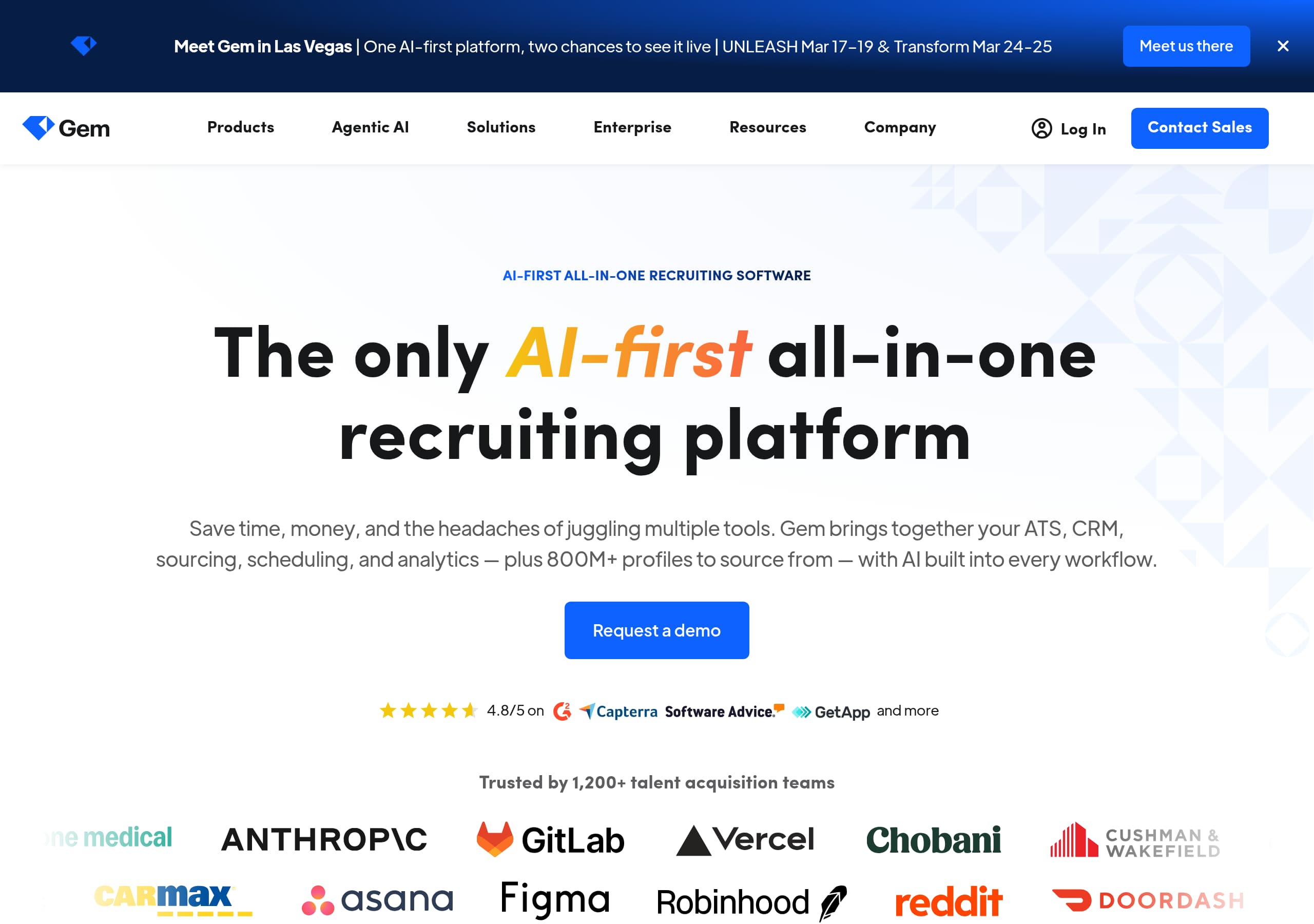
Gem’s homepage nails positioning with a single, specific promise, “The only AI-first all-in-one recruiting platform,” then immediately enumerates what “all-in-one” includes: ATS, CRM, sourcing, scheduling, and analytics, which reduces ambiguity for buyers.
Conversion is driven by consistent high-intent CTAs, especially “Request a demo” and “Contact Sales,” with clear enterprise-first intent rather than pushing self-serve for a complex recruiting suite.
The site sells consolidation and efficiency with tangible outcomes, including “Cut technology costs by 30-50%” and “boosting recruiter productivity up to 5x,” which frames ROI in language procurement and TA leaders recognize.
Segmentation is unusually explicit: Startups (1-100), Growth (101-1000), and Enterprise (1000+). The Enterprise option clearly supports “Enhance Your Existing ATS,” lowering risk for teams anchored to Workday or similar systems.
Social proof is strong and quantified, with named customer stories (for example, Procore and Amazon One Medical) and measurable wins (hours saved, hires, time-to-fill), which increases credibility beyond generic testimonials.
Trust is reinforced by visible navigation to “Security & Compliance,” “Status,” “Privacy,” and “OFCCP,” signaling readiness for regulated and enterprise environments even when detailed certifications are not shown in the excerpt.
Home
Gem’s homepage is built to answer one buying question fast: is this a full recruiting platform or another point solution? The hero headline, “AI-first All-in-one recruiting software” followed by “The only AI-first all-in-one recruiting platform”, clearly stakes a category position, then immediately spells out the suite: ATS, CRM, sourcing, scheduling, and analytics, plus “800M+ profiles to source from” and AI “built into every workflow.” That combination reduces interpretation risk for enterprise evaluators.
Several conversion and clarity patterns stand out:
- The primary CTA is consistently “Request a demo”, which matches a high-ACV, multi-module product where buyers expect a guided evaluation.
- A credibility line appears near the top, “Trusted by 1,200+ talent acquisition teams”, plus a visible 4.8/5 rating reference, which supports the category claim.
- A product navigation bar lists major modules (Agentic AI, ATS, CRM, Sourcing, Scheduling, Analytics, Talent Marketing), signaling breadth before the user scrolls.
The mid-page narrative emphasizes platform cohesion: “one consistent interface, unified data, smarter AI recommendations, and simplified permissions.” This is effective because consolidation is the core business case for Gem, and the page adds measurable framing, “Cut technology costs by 30-50%” and “boosting recruiter productivity up to 5x.” It also segments buyers with explicit employee ranges (1-100, 101-1000, 1000+), and the enterprise path explicitly supports enhancing an existing ATS, which lowers switching anxiety for Workday, Greenhouse, or similar ATS anchors.
One improvement opportunity: the homepage repeats the segment cards multiple times in the excerpt, which can create scanning fatigue. A tighter, single segment block with a sharper “choose your path” interaction could preserve clarity while reducing redundancy.
Pricing
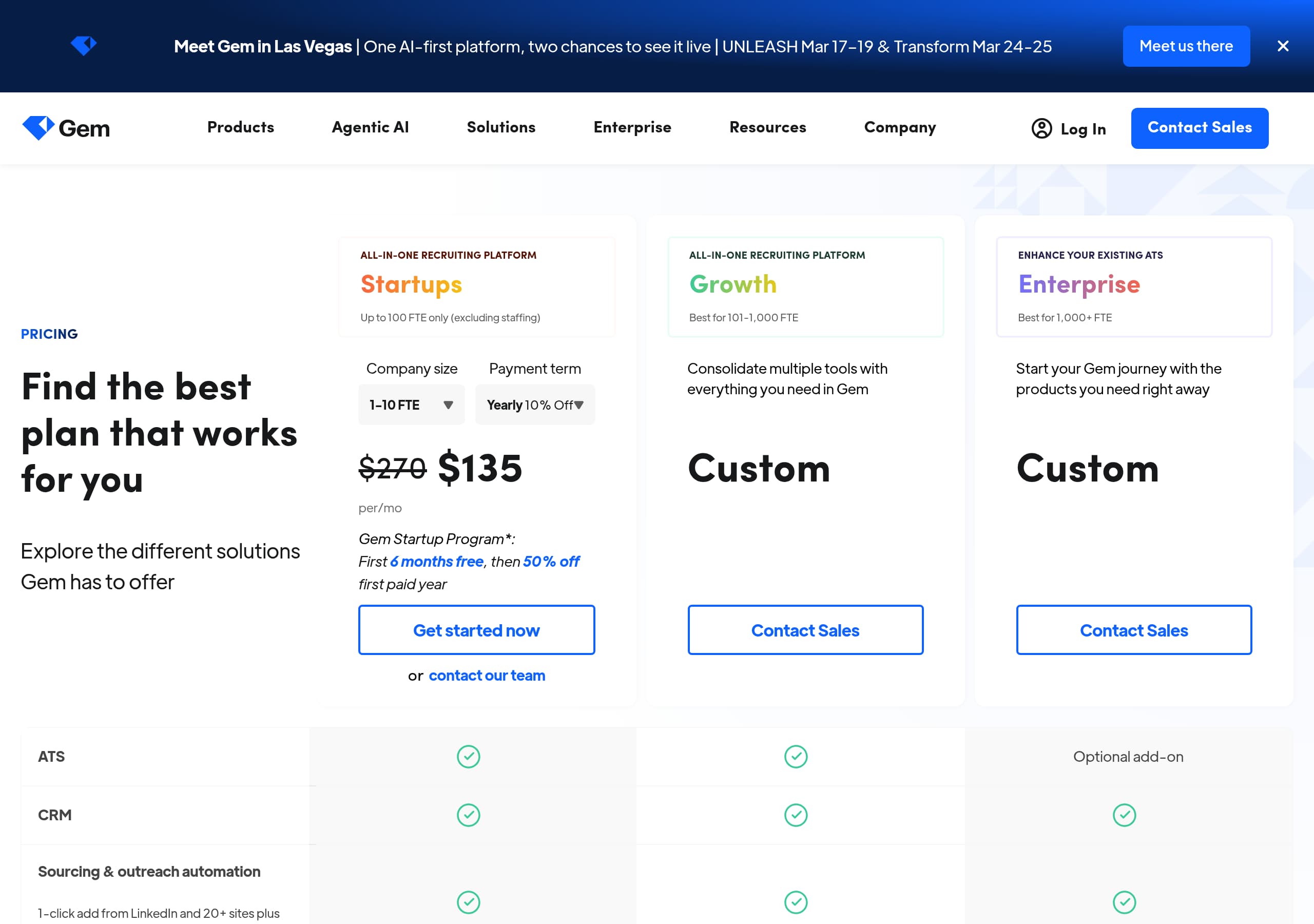
Gem’s pricing approach is optimized for enterprise sales rather than self-serve checkout: the navigation includes “Pricing,” but the primary conversion paths across the site remain “Request a demo” and “Contact Sales.” For a platform that bundles ATS, CRM, sourcing, scheduling, analytics, and AI capabilities, this is a pragmatic choice because packaging often depends on seats, modules, integrations, and data needs.
From the pricing screenshot context and the site-wide IA, expect pricing to function as a qualification page, not a transactional page. What works well for conversion:
- Pricing is positioned alongside other evaluation resources (benchmarks, customers, events), implying a guided buying process.
- The page likely supports multiple buyer types because the homepage segmentation is explicit: Startups, Growth, and Enterprise, with the enterprise option framed as “Enhance Your Existing ATS.” This signals that pricing is not one-size-fits-all.
- “Get started today” repeats the dual CTA pattern: Request a demo and Contact Sales, which reduces decision paralysis and gives procurement a clear next step.
Where pricing could be stronger for buyer confidence is transparent packaging. The excerpt includes “How much does Gem cost?” in the FAQ list, suggesting that users actively look for at least directional guidance. Even without exact numbers, Gem can improve clarity by:
- Listing what is included in “Gem All-in-One” versus add-ons, for example AI agents, analytics, scheduling.
- Calling out integration assumptions (ATS replacement vs. ATS augmentation) because that materially changes cost and implementation.
- Adding a short “typical pricing drivers” section: seats, modules, sourcing volume, and support tier.
Net effect: the pricing motion is aligned with complex enterprise evaluation, but it relies on sales-led discovery. Adding more packaging detail would reduce friction without undermining sales flexibility.
Features
Gem’s features are presented as a platform map rather than a long list, which supports the core claim: one connected recruiting system instead of multiple disconnected tools. The “Products” and “Platform” navigation surfaces key modules: Agentic AI, ATS, CRM, Sourcing, Scheduling, Analytics, Talent Marketing, and the homepage copy reinforces the integration story with “one consistent interface” and “unified data.” For TA leaders, this directly addresses the operational pain of tool sprawl.
The most effective feature framing is outcome-led, not purely functional:
- Consolidation: “Save time, money, and the headaches of juggling multiple tools,” then explicitly names the consolidated categories (ATS, CRM, sourcing, scheduling, analytics).
- AI embedded in workflows: “AI built into every workflow” is more credible when paired with the separate AI entries in the footer navigation, like AI Outbound Sourcing, AI App Review, and AI Talent Rediscovery.
- Data access: “800M+ profiles to source from” is a concrete capability statement that distinguishes Gem from ATS-only messaging.
There is also a subtle but important packaging distinction in the Solutions section:
- Startups and Growth are pointed to Gem All-in-One, implying Gem can be the system of record.
- Enterprise is pointed to “Enhance Your Existing ATS,” implying modular adoption that layers CRM, sourcing, scheduling, and analytics on top of an incumbent ATS.
That dual-mode positioning helps Gem compete both with all-in-one ATS vendors and with point-solution stacks.
A feature-page improvement opportunity is to make the platform connections more explicit visually and procedurally: for example, a simple “candidate lifecycle” diagram showing where ATS, CRM, sourcing, scheduling, and analytics interact, plus a short list of what data is shared automatically across modules. The current navigation richness implies breadth, but a tighter workflow narrative would help evaluators understand “better together” without needing a demo.
Signup
Gem’s site is optimized for a sales-led signup motion, and it is consistent about that choice. Across the homepage and the closing section, the primary next step is “Request a demo”, with “Contact Sales” as a secondary option, and “Log In” available for existing users. That is appropriate for an all-in-one recruiting platform where implementation, integrations, and permissions are part of the value, and a self-serve trial could create incomplete evaluations.
The conversion flow is strengthened by a few observable patterns:
- Persistent top navigation includes “Log In” and “Contact Sales,” supporting both existing customers and new buyers without forcing them through marketing content.
- CTAs are repeated at key scroll depths (hero and final “Get started today”), which helps users who decide later.
- The site uses segment-specific pathways (Startups, Growth, Enterprise), which can route a demo request to the right sales motion—for example, all-in-one ATS adoption versus ATS augmentation.
Where the signup and onboarding experience can improve is pre-demo expectation setting. The excerpt does not show what happens after “Request a demo,” and for enterprise buyers, uncertainty can add friction. Gem could reduce drop-off by adding:
- A short “what happens next” panel (time to respond, what the demo covers, who should attend).
- A checklist of required context (current ATS, hiring volume, sourcing needs, regions) to improve lead quality and reduce back-and-forth.
- Optional scheduling embedded; especially since Gem sells scheduling benefits, a “book a time” widget would align the promise with the experience.
Overall, the flow is coherent: Gem is not trying to be self-serve; it is trying to be evaluated seriously. The main opportunity is making the demo request feel more predictable and lower effort without changing the enterprise-first motion.
Trust
Gem communicates trust primarily through enterprise-ready cues in navigation and compliance-oriented links, combined with high-credibility customer evidence. In the global navigation and footer, “Security & Compliance,” “Status,” “Privacy,” “Terms,” and “OFCCP” are visible, which signals preparedness for regulated recruiting environments and vendor security reviews. This is a practical trust pattern because many TA tools fail procurement not on features, but on documentation and governance.
Trust is also reinforced by product-specific risk reducers:
- The platform pitch emphasizes simplified permissions and unified data, which implies centralized access control rather than scattered tool-level permissions.
- The enterprise solution explicitly supports “Enhance Your Existing ATS,” reducing migration risk for organizations that need continuity in their system of record.
- Customer proof includes a quote about Gem working effectively with Workday, which is a high-signal integration trust marker.
Gem also surfaces “Fraud Detection Agent: Stop fraud before it wastes your team’s time” in Recent News, which indicates awareness of modern recruiting threats such as fake applicants and automation abuse. Even without detailed technical documentation in the excerpt, naming the problem and presenting a productized response helps establish operational seriousness.
Where trust could be strengthened further is on-page specificity. The site points to Security & Compliance, but the excerpt does not show certifications, data handling, or uptime commitments. For enterprise buyers, adding a few concrete, verifiable trust artifacts would reduce time-to-approval:
- A short list of security controls on the marketing page (SSO, audit logs, role-based access).
- Clear links to a security portal or documentation.
- A concise statement of how AI is used, especially for application review, to address fairness, explainability, and governance concerns.
As presented, Gem’s trust layer is solid and enterprise-aware, but it would score higher with more front-of-house security detail rather than relying on navigation links alone.
Footer
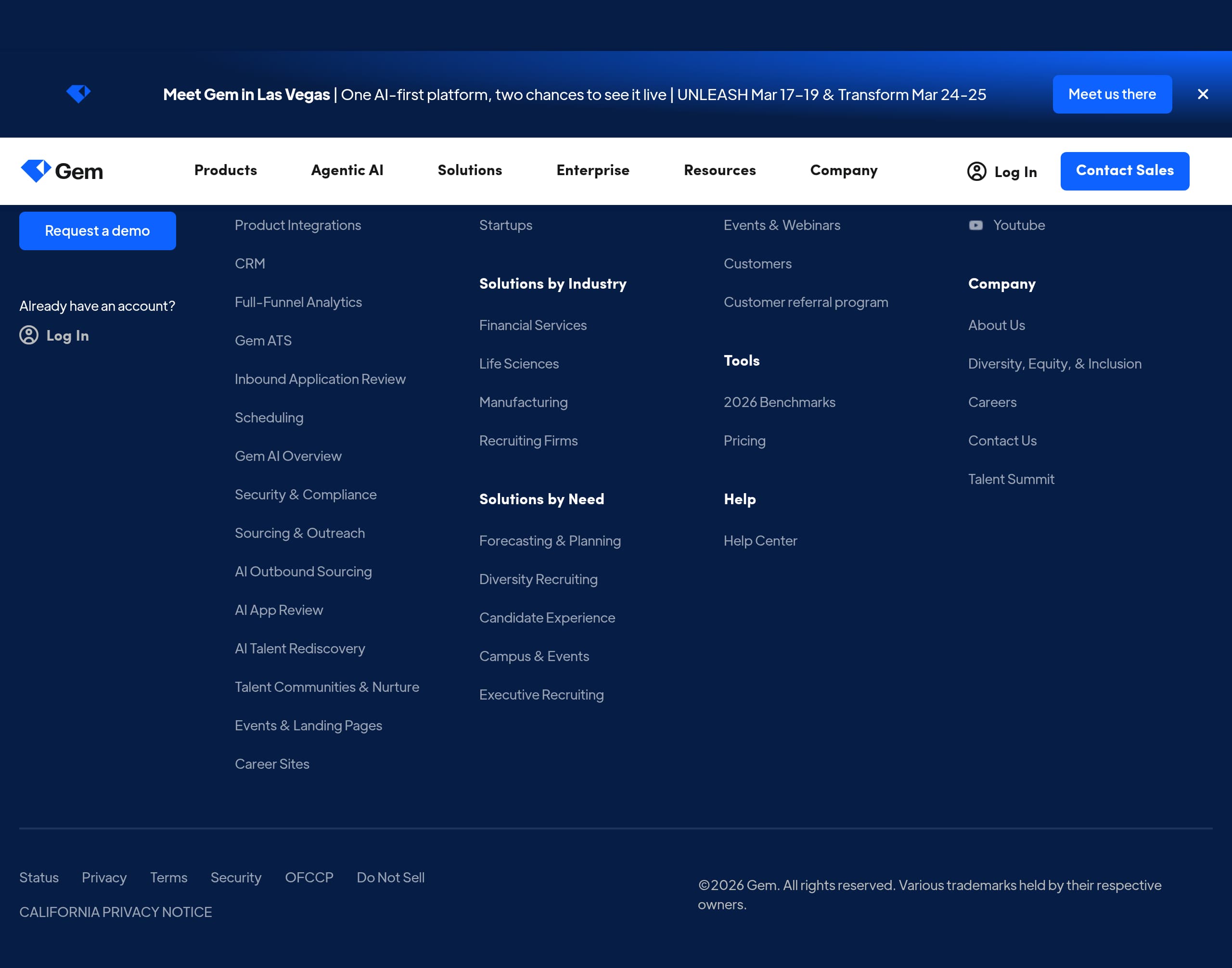
Gem’s footer is built as a complete evaluation hub, not just a legal endpoint. It is dense, scannable, and organized into multiple columns that mirror the buying journey: Platform, Solutions, Resources, Customers, Tools, and Company. This structure matters because Gem sells a broad suite, and the footer acts as a site map for evaluators who want to validate specific capabilities like CRM, analytics, scheduling, and AI.
A few footer elements are especially effective:
- Deep product links: entries like “Full-Funnel Analytics,” “Inbound Application Review,” “Gem AI Overview,” and specific AI pages (AI Outbound Sourcing, AI App Review, AI Talent Rediscovery) suggest a robust feature set and help long-tail SEO.
- Enterprise readiness: “Security & Compliance” is present, alongside “Status,” “Privacy,” “Terms,” and “CALIFORNIA PRIVACY NOTICE”, which supports procurement checklists.
- Regulated hiring support: the explicit “OFCCP” link is a strong signal for US organizations that handle compliance reporting.
The footer also includes discovery hooks that can drive re-engagement: “Events & Webinars,” “2026 Benchmarks,” and a “Customer referral program.” These are useful for nurturing buyers who are not ready to request a demo immediately.
Two opportunities to improve usability and conversion from the footer:
-
Reduce cognitive load with clearer grouping for similar items. For example, several AI links could be nested under a single Gem AI parent, improving scan speed.
-
Add a final footer CTA module. The excerpt shows “Request a demo” higher on the page, but a sticky or footer-level CTA block with “Request a demo” plus “Contact Sales” can catch users who scroll to validate trust and then decide.
Overall, Gem’s footer is enterprise-grade and SEO-friendly, and it supports both detailed evaluation and compliance reassurance without forcing users back to the header navigation.
Detected tech stack
Tools and technologies we detected on Gem's site. Detection is best-effort and may be incomplete.
Scores
Our framework scores for Gem's website in terms of clarity, conversion, and trust. See our methodology for how we calculate these.
How clear the value prop and structure are.
How conversion-friendly signup and pricing are.
How well trust and compliance are surfaced.
FAQ
Gem is an AI-first, all-in-one recruiting platform that brings multiple recruiting functions into one system. The homepage positions it as combining ATS, CRM, sourcing, scheduling, and analytics, with AI built into workflows and access to “800M+ profiles to source from.” The site also presents separate paths for Startups and Growth (Gem All-in-One) and Enterprise teams that want to enhance an existing ATS.
Gem treats pricing as part of a sales-led evaluation rather than a self-serve checkout. The site prominently uses “Request a demo” and “Contact Sales” CTAs, and includes “How much does Gem cost?” in its FAQ list, implying prospects often ask for price guidance. Packaging is also implied by segmentation: Startups and Growth are directed to “Gem All-in-One,” while Enterprise is positioned around augmenting an existing ATS.
Gem’s homepage leads with a clear category claim, “The only AI-first all-in-one recruiting platform,” then immediately clarifies what “all-in-one” means by listing ATS, CRM, sourcing, scheduling, and analytics. It supports the pitch with concrete numbers like “800M+ profiles” and trust indicators like “Trusted by 1,200+ talent acquisition teams” and a 4.8/5 rating reference. The page also segments by company size to reduce mismatched demos.
Gem primarily routes new users into a demo request flow instead of offering an instant self-serve trial. “Request a demo” appears in the hero and again near the bottom, with “Contact Sales” as an alternative, while “Log In” is available for existing accounts. This approach matches a platform that often requires integrations, permissions, and process configuration, especially for enterprise teams that want Gem to work alongside an existing ATS.
Gem includes multiple enterprise trust cues directly in its navigation and footer, including “Security & Compliance,” “Status,” “Privacy,” “Terms,” and an “OFCCP” link. It also uses quantified customer stories with named roles and brands, including a quote referencing Gem’s communication with Workday. These elements help with procurement reviews and reduce perceived risk for teams consolidating critical recruiting workflows.

The world's best-performing SaaS businesses share surprisingly similar patterns. We help you learn and apply them through our human-designed methodology, with AI-assisted research.