
Key takeaways
Here are the key insights from our website breakdown analysis of Domo.
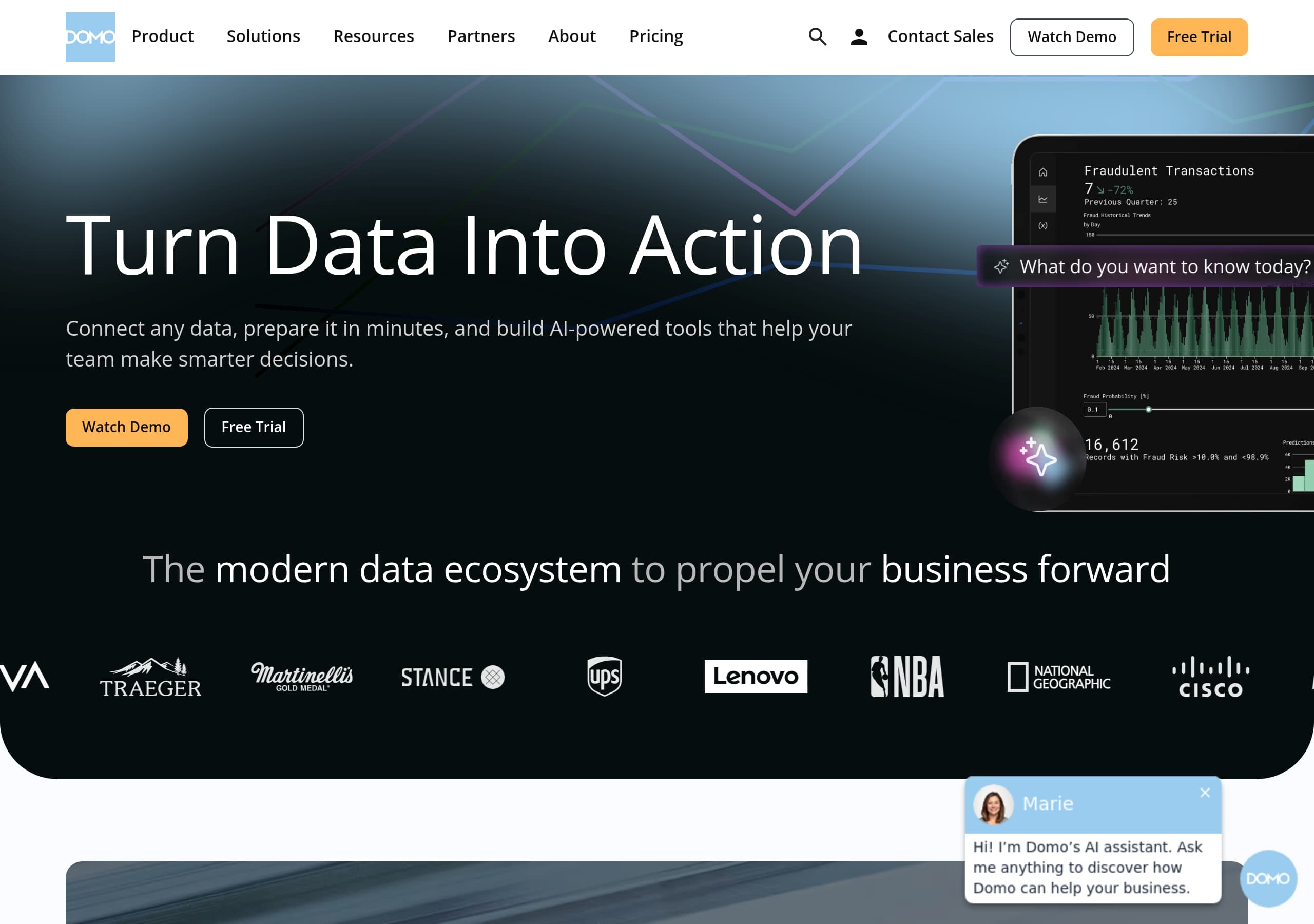
Domo positions itself clearly as an end-to-end platform with a single headline, “The AI and Data Products Platform,” then immediately supports it with dual primary CTAs, Watch Demo and Free Trial, to match enterprise and self-serve intent.
The homepage navigation is structured like a product map, with “Integrate,” “Extend,” “Automate,” and “Domo.AI” as explicit pillars, which reduces ambiguity for buyers comparing Domo to BI tools like Tableau or Power BI and data platforms like Snowflake-focused stacks.
Domo leans heavily into credibility through third-party validation, including G2 and Gartner Peer Insights ratings, plus repeated “Leader” placements, which helps de-risk a complex platform purchase.
Feature communication is use-case-first, especially in AI: the “AI Agents for every use case” section lists concrete agents like HR Benefits Agent and Insurance Claims AI Agent, making the product feel operational rather than conceptual.
Pricing appears optimized for sales-led motion: the site offers a dedicated Pricing entry point but pairs it throughout the experience with Talk to Sales and Watch Demo, signaling a customized quote path for larger deployments.
Trust and governance are integrated into the product story instead of relegated to a compliance footnote, using explicit language like Security and Governance and “secure and private AI,” which is important for regulated industries listed in Solutions.
Home
Domo’s homepage succeeds because it states the category and outcome in one breath: “The AI and Data Products Platform” followed by “Connect any data, prepare it in minutes, and build AI-powered tools,” then it immediately offers Watch Demo and Free Trial.
What the hero does well
- The hero headline is a strong category claim, and the subhead explains the workflow in three verbs: connect, prepare, build. This maps to the buyer journey for analytics and data product teams.
- Dual CTAs reduce friction for different intents: buyers who need stakeholder alignment can choose Watch Demo, while practitioners can choose Free Trial.
Information architecture that matches the product
The top navigation reads like a platform blueprint: Data Integration, Business Intelligence, Workflows and Intelligent Automation, and Domo.AI. Each pillar has sub-items that signal depth, for example “Drag-and-drop ETL,” “Low-Code App Studio,” “Embedded Analytics,” and “No-Code Workflows.” This structure helps Domo compete against point solutions by showing it spans ingestion, modeling, visualization, and activation.
Enterprise storytelling with a specific hook
A prominent partnership module references Formula 1 driver Alex Albon and a 2026 season collaboration, which works as a memorable proof-of-scale story. It also sets an expectation that Domo is used in high-velocity environments where time-to-decision matters.
Overall, the homepage balances platform breadth with scannable “Explore” links (for example, “Explore integration tools” and “Explore Domo.AI”), which keeps the page from feeling like a generic BI landing page while still supporting multiple audiences, including IT, analytics, and operations.
Pricing
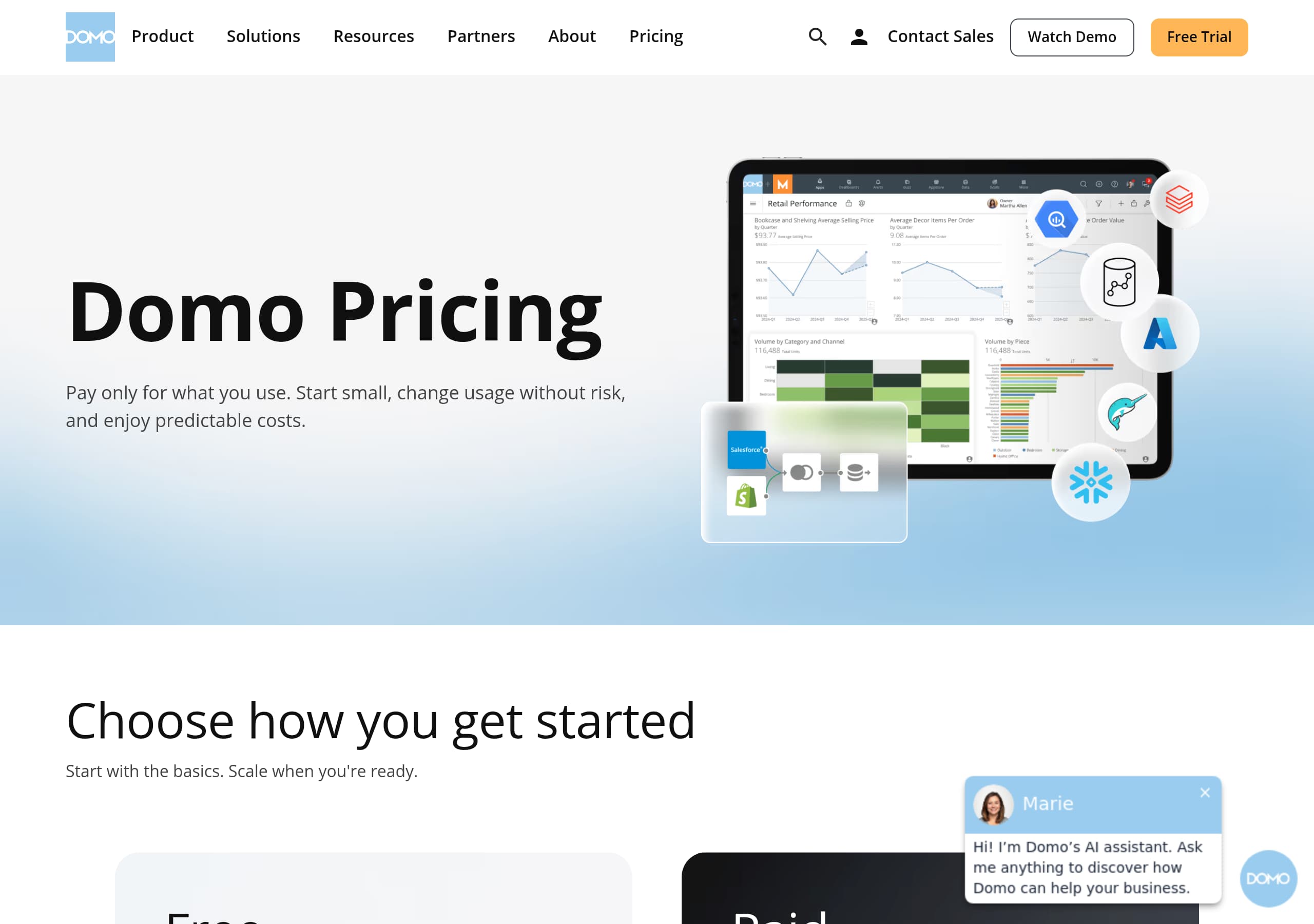
Domo’s pricing experience is positioned for a sales-led platform purchase: Pricing is accessible in the navigation, but the dominant conversion actions across the site remain Talk to Sales, Watch Demo, and Free Trial. That combination signals that Domo expects many customers to need scoping, security review, and packaging decisions rather than a simple self-checkout.
What the pricing UI likely communicates (based on the provided page context)
From the site-wide layout and CTAs, Domo treats pricing as a decision step that routes to a conversation. You see multiple ways to proceed without forcing a price-first choice:
- Talk to Sales for enterprise procurement and multi-team rollouts.
- Watch Demo to support internal buy-in and evaluation.
- Free Trial to capture high-intent users who want hands-on validation.
Why this fits Domo’s product scope
Domo is not presented as a single-feature tool. The navigation lists multiple suites: Integration Suite, BI dashboards, Embedded Analytics, Intelligent Automation, plus Agentic AI and AI agent templates. When a product spans integration, governance, and app building, pricing often depends on factors like data sources, deployment scope, and embedded use cases. The site’s CTA mix aligns with that reality without hiding the pricing entry point.
Conversion detail that improves outcomes
The repeated presence of “Pricing” alongside “Product Overview” and “All Features” helps buyers do a three-tab evaluation: capabilities, packaging, and proof. The best part is the consistency of action labels: the same core CTAs appear near the top navigation and again in “Ready to get started?” which reduces cognitive load and makes the pricing page less of a dead end.
Net: Domo uses pricing as a routing mechanism, not just a table, which is appropriate for a platform sale.
Features
Domo communicates features as platform capabilities grouped into buyer-relevant pillars, which makes a broad product feel navigable. Instead of an exhaustive list, the homepage presents a curated set of “tools you need” and then deepens with AI and lifecycle sections.
Clear pillar grid
The core feature grid highlights four pillars with short explanations and action links:
- Artificial Intelligence: “Get instant answers with AI-powered agents.”
- Data Integration: “Bring 1,000+ data sources together in one place.”
- Business Intelligence: “See how your business is performing in real time.”
- Workflows and Intelligent Automation: “Save time by automating processes.” Each pillar has an “Explore” link, which turns the grid into a routing layer rather than a static brochure.
AI is made tangible with agent examples
Domo goes beyond “AI for analytics” claims by listing specific AI Agent templates and use cases: HR Benefits Agent, Competitive Research Agent, Retail Associate Agent, Insurance Claims AI Agent, Retail Shopping Agent, and Customer Support Agent. Each includes a “Watch the video” CTA, which is a practical way to demonstrate behavior and reduce skepticism.
Lifecycle framing: Integrate, Extend, Automate
The “Understanding Domo” section introduces a three-step platform story:
- Integrate: centralized access and ETL “on top of your existing cloud data platform,” with the explicit reassurance that “your data stays where you want it.”
- Extend: visualizations, interactive apps, shareable data products, and Embedded Analytics.
- Automate: baked-in automation to reduce errors and speed operations.
This structure is effective because it mirrors real adoption: connect data, deliver insights, operationalize.
Net: Domo’s feature presentation balances breadth with concrete “next clicks,” minimizing overwhelm while still signaling a full platform.
Signup
Domo’s signup path is designed to support both self-serve evaluation and enterprise buying, using persistent CTAs and repeated entry points rather than a single “Start” button. The site consistently presents Free Trial, Watch Demo, and Talk to Sales, which matches how analytics platforms are adopted across teams.
Multiple conversion routes, consistently labeled
Across the navigation and hero, the CTAs are stable: Free Trial for hands-on users, Watch Demo for evaluation, and Contact Sales/Talk to Sales for procurement-driven paths. This consistency matters because Domo targets different stakeholders (BI, IT, operations), and each stakeholder has a different tolerance for immediate signup.
Friction management for enterprise products
The platform includes advanced areas like Security, governance frameworks, embedded analytics, and automation. For products with that scope, forcing a single-step “credit card trial” can create drop-off. Domo mitigates this by making the demo path first-class, while still offering a trial for users who want to validate connectors, dashboards, and AI agents quickly.
Onboarding expectations set by content
The homepage indicates what a new user can do early:
- Connect data using “1,000+ data sources” and “View all connectors.”
- Build agents using “AI Agent Templates” and example agents like “Competitive Research Agent.”
- Explore learning resources via Domo University, certifications, and a knowledge base.
That combination suggests onboarding is not only product-led, it is also education-led, which is typical for platforms that span ETL, BI, and workflow automation.
Practical improvement opportunity
The excerpt does not show the actual trial form steps or required fields, so it is hard to assess form friction. If the trial flow is more than a few fields, Domo could further reduce anxiety by previewing “what you get in the trial” near the CTA.
Overall, Domo’s signup approach is conversion-resilient: it captures intent at multiple readiness levels without breaking the platform narrative.
Trust
Domo builds trust by treating security, governance, and privacy as core platform capabilities, then reinforcing that with recognizable partner ecosystems and independent review sources. This is crucial for a product that handles sensitive operational and customer data.
Security positioned as a first-class concept
The site includes a dedicated Security and Governance section with explicit language: “secure, compliant, and well-governed interactions” and “pre-built governance frameworks” plus “proactive alerting.” Importantly, this appears as part of the platform story, not buried only in a legal footer, which signals maturity to IT and risk stakeholders.
AI trust language that addresses enterprise concerns
Domo repeatedly frames AI in controlled terms: “Utilize secure and private AI,” “custom AI agents and automations grounded in your data,” and “Prepare data for AI” with steps like “Validate details, add structure.” This reduces fear that AI features are bolted on without governance.
Partner ecosystem as trust proxy
The site highlights “Trusted partnerships” and explicitly names major cloud and data ecosystem entities: Snowflake, AWS, Databricks, Google, Azure, Oracle, plus Microsoft and Salesforce in the partner strip. For many buyers, compatibility with existing cloud data warehouses is a trust requirement, and the page directly addresses this with “data stays where you want it” and “hybrid architecture.”
Third-party validation supports diligence
Trust is also reinforced through review platforms and analyst mentions, including Gartner Peer Insights and Dresner. When paired with review counts and dated references (“Jan 2026”), it signals the brand is actively used and evaluated.
What is missing from the excerpt
The excerpt references “Security” in navigation, but does not show specific compliance standards (for example SOC 2, ISO 27001) on the captured content. If those are present on the Security page, surfacing 2 to 3 top certifications near the homepage trust blocks would further strengthen fast-path trust.
Net: Domo’s trust posture is credible because it connects governance to AI and data workflows, not just policy statements.
Footer
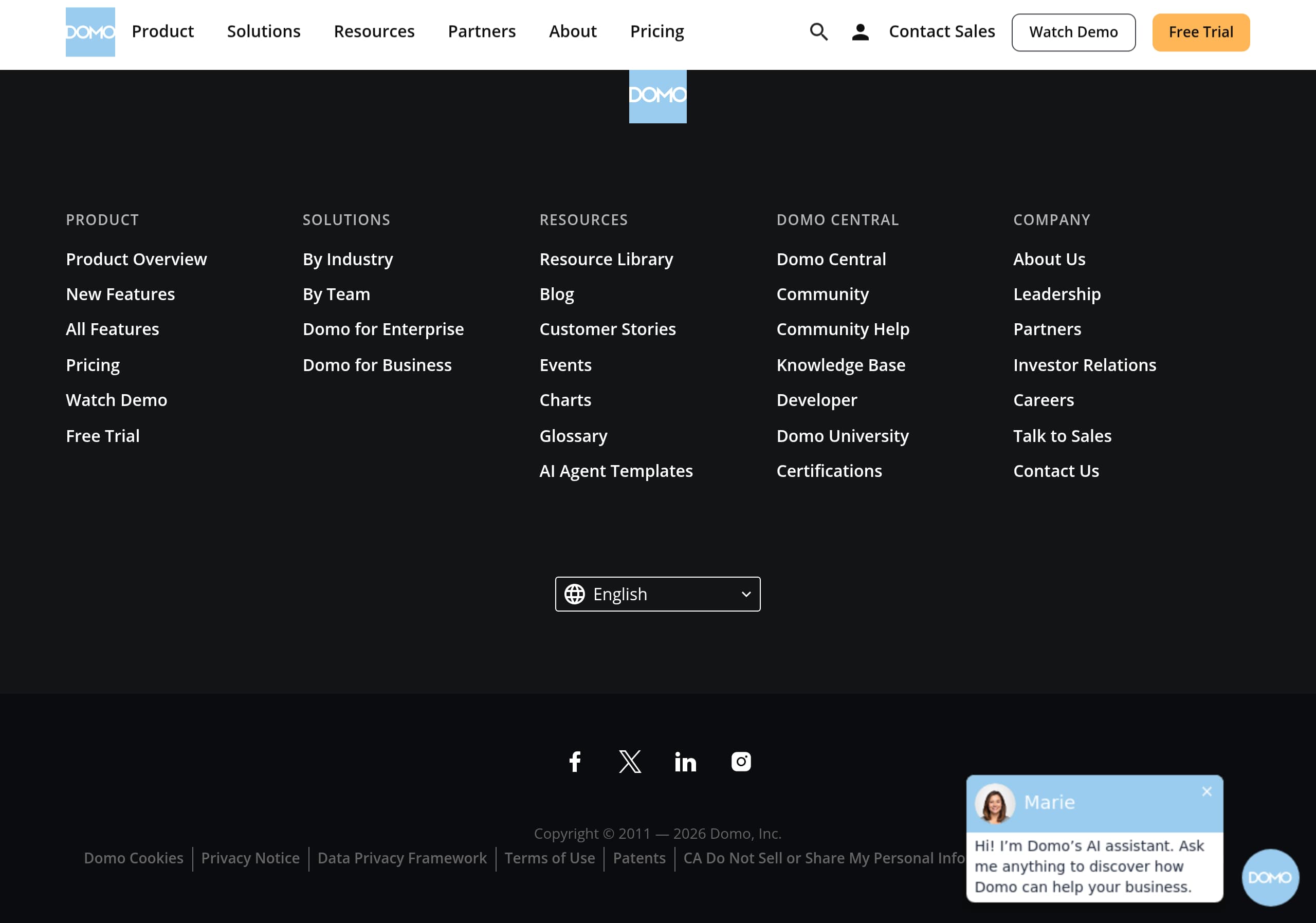
Domo’s footer is built for enterprise navigation depth and compliance hygiene, acting as both a sitemap and a trust anchor. It includes structured columns for Product, Solutions, Resources, Domo Central, and Company, which helps users who land deep in the site re-orient quickly.
Footer as a conversion backstop
The pre-footer callout, “Ready to get started?”, repeats the three primary CTAs: Get a Free Trial, Watch a Demo, and Talk to Sales. Repeating these at the bottom is a practical pattern for long, content-heavy pages where users decide after scrolling.
Strong sitemap utility for a broad platform
The Product column links to “Product Overview,” “New Features,” “All Features,” and Pricing, supporting comparison-driven browsing. Resources include “Resource Library,” “Customer Stories,” and “Events,” while “Domo University” and “Certifications” appear under Domo Central, which signals the company expects users to learn and operationalize the platform, not just try it once.
Legal and privacy completeness
The footer contains a dense set of legal links: Privacy Notice, “Data Privacy Framework,” “Terms of Use,” “Patents,” “CA Do Not Sell or Share My Personal Information,” and “Modern Slavery Statement.” The cookie banner text explains tracking purposes (analyze traffic, personalize content, display ads) and provides a “Learn more” link and an I consent action, which is a visible compliance pattern.
Global readiness
Language options include English, Deutsch, Español, Français, Italiano, and 日本語, which supports international enterprise procurement and regional teams.
Notable quality issue
The excerpt includes repeated placeholder text: “This is some text inside of a div block.” If this appears on the live footer, it can weaken perceived polish and trust. Removing placeholders is a quick win because the rest of the footer is otherwise well-structured and enterprise-appropriate.
Overall, Domo’s footer does a good job turning a complex platform site into a navigable, compliant destination with consistent conversion opportunities.
Detected tech stack
Tools and technologies we detected on Domo's site. Detection is best-effort and may be incomplete.
Frontend
Scores
Our framework scores for Domo's website in terms of clarity, conversion, and trust. See our methodology for how we calculate these.
How clear the value prop and structure are.
How conversion-friendly signup and pricing are.
How well trust and compliance are surfaced.
FAQ
Domo leads with a direct category claim, “The AI and Data Products Platform,” then explains the value in a single workflow sentence: connect data, prepare it, and build AI-powered tools. The hero includes two primary CTAs, Watch Demo and Free Trial, which match both enterprise evaluation and hands-on testing. The navigation mirrors the product pillars, including Data Integration, Business Intelligence, Workflows, and Domo.AI.
Pricing is available as a top-level destination, but the site consistently pairs it with sales and evaluation CTAs like Talk to Sales, Watch Demo, and Free Trial. This indicates Domo expects many buyers to need scoping and packaging decisions rather than a simple checkout. The pricing experience functions as part of a broader conversion system, routing users to the next best step based on intent.
Domo combines analyst-style recognition and review platforms with quantified metrics. The site shows ratings like 4.5 on Gartner Peer Insights with 489 reviews (Jan 2026) and 4.3 on G2 with 974 reviews (Jan 2026). It also uses named testimonials with roles and links to customer stories, which helps prospects validate outcomes in contexts similar to their own.
Domo emphasizes Domo.AI and AI agents, framing them as practical teammates that automate tasks and adapt dynamically. The site lists specific agent examples such as HR Benefits Agent, Competitive Research Agent, Insurance Claims AI Agent, and Customer Support Agent, each paired with a video CTA. It also highlights “secure and private AI” and data preparation steps to position AI as governed and enterprise-ready.
Yes. Domo explicitly states it can bring “1,000+ data sources” together and showcases featured connectors like Salesforce, SAP, Excel, Google Sheets, BigQuery, and MySQL. It also highlights partnerships with major cloud and data ecosystem providers including Snowflake, AWS, Databricks, Google, Azure, and Oracle. The site reinforces a hybrid approach by stating data can stay where customers want it.

The world's best-performing SaaS businesses share surprisingly similar patterns. We help you learn and apply them through our human-designed methodology, with AI-assisted research.