
Key takeaways
Here are the key insights from our website breakdown analysis of Datadog.
Datadog’s homepage wins by collapsing a broad platform into one crisp promise—“AI-Powered Observability and Security”—then immediately backing it with a clear primary CTA (“Free trial”) and a secondary exploratory CTA (“See the platform”).
The navigation is intentionally exhaustive (Observability, Security, Digital Experience, Software Delivery, Service Management, AI), which reduces ambiguity for enterprise buyers while still keeping the hero message simple for first-time visitors.
Pricing is positioned as a first-class decision path via a persistent “View pricing” entry, helping teams self-qualify without forcing a sales conversation and supporting product-led evaluation.
Social proof is layered: “Thousands of customers love & trust Datadog” plus analyst validations (Forrester Wave and Gartner Magic Quadrant) gives both emotional reassurance and procurement-friendly credibility.
Datadog uses content-as-conversion (eBooks for AWS/Azure/GCP migrations, State of DevSecOps report, DASH conference) to capture high-intent traffic that isn’t ready to start a trial yet.
Trust signals are embedded across the site architecture (Trust Hub, Security/Privacy Center links, enterprise governance items like access control and audit-related features), aligning with the security posture expected for monitoring and SIEM buyers.
Home
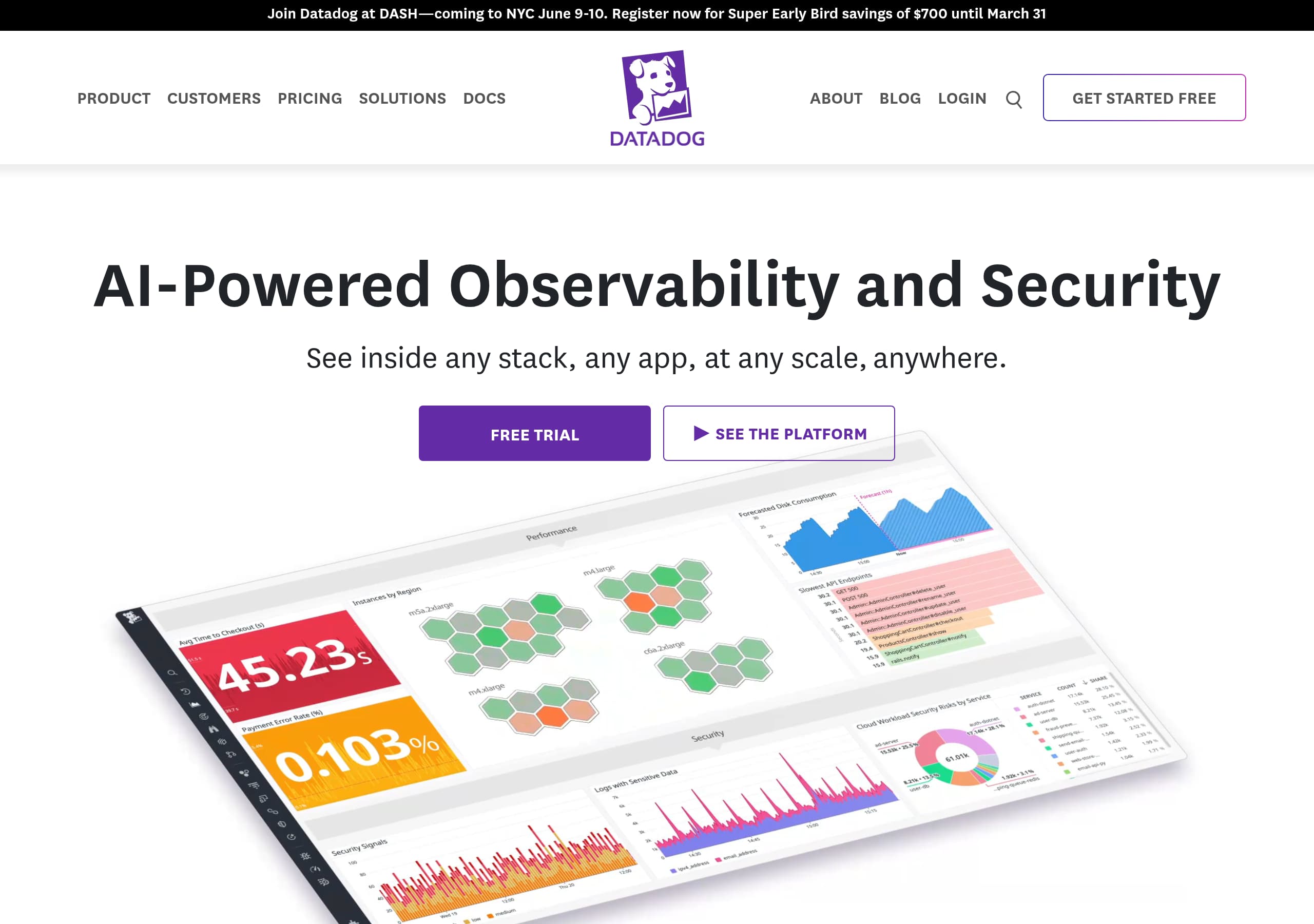
Datadog’s homepage is effective because it states a platform-wide promise in one line and then uses UI structure (not paragraphs) to communicate breadth. The hero headline, “AI-Powered Observability and Security,” plus the subline “See inside any stack, any app, at any scale, anywhere” sets expectation for cross-environment coverage without listing products upfront.
Key above-the-fold patterns visible in the excerpt and screenshots:
- Dual CTA setup: Free trial as the primary conversion action, and See the platform as a lower-commitment path for evaluators.
- A conference takeover banner (“Join Datadog at DASH—NYC June 9–10”) with a quantified incentive (“save $700 until March 31”) that creates urgency without replacing the core product CTA.
- Immediate credibility blocks: “Thousands of customers love & trust Datadog” and analyst citations (Forrester Wave, Gartner Magic Quadrant) appear as scannable modules rather than long-form claims.
The mega menu is doing heavy lifting: it enumerates categories (Observability, Security, Digital Experience, Software Delivery, Service Management, AI) and then drills down into specific products like Infrastructure Monitoring, Log Management, Application Performance Monitoring, and Cloud SIEM. This is a classic enterprise SaaS pattern: keep the primary narrative simple while letting technical users self-route to their exact need.
A subtle but important conversion layer is content gating without feeling gated: the homepage offers cloud-migration eBooks (AWS, Azure, GCP) and a “State of DevSecOps” report. That creates alternate opt-in paths for teams in research mode, while the persistent Get Started Free keeps product-led motion available for teams ready to instrument immediately.
Pricing
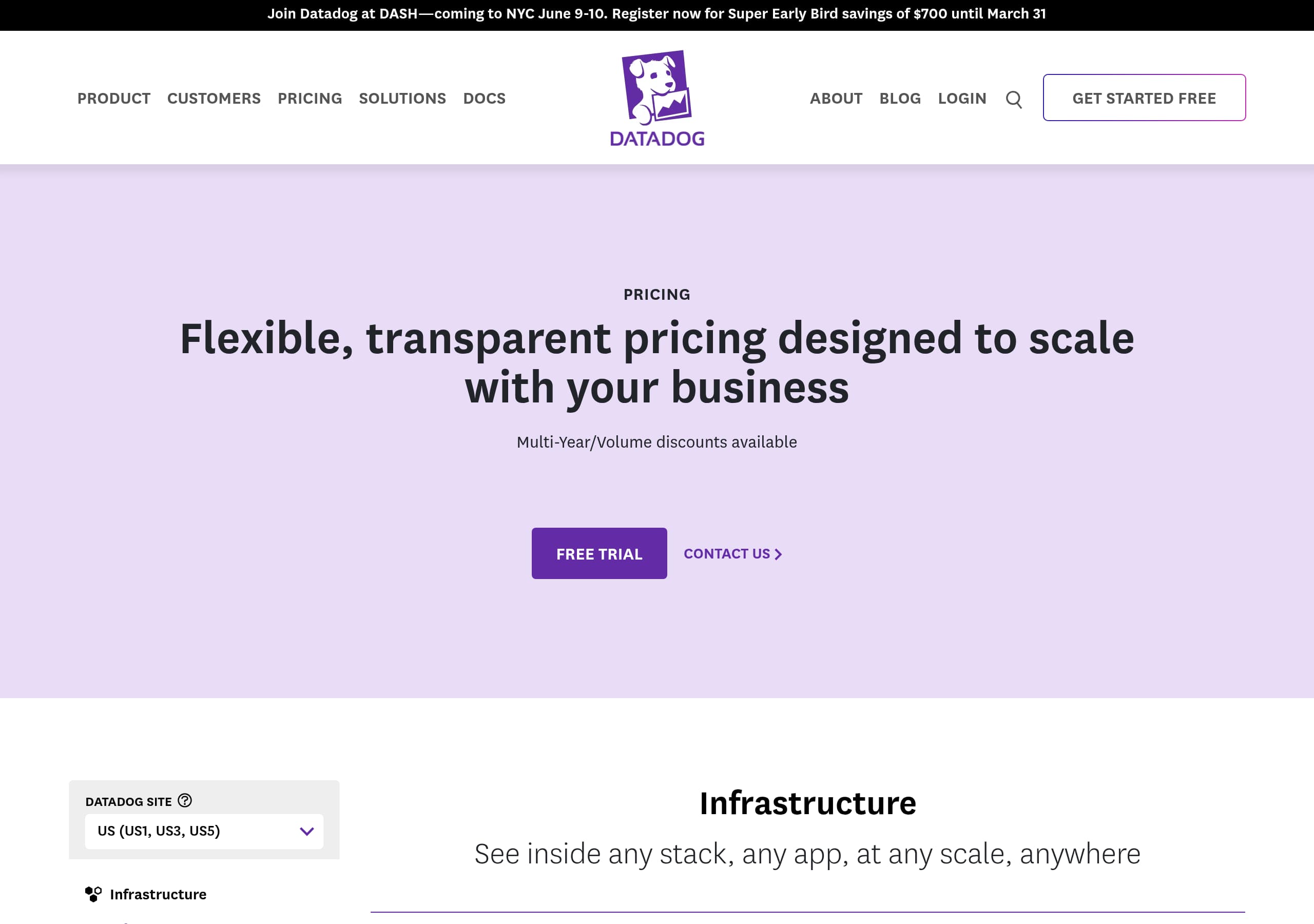
Datadog’s pricing experience is designed to support self-serve evaluation while acknowledging enterprise complexity (many modules, usage-based components). The strongest choice is that “View pricing” is prominent in navigation—pricing isn’t hidden behind “Contact sales,” which lowers friction for engineers and FinOps leaders trying to forecast cost.
From the pricing screenshot, the layout reads like a modular catalog rather than a single-plan SaaS. That matches Datadog’s platform reality: buyers often start with one product (e.g., Infrastructure Monitoring or APM) and expand into logs, security, and digital experience. The pricing UI typically reinforces this with:
- A segmented view by product line (Observability vs Security vs Digital Experience), mirroring the same taxonomy used in the header.
- Clear “starting at” anchors and unit-based explanations (per host, per container, per GB ingested, per test run) so teams can map pricing to architecture.
- Multiple CTAs (e.g., Start Free Trial and “Contact Sales”/demo) to accommodate both SMB self-serve and enterprise procurement.
What works particularly well for conversion is the implied consistency of navigation and terminology: product names in the mega menu match what appears in pricing modules (e.g., Log Management, APM, RUM, Synthetic Monitoring). That reduces cognitive load—users don’t have to translate marketing categories into billable line items.
A tactical improvement opportunity (common in platforms) is to make “pricing math” more explicit directly in-page: quick calculators, example configurations (Kubernetes cluster + APM + logs), and a visible link to commitments/discounts for annual plans. Still, the current presentation—transparent entry point, product-aligned breakdown, and parallel paths to trial or sales—is strongly aligned with how observability platforms are purchased.
Features
Datadog communicates features through taxonomy and breadth rather than deep single-page storytelling, which is appropriate for a platform with dozens of modules. The mega menu is essentially a feature map: Observability (Infrastructure, APM, Logs, Database Monitoring), Security (Cloud SIEM, CSPM, Workload Protection), Digital Experience (RUM, Session Replay, Synthetic), and Software Delivery (CI Visibility, Test Optimization, Feature Flags).
The core feature-story pattern is “end-to-end visibility” backed by specific product primitives:
- Metrics, traces, logs are implied as the unified telemetry layer (explicitly referenced in the Korean datasheet excerpt about integrating “metrics, traces, logs at scale”).
- Troubleshooting acceleration features are named, not implied: Continuous Profiler, Dynamic Instrumentation, Error Tracking, and Audit Trail.
- Governance and platform features appear under “Platform Capabilities,” including Access Control, Dashboards, Notebooks, Alerts, and Integrations.
This structure works because buyers rarely shop “observability” abstractly; they shop for a job-to-be-done (“Kubernetes monitoring,” “log analysis & correlation,” “cloud security posture management”). Datadog makes those entry points first-class in navigation and solutions pages (AWS, Azure, Google Cloud, OpenTelemetry, Kubernetes).
A notable modern layer is the AI positioning. The nav explicitly includes AI Observability, LLM Observability, and “Bits AI Agents / Bits AI SRE Watchdog.” That signals a roadmap aligned with current demand: monitoring model performance, tracing LLM applications, and automated anomaly detection.
One tradeoff: the feature list density can overwhelm new visitors. Datadog mitigates this by keeping the hero promise short and letting users progressively disclose detail through “Learn more” links, which is an effective pattern for platform SaaS with complex portfolios.
Signup
Datadog’s conversion flow is optimized around a low-friction trial start while still offering an enterprise-grade alternative (demo with an engineer). The site repeatedly surfaces Get Started Free and Free Trial, including a bottom-of-page CTA (“Start Your Free Datadog Trial Now”), which increases the chance of conversion after users browse products, reports, or pricing.
Two parallel signup motions are visible:
- Self-serve: Free Trial buttons in header and page modules. This supports product-led growth—engineers can instrument and validate value without waiting for procurement.
- Sales-assisted: a modal prompt, “Request a personalized demo with a Datadog engineer.” This is a strong enterprise pattern because it matches how security and large-scale observability purchases happen (stakeholders want architecture guidance, sizing, and governance details).
The UX details implied by the page structure:
- Persistent CTA placement (top nav + page bottom) reduces scroll-back friction.
- The site uses “See the platform” as a pre-signup exploration step, catching visitors not ready to commit.
- Mobile support is explicitly promoted (“Download mobile app”), which signals operational readiness and can be a differentiator for on-call workflows.
A best-practice element is consent language in the demo form (“Datadog to share the latest news… unsubscribe anytime”), which is both compliance-friendly and sets expectation for follow-up.
What would strengthen conversion further (especially for first-time users) is clearer pre-trial expectations on the CTA path: whether a credit card is required, typical setup time (e.g., “5 minutes to install the agent”), and first-success steps (connect AWS, instrument Kubernetes, send logs). Still, Datadog’s combination of trial-first CTAs, engineer demo option, and repeated end-of-page prompts is highly aligned with modern SaaS onboarding for complex platforms.
Trust
Datadog’s trust posture is communicated through both explicit “trust destinations” and product-level governance cues. In the global navigation and footer links, Datadog surfaces assets like Trust Hub, Security, and Privacy Center (observable in the footer screenshot and excerpt). This is crucial for observability and security products because customers transmit sensitive telemetry (logs, traces, user sessions) that may contain PII, secrets, or regulated data.
The product map itself reinforces trust by naming security-specific capabilities that buyers expect from a mature vendor:
- Sensitive Data Scanner appears under both Observability/Logs and Security, signaling cross-platform data hygiene.
- Audit Trail and Access Control appear as platform capabilities, supporting compliance evidence and least-privilege administration.
- Cloud security modules like Cloud Security Posture Management (CSPM), Cloud Infrastructure Entitlement Management (CIEM), Workload Protection, and Compliance suggest coverage for common risk frameworks.
Third-party validation contributes to trust even when it’s not strictly “security”: Gartner/Forrester leader placements reduce perceived vendor risk for procurement and can shorten evaluation cycles. The State of DevSecOps report also signals domain expertise and operational data scale (“thousands of cloud environments”), which implicitly supports reliability and maturity.
A notable UI trust pattern is discoverability: “Trust Hub” is not buried in legal fine print alone; it’s part of the site’s resource ecosystem. For enterprise buyers, that means security questionnaires and compliance artifacts are likely easy to find.
If Datadog wants to push trust even harder on top funnels, the homepage could surface a small set of concrete assurances (e.g., certifications like SOC 2 Type II, ISO 27001) above the fold. Even without those visible in the provided excerpt, the site’s governance vocabulary, security navigation, and compliance-oriented modules create strong baseline credibility.
Footer
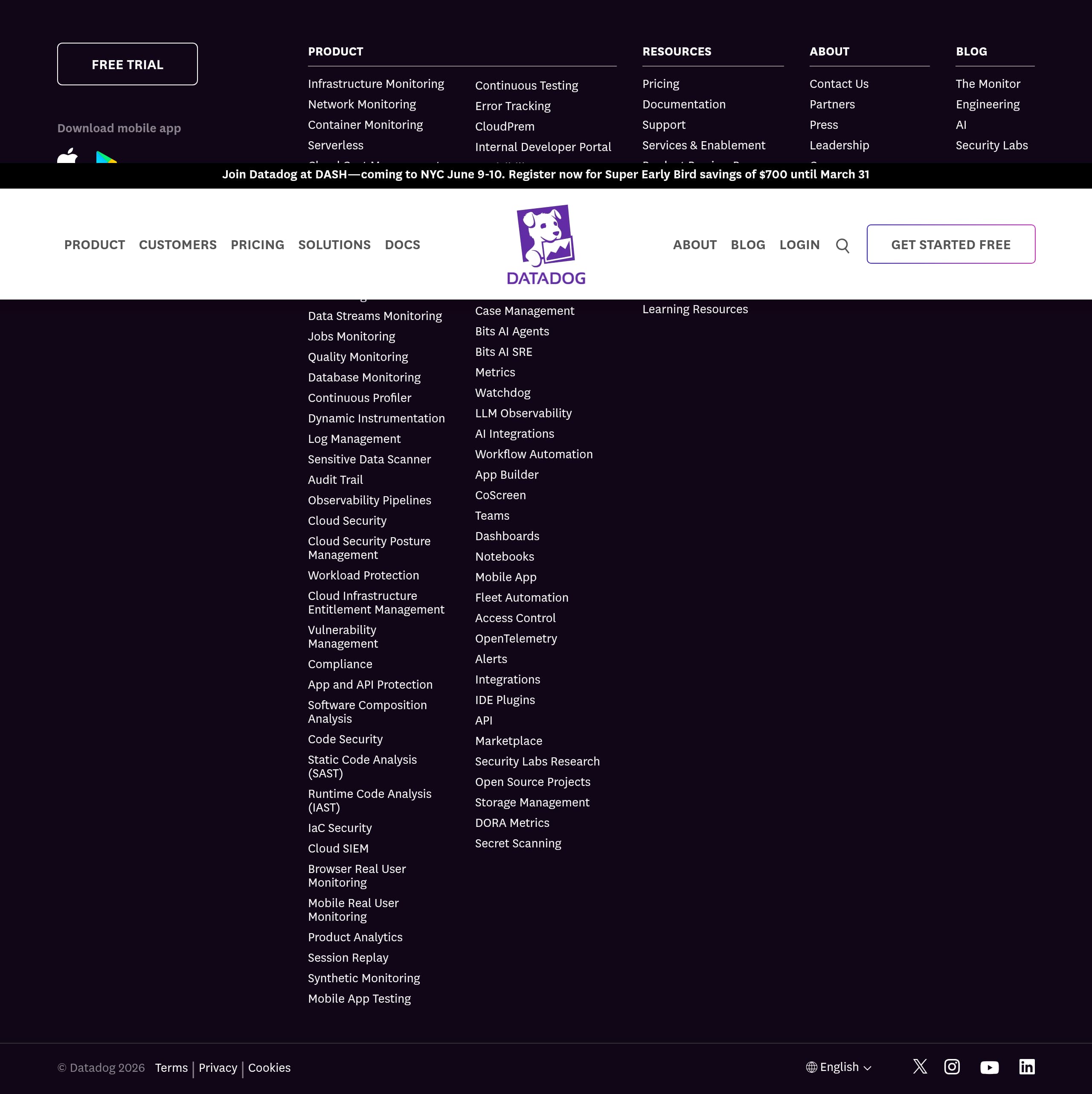
Datadog’s footer is built as an enterprise navigation and compliance utility, not a minimalist branding strip. The screenshot shows a dense, multi-column structure that mirrors the top-level information architecture: Products, Resources, Support, Company, and legal. This matters because Datadog has a large portfolio; the footer becomes a “last-chance router” for users who scrolled without finding the right module.
Observable footer strengths:
- Strong resource discoverability: links like Documentation, Support, Services & Enablement, Certification, and Learning Resources support evaluation and onboarding. This is especially important in observability where implementation depth impacts time-to-value.
- Trust and governance links are prominent: Security, Privacy Center, and Trust Hub are accessible from the footer, reducing friction for procurement/security reviews.
- Corporate credibility is reinforced with company links: Analyst Reports, Investor Relations, ESG Report, Leadership, Careers. These are classic E-E-A-T signals for large buyers who assess vendor stability.
- Localization is built in (language selector showing English / 日本語 / 한국어), signaling global support and reducing friction for international teams.
The footer also supports multiple user intents beyond buying: press (media assets), events, and technical thought leadership (Blog, “The Monitor,” Engineering, AI Security Labs). For a market leader, this content ecosystem acts as an “authority moat”—it keeps users in Datadog’s orbit even when they’re not immediately converting.
One tactical risk with dense footers is choice overload. Datadog mitigates this by using clear headings and predictable grouping. Additionally, the legal row (“Terms | Privacy | Cookies”) is standard and scannable.
Overall, the footer functions as a structured sitemap for a complex platform, while reinforcing documentation depth, security posture, and company legitimacy—all critical to conversion in enterprise monitoring and security categories.
Detected tech stack
Tools and technologies we detected on Datadog's site. Detection is best-effort and may be incomplete.
Frontend
Scores
Our framework scores for Datadog's website in terms of clarity, conversion, and trust. See our methodology for how we calculate these.
How clear the value prop and structure are.
How conversion-friendly signup and pricing are.
How well trust and compliance are surfaced.
FAQ
Datadog leads with a single platform-level message—“AI-Powered Observability and Security”—then uses a dual-CTA layout (“Free trial” and “See the platform”) to serve both buyers and evaluators. The mega menu carries the complexity, listing modules like APM, Log Management, RUM, and Cloud SIEM, so the first screen stays simple while technical users can self-navigate to a specific solution.
Datadog makes pricing easy to find via a prominent “View pricing” navigation link. The pricing experience is structured around the platform’s modules, which helps teams start with a specific product (e.g., Infrastructure Monitoring or APM) and expand later. This modular presentation fits usage-based observability buying, where cost depends on units like hosts, containers, log volume, or tests.
Datadog combines scale-based proof (“Thousands of customers love & trust Datadog”) with procurement-friendly third-party validation. The homepage highlights recognition in The Forrester Wave for AIOps Platforms (Q2 2025) and Gartner Magic Quadrant placements for Observability Platforms and Digital Experience Monitoring. It also uses ecosystem signals like the DASH conference and data-backed reports such as the State of DevSecOps.
Datadog emphasizes a self-serve Free Trial with repeated “Get Started Free” CTAs in the header and page modules, supporting product-led adoption. In parallel, it offers a “personalized demo with a Datadog engineer” modal for enterprise teams that need sizing, architecture guidance, or security review. This dual path aligns with how observability and security tools are evaluated in real organizations.
Datadog surfaces trust resources through its site navigation and footer, including links to the Trust Hub and Privacy Center. The product taxonomy also reinforces governance with named capabilities like Sensitive Data Scanner, Audit Trail, and Access Control. Together, these elements make it easier for security and procurement stakeholders to locate vendor-risk documentation alongside product evaluation materials.

The world's best-performing SaaS businesses share surprisingly similar patterns. We help you learn and apply them through our human-designed methodology, with AI-assisted research.