
Key takeaways
Here are the key insights from our website breakdown analysis of HireVue.
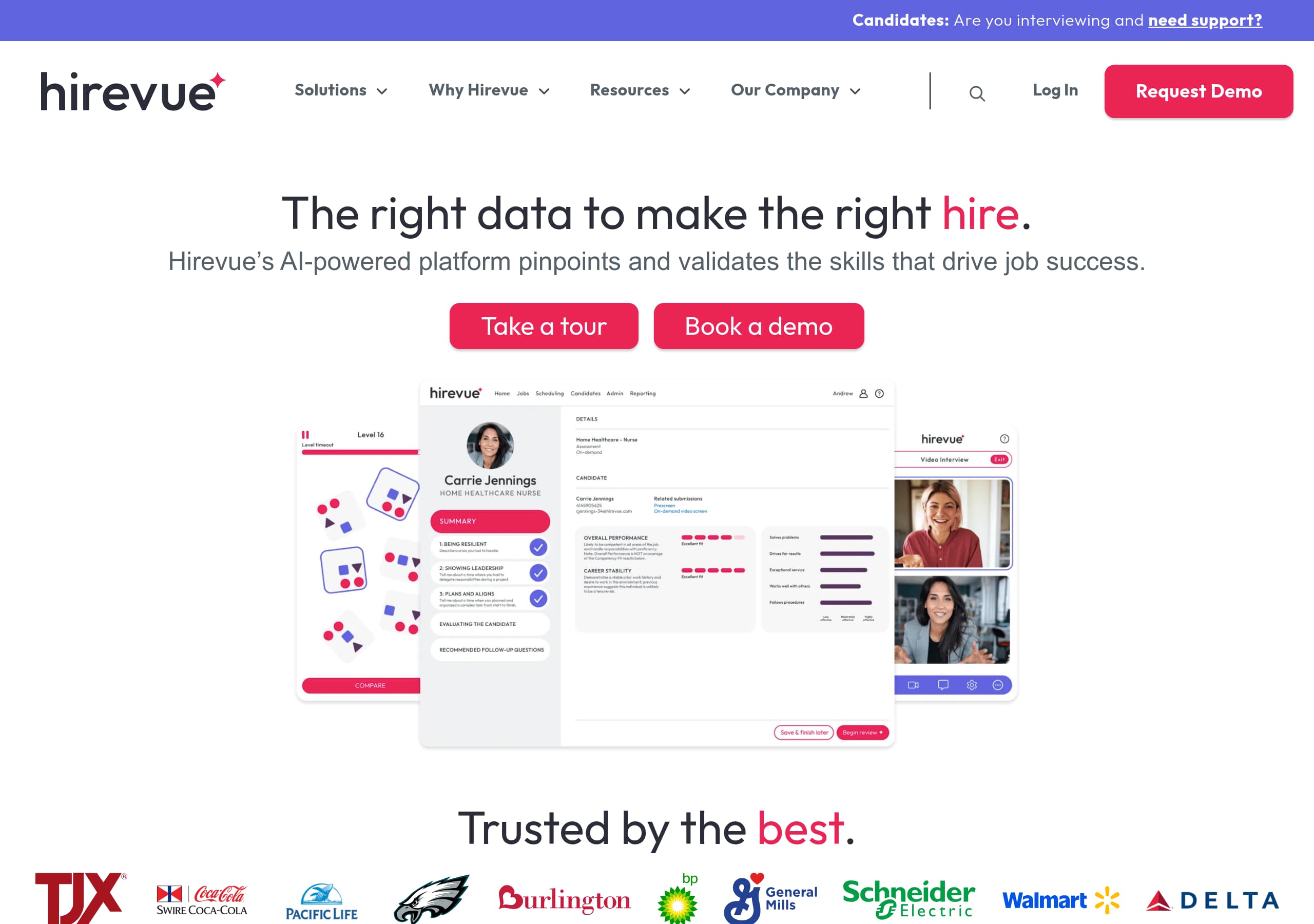
HireVue’s homepage leads with a crisp, outcomes-based promise, “The right data to make the right hire,” then immediately reinforces it with two parallel CTAs, “Take a tour” and “Book a demo,” to match different buying stages.
The site converts well because it routes visitors into pre-segmented paths (Hourly, Professional, Campus, Technical, Internal Mobility), reducing cognitive load and making “what’s in it for me” obvious within one click.
HireVue builds trust with concrete, defensible signals like “FedRAMP authorized” and named ATS partnerships (Workday, SAP, Oracle, SmartRecruiters), which are especially persuasive for enterprise and public sector buyers.
The feature narrative is structured as an end-to-end platform, with four pillars (Skills Validation, Intelligent Interviewing, Talent Engagement, Workflow Automation) that map to the hiring funnel and prevent the product from feeling like “just video interviews.”
Social proof is quantified and scannable, using multiple top-line metrics (95% completion rate, 92% candidate satisfaction, $667k saved annually) linked to “Read now” or “Watch now,” which supports proof-driven evaluation.
Pricing appears to be sales-led rather than self-serve, with the primary conversion motion centered on demos and tours, which fits HireVue’s enterprise integrations but may frustrate SMB buyers looking for instant price transparency.
Home
HireVue’s homepage is effective because it states the promise in one line, then immediately shows how the platform delivers it across the hiring funnel. The hero message, “The right data to make the right hire,” positions HireVue as a decision-quality layer, not a generic recruiting tool. Directly beneath, the dual CTAs, “Take a tour” and “Book a demo”, create a clean fork between self-serve exploration and sales-assisted evaluation.
The page structure does a few conversion-smart things:
- It frames the platform as AI-powered skill validation and hiring automation, not only video interviewing. The navigation and on-page sections repeat the four pillars: Skills Validation, Intelligent Interviewing, Talent Engagement, and Workflow Automation, which maps neatly to screening, interviewing, engagement, and scheduling.
- It uses segment-based entry points (Hourly, Professional, Campus, Technical, Internal Mobility). Each segment includes a short outcome statement like “Post. Interview. Hire.” for Hourly, making the relevance obvious without scrolling through irrelevant detail.
The homepage also supports evidence-based buying. A dedicated results band shows quantified outcomes such as “60% less time screening”, “90% faster time-to-hire”, and “50% decrease in cost per interview”, plus a repeated “$667K saved annually” figure. Importantly, these are presented as scannable proof points rather than buried in a case study PDF.
Finally, the site’s header caters to multiple audiences. It includes a “For Candidates” area with interview tips and FAQs, plus a clear “Log In” and “Request Demo.” That reduces support friction and protects the buyer journey from candidate confusion, a common issue in hiring tech websites.
Pricing
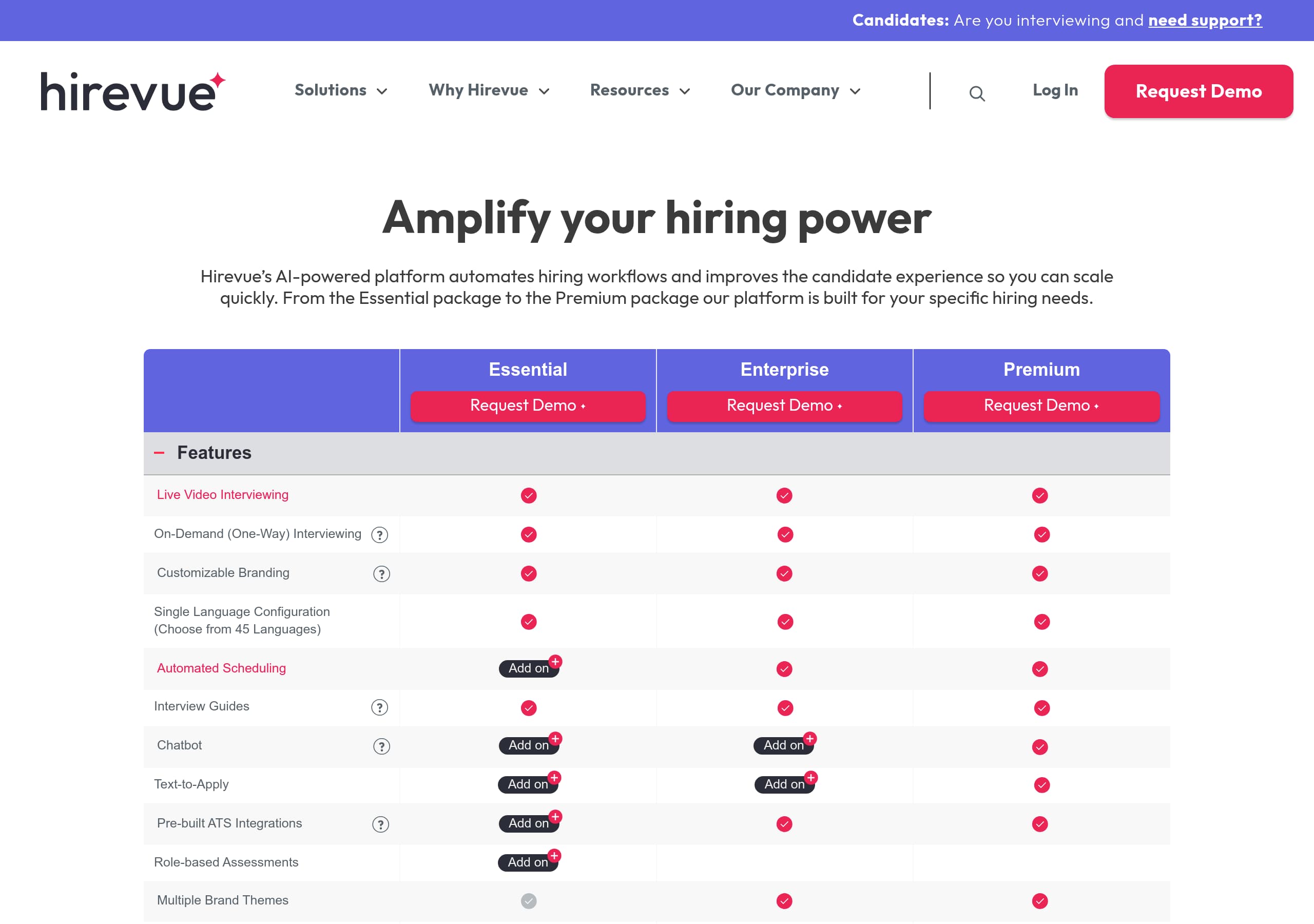
HireVue’s pricing experience appears intentionally sales-led, optimizing for enterprise qualification rather than instant checkout. From the provided pricing screenshot and the global navigation, the primary monetization path is consistently “Request Demo” or “Book a demo,” with no prominent self-serve plan grid or checkout flow. That is coherent for a platform that emphasizes ATS integration, multi-module packaging (assessments, interviewing, engagement, automation), and regulated-sector requirements.
What HireVue does well for pricing-stage visitors is reduce uncertainty about what they are buying:
- The site repeatedly frames the product as an end-to-end hiring platform with multiple components, which implicitly explains why pricing is likely custom. Buyers can see distinct modules like Skill Validation (Virtual Job Tryout, assessment builder, game-based assessments), Intelligent Interviewing (video interviewing, interview insights), and workflow automation.
- It reinforces enterprise fit with named ecosystem cues such as Workday, SAP, Oracle, and SmartRecruiters integration references. That helps a pricing evaluator understand implementation and procurement reality.
Where pricing clarity could be stronger is in expectation-setting. When a site is demo-first, the best practice is to provide at least one of the following on the pricing page: packaging tiers (Core vs Enterprise), “starting at” ranges, or a short list of pricing drivers (number of hires, modules, regions, integrations). In the excerpted content, those explicit anchors are not visible.
Net, HireVue’s pricing approach likely converts best for mid-market and enterprise TA teams who already expect a consultative sales motion. For smaller teams comparing alternatives like Spark Hire, VidCruiter, or self-serve assessment tools, the lack of transparent pricing can slow evaluation unless the page offers clearer package definitions and what’s included by default.
Features
HireVue’s feature positioning works because it is organized around what hiring teams need to accomplish, not around product jargon. The homepage sets a four-part platform frame, Skills Validation, Intelligent Interviewing, Talent Engagement, and Workflow Automation, then describes each in plain outcomes language. This reduces the “tool sprawl” perception that often affects hiring tech suites.
Feature communication is notably specific:
- Skills Validation: It references Virtual Job Tryouts and “AI-powered assessments,” and it explicitly links this to “simplify hiring, reduce bias, and future-proof your hiring.” That ties assessment use to measurable business intent.
- Intelligent Interviewing: It mentions “Tailor interviews in minutes” and candidates who “self-schedule seamlessly,” which communicates both configuration speed and operational efficiency.
- Talent Engagement: The promise “Engage talent 24/7” and “AI-driven engagement” positions it as always-on candidate interaction rather than recruiter-only workflows.
- Workflow Automation: It describes “self-scheduling automation” and keeping the talent pool moving through the funnel, a practical pain point for high-volume teams.
Beyond the four pillars, a “What makes HireVue unique?” section provides differentiators that are concrete and enterprise-relevant. Examples include “ATS Integration” (with “zero headaches” phrasing), “Global reach” with “40+ languages,” and “VI your way” which claims flexibility to use HireVue video interviewing or integrate an existing tool. The UI appears to present these as expandable tiles or cards with “Learn more,” which is a good pattern for keeping the page scannable.
The main opportunity is to connect each feature pillar to a single example deliverable, like a sample assessment, an interview kit template, or a scheduling workflow diagram. The site already has strong modular structure, adding 1 visual per pillar would make the feature claims even more tangible for first-time evaluators.
Signup
HireVue’s conversion flow is built around a guided evaluation, not a self-serve signup, which matches its enterprise positioning. The most prominent paths are “Request Demo”, “Book a demo”, and a “Self-Guided Product Tour” CTA (“Take a Self-Guided Product Tour Now”). This creates a pragmatic two-lane onboarding model: let curious buyers explore immediately, and route serious evaluators into sales.
Several UX choices reduce friction before the form stage:
- Persistent top navigation includes Log In for existing customers and “Request Demo” for new ones, keeping intent clear.
- The “By Use Case” and “By Industry” menus act as pre-qualification. A visitor can self-identify as Campus or Hourly hiring, or as Public Sector, before talking to sales. That typically improves demo quality and reduces drop-off because the buyer feels “this is for me.”
Because no explicit form fields are shown in the provided excerpt, the main assessment is about the lead capture strategy. HireVue smartly offers the Self-Guided Product Tour as a lower-commitment step, which can collect intent data (module interest, industry) and warm leads for follow-up.
What could further improve conversion is clearer expectation-setting around what happens after clicking “Request a demo.” Best-in-class demo flows show a short checklist such as: “choose modules,” “pick a time,” “get a calendar invite,” plus an estimate like “2 minutes.” If HireVue’s demo request is longer due to enterprise qualification, a brief explanation of why it asks for certain info (ATS, hiring volume, industry) can reduce abandonment.
Overall, the site is optimized for sales-assisted onboarding and for teams that require stakeholder alignment, security review, and integration planning, rather than for instant account creation.
Trust
HireVue’s trust layer is one of the strongest parts of the site because it includes concrete compliance, governance, and ecosystem signals, not just generic “secure” claims. The “What makes HireVue unique?” section explicitly calls out FedRAMP with a clear statement: “The only FedRAMP-authorized hiring solution for the public sector.” This is a high-impact trust differentiator for government and regulated buyers, and it is presented in plain language that non-security stakeholders can understand.
The trust story is reinforced in multiple ways:
- Dedicated navigation items: “Our Science,” “Security,” “HireVue’s AI Explainability Statement,” and “AI Ethical Principles.” These are strong E-E-A-T signals because they show the company expects scrutiny around AI, bias, and validation.
- “Backed by science” positioning: “science-backed evaluations” and “predict job performance” frames HireVue as evidence-driven. Even without publishing metrics on the homepage, the existence of “Our Science” suggests documentation depth behind the claim.
- Integration partner references: Workday, SAP, Oracle, SmartRecruiters. This implies enterprise readiness and reduces perceived implementation risk.
The site also addresses candidate trust indirectly by providing a separate “For Candidates” hub with “Candidate FAQs,” “Candidate Help Center,” and “Interview Tips.” That reduces anxiety around recorded interviews and assessments, and it lowers support burden for hiring teams.
One improvement would be to surface more explicit security artifacts on high-intent pages, for example SOC 2 references, data retention controls, and administrative audit capabilities, if applicable. The footer includes “Legal Center” and privacy terms, but high-trust SaaS buyers often look for a compact security summary block near primary CTAs. Still, the combination of FedRAMP, AI explainability, and science-backed evaluations creates a defensible trust posture compared with many hiring tech competitors.
Footer
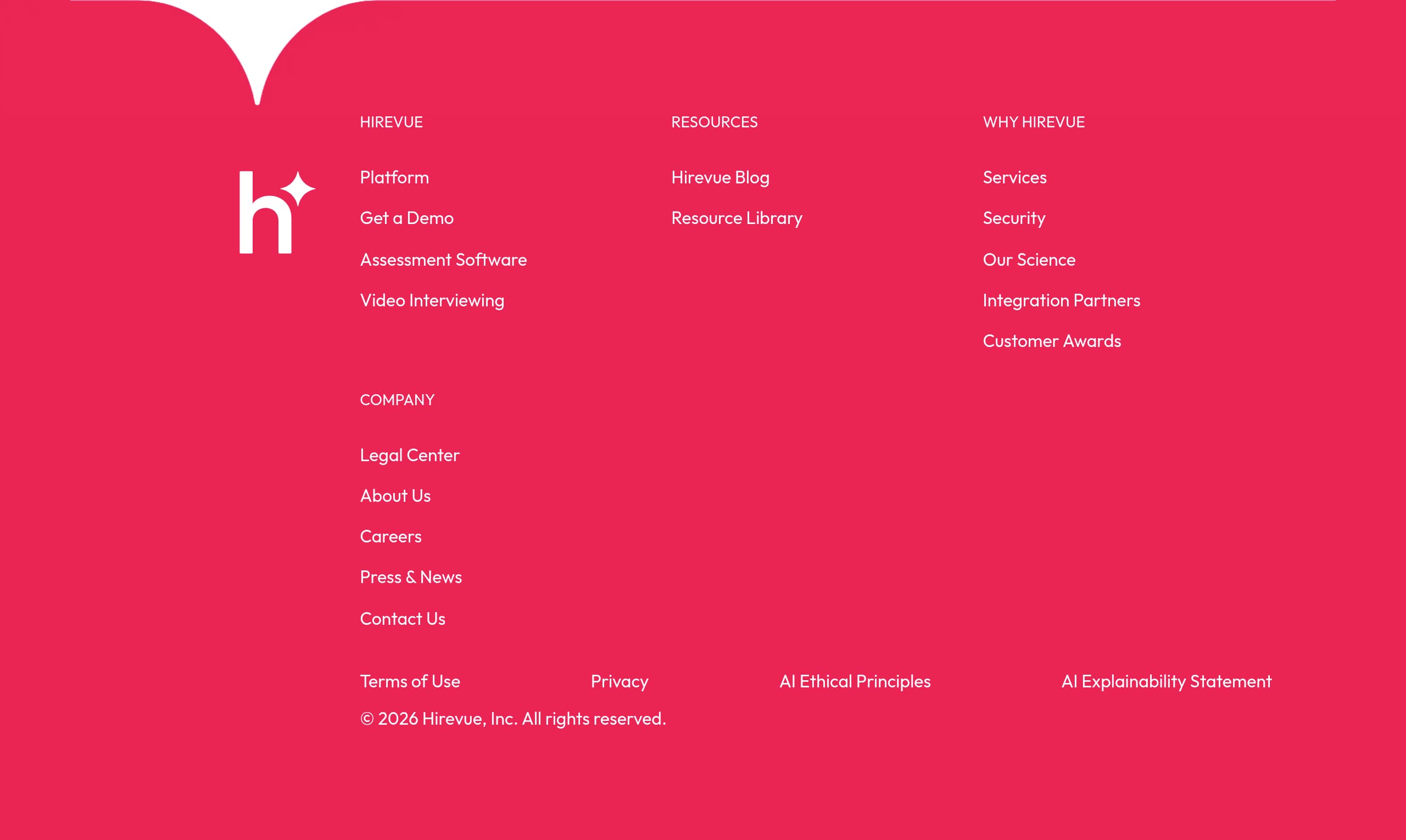
HireVue’s footer is conversion-supportive because it functions like a compact site map for multiple audiences while also providing the governance links required for an AI-driven hiring platform. The footer includes direct product-entry links such as “Get a Demo”, “Assessment Software,” and “Video Interviewing,” which helps visitors re-orient late in the scroll without hunting through the header.
The footer structure is organized into clear buckets:
- Platform and product: “HireVue Platform,” “Get a Demo,” plus key solution categories.
- Resources: “HireVue Blog” and “Resource Library,” which supports research-driven buyers and content-led SEO.
- Why HireVue: “Services,” “Security”, “Our Science,” “Integration Partners,” and “Customer Awards.” This is an effective trust cluster because it groups proof, implementation support, and assurance in one place.
- Company: About, Careers, Press and News, Contact, plus a “Legal Center.”
What stands out is the presence of AI governance links in the legal area, including “AI Ethical Principles” and “AI Explainability Statement.” For a product selling AI-powered skill validation, these links reduce perceived risk and signal operational maturity. The footer also includes “Terms of Use” and “Privacy,” which are table stakes, but the AI-specific policies are a meaningful differentiator.
From an SEO and navigation standpoint, the footer’s internal linking likely improves crawlability across product and resource hubs, especially when paired with the robust top nav by use case and industry.
A small opportunity is to add a short, explicit support path in the footer for candidates, since “For Candidates” content exists in the main navigation. Including “Candidate Help Center” in the footer would reduce friction for users who land on a page via search and scroll straight down for next steps. Overall, the footer communicates enterprise seriousness and supports both evaluation and compliance workflows.
Detected tech stack
Tools and technologies we detected on HireVue's site. Detection is best-effort and may be incomplete.
Scores
Our framework scores for HireVue's website in terms of clarity, conversion, and trust. See our methodology for how we calculate these.
How clear the value prop and structure are.
How conversion-friendly signup and pricing are.
How well trust and compliance are surfaced.
FAQ
HireVue’s homepage leads with an outcomes-based headline, “The right data to make the right hire,” then immediately offers two CTAs: “Take a tour” and “Book a demo.” It organizes the platform into four clear pillars (Skills Validation, Intelligent Interviewing, Talent Engagement, Workflow Automation) and supports claims with visible metrics like 95% completion rate and $667k saved annually. Use-case paths (Hourly, Campus, Technical) help visitors self-qualify fast.
HireVue appears to use a sales-led pricing model rather than publishing a public plan grid. The site emphasizes “Request Demo,” “Book a demo,” and a self-guided product tour instead of checkout or monthly tiers. This fits an enterprise platform that highlights ATS integrations (Workday, SAP, Oracle, SmartRecruiters) and compliance needs. Buyers can infer packaging is module-based across assessments, interviewing, engagement, and workflow automation.
HireVue frames its product as an end-to-end hiring platform with four core areas: Skills Validation (including Virtual Job Tryouts and AI-powered assessments), Intelligent Interviewing (video interviewing, interview insights, self-scheduling), Talent Engagement (24/7 AI-driven engagement and matching), and Workflow Automation (automation to move candidates through the funnel). A “What makes HireVue unique?” section adds differentiators like ATS integration, 40+ languages, and flexible video interviewing options.
HireVue highlights concrete trust signals, including a FedRAMP authorization claim for the public sector and dedicated navigation to Security, Our Science, and an AI Explainability Statement. It also references integration partners like Workday, SAP, Oracle, and SmartRecruiters, which reduces perceived implementation risk. The footer reinforces governance with links to AI Ethical Principles, privacy, and a Legal Center, helping buyers find assurance documentation quickly.
HireVue’s onboarding is primarily demo and tour driven, not a self-serve account signup. Visitors are pushed toward “Request Demo,” “Book a demo,” or a self-guided product tour, which matches enterprise evaluation behavior. The site also separates audiences with a “For Candidates” hub that includes Candidate FAQs and a Help Center, reducing confusion and support load while buyers focus on product evaluation and rollout planning.

The world's best-performing SaaS businesses share surprisingly similar patterns. We help you learn and apply them through our human-designed methodology, with AI-assisted research.