
Key takeaways
Here are the key insights from our website breakdown analysis of Intercom.
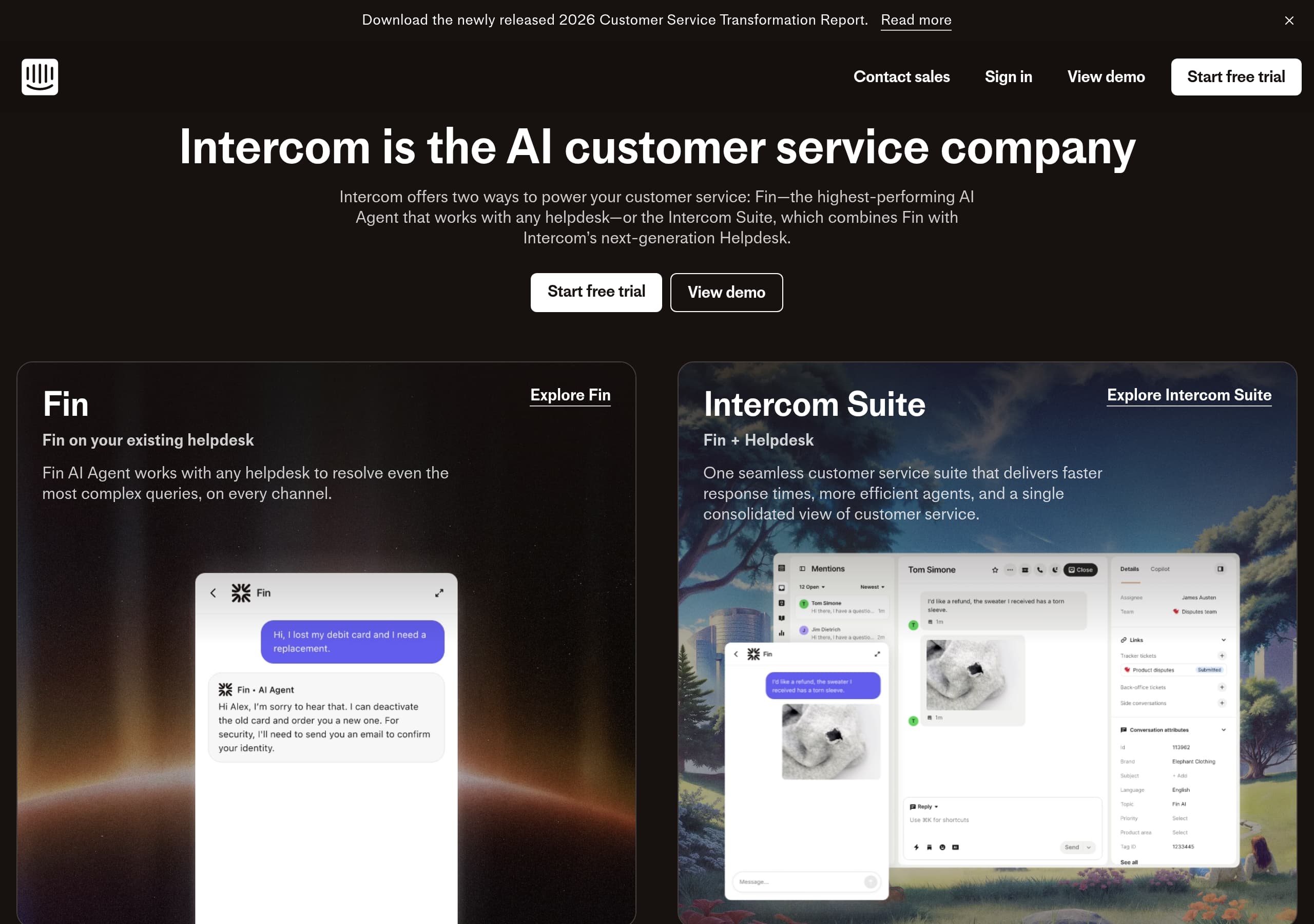
Intercom positions itself immediately as “The AI customer service company,” then reinforces it with repeated high-intent CTAs like “Start free trial,” “View demo,” and “Contact sales” to capture both self-serve and enterprise buyers.
The homepage uses product UI visuals and short, punchy sections to make the concept of AI support feel concrete, reducing ambiguity for buyers comparing Intercom to Zendesk or Salesforce Service Cloud.
Pricing is structured to nudge commitment with clear plan tiers and a visible upgrade path, while still giving an easy on-ramp via free trial for teams that want to validate quickly.
Trust is supported through security/legal links (Terms, Privacy, Security, Your Privacy Choices) and a polished enterprise-grade layout that signals maturity and compliance readiness.
Navigation and footer design prioritize task completion: buyers can always find demos, trials, sales contact, and key governance pages without hunting through dense menus.
Home
Intercom’s hero does the most important job in one line: “The AI customer service company.” That category-level positioning is clear enough for visitors arriving from search, review sites, or competitor comparisons.
The top navigation emphasizes action, not exploration, with repeated CTAs: Start free trial, View demo, Contact sales, plus Sign in for existing customers. That redundancy matters because Intercom serves mixed intent (new prospects vs. returning admins).
From the homepage screenshot, the design leans on product-forward visuals and clean spacing rather than heavy copy, which makes the AI promise feel operational instead of theoretical. The page structure supports quick scanning:
- Short, benefit-oriented sections
- UI imagery that implies real workflows
- Consistent CTAs that don’t change labels mid-page
Net effect: the homepage reduces time-to-understanding and provides a clear next step for both self-serve and enterprise buyers.
Pricing
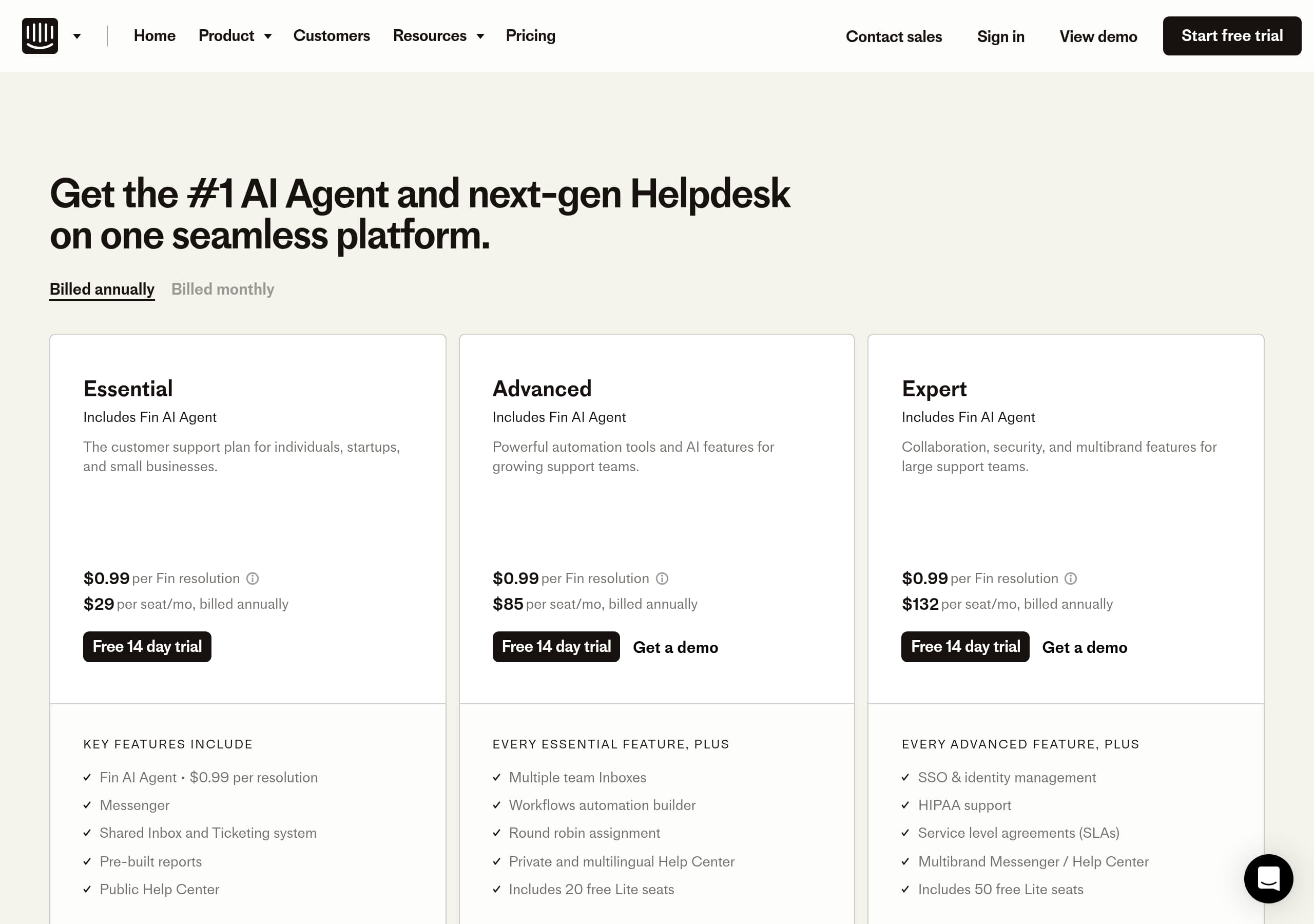
Intercom’s pricing page uses a familiar SaaS pattern: a tiered grid that supports fast plan comparison and encourages an upgrade path as needs grow. The pricing screenshot shows structured columns (rather than paragraphs), which helps buyers answer “Which plan fits?” in under a minute.
The page also supports two buying motions:
- Self-serve evaluation with an obvious “Start free trial” path
- Sales-assisted purchase via “Contact sales” for custom needs
This dual-track is especially important for Intercom because it competes across segments (startup support teams up through enterprise CX orgs). A grid layout also clarifies feature gating—buyers can see which capabilities are included at each tier without reading long docs.
A conversion-friendly detail is CTA consistency: the labels match the homepage (“Start free trial,” “View demo”), which reduces cognitive load and keeps users from questioning whether they’re being routed into a different funnel.
Features
Intercom’s positioning (“The AI customer service company”) sets the expectation that features will map to core support outcomes: faster resolution, higher deflection, and better agent efficiency. The homepage screenshot style suggests feature communication is visual and UI-led, which is effective for complex tools where buyers want to see workflow reality.
Strong feature sections for Intercom typically work because they are framed around jobs-to-be-done, not modules. Look for (and Intercom usually highlights) capabilities like:
- AI agent / automation that handles common questions
- Inbox and routing for human teams
- Help center and knowledge delivery
- Reporting for support operations
The site’s clean hierarchy makes it easier to connect each feature to a measurable benefit (response time, containment rate, CSAT). Keeping feature blocks short with clear headers and a visible CTA ensures visitors don’t get trapped in “learn more” loops before committing to a demo or trial.
Signup
Intercom reduces signup hesitation by keeping the primary actions globally visible: Start free trial, View demo, and Contact sales appear in the header excerpt and align with the common SaaS decision tree. That matters because Intercom’s product can involve workspace setup, channels, and teammates—users need to choose the right onboarding depth.
A conversion-optimized signup motion here is offering both:
- A free trial for quick validation (self-serve teams)
- A demo/sales route for orgs that need security review or procurement
The presence of Sign in also reduces friction for existing customers and admins who may be returning to adjust settings rather than evaluating.
To keep abandonment low, Intercom’s best practice is a short initial form (email + company) with progressive profiling after account creation. The site’s consistent CTA labels suggest the funnel is designed to feel continuous from homepage → pricing → trial.
Trust
Intercom makes trust easy to verify by surfacing governance links directly in the global experience: Terms, Privacy, Security, and Your Privacy Choices are explicitly visible in the provided excerpt and footer area. For customer service software that handles conversation data, these are high-signal trust elements for both buyers and security reviewers.
The trust impact comes from two concrete design choices:
- Findability: security and privacy are one click away, not buried in a PDF library.
- Consistency: the same legal/trust links appear where users expect them (footer/global), supporting quick due diligence.
This setup supports enterprise evaluation workflows where stakeholders (IT, legal, procurement) check for security posture early—often before a demo is scheduled. Intercom’s “AI customer service” positioning also increases scrutiny; a dedicated Security destination helps address concerns about data handling, model usage, and compliance expectations without interrupting the conversion path.
Footer

Intercom’s footer functions as both a navigation safety net and a compliance checkpoint. In the footer screenshot and excerpt, the presence of Terms, Privacy, Security, and Your Privacy Choices is immediately visible, which reduces friction for buyers doing quick governance checks.
The footer supports multiple audiences at once:
- Prospects who need Contact sales or a demo path
- Self-serve evaluators looking for trial/account details
- Existing customers who need Sign in access
- Legal/security reviewers validating policies
A strong footer for a product like Intercom should also include structured product/company links (platform, resources, careers, docs), but the most conversion-relevant element is that key trust pages are not hidden. This design choice is particularly important in customer support software, where sensitive content can be present in tickets and chats. Net effect: the footer reduces abandonment caused by unanswered trust questions late in the journey.
Detected tech stack
Tools and technologies we detected on Intercom's site. Detection is best-effort and may be incomplete.
Scores
Our framework scores for Intercom's website in terms of clarity, conversion, and trust. See our methodology for how we calculate these.
How clear the value prop and structure are.
How conversion-friendly signup and pricing are.
How well trust and compliance are surfaced.

The world's best-performing SaaS businesses share surprisingly similar patterns. We help you learn and apply them through our human-designed methodology, with AI-assisted research.