
Key takeaways
Here are the key insights from our website breakdown analysis of Pendo.
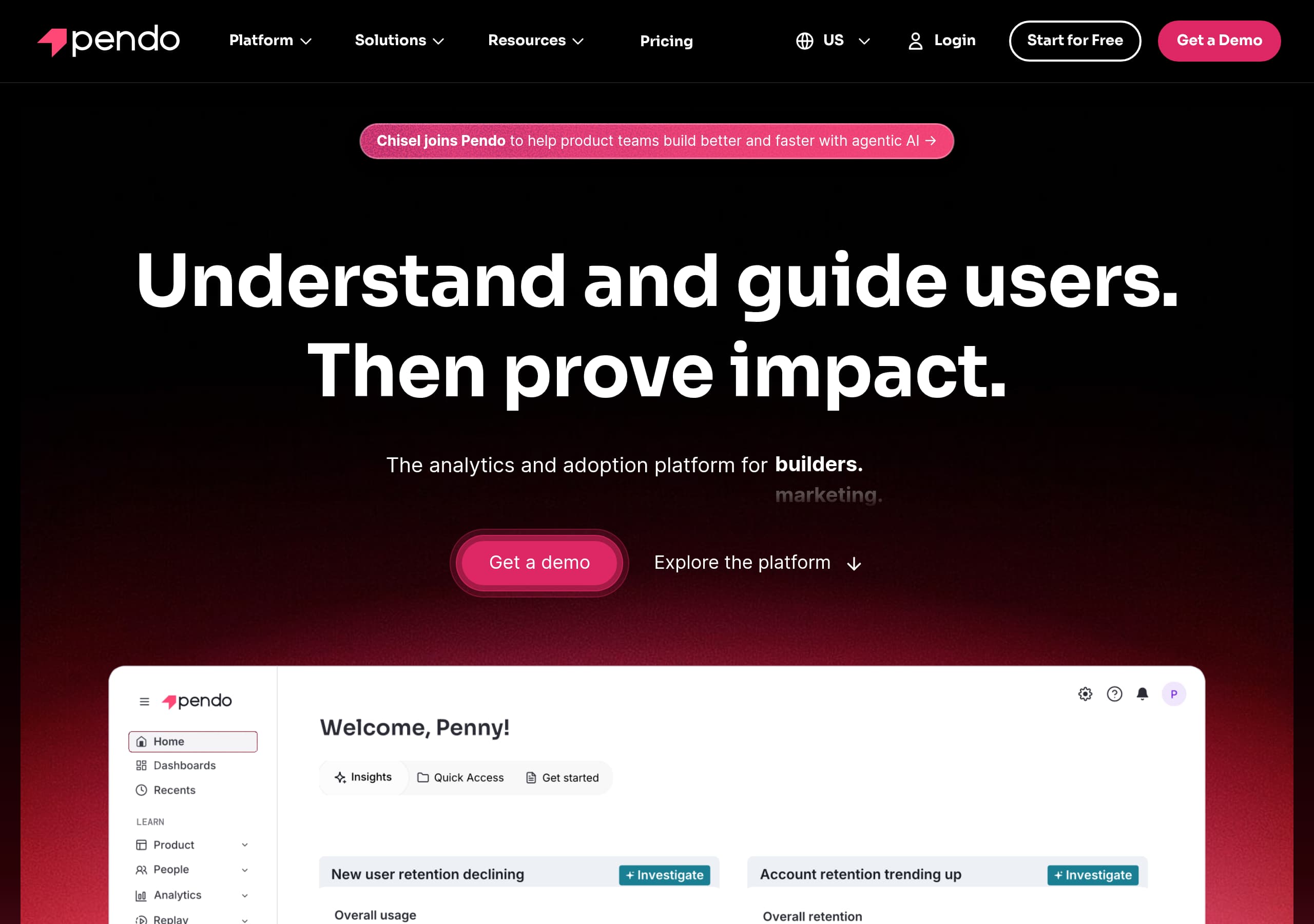
Pendo’s homepage nails a two-part narrative, “Understand and guide users. Then prove impact.”, which cleanly bridges product analytics to business outcomes without forcing users to choose a single use case upfront.
Conversion is driven by persistent, redundant CTAs, including “Get a demo,” “Start for Free,” “Explore the platform,” and “Request pricing,” but the dominance of demo CTAs may still route many visitors into sales-first motion.
The platform positioning is strengthened by an explicit portfolio frame, “apps and agents, bought and built,” which differentiates Pendo from single-product analytics tools and aligns with enterprise digital adoption needs.
AI is marketed with concrete interaction patterns, like “Agent Mode” natural-language questions and “MCP” connections to Claude and Cursor, making the AI value feel operational, not aspirational.
Trust is reinforced with a dedicated Trust Center CTA and visible compliance badges (GDPR, SOC 2 Type 2, PCI DSS, HIPAA), which reduces perceived risk for regulated buyers.
Social proof is multi-layered, combining a large customer count (“Join 14,000+ teams”), quantified outcomes (40% increase in sales opps, 99% decrease in development time), and a named executive quote, which supports both PLG and enterprise evaluation.
The footer acts as a discovery engine: it includes multiple “Pendo vs.” comparison pages, certifications, and a robust resource library, capturing SEO demand across alternatives and adjacent jobs-to-be-done.
Home
Pendo’s homepage works because it communicates a full-loop promise, insight plus action plus measurement, in the first screen: “Understand and guide users. Then prove impact.” This headline pairs naturally with the subhead, “The analytics and adoption platform for product people,” and is reinforced by repeated top-level CTAs like “Get a demo” and “Start for Free”, which keep the next step visible regardless of intent.
The layout in the provided excerpt suggests a layered hero followed by platform navigation. You see repeated entry points, “Explore the platform” and “Meet the Pendo Platform”, then a scannable grid of modules (Product Analytics, Guides, Session Replay, Listen, Predict, Orchestrate, Data Sync, Integrations). That pattern reduces cognitive load: visitors can land on a familiar capability without reading a long narrative, while still absorbing that Pendo is a connected suite.
A notable 2026 positioning move is the “apps and agents” framing, then a dedicated “AI that delivers outcomes for you” section. It is not just AI branding: the page names specific surfaces like Agent Analytics, Agent Mode, and MCP with explicit verbs (“Track AI, prove ROI”, “Questions become answers, instantly”, “Query Pendo from anywhere”). The homepage also uses scale proof, “35 trillion events” plus “1B+ users” and “50K+ agents & apps,” which helps justify why Pendo can power product context and benchmarking.
Finally, the bottom-of-page pathways, “Show yourself around” with 3 to 5 minute product tours, video demos, and a seasonal release callout, are strong for self-serve evaluators who want evidence before engaging sales.
Pricing
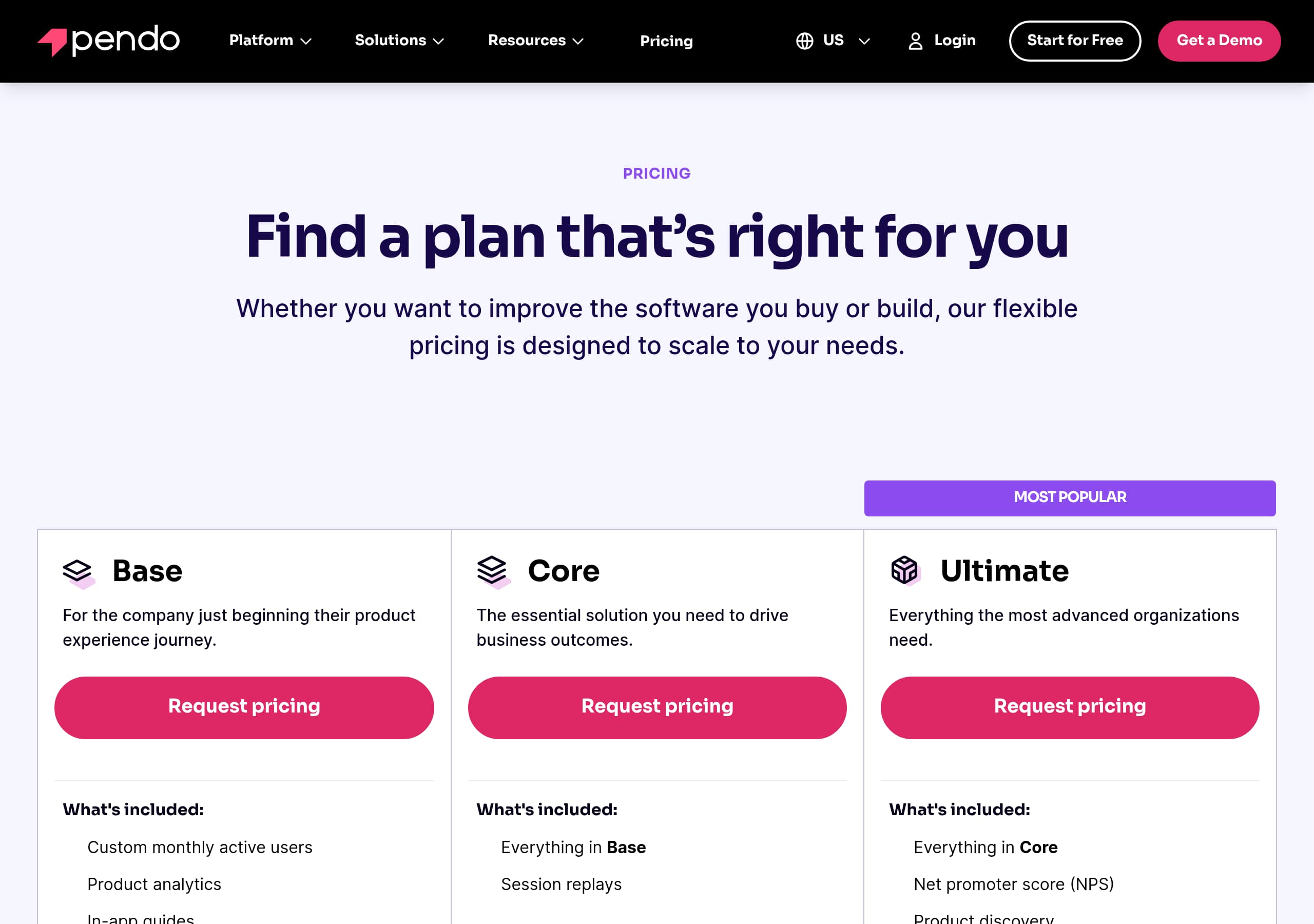
Pendo’s pricing experience is designed to qualify intent rather than fully self-serve, using “Pricing and Plans” as a hub while still routing many users to high-intent actions like “Request pricing” and “Get a demo.” From the homepage excerpt, pricing is consistently present in the main navigation, and the site repeats pricing prompts near the decision section (“No pressure. Just answers.”), which is a smart placement right after feature and proof content.
Based on the pricing screenshot input (Pricing page), Pendo appears to present pricing in a structured, plan-based layout rather than a single number. This style is typical for platforms that sell across segments (startups to enterprise) and multiple modules (Analytics, Guides, Session Replay, AI). The tradeoff is important: pricing opacity can reduce low-intent trial starts, but it can also increase sales efficiency by preventing misfit leads from anchoring on the wrong tier.
What makes the conversion mechanics work is the multi-path design:
- A direct PLG option is visible sitewide via “Start for Free”, which captures teams that want to test Guides or basic analytics without procurement.
- A sales-led option is emphasized with repeated “Get a demo” CTAs, which aligns with the platform’s enterprise positioning and security requirements.
- A mid-funnel option exists via self-guided tours and “Demo Center” resources, reducing the need to price-shop immediately.
To improve clarity, the pricing page should make the packaging logic explicit in on-page language, for example: which modules are included by tier, whether Agent Analytics and MCP are add-ons, and what triggers enterprise pricing (seats, events, app count, or portfolio scope). Without that, “Request pricing” becomes the only way to answer basic budgeting questions.
Features
Pendo’s feature presentation succeeds because it reads like a connected platform map, not a long list of tools. The “Meet the Pendo Platform” section positions Pendo as “the infrastructure” that connects “apps and agents, bought and built,” to user success and business outcomes. That phrasing matters, it reframes Pendo from a product analytics SKU into a portfolio-wide system.
The module grid is highly scannable and uses verb-led descriptions:
- Product Analytics: “Understand what users actually do.”
- Guides: “Help users right where they need it.”
- Session Replay: “See experiences through users’ eyes.”
- Listen and Sentiment: “Turn user voices into product insights,” and “Understand what users care about.”
- Predict: “Know who will churn before they do.”
- Orchestrate and Data Sync: extend beyond in-app into coordination and data plumbing.
This grid design is effective for multiple audiences because each tile answers “what is it?” in one sentence, then offers a consistent “Learn More” path. Consistency reduces friction, and it avoids the common enterprise problem where each feature page has different IA and CTAs.
The AI feature block is the most concrete part of the feature story. It names specific products and workflows: Agent Analytics (measure AI adoption and impact), Agent Mode (ask natural-language questions), and MCP (connect Pendo data to Claude, Cursor, or other AI tools). These are clear mental models: measurement, interrogation, and distribution of context.
Finally, the site reinforces “build on it” with scale data: “35 trillion events,” “1B+ users,” “50K+ agents & apps.” Whether or not a visitor validates the numbers, the inclusion signals that Pendo expects to be a system of record for behavioral data, not a small-team dashboard.
Signup
Pendo supports both PLG and sales-led signup paths, and the site makes that choice obvious through parallel CTAs: “Start for Free” for self-serve evaluation and “Get a demo” for guided evaluation. This dual motion is particularly important for Pendo because it sells to startups and enterprises while also spanning multiple teams, product, revenue, IT, and marketing.
From the homepage excerpt, there are several low-friction “experience before sales” options clustered together:
- “Show yourself around” with interactive demos and 3 to 5 minute product tours.
- “Video demos” for lightweight evaluation.
- A release education path (“Pendo Autumn Release”) to keep existing users engaged.
These are strong onboarding substitutes when a prospect is not ready to install a snippet or involve engineering. They also reduce pressure for buyers who are still defining requirements.
However, the dominant repetition of “Get a demo” suggests the primary conversion goal is still sales conversations. That is consistent with enterprise procurement, but it can slightly blur what “Start for Free” means: free trial of which modules, for which product type (web, mobile), and what setup is required. The FAQ list includes “Is Pendo easy to install?” and “Do we need a data science team or developers?”, which implies the signup flow likely requires at least some implementation steps.
A conversion-positive improvement would be to clarify the self-serve promise adjacent to “Start for Free,” for example: a 3-step overview like “Create workspace, install snippet or SDK, launch first Guide.” Even a short line about time-to-first-insight would reduce uncertainty.
Overall, Pendo’s signup strategy is coherent: self-guided tours capture mid-funnel visitors, while demo and pricing requests capture high-intent accounts that need security and portfolio governance answered early.
Trust
Pendo’s trust posture is unusually explicit for a marketing homepage, and that helps close the gap between product-led interest and enterprise requirements. The site includes a dedicated section titled “Security, Privacy, and Trust” with the strong claim, “Enterprise-grade security. Zero exceptions.” Crucially, it pairs this with a direct CTA, “Visit the Trust Center”, which signals there is a destination for security documentation, not just marketing copy.
The compliance badges are concrete and recognizable: GDPR Compliant, SOC 2 Type 2 Certified, PCI DSS Compliant, and HIPAA Compliant. Showing all four on the primary page is a practical conversion aid for buyers in financial services, healthcare, and any B2B SaaS with payment data. It also reduces the need for security questionnaires early in evaluation.
Trust is reinforced indirectly through positioning and data claims. Pendo states it has collected 35 trillion events, and highlights “product context anywhere” via access in LLMs like Claude or ChatGPT. When a company claims this scale and cross-tool connectivity, visitors immediately worry about governance and privacy, so the trust section’s placement matters. Here, it appears close enough to the AI story to counterbalance risk perception.
Another trust indicator is the breadth of enterprise-oriented navigation and resources: “Governance & Compliance,” “Contract Center,” “Developers,” and “Help Center.” These links imply operational maturity, which is a different trust signal than testimonials.
One thing Pendo does well is avoid vague security language. The page uses named standards and a Trust Center path, which is what security reviewers actually need. A further improvement would be a short on-page summary of data handling for AI features, for example how MCP access is controlled, but the current structure already sets the right expectation for deeper review.
Detected tech stack
Tools and technologies we detected on Pendo's site. Detection is best-effort and may be incomplete.
Scores
Our framework scores for Pendo's website in terms of clarity, conversion, and trust. See our methodology for how we calculate these.
How clear the value prop and structure are.
How conversion-friendly signup and pricing are.
How well trust and compliance are surfaced.
FAQ
Pendo leads with a clear outcome chain: “Understand and guide users. Then prove impact.” It immediately supports that promise with platform modules (Product Analytics, Guides, Session Replay, Listen, Predict, Orchestrate, Data Sync) and strong AI-specific entries (Agent Analytics, Agent Mode, MCP). The page also includes scale proof like “35 trillion events” and direct CTAs such as “Get a demo,” “Start for Free,” and “Explore the platform.”
Pendo includes “Pricing” and “Pricing and Plans” in its navigation and uses a “Request pricing” CTA near decision-focused sections. This indicates pricing is handled through packaging and sales qualification rather than a single public price for all customers. The site supports evaluation with self-guided tours and demos, then encourages buyers to request pricing when they need a plan fit across modules like analytics, in-app guides, and AI capabilities.
Pendo offers both “Start for Free” and “Get a demo,” signaling a hybrid PLG and sales-led approach. For visitors not ready to install or involve engineering, the site provides “Show yourself around” options, including interactive demos and 3 to 5 minute product tours, plus video demos. This lets prospects experience the platform before committing to a full implementation or procurement process.
Pendo combines multiple proof types: scale (“Join 14,000+ teams”), quantified outcomes (examples include 40% increase in sales opps and 99% decrease in development time), and a named executive testimonial from Demandbase that references in-product feedback for AI agents. The footer also shows an aggregate review signal, “4.5” with “1500+ reviews,” which helps late-stage evaluators validate market sentiment.
Pendo dedicates a homepage section to “Security, Privacy, and Trust,” includes a Trust Center link, and displays recognizable compliance markers: GDPR, SOC 2 Type 2, PCI DSS, and HIPAA. This is especially relevant because Pendo positions itself as infrastructure across a portfolio of apps and AI agents, which raises data governance questions. The explicit badges and Trust Center path reduce risk for enterprise and regulated buyers.

The world's best-performing SaaS businesses share surprisingly similar patterns. We help you learn and apply them through our human-designed methodology, with AI-assisted research.