
Key takeaways
Here are the key insights from our website breakdown analysis of Mailchimp.
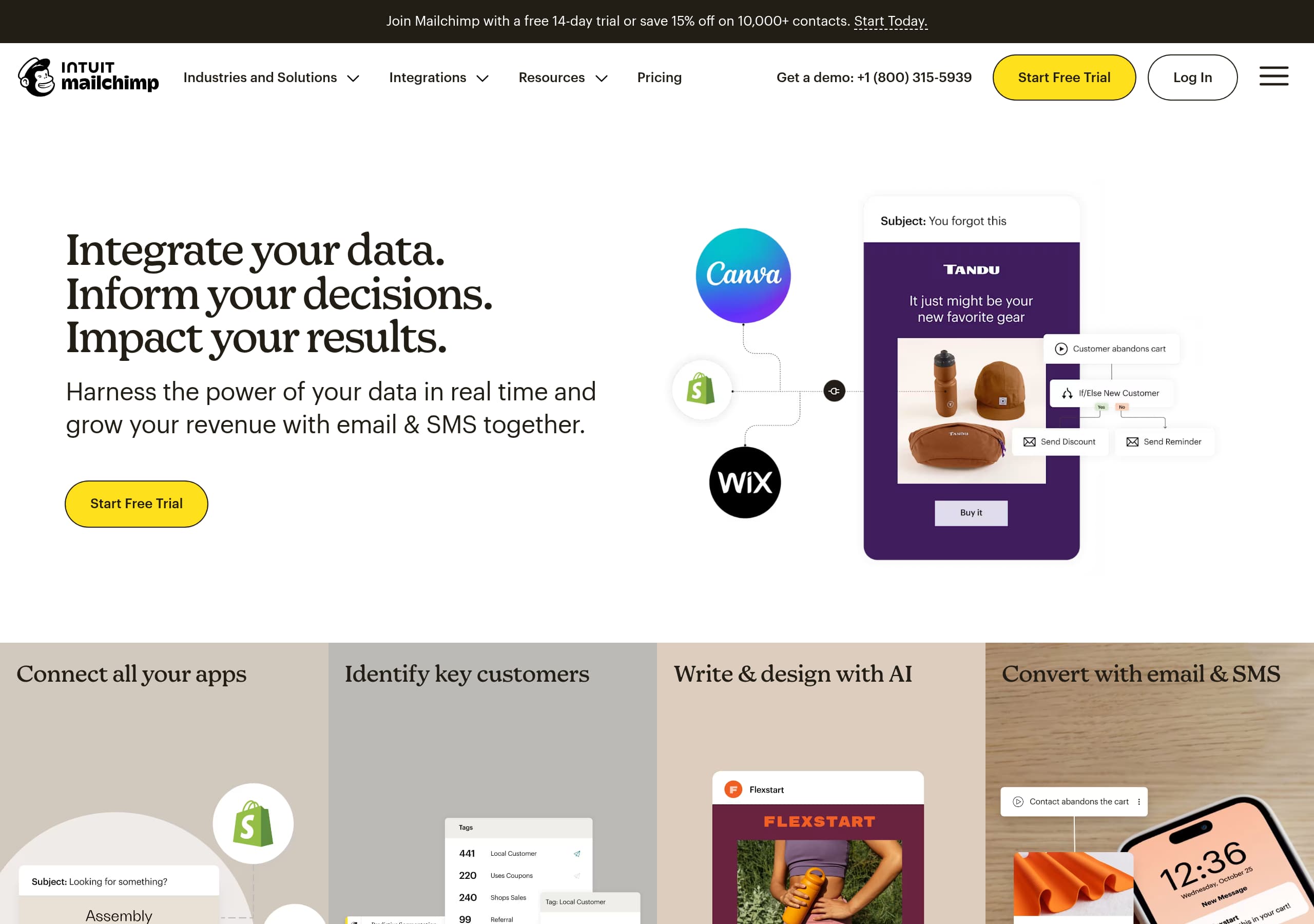
Mailchimp positions itself with a single, high-confidence headline (“#1 AI-powered email marketing and automations platform”) and immediately clarifies the outcome (“data-driven marketing without the complexity”), which reduces evaluation time for first-time buyers.
The homepage pairs multiple low-friction CTAs (free trial, no credit card) with measurable proof points (24,900+ reviews, 97% more clicks, up to 30x ROI, 99.99% delivery) to justify action without forcing a deep scroll.
Navigation is structured around real buyer mental models—Industries, Solutions, and Integrations—making it easy for e-commerce, restaurants, and mid-market teams to self-identify a path.
Mailchimp repeatedly de-risks switching with explicit migration tools and personalized onboarding, addressing a common objection for teams coming from Klaviyo or other email/SMS platforms.
Pricing emphasizes trial terms, contact tiers, and send limits in-line (including overage notes), which sets expectations early and helps prevent surprise costs that create churn.
Home
Mailchimp’s homepage clarifies positioning fast by pairing a categorical claim with an outcome and immediate action. The hero uses “#1 AI-powered” framing and translates it into a plain-language promise: “Data-driven marketing without the complexity,” followed by a persistent Start Free Trial CTA.
Several modules map to common jobs-to-be-done:
- Email + SMS as the core channel pairing (with SMS called out as integrated)
- Automations, drag-and-drop design, and AI tools for faster campaign creation
- Integrations emphasized as “300+” to reduce stack-friction
The page de-risks early with visible proof (“4.5 star rating,” “24,900+ reviews”) and later anchors results with quantified claims (e.g., 97% more clicks, up to 30x ROI, 99.99% delivery). A short personalization prompt (industry + top 3 goals) is a smart routing mechanism that keeps the page broad while still feeling tailored for e-commerce, nonprofits, and professional services.
Pricing
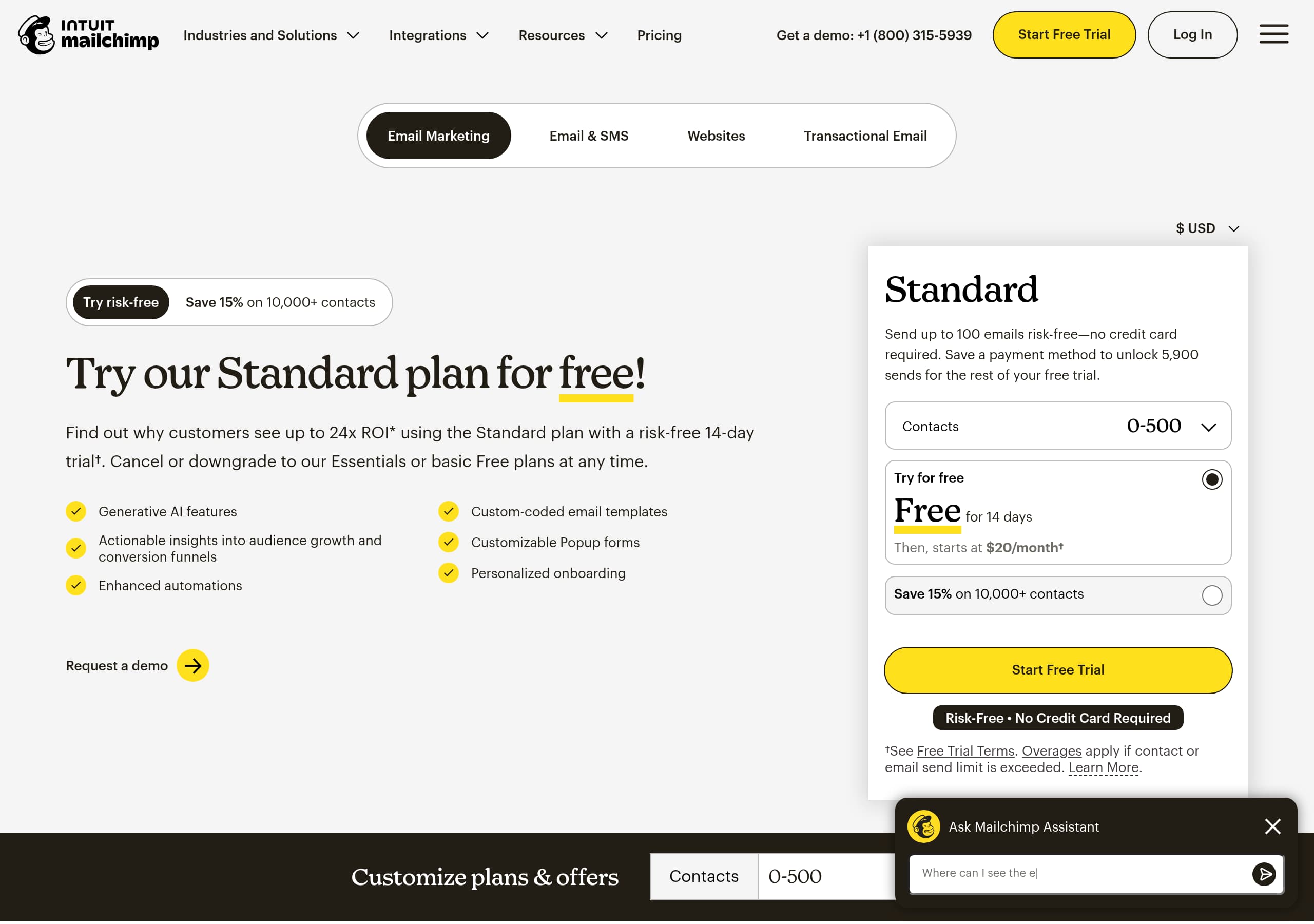
Mailchimp’s pricing presentation is optimized for commitment without surprises by putting constraints, terms, and upgrade paths right next to the primary CTA. The Standard plan emphasizes “Try free for 14 days” and repeats Risk-Free / No Credit Card Required, reducing the biggest signup objection.
Tactical clarity cues include:
- A visible contact-tier selector (0–500 through 100,000+) that frames pricing around list size
- A stated send allowance (e.g., “Send up to 6,000 emails each month”) to prevent assumption gaps
- Upfront notes on overages if contact or send limits are exceeded
The pricing area also segments incentives: a broad free trial plus a 15% discount for “10,000+ contacts,” which targets higher-intent, larger lists without cluttering entry-level messaging. Multiple CTAs (Start Free Trial / Buy Now) support both evaluation and procurement-ready visitors.
Features
Mailchimp structures features around outcomes and workflows rather than a flat feature dump, which helps visitors self-qualify quickly. The homepage highlights Email marketing, SMS marketing, AI marketing tools, marketing automations, content creation, and reporting/analytics as top-level solution categories.
Feature blocks are phrased as tasks:
- “Send high-quality content with ease” (drag-and-drop builder + 300+ templates)
- “Save time on repetitive tasks” (always-on automations)
- “Measure your ROI impact” (advanced reporting & analytics)
- “Grow your audience” (popup forms, lead ads, segmentation)
The integrations story is treated as a feature: “Discover 300+ integrations,” with recognizable platforms listed (Shopify, WooCommerce, Square, Wix, Stripe, Salesforce). This is important because Mailchimp often competes with Klaviyo and HubSpot; buyers want confirmation that their commerce, CRM, and design tools fit. The copy also repeatedly ties AI to concrete outputs (content generation, insights, optimization).
Signup
Mailchimp makes signup feel low-risk and reversible by repeating trial terms and keeping the primary action consistent. Across the page, the CTA is Start Free Trial, supported by “risk-free 14-day trial—no credit card required,” which reduces friction for first-time evaluators.
The flow is supported by two conversion assists:
- A personalization widget (“Which industry?” + “top 3 things you want to achieve”) that can route users toward SMS, automations, reporting, or switching tools.
- Strong post-signup safety nets: explicit onboarding support and migration tools, plus “Cancel or downgrade… at any time.”
Mailchimp also handles procurement-ready visitors with “Contact Sales” and a visible phone number, while keeping self-serve primary. The pricing section clarifies that saving a payment method unlocks additional sends during the trial, which sets expectations early. Overall, the signup messaging is designed to reduce perceived commitment while signaling that advanced support exists for serious migrations.
Trust
Mailchimp builds trust with a mix of operational assurances, scale signals, and transparent disclaimers. Key trust cues include 24 years in market, 11 million businesses using Mailchimp, and quantified delivery performance (“99.99% transactional email delivery”).
Risk-reduction is reinforced by service availability:
- 24/7 live chat and email support on paid plans
- “AWARD-WINNING SUPPORT” positioning
- Explicit migration & onboarding help to import contacts and brand assets
The site also increases credibility by adding footnotes for major claims, including the methodology behind “#1 AI-powered email marketing platform” and “#1 email marketing and automation platform” based on publicly available competitor customer data (with dates like Dec 2023 and May 2025). SMS is clearly constrained (add-on, select countries, approval required), which prevents compliance surprises.
While the excerpt doesn’t foreground security badges on-page, the combination of delivery metrics, support, and sourced leadership claims provides strong trust scaffolding for both SMB and mid-market buyers.
Footer
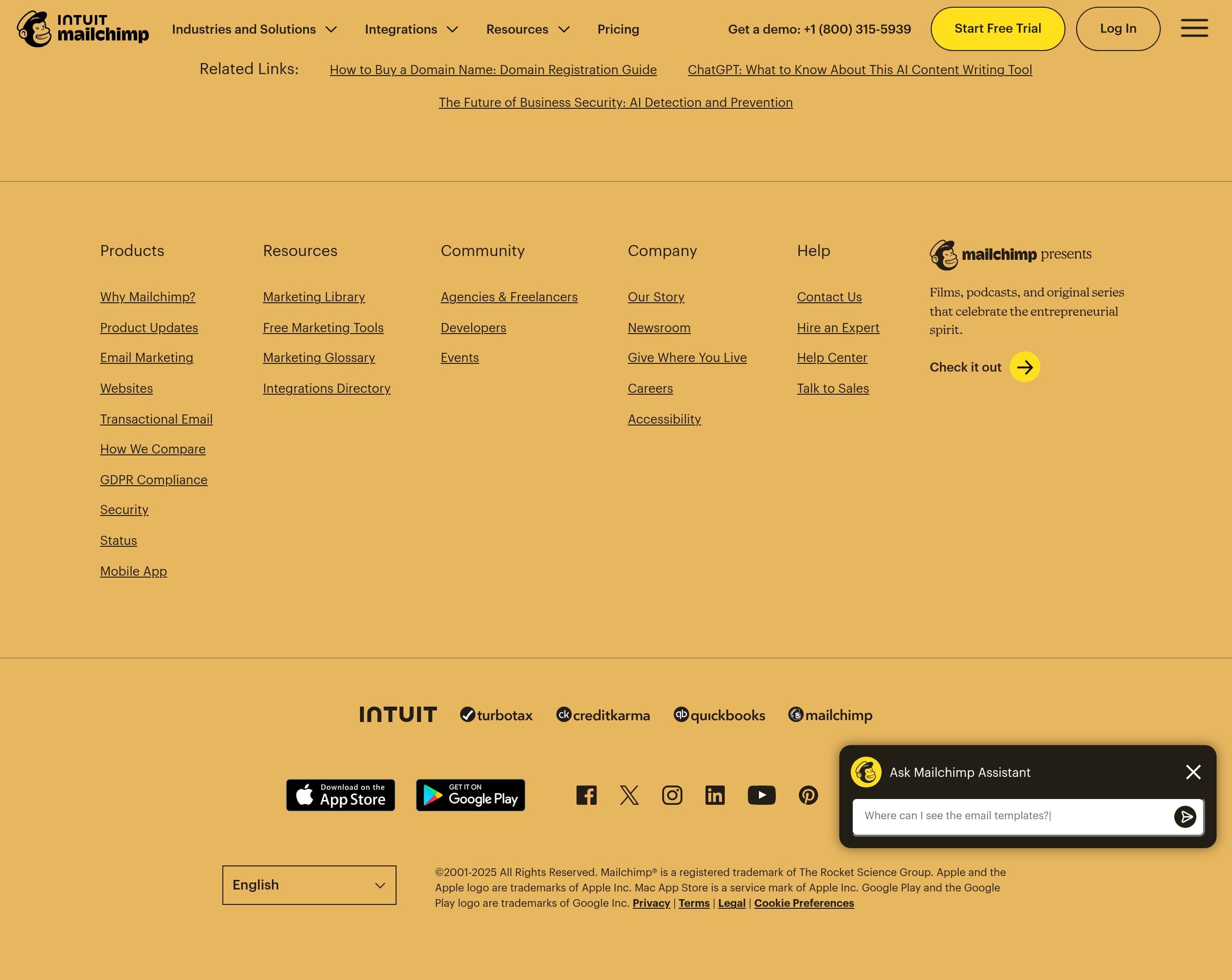
Mailchimp’s footer is built for enterprise-grade scanning and SEO coverage by exposing many routes without forcing users back to the header. The screenshot shows dense, columned navigation that typically includes product, resources, company, and legal destinations, helping different intents (learn, compare, buy, get support) resolve quickly.
Notable trust and usability patterns visible across the page/footer area:
- Multi-language availability (English, Español, Français, Português, Deutsch, Italiano), which signals global support readiness.
- Strong support and professional services pathways (“Hire an Expert,” “Personalized onboarding,” “Customer success”).
- Developer-facing resources (Marketing API, Transactional API, webhooks) that reduce integration anxiety.
The footer area also reinforces compliance through links to terms/offer terms and trial disclaimers (overages, contact limits). For conversion, the repeated availability of pricing, trial CTAs, and help center routes reduces dead-ends—especially for users who scroll to validate details before clicking “Start Free Trial.”
Detected tech stack
Tools and technologies we detected on Mailchimp's site. Detection is best-effort and may be incomplete.
Scores
Our framework scores for Mailchimp's website in terms of clarity, conversion, and trust. See our methodology for how we calculate these.
How clear the value prop and structure are.
How conversion-friendly signup and pricing are.
How well trust and compliance are surfaced.

The world's best-performing SaaS businesses share surprisingly similar patterns. We help you learn and apply them through our human-designed methodology, with AI-assisted research.