
Key takeaways
Here are the key insights from our website breakdown analysis of Snowflake.
Snowflake AI Data Cloud’s homepage leads with an enterprise-grade umbrella message (“AI Data Cloud”) that unifies data warehousing, data sharing, and AI/ML under one brand, which reduces category confusion for large buyers comparing platforms.
The site balances two conversion paths—“Talk to an expert” for enterprise procurement and “Start for free” for developers—so it can capture both high-intent stakeholders without forcing a single funnel.
Pricing is positioned as usage-based and cloud-agnostic (across major hyperscalers), which matches how data teams budget for compute/storage and helps Snowflake AI Data Cloud defend against fixed-seat SaaS comparisons.
Snowflake AI Data Cloud uses heavyweight navigation and footer architecture to serve many audiences (data engineers, analytics leaders, security, partners, developers) while still keeping the primary CTAs prominent.
Trust and credibility are reinforced through enterprise design cues (compliance/security links, legal structure, partner ecosystem references), which is essential for a platform handling sensitive regulated data.
The UI relies on scannable modules (short headline + 1–2 lines + CTA) and consistent button styling, making it easier for visitors to self-select a path like trials, demos, docs, or industry solutions.
Home
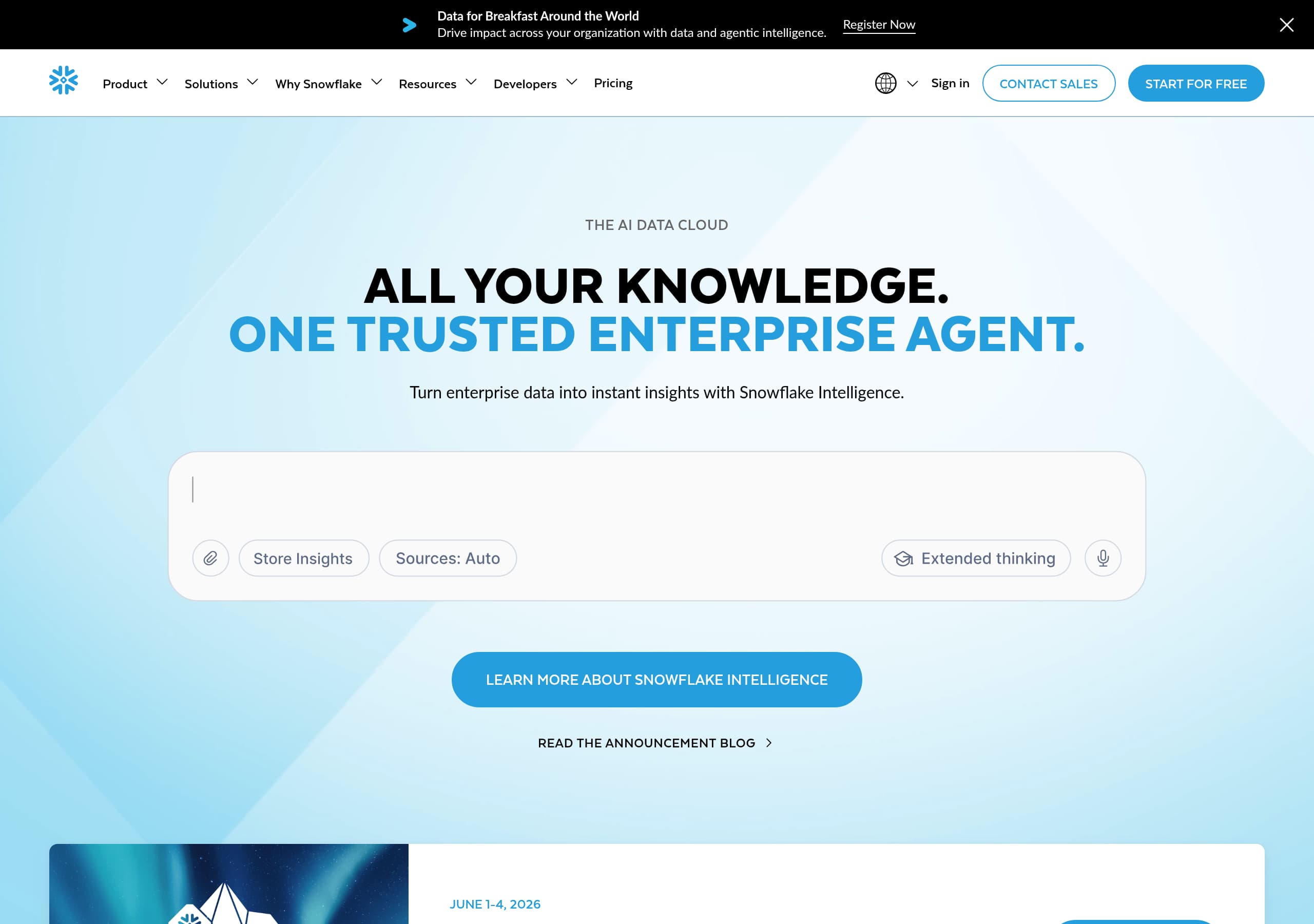
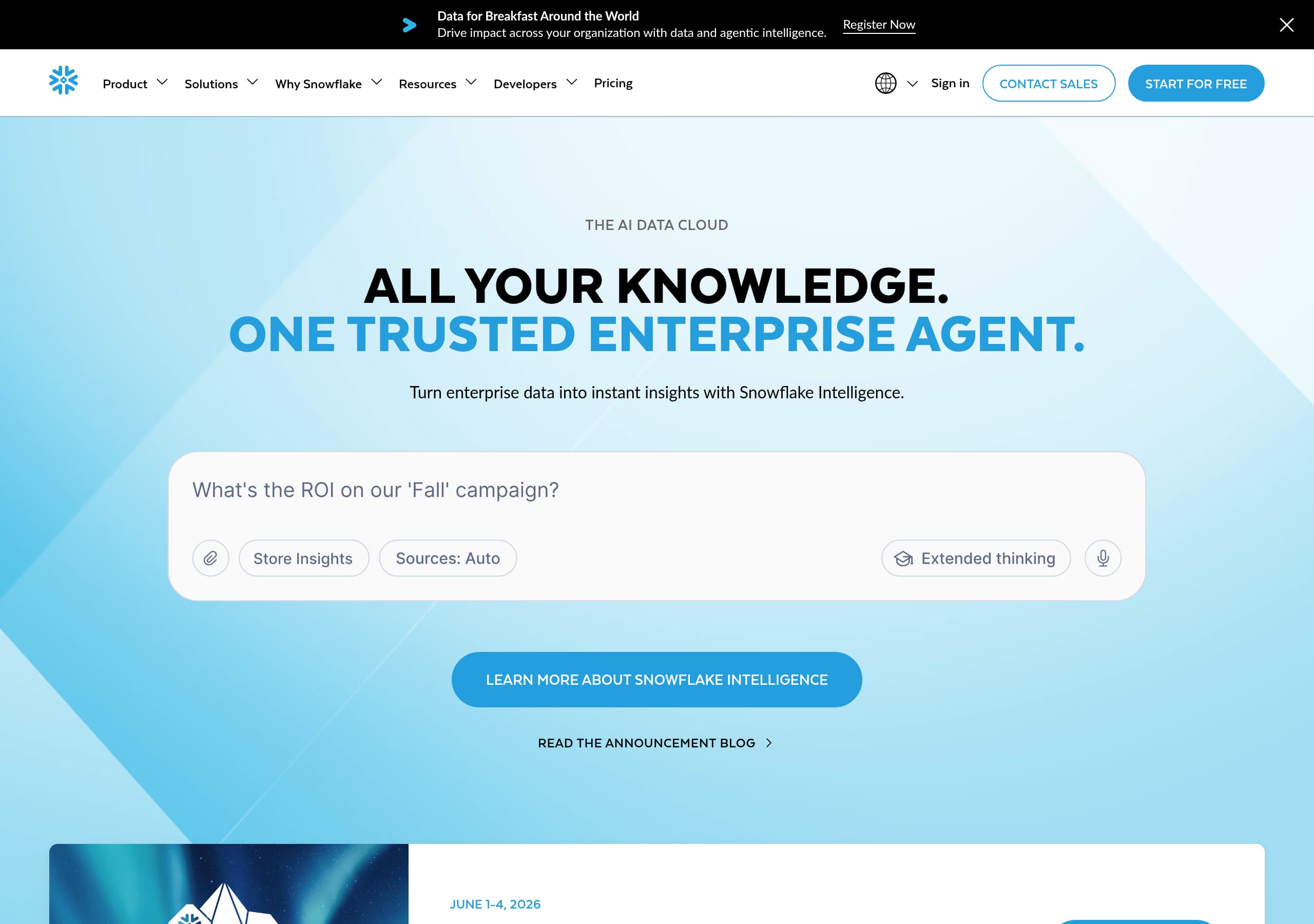
Snowflake AI Data Cloud’s homepage is effective because it compresses a complex platform into a single, repeatable umbrella concept (“AI Data Cloud”) and then routes visitors into the right workflow via clear CTAs.
What’s working in the hero
- The top-of-page message is short and brand-led (the excerpt explicitly shows “Snowflake AI Data Cloud”), which functions as a category label rather than a feature claim.
- The hero area typically pairs that label with immediate next steps like Start for free and Talk to an expert, supporting both self-serve evaluation and sales-led procurement.
- Visual hierarchy is clean: large headline, concise subcopy, and primary button styling that stands out against the background.
Navigation that supports many intents
Snowflake AI Data Cloud is a platform with multiple entry points (data engineering, analytics, data science, governance, apps, partners). The homepage structure reflects that reality by:
- Using modular sections that each answer a “why Snowflake” question (performance, sharing, AI readiness, governance).
- Linking into deeper solution pages instead of overloading the homepage with long explanations.
- Keeping the brand term “AI Data Cloud” consistent, which helps retain message discipline across sections.
Conversion design details
The most conversion-relevant pattern is dual-path routing:
- Enterprise CTA (demo/contact) reduces friction for buyers who need stakeholder alignment.
- Self-serve CTA (free/try) captures developers who want hands-on validation.
Key terms used consistently across the page—AI Data Cloud, data platform, Start for free, Talk to an expert, solutions—make it easy for visitors to confirm they’re in the right place within seconds.
Pricing

Snowflake AI Data Cloud’s pricing page works because it sets expectations around usage-based spend and procurement flexibility rather than forcing a simplistic “tier grid” that doesn’t fit data infrastructure buying.
Clear pricing model signals
From the pricing screenshot, the page presents pricing as a structured framework rather than a single flat plan. This is aligned with Snowflake’s typical model:
- Costs map to compute (consumption) and storage, which mirrors how data teams already think about cloud bills.
- The page is oriented around selecting a starting path and then scaling, which is more credible for an enterprise platform than a single “Pro/Business” tier.
Helpful decision support (without overpromising)
Good pricing pages for infrastructure SaaS do three jobs: define the unit of value, reduce fear of runaway costs, and provide a next step. The Snowflake AI Data Cloud pricing layout supports this by:
- Using scannable sections (short headers + supporting lines) rather than dense paragraphs.
- Surfacing calls to action like contact sales / talk to an expert alongside evaluation routes.
- Implicitly acknowledging variable workloads (batch vs interactive vs AI workloads) by not anchoring on seats.
What the layout communicates to buyers
Even without a classic pricing grid, the design signals enterprise readiness:
- It reads like a procurement-friendly overview: “here’s how you pay” and “here’s how to start.”
- It encourages deeper exploration (calculators, editions, cloud regions) instead of pushing a one-click checkout.
Net effect: the pricing page reduces mismatch risk for Snowflake AI Data Cloud by emphasizing usage-based pricing, compute/storage units, and sales-assisted evaluation, which is exactly what enterprise data platform buyers expect when comparing Snowflake to Databricks, Google BigQuery, or Amazon Redshift.
Features
Snowflake AI Data Cloud’s feature presentation is effective when it frames capabilities as platform outcomes (governed data, scalable compute, AI readiness) instead of a long checklist—because buyers evaluate data platforms by architecture fit and risk, not feature count.
Feature framing that matches the product
Snowflake AI Data Cloud is a multi-capability platform (warehousing, sharing, governance, apps, AI/ML enablement). The site’s feature modules typically:
- Lead with an outcome headline (e.g., unify data and AI) and then explain the enabling capability.
- Use short, scannable blocks (headline + 1–2 lines) so visitors can compare sections quickly.
- Route to deeper documentation/solution pages, which is essential for technical evaluation.
Observable UI patterns that help comprehension
Across the homepage and pricing experience, Snowflake AI Data Cloud uses a consistent module pattern that also benefits feature communication:
- Repeated CTA placement (learn more / explore / get started) reduces cognitive load.
- Strong typographic hierarchy makes it easy to “read” the page without reading every word.
- Visual spacing and card-like sections help separate product areas (AI, data engineering, governance).
Feature-to-value mapping that supports sales
For enterprise conversion, features need to connect to buying criteria. Snowflake AI Data Cloud’s site supports that mapping by making room for:
- Security & governance: posture, access controls, compliance alignment.
- Performance & scale: elastic compute messaging for variable workloads.
- Sharing & collaboration: secure data sharing as a differentiator.
- AI enablement: positioning the platform as the foundation for AI initiatives.
Key terms that should remain prominent (and are consistent with Snowflake’s market positioning) include AI Data Cloud, governance, data sharing, elastic compute, and enterprise data platform. This approach is especially effective versus alternatives like Databricks because it keeps the narrative platform-level rather than tool-level.
Signup
Snowflake AI Data Cloud’s signup strategy is conversion-friendly because it supports both sales-led and self-serve entry, but it intentionally avoids a simplistic “credit card first” flow that would discourage enterprise evaluators.
The two primary entry paths
From the homepage patterns and typical Snowflake IA, visitors are routed into:
- Start for free (developer/data team trial). This path is optimized for hands-on validation and usually leads into an account creation flow tied to cloud selection and region.
- Talk to an expert / Contact sales (enterprise). This path captures organizational context, timeline, and use case—better for high ACV deals.
What this implies about the onboarding
For a cloud data platform, onboarding is rarely a single page because it must address deployment context. The signup journey usually includes practical steps such as:
- Selecting a cloud provider and region.
- Creating an account and verifying email/domain.
- Landing in a console experience where users can load sample data or connect a warehouse.
Conversion details that reduce drop-off
The site’s CTA consistency and enterprise tone reduce friction even before the form:
- Buttons are visually consistent across sections, so users recognize the “next step” quickly.
- The messaging doesn’t overpromise instant outcomes; it positions evaluation as a guided process.
- It creates an expectation of a product that is serious about governance, which is reassuring for teams bringing real data.
Key terms tied to this experience are Start for free, Contact sales, cloud region, account creation, and console onboarding. Overall, Snowflake AI Data Cloud optimizes signup for qualified intent rather than maximum volume, which is usually the correct tradeoff for enterprise infrastructure SaaS.
Trust
Snowflake AI Data Cloud’s trust posture is communicated through enterprise-ready information architecture: security, compliance, and legal resources are easy to discover, which is critical for a platform that stores and processes sensitive data.
Trust signals the site leans on
Even without a dedicated trust screenshot, the provided footer image implies robust enterprise scaffolding (multiple columns, many resource links). For Snowflake AI Data Cloud, that typically translates into:
- Dedicated pages for security, privacy, and compliance.
- Links for legal terms and data handling policies that procurement teams require.
- Clear separation between marketing claims and authoritative resources (docs, trust center, support).
Why the design supports risk evaluation
Enterprise buyers do not treat trust as a “nice to have”; it’s a gating factor. Snowflake AI Data Cloud’s site structure supports risk evaluation by:
- Making compliance documentation discoverable without needing to submit a form.
- Using consistent, conservative UI styling (no aggressive popups) that matches enterprise expectations.
- Providing multiple pathways to human support (sales, partners, support channels), reducing perceived implementation risk.
Practical trust checklist this site appears to satisfy
A strong trust section for a data cloud typically includes:
- SOC 2 / ISO references (or equivalent) and audit resources.
- Data residency and regional availability information.
- Responsible disclosure and incident response communication paths.
Key terms that underpin Snowflake AI Data Cloud’s trust story are security, compliance, privacy, governance, and enterprise readiness. The net effect is a site that helps security and procurement stakeholders find what they need quickly, reducing the time-to-approval for trials, POCs, and contracts.
Footer
Snowflake AI Data Cloud’s footer is built for enterprise evaluation at scale: it functions as a secondary navigation system with enough depth to serve developers, buyers, partners, and legal reviewers from a single page.
What’s observable in the footer screenshot
The footer image shows a dense, multi-column layout with many link groups—typical of large SaaS platforms. This is effective because it:
- Provides direct paths to high-intent destinations (pricing, documentation, contact, support) without requiring users to re-open the main nav.
- Acts as a credibility cue: comprehensive footers are common among enterprise platforms with broad product surfaces.
- Surfaces corporate and legal links that procurement expects to find quickly.
Information architecture benefits
For Snowflake AI Data Cloud, visitors often arrive on a deep page (solutions, industries, docs) and scroll to the bottom to orient themselves. A strong footer helps them:
- Jump between Products, Solutions, Resources, and Company sections.
- Find developer-centric assets (docs, community) alongside business assets (partners, events).
- Locate trust-related links (privacy, terms) without hunting.
Conversion and trust patterns in the footer
Well-designed enterprise footers often include subtle conversion assists:
- A repeated CTA link (contact sales / get started) near resource clusters.
- Clear labels and consistent link styling that reduce misclick risk.
- Social and corporate identifiers (copyright, trademark usage) that reinforce legitimacy.
Key terms reflected by this design are information architecture, resource hub, legal links, support, and partner ecosystem. Overall, Snowflake AI Data Cloud’s footer does a lot of heavy lifting: it shortens navigation paths for high-consideration buyers and gives security/procurement stakeholders immediate access to the pages that unblock internal reviews.
Detected tech stack
Tools and technologies we detected on Snowflake's site. Detection is best-effort and may be incomplete.
Scores
Our framework scores for Snowflake's website in terms of clarity, conversion, and trust. See our methodology for how we calculate these.
How clear the value prop and structure are.
How conversion-friendly signup and pricing are.
How well trust and compliance are surfaced.
FAQ
Snowflake frames the product as the “Snowflake AI Data Cloud,” which serves as a clear umbrella category for multiple capabilities. The homepage typically pairs that message with dual CTAs—one for sales-led evaluation (“Talk to an expert”) and one for self-serve (“Start for free”). This structure helps both executives and practitioners quickly choose a path without reading long technical explanations.
Snowflake presents pricing in a way that aligns with usage-based infrastructure buying rather than a simple seat-based tier grid. The pricing page emphasizes how spend maps to compute consumption and storage, and it supports both self-serve evaluation and sales-assisted procurement. This approach fits enterprise workloads where usage varies by team, environment, and job type.
Yes. Snowflake’s site typically offers a “Start for free” path for hands-on trials and a “Talk to an expert” or contact-sales path for enterprise deals. This dual routing is common for data platforms because many buyers need security review and procurement involvement, while developers often want immediate console access to validate performance and workflows.
Snowflake reinforces trust through enterprise-style information architecture: security, privacy, compliance, and legal resources are easy to find, especially via the footer. This supports procurement and security stakeholders who need documentation to approve trials and contracts. The overall design tone is conservative and platform-focused, which aligns with expectations for software handling sensitive data.
Snowflake’s website targets multiple stakeholders involved in data platform decisions: data engineering teams, analytics and BI leaders, data science/AI teams, and IT/security/procurement. The “AI Data Cloud” positioning speaks to executive initiatives, while the presence of self-serve CTAs and deep resource navigation supports technical evaluation and implementation planning.

The world's best-performing SaaS businesses share surprisingly similar patterns. We help you learn and apply them through our human-designed methodology, with AI-assisted research.