
Key takeaways
Here are the key insights from our website breakdown analysis of Trello.
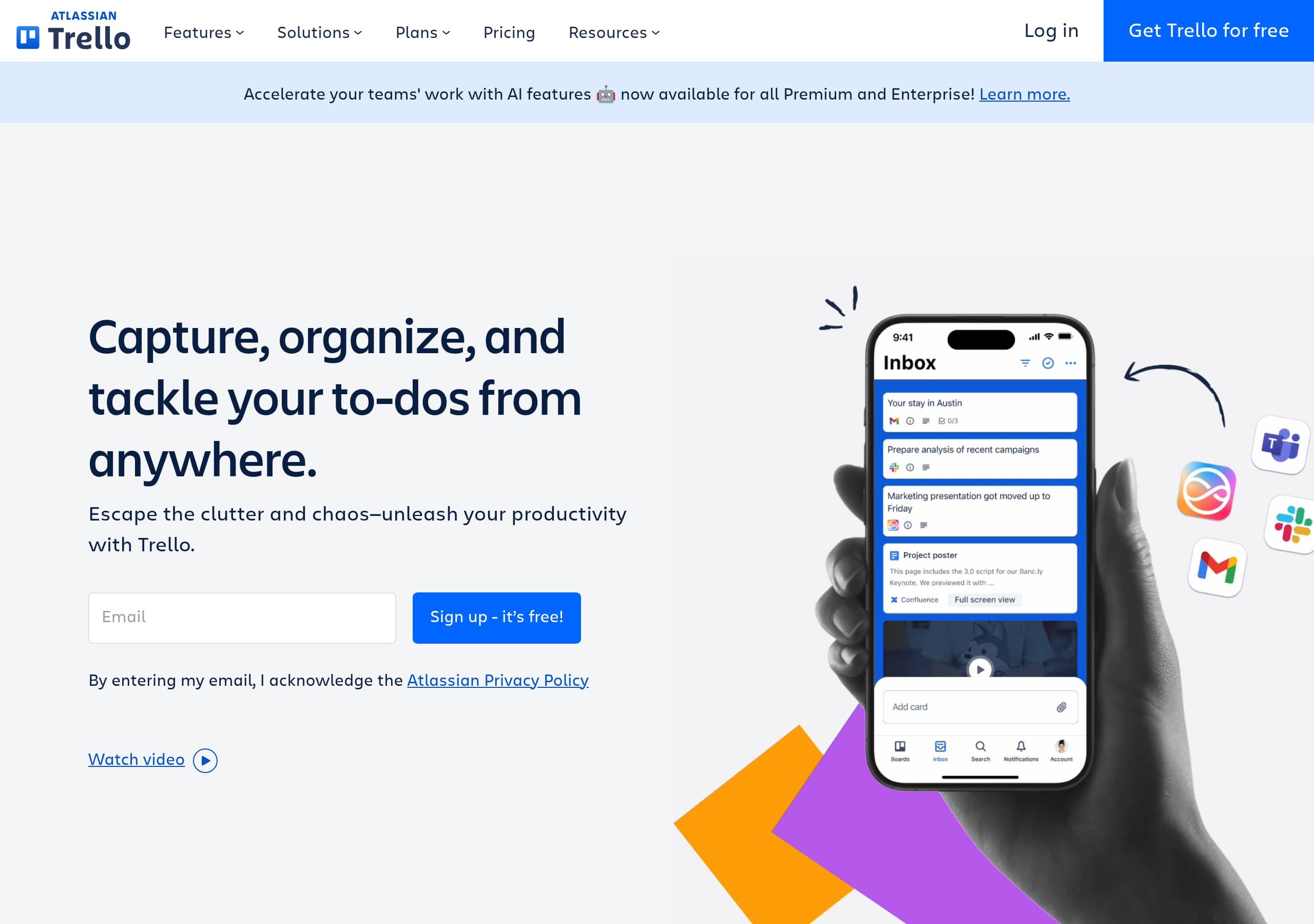
Trello’s homepage reduces time-to-value with a single-sentence promise (“Capture, organize, and tackle your to-dos from anywhere”) and an immediate primary CTA (“Sign up – it’s free!”) that’s repeated near the bottom for reinforcement.
The site sells outcomes before mechanics by mapping Trello to specific teams (Marketing, Product management, Engineering, Design, Startups, Remote teams) and then grounding those claims in concrete “use case” modules like task management and project management.
Feature positioning is packaged into three memorable primitives—Inbox, Boards, Planner—then expanded with Integrations, Automation, and Power-Ups, which helps multiple audiences self-identify without reading long copy.
Conversion is supported with visible plan segmentation (Free, Standard, Premium, Enterprise) and clear fit language (e.g., “Best for teams up to 100”), reducing pricing-page ambiguity for buyers comparing Trello to Asana, Monday.com, or Jira.
Trust is strengthened using named customer quotes (Women Who Code, ThoughtWorks, IKEA/PTC) and quantified survey stats (75% value in 30 days, 81% chose for ease of use, 74% improved communication) that function as proof points, not just testimonials.
Home
Trello’s homepage communicates value proposition fast: “Capture, organize, and tackle your to-dos from anywhere,” followed immediately by CTA (“Sign up – it’s free!”) and a secondary “Watch video” for evaluators.
The page uses a simple product taxonomy—Inbox, Boards, Planner—to explain the workflow without requiring prior knowledge of kanban. Each module has a short, action-oriented line (e.g., “Drag, drop, get it done”), which improves skim comprehension.
It also expands to broader buyers with audience routing:
- Team pages for Marketing, Product management, Engineering, Design, Startups, and Remote teams
- “Our product in action” use cases (Task management, Resource hub, Project management)
A notable differentiator is the “From message to action” section, tying email, Slack, and Microsoft Teams to Trello Inbox with AI summaries/to-do creation. Repeated CTAs near the bottom reduce scroll-dropoff before signup.
Pricing
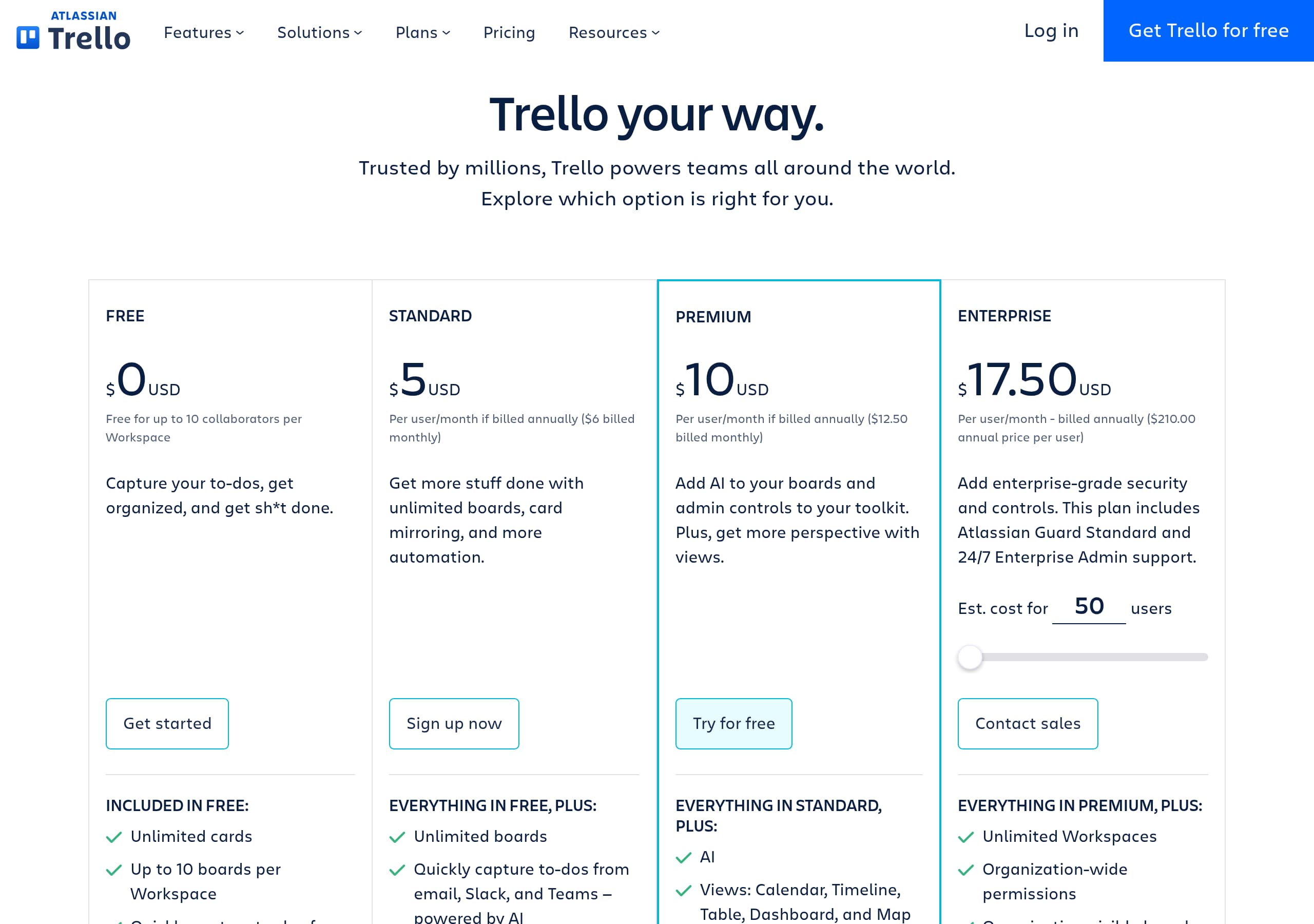
Trello’s pricing structure supports quick self-selection by presenting four clear tiers: Free, Standard, Premium, and Enterprise. Each tier is paired with “who it’s for” language, including a concrete sizing cue (“Premium… best for teams up to 100”), which reduces ambiguity for managers estimating rollout.
The page copy addresses cost objections directly: “Whether you’re a team of 2 or 2,000… you only pay for what you need.” That line reframes pricing as scalable rather than punitive, which matters when Trello is compared with Asana or Monday.com.
Conversion mechanics visible in the pricing experience:
- A Compare plans & pricing path for analytical buyers
- Plan naming that maps to common procurement stages (individual → team → org)
- Clear separation between collaboration scaling (Standard) and advanced visualization/multi-project needs (Premium)
The result is a pricing page that supports both quick upgrades and stakeholder-driven evaluation without forcing an immediate sales call.
Features
Trello’s feature presentation is structured as progressive disclosure: start with core behavior, then reveal extensibility. The primary set—Inbox, Boards, Planner—creates a clear mental model for new users, while advanced capability is framed as optional upgrades rather than mandatory complexity.
Feature modules are written as outcomes and actions:
- Inbox captures tasks “from anywhere”
- Planner syncs a calendar and allocates time slots
- Boards keep long to-do lists manageable
Then Trello introduces scale levers:
- Automation positioned as no-code and “built into every board”
- Integrations and Power-Ups to connect existing tools
- Card mirroring to reduce duplication across boards
A differentiated section (“From message to action”) ties email, Slack, and Microsoft Teams into Trello Inbox with AI-generated summaries and AI-transformed to-dos, making integrations feel immediately useful rather than just a compatibility list.
Signup
Trello’s signup conversion is optimized around low friction and low risk. The primary homepage CTA is “Sign up – it’s free!” and it’s repeated in multiple locations, capturing both fast deciders and users who need more information before committing.
The signup prompt uses a single input (email) and includes an immediate acknowledgment of the Atlassian Privacy Policy directly under the field. Placing that disclosure at the point of action helps reduce hesitation without forcing users to hunt for legal links.
The messaging also sets clear time-to-value expectations: “It’s simple – sign-up, create a board, and you’re off!” That is effectively a 3-step onboarding promise, which is easier to visualize than a vague “get started.”
The presence of “Log In” supports returning users, while the “Watch video” option provides a parallel path for stakeholders who want a short product tour before sharing an email address.
Trust
Trello builds trust signals primarily through brand affiliation, attributable proof, and transparent policy placement. The product is clearly under Atlassian (copyright and site-wide policy references), which signals operational maturity for buyers who associate Atlassian with enterprise software.
Trust reinforcement appears in three observable patterns:
- Attribution: testimonials include real names, job titles, and organizations (Women Who Code, ThoughtWorks, IKEA/PTC)
- Quantification: TechValidate Survey metrics (75% value in 30 days, 81% ease of use, 74% improved communication)
- Disclosure: Atlassian Privacy Policy is referenced directly under the email capture CTA
While the excerpt doesn’t show explicit compliance badges (SOC 2, ISO 27001) or security-page callouts, the Enterprise plan positioning (“admins need”) implies governance features that enterprise evaluators look for. The multilingual footer also signals global readiness and localization investment.
Footer

Trello’s footer is structured to support both product discovery and risk reduction. It includes navigational links that map to common buyer questions—About Trello, Jobs, Apps, and Contact us—so users can validate legitimacy and find the next step without returning to the top.
Two footer choices improve credibility and usability:
- Legal clarity: Notice at Collection, Privacy Policy, Terms, and copyright attribution to Atlassian are grouped together, making governance information easy to locate.
- Global support: an extensive language selector (20+ languages, including English, Español, 日本語, Русский, 中文) signals that Trello is maintained for international teams.
The “Apps” link supports cross-device adoption, aligning with the “from anywhere” promise. “Contact us” provides a human escalation path, which is especially important for Enterprise evaluators. Overall, the footer closes the loop: it reinforces Atlassian ownership, exposes compliance/legal pathways, and reduces dead ends at the bottom of the page.
Detected tech stack
Tools and technologies we detected on Trello's site. Detection is best-effort and may be incomplete.
Scores
Our framework scores for Trello's website in terms of clarity, conversion, and trust. See our methodology for how we calculate these.
How clear the value prop and structure are.
How conversion-friendly signup and pricing are.
How well trust and compliance are surfaced.

The world's best-performing SaaS businesses share surprisingly similar patterns. We help you learn and apply them through our human-designed methodology, with AI-assisted research.