
Key takeaways
Here are the key insights from our website breakdown analysis of UKG.
UKG’s homepage clarifies its scope quickly by anchoring everything to “HR, pay, and workforce management” and repeating a unified platform narrative, but it still risks sounding broad because “people-first AI” appears in many sections without a concrete, first-screen example.
Navigation is built for enterprise buying committees: product families, business size, industries, and leader personas are all one click away, which reduces “where do I start?” friction for complex evaluations.
Conversion is driven by persistent, low-friction CTAs like “Get started,” “Learn more,” and “See all demos,” but the site favors exploration over immediate product qualification, and pricing transparency is not positioned as a primary next step.
Social proof is a major strength: the page stacks multiple third-party validations, including The Forrester Wave Q4 2025, Gartner Magic Quadrant 2025 mentions, Nucleus Research 2025, and G2 Best Software Awards, which helps UKG compete in crowded HCM and WFM categories.
UKG segments its value proposition by audience (HR leaders, payroll and finance leaders, operations leaders) and by industry (healthcare, retail, manufacturing, public sector), improving relevance and SEO coverage for high-intent searches.
The site’s trust story is built more around analyst recognition, community, and customer experience than explicit security details on the homepage, so prospects with strict compliance requirements may need clearer pathways to security documentation and certifications.
Home
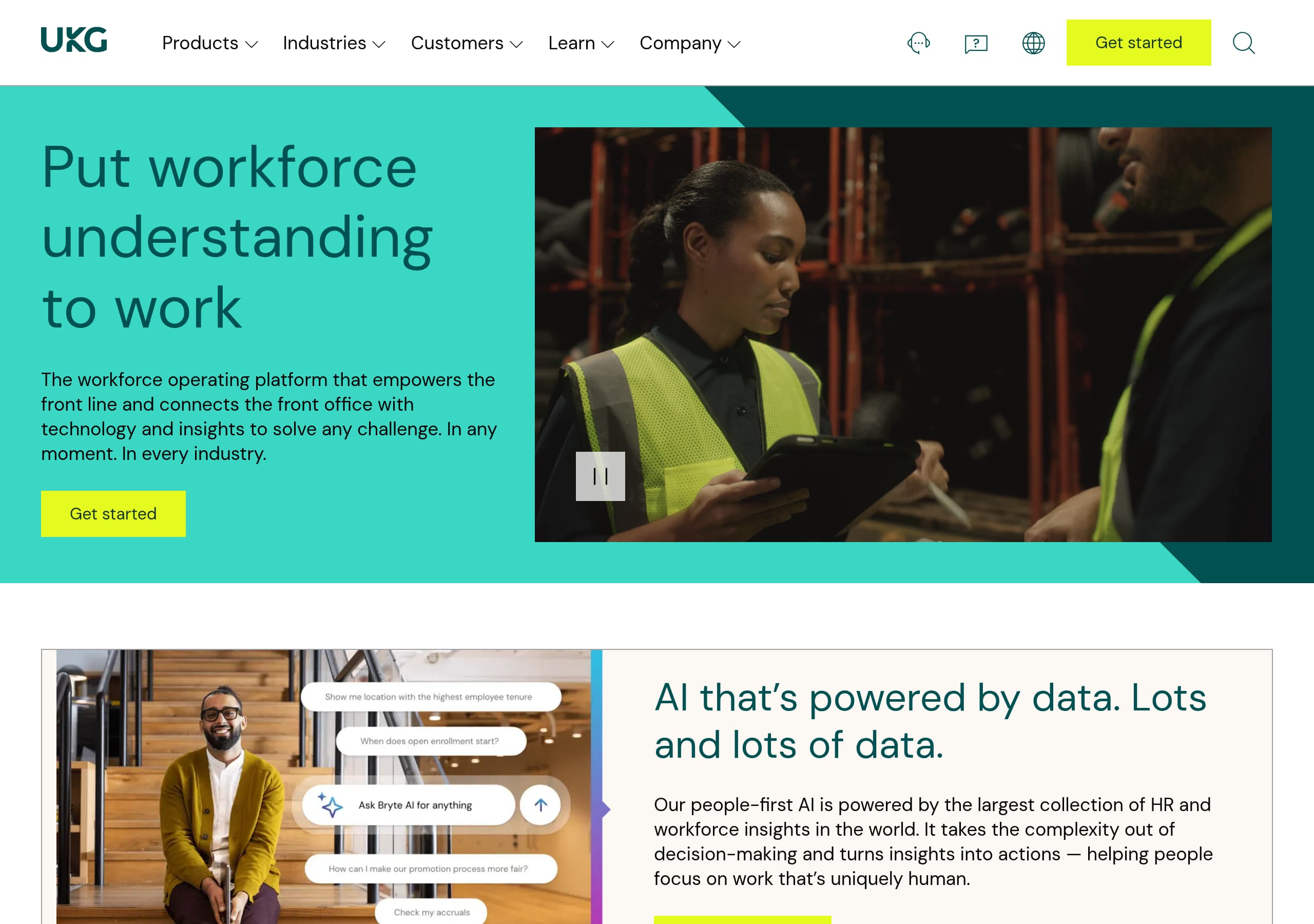
UKG’s homepage wins on breadth and navigation clarity: it quickly establishes UKG as “UKG HR, pay, and workforce management” and reinforces a single platform story rather than disconnected point solutions. The hero headline, “Put workforce understanding to work,” sets an outcome-led frame, while the subhead calls UKG “the workforce operating platform” that connects the front line and front office with “technology and insights,” plus a prominent Get started CTA.
Where the page is strongest is in structured segmentation. You can see multiple parallel entry points:
- Product pillars: Human Capital Management, Workforce Management, and Payroll, each with a short benefit statement and a “Learn more” CTA.
- Audience lanes: “For HR leaders,” “For payroll & finance leaders,” and “For operations leaders,” each mapping to a distinct job-to-be-done.
- Industry hubs: healthcare, retail, hospitality, public sector, manufacturing, logistics, and financial services, each framed in operational language like scheduling complexity and compliance.
The site leans heavily into people-first AI and the named innovation “Bryte AI,” with an explicit claim that AI is “powered by data” and “the largest collection of HR and workforce insights in the world.” Visually (per the home screenshot), the layout appears modular and enterprise-standard, with repeated “Learn more” blocks designed for scanning.
The main opportunity is specificity. “People-first AI” appears across many modules, but the first screen does not show a concrete example (for example, a scheduling recommendation, anomaly detection, or payroll variance insight). Adding one tangible AI outcome above the fold would make the value proposition feel less abstract while preserving the strong platform narrative.
Pricing
UKG’s website, based on the provided homepage and navigation excerpt, does not present a direct pricing page as a primary destination, and pricing is not surfaced as a first-order CTA alongside “Get started.” That is a common pattern for enterprise HCM and workforce management platforms, where packaging depends on modules (HCM, WFM, Payroll), geography, and workforce complexity, but it changes the conversion job: the site must qualify and route, not close a self-serve purchase.
From a buyer’s perspective, the information scent suggests a sales-led pricing motion:
- Primary CTAs emphasize Learn more, Get started, and “See all demos,” indicating the next step is exploration or a conversation.
- Product families list “Features” under each pillar (for example, Time & Attendance, Scheduling, Compliance, Global Payroll), implying modularity that would affect cost.
- “Business size” segmentation (Small Business, Midsize, Enterprise) indicates tiered or tailored offers, but without visible plan comparisons.
What works is alignment with enterprise reality: a multinational payroll buyer needs “every time, everywhere,” and a frontline-heavy WFM buyer needs shift optimization. UKG’s page architecture supports those routes before discussing price.
What is missing, at least from the excerpted experience, is a clear “How pricing works” explainer. UKG could improve pricing clarity without publishing numbers by adding:
- A short pricing model description, such as per-employee-per-month and module-based packaging.
- A visible “Request pricing” CTA adjacent to Get started.
- A checklist of variables that impact price, such as countries, payroll complexity, and time clock integrations.
Without those cues, prospects may delay engagement or bounce to competitors that more explicitly outline packaging expectations.
Features
UKG presents features as guided pathways rather than a single giant grid, which is a smart approach for a suite that spans HCM, workforce management, and payroll. In the navigation and product sections, each pillar includes a short benefits statement and a “Features” list that reveals what UKG wants buyers to associate with that category.
Observed feature grouping from the excerpt:
- Human Capital Management includes AI, Employee Engagement, Human Resources, Scheduling, Payroll, Talent Management.
- Workforce Management includes AI, Compliance, Time & Attendance, Strategic Workforce Planning, Scheduling, Payroll.
- Payroll includes AI, Compliance, Payroll Analytics and Reporting, Global Payroll, Payment services.
This structure does two things well. First, it highlights cross-cutting capabilities (AI and compliance recur) that unify the suite into “one platform.” Second, it makes it easier for different stakeholders to find their anchor feature quickly, for example Time & Attendance for operations, or Payroll Analytics for finance.
The copy is also benefit-oriented rather than purely functional, for example “Plan smarter, schedule faster, and lead with confidence,” or “Build trust by paying your people right, every time, everywhere.” Those lines translate features into outcomes, which helps non-technical buyers.
Where the feature presentation could be stronger is in demonstrating “how it works” visually. The excerpt points to “UKG Demos” with multiple demo types (HCM, Workforce Management, Pay, SMB). That is a solid bridge, but the main pages would benefit from:
- A consistent 3 to 5 card feature layout per pillar, each with a UI screenshot.
- Clear differentiation of Bryte AI as a named capability: what inputs it uses, what outputs it produces, where it appears in workflow.
- Fewer repeated feature words across pillars (Scheduling and Payroll show up multiple times) with sharper “what’s unique here” framing.
As-is, UKG’s features are easy to scan and route, but they remain slightly abstract until a visitor watches a demo.
Signup
UKG’s conversion flow, as implied by the homepage excerpt, is built around guided sales or demo engagement rather than a classic self-serve product signup. The dominant CTAs are Get started, Learn more, “See all demos,” and report downloads like “Get the report” or “Download the latest Nucleus Research report,” which indicates UKG is optimizing for lead capture, qualification, and education.
Several elements support that enterprise motion:
- Multiple entry points for different intents: product exploration (HCM, WFM, Payroll), persona-based pages (HR leaders, payroll and finance, operations), and industry pages.
- A dedicated “UKG Demos” hub with at least four demo routes: HCM product demo, Workforce Management product demo, Pay product demo, and SMB product demo. That is a clear, low-risk next step for evaluators.
- “Contact Support” and “Support” are present in the global header, suggesting UKG also serves existing customers directly from the marketing site.
What is not visible in the provided content is a true account creation path, trial language, or a “Start free trial” CTA. For a suite like UKG, that may be intentional, but it means the “Get started” action must do heavy lifting. It should quickly answer: Are you requesting a demo, requesting pricing, or starting an implementation conversation?
To reduce friction, UKG could make the flow more explicit by:
- Labeling the primary CTA as “Request a demo” if that is the outcome.
- Adding a short 3-step expectation near CTAs, for example: submit form, schedule discovery, receive tailored walkthrough.
- Providing a lightweight qualifier upfront (company size, countries, primary need) to route visitors faster to the right product team.
As presented, the site is strong for discovery and education, but the next-step clarity depends on what “Get started” actually delivers after the click.
Trust
UKG builds trust primarily through authority signals and operational language, not through a security-center-first approach on the homepage. The most prominent trust elements in the excerpt are third-party recognitions, a strong customer experience narrative, and repeated emphasis on compliance and accuracy across modules.
Trust signals visible in the page content include:
- Multiple analyst citations, including Gartner Magic Quadrant 2025, The Forrester Wave Q4 2025, and Nucleus Research 2025 leadership mentions.
- A quality-and-accuracy narrative in Payroll: “Build trust by paying your people right, every time, everywhere,” plus “Stay compliant globally, reduce risk, and cut costs.”
- A support-forward positioning in “Customer Experience,” described as “Clarity and confidence starts with support that puts you at the center,” backed by “decades of experience.”
- Ecosystem credibility via “UKG Marketplace” and “UKG Developer Hub,” which implies integrations and extensibility, important for enterprise IT trust.
For many HCM buyers, especially in regulated industries like healthcare and public sector, trust also requires explicit security and privacy signals. In the provided excerpt, there is no visible mention of common compliance frameworks (for example SOC 2) or a dedicated “Security” link near top navigation. That does not mean UKG lacks these, only that the homepage experience prioritizes outcomes and authority proof.
A tactical improvement would be to add a clear, consistent trust pathway in the header or footer, such as “Security and compliance,” and to summarize what prospects will find there: certifications, data protection commitments, uptime communication, and audit documentation. Given UKG’s heavy focus on global payroll and compliance, a visible security hub would strengthen buyer confidence earlier, especially for IT and risk stakeholders joining late in the evaluation.
Detected tech stack
Tools and technologies we detected on UKG's site. Detection is best-effort and may be incomplete.
Scores
Our framework scores for UKG's website in terms of clarity, conversion, and trust. See our methodology for how we calculate these.
How clear the value prop and structure are.
How conversion-friendly signup and pricing are.
How well trust and compliance are surfaced.
FAQ
UKG positions itself as a workforce operating platform for “HR, pay, and workforce management.” The homepage headline “Put workforce understanding to work” is paired with language about connecting the front line and the front office using technology, insights, and “people-first AI.” The site then routes visitors into HCM, Workforce Management, and Payroll pillars, plus persona and industry pathways.
In the provided homepage content and navigation, UKG does not surface a clear pricing page or plan comparison. Instead, the primary next steps are “Get started,” “Learn more,” demos, and report downloads. That suggests a sales-led approach where pricing depends on modules like HCM, Workforce Management, and Payroll, plus business size and potentially global requirements such as global payroll.
UKG emphasizes third-party validation across the site. Examples in the excerpt include UKG ranking highest in the current offering category in The Forrester Wave Q4 2025 for HCM, being recognized as a Leader in the 2025 Gartner Magic Quadrant, and being named a Leader in the Nucleus Research WFM Technology Value Matrix 2025. UKG also references G2’s 2025 Best Software Awards and lists customer stories.
UKG organizes features by suite pillar rather than one combined list. Human Capital Management, Workforce Management, and Payroll each have their own feature sets, with recurring themes like AI and compliance. For example, Workforce Management highlights Time & Attendance, Strategic Workforce Planning, and Scheduling, while Payroll highlights Global Payroll and Payroll Analytics and Reporting. UKG also funnels visitors to dedicated product demos.
UKG’s primary CTAs on the homepage are “Get started,” “Learn more,” and demo pathways such as HCM product demo, Workforce Management product demo, and Pay product demo. There is no visible self-serve trial or account creation flow in the provided excerpt, indicating a guided evaluation. The site is designed to route visitors by role, industry, and product area before prompting a deeper sales or demo interaction.

The world's best-performing SaaS businesses share surprisingly similar patterns. We help you learn and apply them through our human-designed methodology, with AI-assisted research.