
Key takeaways
Here are the key insights from our website breakdown analysis of Xero.
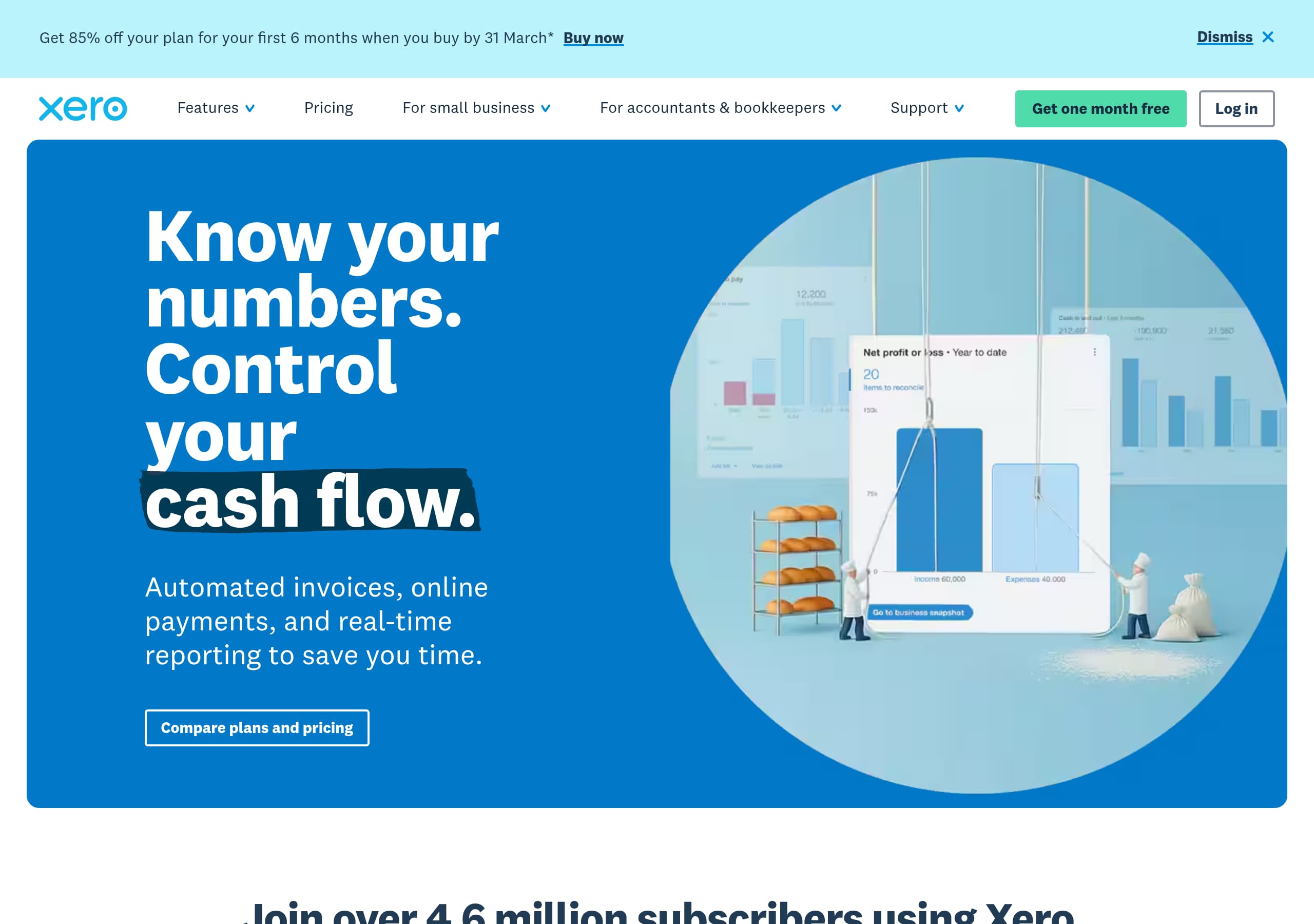
Xero’s homepage pairs a single-sentence promise (“Get back to what you love”) with a plain-language descriptor (“Accounting software made for small businesses and sole traders”), so the audience self-qualifies immediately.
The site uses a two-sided go-to-market structure—Small Business and Accountants/Bookkeepers—with dedicated navigation, product variants (Xero HQ, Xero Practice Manager, Workpapers), and a partner program callout to capture both buyers and influencers.
Pricing is conversion-optimized with three tiers (Starter, Standard, Premium), clear “Usually vs Now” promo math, and an anchored “Try Xero for free” CTA that reduces decision friction.
Xero heavily leverages proof and legitimacy through a specific adoption metric (“Join over 4.6 million subscribers”) and visible comparison pages (Xero vs QuickBooks, Xero vs FreshBooks) that signal category leadership.
The JAX AI positioning is integrated as a productivity layer inside Xero (quotes/invoices via WhatsApp/SMS/email), framing AI as workflow automation rather than novelty.
Home
Xero’s homepage communicates who it’s for and what it does in the first screen: “Accounting software made for small businesses and sole traders” plus the outcome-led line “Get back to what you love.” The primary CTA Try Xero for free is visible in the header and repeated in-page, while Log in is clearly separated for existing users.
The top navigation is task-oriented, which mirrors real accounting workflows:
- Online invoicing, Pay bills, Claim expenses, Bank connections, Payroll
- A dedicated path for accountants and bookkeepers (Xero HQ, Practice Manager, Workpapers)
Xero also introduces JAX (AI financial superagent) with three concrete use cases (answers with public info, financial Q&A, and automations like quotes/invoices via WhatsApp/SMS/email). Finally, it anchors legitimacy with a precise scale metric—over 4.6 million subscribers—before the visitor has to scroll into deeper product detail.
Pricing
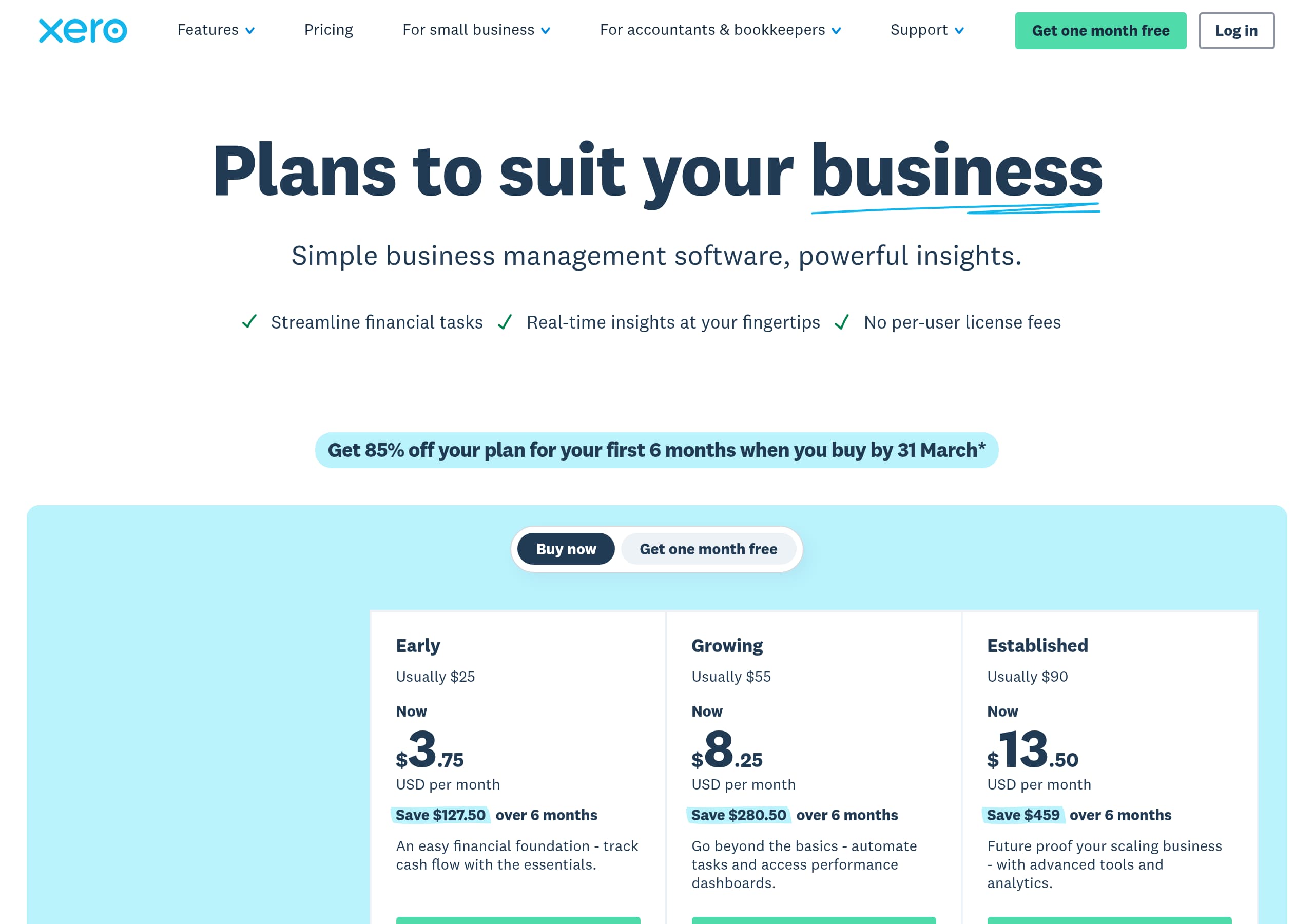
Xero’s pricing presentation is optimized for speed-to-decision: three tiers—Starter, Standard, Premium—each paired with a short “good for” statement that helps self-selection (sole traders → growing businesses → established businesses). The pricing cards show Usually vs Now pricing and explicit savings (e.g., “Save $78.30 over 3 months”), making the promotion measurable rather than vague.
Conversion elements are placed directly next to price evaluation:
- Persistent Try Xero for free CTA
- “See full pricing detail” for buyers who need line-item confirmation
The trial module reduces commitment anxiety with a clear risk-reversal stack: 30-day free trial, $0, no credit card required, cancel any time, and 24/7 online support. Together, these choices address the most common objections for accounting software (cost, lock-in, and support) without forcing a sales conversation.
Features
Xero’s feature discovery is organized around recognizable workflows rather than technical modules, which makes evaluation faster for non-accountants. The homepage and navigation enumerate core accounting jobs (Online invoicing, Pay bills, Claim expenses, Bank connections, Payroll, Accept payments) and then offer a single “See all Xero features” path for deeper research.
Two product lines are clearly separated:
- Xero Accounting app and “Analytics powered by Syft” for small businesses
- Practice tooling for advisors: Xero HQ, Xero Practice Manager, Xero Workpapers, and Cashbook & Ledger for smaller clients
Xero also positions extensibility as a first-class feature via the Xero App Store (“Find, try and buy business apps that connect with Xero”), which signals that the product is designed to sit at the center of a broader finance stack.
The JAX feature block adds specificity by listing automations (quotes/invoices across WhatsApp/SMS/email), making “AI” feel like workflow throughput gains.
Signup
Xero’s signup offer is framed as a low-risk evaluation rather than a purchase: 30-day free trial, $0, and no credit card required are stated together, which reduces form abandonment for first-time visitors. The primary CTA Try Xero for free is repeated across the header, hero, and pricing section, keeping the action consistent no matter where a visitor enters.
The trial message includes activation support cues that typically improve time-to-value:
- Set up with your data or a demo (supports both committed and exploratory users)
- 24/7 online support (reduces fear of getting stuck)
- Cancel any time (removes lock-in anxiety)
Xero also avoids mixing conversion paths by keeping Log in separate, preventing existing customers from entering the trial funnel. While the excerpt doesn’t show the exact number of signup steps, the messaging suggests a streamlined flow designed to start product usage immediately, not route users into sales qualification.
Trust
Xero’s trust strategy emphasizes operational credibility: scale, support availability, and ecosystem maturity. The site states 4.6 million subscribers, which functions as a reliability proxy for software that touches bank data, invoicing, and payroll. For professional assurance, Xero highlights 250,000+ accountants and bookkeepers using Xero, which implies established best practices and familiarity among financial advisors.
Trust is reinforced through several site-level cues:
- A dedicated “Data & authentication” item under Why Xero (signals security is documented, not implied)
- 24/7 online support listed inside the trial offer (reduces perceived adoption risk)
- The Xero App Store positioning suggests vetted integrations rather than one-off plugins
The footer also links to corporate trust pages—Governance and leadership, Investors, Sustainability, and Privacy notice—which matters for finance software buyers who look for company stability and compliance posture. This approach builds confidence without overclaiming security certifications in the hero.
Footer
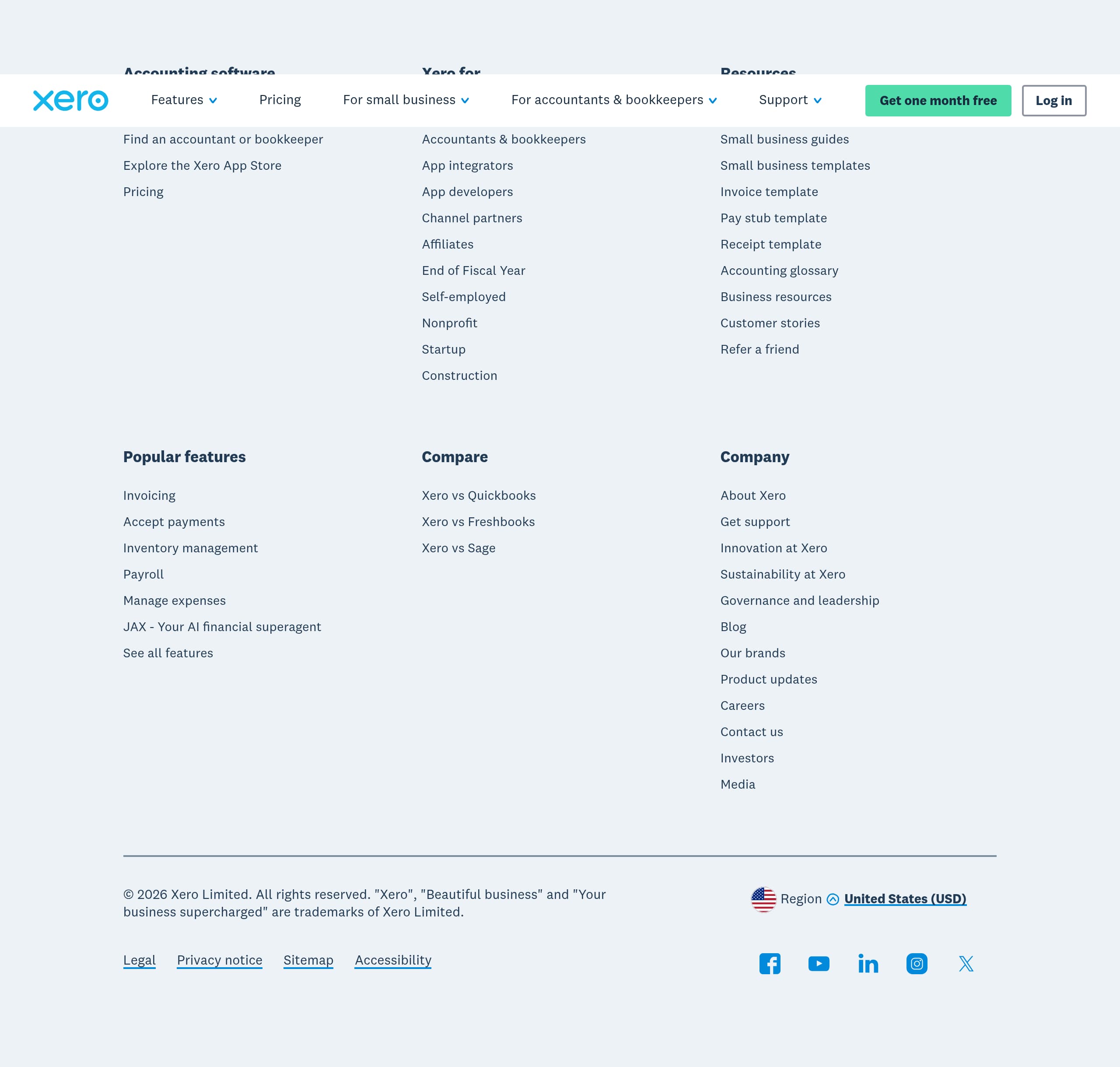
Xero’s footer is built as an SEO and trust utility hub rather than a minimal legal strip. It exposes multiple high-intent pathways—Pricing, Explore the Xero App Store, Find an accountant or bookkeeper, and “How Xero accounting software works”—which helps visitors re-orient when they reach the page end.
It also expands topical authority with structured resource links:
- Small business guides, templates (invoice, payslip, receipt), handy calculators, and an accounting glossary
- “Popular features” like Invoicing, Accept payments, Inventory management, Payroll, Manage expenses, and JAX
Competitive evaluation is explicitly supported through comparison entities: Xero vs QuickBooks and Xero vs FreshBooks, which can capture bottom-funnel search traffic.
For credibility, the footer includes corporate and compliance navigation—About Xero, Governance and leadership, Investors, Media, plus Legal, Privacy notice, Accessibility, and a visible Global (USD) region selector. That combination signals a mature, regulated-category-ready SaaS presence.
Detected tech stack
Tools and technologies we detected on Xero's site. Detection is best-effort and may be incomplete.
Scores
Our framework scores for Xero's website in terms of clarity, conversion, and trust. See our methodology for how we calculate these.
How clear the value prop and structure are.
How conversion-friendly signup and pricing are.
How well trust and compliance are surfaced.

The world's best-performing SaaS businesses share surprisingly similar patterns. We help you learn and apply them through our human-designed methodology, with AI-assisted research.