
Key takeaways
Here are the key insights from our website breakdown analysis of Zoho.
Zoho’s homepage clarifies the umbrella value proposition (“Cloud Software Suite for Businesses”) and immediately routes visitors into either a free start or app-level entry, reducing decision friction for multi-product suites.
The site sells “Zoho One” as an operating system for business, using a unified-suite narrative to differentiate against buying point tools like Salesforce + HubSpot + QuickBooks separately.
Social proof is unusually dense and specific, combining named executive quotes, measurable outcomes (e.g., “saved about 30%”), and a “Brands that trust us” band to support enterprise consideration.
Trust is positioned as a primary differentiator through explicit privacy language (“do not own or sell your data”) and a first-party infrastructure story (own data centers), which is rare among SaaS competitors.
Zia (Zoho’s AI assistant) is framed as cross-app intelligence “built into the fabric” of the ecosystem, reinforcing the suite advantage rather than treating AI as a standalone feature.
Home
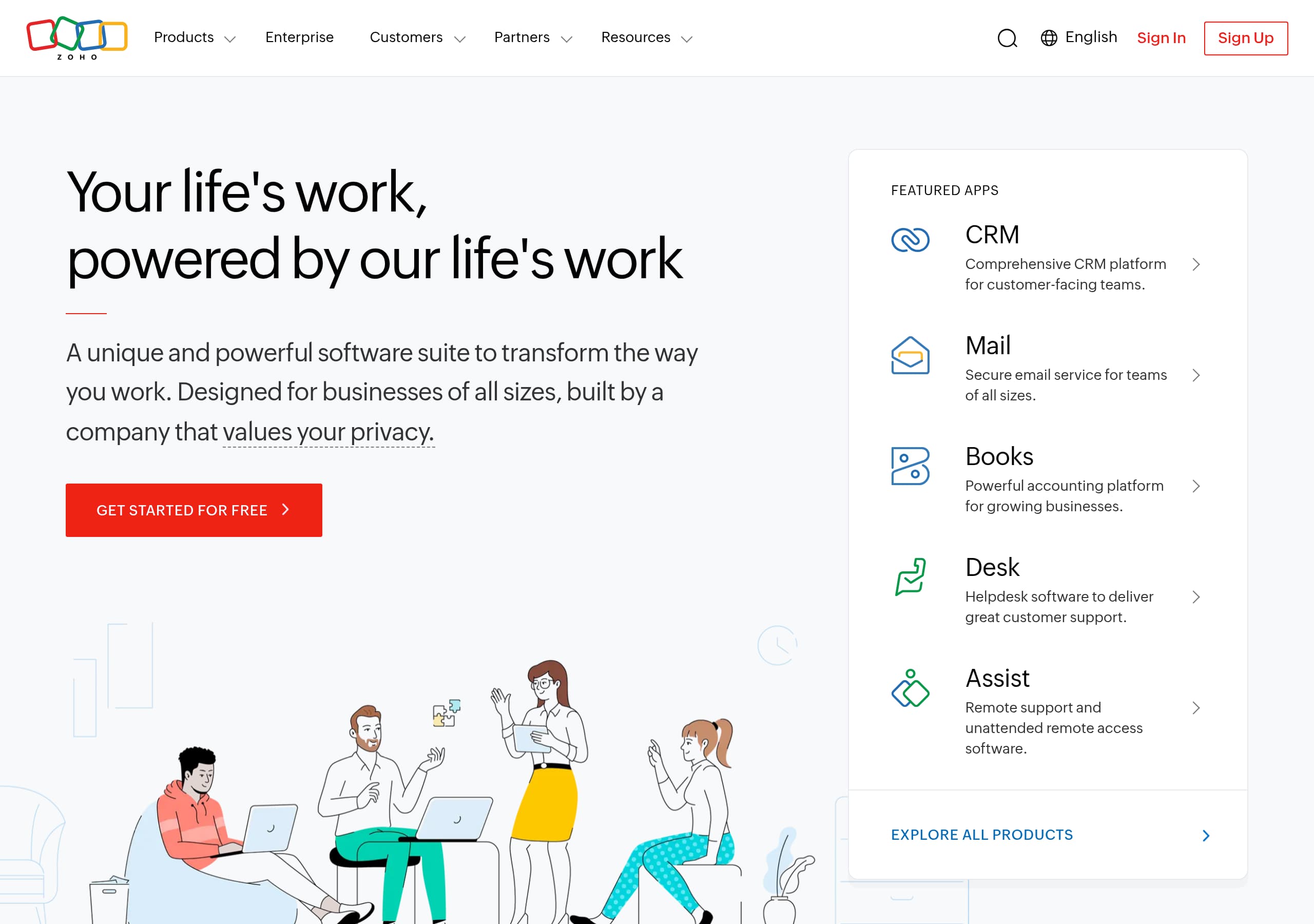
Zoho’s homepage communicates a suite-first promise without hiding the individual products. The hero pairs a single-sentence value proposition (“Cloud Software Suite for Businesses”) with a differentiator (“values your privacy”) and a primary Get Started For Free CTA.
The next block reduces choice overload using a curated “Featured apps” row (CRM, Mail, Books, People, Desk) plus Explore all products, which supports both new and returning visitors.
Key structure choices visible in the layout:
- A dedicated Zoho One section reframes the suite as “The operating system for business,” making consolidation the headline benefit.
- A separate Zia section positions AI as cross-app context, reinforcing the ecosystem story.
- Multiple “Read the story / Watch video” links create depth for evaluators without cluttering the top of the page.
This is an effective information hierarchy for a broad ICP spanning SMB teams and enterprise buyers.
Pricing
Zoho’s homepage sets expectations for pricing by repeatedly emphasizing free start and modular entry (“Access your apps”), which is important because Zoho includes dozens of products and multiple packaging paths (single apps vs Zoho One). Even without a visible pricing table in the excerpt, the UX implies a two-track monetization model: start with a product trial, then expand to the suite.
Tactically, Zoho supports pricing acceptance with:
- A cost anchor in testimonials (e.g., “saved about 30%”), which pre-sells affordability before visitors ever see numbers.
- A consolidation narrative (“break down silos,” “unified cloud software”) that reframes cost as replacing multiple vendors.
- Clear CTAs tied to intent: Try Zoho One for suite evaluators vs app access for existing users.
For a pricing page, this messaging suggests the most effective structure: app-level plans, a Zoho One comparison, and an enterprise contact path aligned to “Zoho for Enterprise.”
Features
Zoho presents features as an ecosystem map rather than a long checklist. The “Featured apps” strip highlights five core categories—CRM, Mail, Books, People, and Desk—which implicitly covers revenue, communication, finance, HR, and support. That selection is strategic: it demonstrates “run the business” coverage in one glance.
Two ecosystem-level feature pillars do most of the work:
- Zoho One: framed as a unified operating system that breaks down silos and increases organizational efficiency.
- Zia: described as embedded AI that can recommend, generate insights, and take action using cross-app context.
This approach avoids overwhelming visitors with “50+ products” upfront, while still offering an escape hatch via Explore all products for power users.
A strong next step on feature pages would be consistent cross-links from each app to integrations within the Zoho suite, reinforcing the core suite advantage (shared data + shared workflows).
Signup
Zoho’s conversion path is designed for different intents: new users can click Get Started For Free, while existing customers can go straight to Access your apps. That dual-CTA pattern prevents a common suite problem where return visitors are forced through marketing pages.
The homepage also repeats bottom-of-page activation (“Ready to do your best work? Sign Up Now”), which captures users after they’ve consumed proof and trust content.
Conversion-friendly elements implied by the content:
- Product-level entry points (CRM/Mail/Books/People/Desk) reduce the need to decide on Zoho One immediately.
- Separate enterprise pathway (“Get in touch” under Zoho for Enterprise) aligns with longer sales cycles and procurement requirements.
To maximize clarity in signup, Zoho should keep the flow consistent across apps (similar step count, consistent SSO options) and clearly label whether “free” means free plan vs time-limited trial—details buyers often look for before committing.
Trust
Zoho builds trust by making privacy and business model transparency part of the main narrative, not hidden in legal pages. The homepage states: “We do not own or sell your data” and explicitly rejects advertising-based business models, clarifying incentives in a way many SaaS sites avoid.
Additional trust signals are operational and verifiable in tone:
- “30+ years” and “profitable organization” emphasize longevity and stability.
- “Prefer to own the entire technology stack” and “running our data centers globally” signals infrastructure control.
- A global scale metrics band (users, countries, employees, years, products) supports credibility for enterprise procurement.
Trust is also reinforced through customer-first language and local presence (“Transnational Localism”), which reduces perceived risk for international buyers.
For security-focused visitors, the strongest companion assets would be a dedicated security/compliance page linked near this section (SOC reports, encryption, uptime, DPA), but the core trust framing is already unusually direct.
Footer
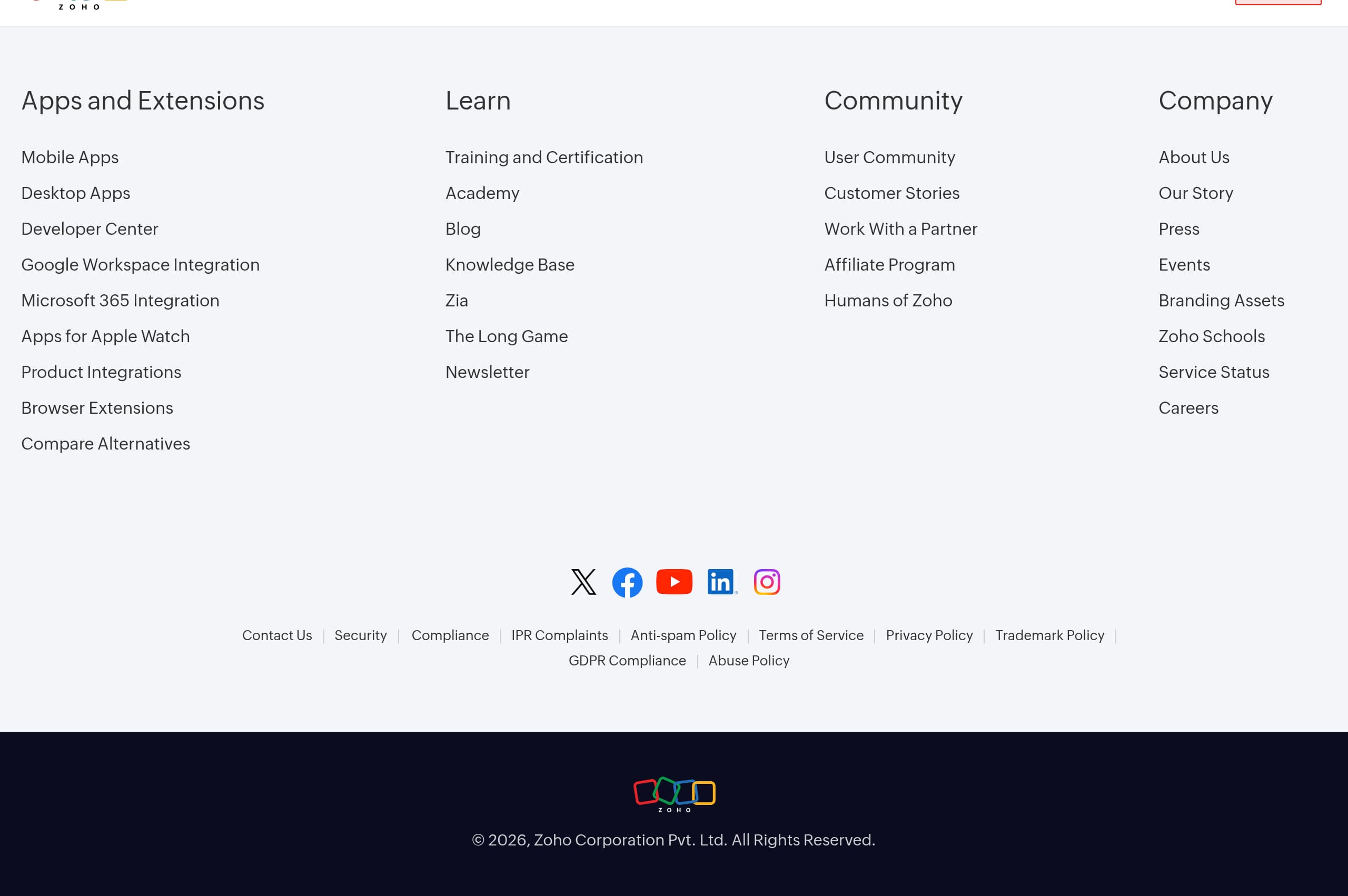
Zoho’s footer (as seen in the screenshot) is structured like a navigation hub rather than a minimal legal strip, which fits a multi-product ecosystem. The density is useful: visitors often reach the footer when they’re ready to compare products, find documentation, or validate legitimacy.
Effective footer components for Zoho’s model:
- Clear pathways to Products, Zoho One, and likely app categories, supporting discovery across dozens of tools.
- Company-level links that back up the homepage story (About, Story, possibly Careers/Press), reinforcing E-E-A-T.
- Support resources (Help, Contact) that reduce friction for enterprise evaluators.
- Standard legal and policy links that complement the privacy-first messaging.
Because Zoho serves global audiences, the footer is also the right place for region/language selectors and compliance references. The main improvement opportunity is prioritization: highlight the top conversion paths (free start, Zoho One, contact sales) so the footer doesn’t become a purely informational dead end.
Scores
Our framework scores for Zoho's website in terms of clarity, conversion, and trust. See our methodology for how we calculate these.
How clear the value prop and structure are.
How conversion-friendly signup and pricing are.
How well trust and compliance are surfaced.

The world's best-performing SaaS businesses share surprisingly similar patterns. We help you learn and apply them through our human-designed methodology, with AI-assisted research.