
Key takeaways
Here are the key insights from our website breakdown analysis of Greenhouse.
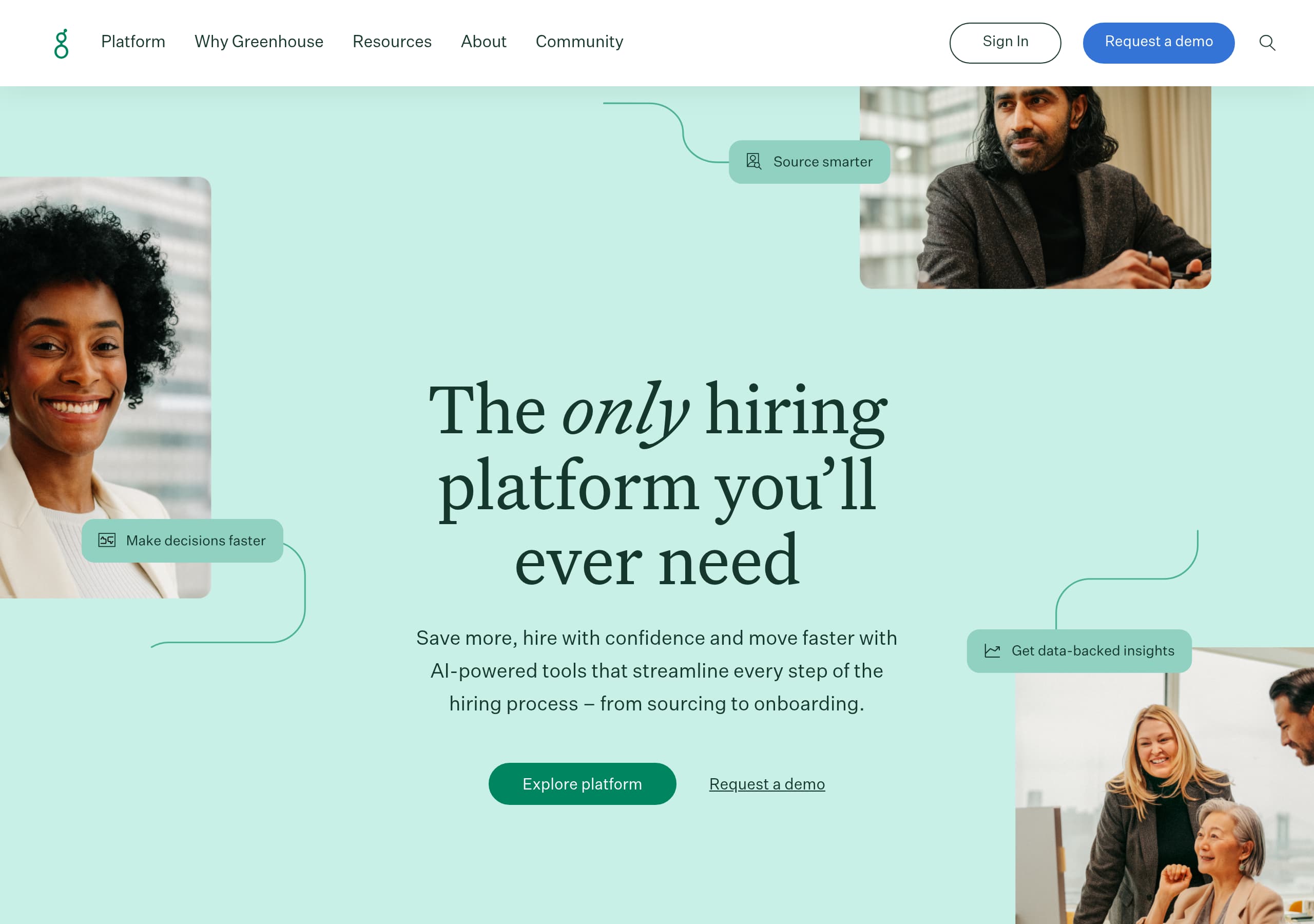
Greenhouse makes the homepage do conversion work immediately with a single, broad value prop and repeated dual CTAs, “Explore platform” and “Request a demo,” which matches how ATS buyers typically evaluate enterprise software.
The site uses timely, concrete product hooks like Greenhouse Real Talent™ and Greenhouse AI to make “AI-powered hiring” feel specific, not generic, and to give visitors a reason to book a demo now.
Social proof is unusually enterprise-forward: the navigation calls out awards and accolades, the hero includes “Great companies hire with Greenhouse,” and a named testimonial includes an operational metric (time-to-hire reduced by nearly 30%).
Greenhouse reduces perceived implementation risk by emphasizing end-to-end coverage “from sourcing to onboarding” plus “hundreds of pre-built integrations,” which helps justify a platform purchase vs point tools.
Conversion is optimized around sales-led motion: consistent “Request a demo” placement, global “Sign in,” and multiple mid-page prompts keep momentum without forcing self-serve signup that would not match the product’s target accounts.
Trust and governance content is discoverable from global navigation and footer (Security, Ethical principles, Bias audit statement, APIs, Terms, Privacy), which is critical for HR, TA, and enterprise procurement reviews.
Home
Greenhouse’s homepage is built to answer one question fast: “Is this the end-to-end hiring platform my team should standardize on?” The hero headline, “The only hiring platform you’ll ever need,” pairs with a concrete scope statement, “from sourcing to onboarding,” which immediately frames Greenhouse as a platform purchase rather than a single-feature tool.
A few on-page patterns make the message easy to scan and act on:
- Dual primary CTAs appear immediately and repeat throughout: “Explore platform” for evaluators and “Request a demo” for buyers ready to talk.
- The page introduces timely, named capabilities, including Greenhouse Real Talent™ (“detects fraud and spam, verifies candidate identity”) and Greenhouse AI (“instant candidate summaries,” “AI-powered job boards,” “interview plans”). Naming the modules reduces “AI-washing” skepticism.
- The navigation supports multiple audiences with dedicated paths like “Greenhouse for Early-stage business,” “Scaling company,” “Modern enterprise,” and “Job seekers,” which clarifies that the product serves both employers and candidates.
The mid-page narrative reinforces platform breadth without becoming vague. Statements like “Everything you need to hire, in one platform” and “Flex and scale with ease” are backed by a tangible proof point: hundreds of pre-built integrations and the ability to “customize a tech stack.” The page also uses community content to extend authority, for example “Talent Makers” awards, events, and “Learn Greenhouse” training.
One improvement opportunity is hierarchy: multiple announcements (AI, Real Talent, MyGreenhouse, events, awards) compete for attention. Even so, Greenhouse keeps conversion consistent with repeated Request a demo prompts and a clear platform framing.
Pricing
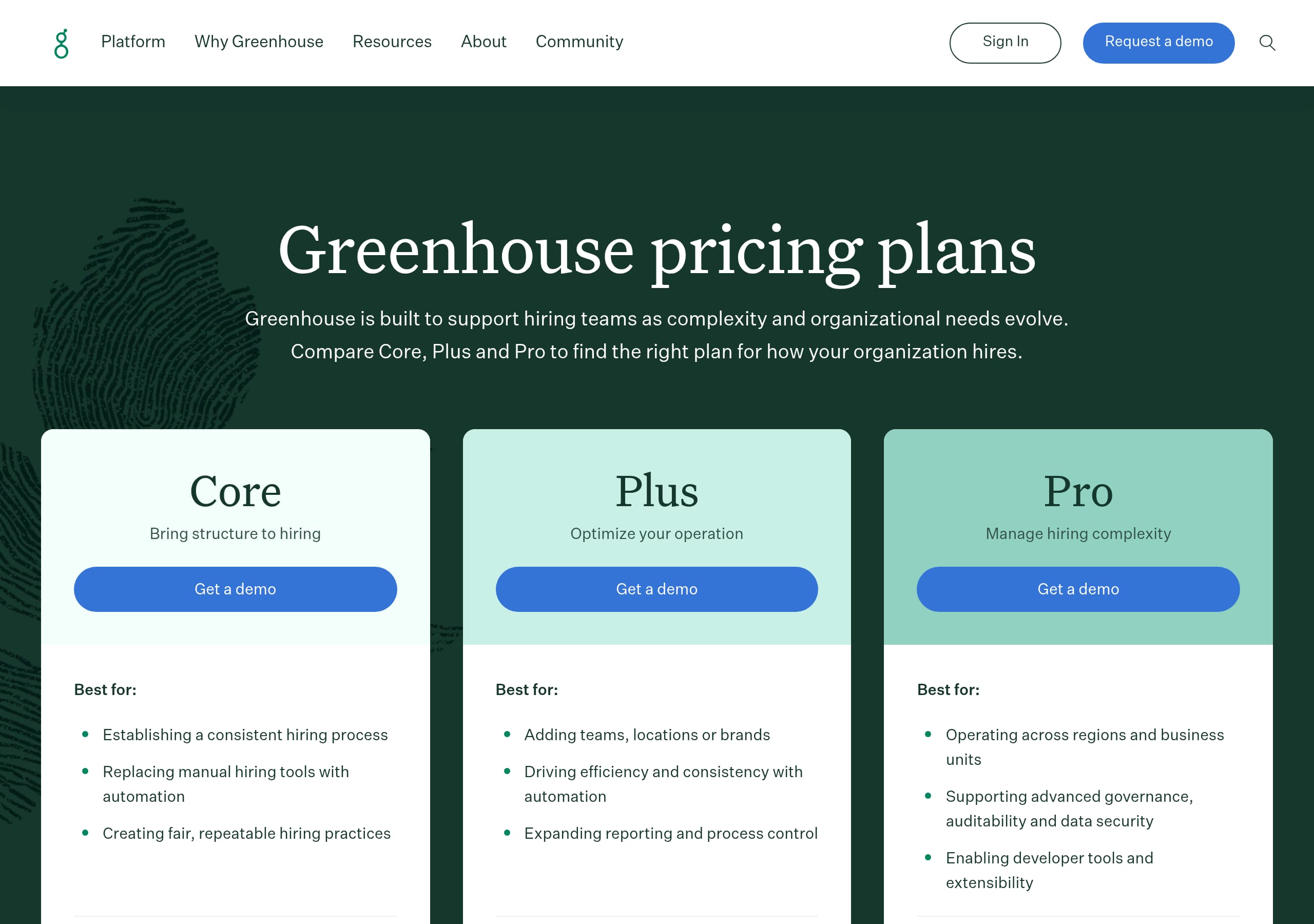
Greenhouse’s pricing experience is positioned as an enterprise evaluation step, not a checkout flow. From the site structure and persistent conversion pattern, the likely intent is to qualify visitors, push them toward “Request a demo,” and tailor pricing based on company size, hiring volume, and required modules. That matches how applicant tracking systems are commonly purchased and implemented.
What stands out in the pricing presentation (from the provided pricing screenshot context and site navigation) is the way Greenhouse reduces anxiety about “hidden” costs by surrounding pricing with decision-support pages: “How we compare,” “Return on your hiring investment,” and “Your partner in success.” These are not fluff links, they map to procurement questions like value justification, switching risk, and support model.
Conversion mechanics are consistent with sales-led pricing:
- A clear Request a demo pathway is visible globally, which acts as the pricing CTA.
- The platform is framed as “end-to-end,” which implicitly explains why pricing is not a simple per-seat number.
- Adjacent pages like “Integrations,” “Security,” and “APIs” help buyers do technical validation before engaging sales.
To improve pricing clarity further, Greenhouse could make packaging more legible in-page by explicitly listing plan tiers or modules (ATS, onboarding, reporting, AI add-ons) and what varies by segment (early-stage vs enterprise). Even without self-serve purchase, pricing pages rank and convert better when they include at least 3 concrete anchors: an example starting range, what drives the quote (recruiter seats, job volume, employees), and a short list of what is always included.
Overall, the pricing UX supports enterprise buying behavior, keeps CTAs focused, and uses surrounding content to defend value rather than racing to a number.
Features
Greenhouse communicates features as workflow coverage, not a checklist, which is the right frame for an applicant tracking system and hiring platform. The homepage repeatedly ties capabilities to stages, “streamline every step of the hiring process, from sourcing to onboarding,” and the global navigation mirrors that mental model with grouped solutions: “Talent sourcing,” “Candidate experience,” “Interviewing & decision-making,” “Talent matching,” “Onboarding,” and “Reporting & insights.”
Two feature callouts do a lot of heavy lifting because they are both named and outcome-driven:
- Greenhouse AI is described with concrete use cases: “instant candidate summaries,” “AI-powered job boards,” and “interview plans.” These are specific enough for a recruiter or hiring manager to visualize day-to-day value.
- Greenhouse Real Talent™ is positioned around a real pain: “fraud and noise,” with explicit actions like “detects fraud and spam,” “verifies candidate identity,” and “prioritizes applicants based on fit and risk.” That goes beyond generic “AI screening” language.
The platform story is reinforced with integration and scale messaging: “connect with business tools you already use” and “hundreds of pre-built integrations.” In ATS evaluations, integrations are a feature, but they are also a risk reducer because they imply faster rollout and fewer internal engineering dependencies.
A tactical UX pattern that supports scanning is the presence of multiple “Explore” links, for example “Explore platform,” “View scalable workflows,” and “Learn about AI recruiting.” This creates progressive disclosure: visitors can stay high-level or dive into a single domain without losing context.
One improvement opportunity is feature differentiation versus competitors like Lever, Workday Recruiting, iCIMS, and SmartRecruiters. Greenhouse hints at differentiation through “structured hiring” leadership and Real Talent, but the page could more explicitly map “Only in Greenhouse” to 3 to 5 defensible capabilities with short proofs (screenshots, workflow steps, or before/after process diagrams).
Signup
Greenhouse’s conversion funnel is intentionally sales-led, and the site design supports that with repeated “Request a demo” CTAs and a persistent “Sign in” for existing customers. This is a pragmatic choice for Greenhouse Software’s target market because implementing an applicant tracking system typically requires configuration, data migration, integrations, and stakeholder alignment, all better handled via a guided sales and onboarding process.
From the provided navigation and homepage excerpt, there are effectively two “signup” paths:
- Request a demo: the primary acquisition flow. It appears in the header and multiple times on the page, which reduces the chance that visitors must scroll back up to convert.
- Sign in: for active users, reducing friction for returning traffic and preventing the marketing site from becoming a dead end.
Greenhouse also supports a distinct job-seeker experience through “MyGreenhouse,” presented with a separate value proposition: “Search smarter, apply faster and take control of your job search.” Importantly, this is not mixed into the employer funnel. The job seeker CTA (“Learn more” and “See who’s hiring with Greenhouse”) keeps candidate intent separate from employer intent, which prevents conversion dilution.
What the site does well is maintain CTA consistency: “Explore platform” is the softer step, “Request a demo” is the hard step, and both are repeated. The messaging around “save more,” “hire with confidence,” and “move faster” sets expectations for outcomes rather than promising an instant self-serve setup.
To strengthen signup conversion further, Greenhouse could preview what happens after requesting a demo, for example a 3-step timeline (“form, discovery call, tailored demo”) and the typical stakeholders invited. That kind of process transparency often increases form completion for enterprise buyers without changing the sales motion.
Trust
Greenhouse builds trust through a combination of enterprise governance signals and product positioning that anticipates HR and procurement concerns. Even in the homepage excerpt, there are multiple trust-adjacent cues: “Hire with confidence,” emphasis on process rigor via “structured hiring,” and a dedicated feature aimed at fraud reduction, Greenhouse Real Talent™, which explicitly addresses spam, identity verification, and applicant risk prioritization.
Trust is also reinforced structurally through the site’s information architecture. In the platform navigation and footer, Greenhouse exposes links that enterprise evaluators look for during security and compliance review:
- Security (dedicated page link)
- Ethical principles (signals responsible AI and product governance)
- Bias audit statement (directly relevant to hiring fairness and DE&I scrutiny)
- APIs and “Developer resources” (technical transparency for integration and data control)
- Legal basics like “Privacy policy” and “Terms of service”
The presence of “How we compare” and “Return on your hiring investment” also functions as trust content because it implies Greenhouse expects to be evaluated and provides material to support a business case.
A notable trust pattern is separating audiences without mixing claims. Job seekers are routed to MyGreenhouse content, while employers see platform, AI recruiting, and workflow content. This reduces confusion about data handling and user roles, which is a common trust pitfall in hiring software.
What is not visible in the excerpt is specific compliance badges or standards (for example SOC 2 or ISO 27001). If those exist on the Security page, Greenhouse should consider surfacing 2 to 3 concrete assurance markers near demo CTAs on high-intent pages like Pricing. Even without that, the site already communicates governance readiness and risk reduction in ways that match enterprise buying criteria.
Footer
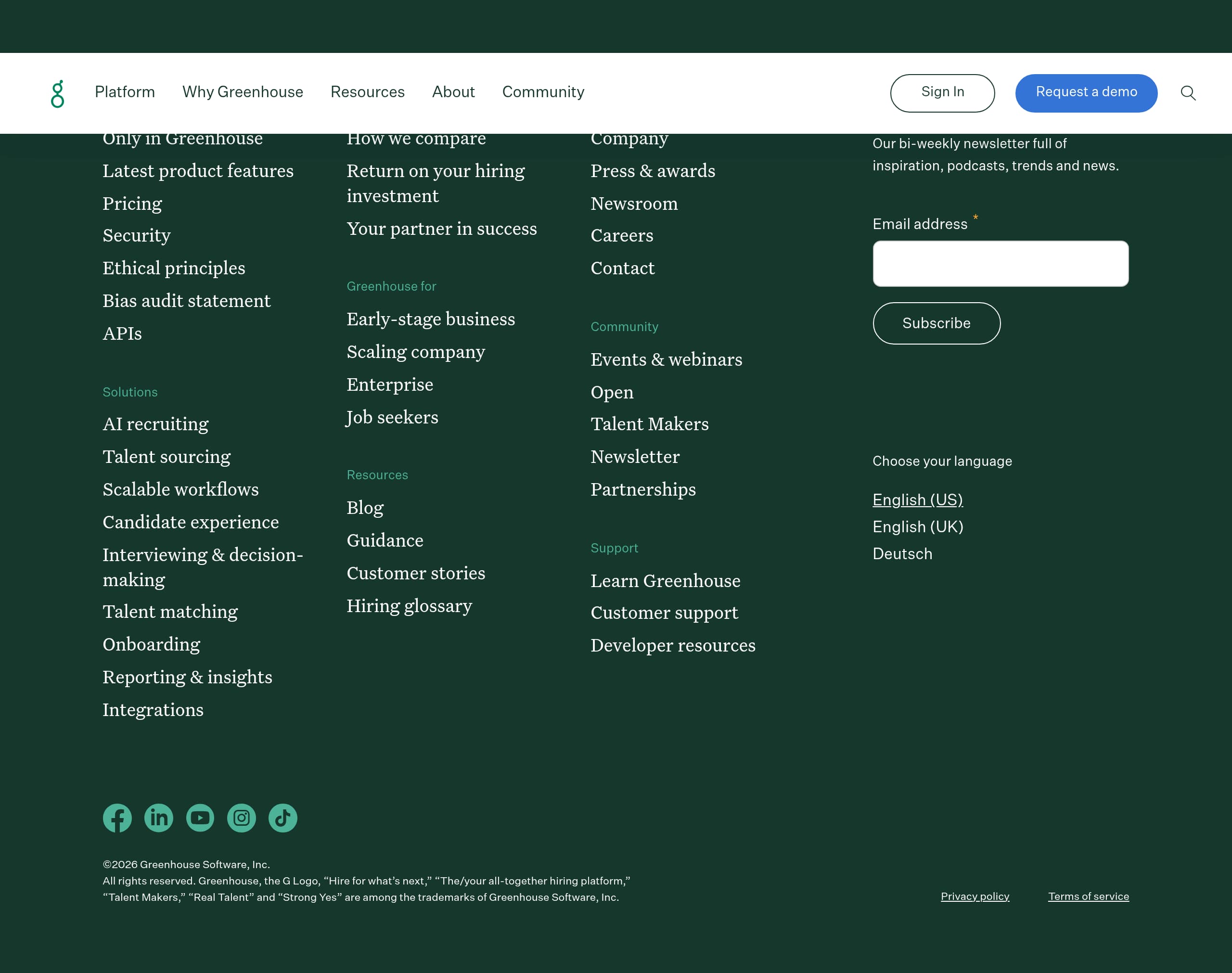
Greenhouse’s footer functions as a secondary navigation hub for high-intent evaluators, and it is structured to support procurement, security review, and deeper product exploration. The footer includes a dense set of links across Platform, Solutions, Why Greenhouse, Resources, About, Community, and Support, which is typical for enterprise SaaS and helpful when multiple stakeholders are researching different angles.
From the provided excerpt and footer screenshot context, several footer elements are especially effective:
- Clear pathways for technical teams: Developer resources and APIs are accessible without hunting, which supports integration validation.
- Governance and legal coverage is explicit: Privacy policy, Terms of service, and “Cookie preferences” are present, meeting baseline compliance expectations.
- Support and enablement are not hidden: “Customer support” and “Learn Greenhouse” links help reduce implementation anxiety.
- Internationalization is handled via “Choose your language” options (English US, English UK, Deutsch), which signals global readiness.
The footer also includes brand protection and trademark language, listing “Greenhouse,” “Hire for what’s next,” “Talent Makers,” “Real Talent,” and “Strong Yes.” While this is legal in nature, it doubles as subtle brand reinforcement by reminding visitors of distinct product and program names.
One practical UX benefit is that the footer mirrors top navigation categories, which reduces backtracking. If a reader lands on a long-form resource page or scrolls deep, they can still jump to “Pricing,” “Security,” or “Integrations” quickly.
A conversion opportunity is to add a footer-level primary CTA block, for example a short “Ready to see Greenhouse?” with “Request a demo,” especially for visitors who scroll to the bottom after reading. The existing footer is information-rich and credible, but a final conversion prompt could capture high-intent traffic without changing page design elsewhere.
Detected tech stack
Tools and technologies we detected on Greenhouse's site. Detection is best-effort and may be incomplete.
Scores
Our framework scores for Greenhouse's website in terms of clarity, conversion, and trust. See our methodology for how we calculate these.
How clear the value prop and structure are.
How conversion-friendly signup and pricing are.
How well trust and compliance are surfaced.
FAQ
Greenhouse leads with a platform-level promise, “The only hiring platform you’ll ever need,” and immediately clarifies scope, “from sourcing to onboarding.” The page repeats two consistent CTAs, “Explore platform” and “Request a demo,” so both researchers and buyers have a clear next step. It also names specific initiatives like Greenhouse AI and Greenhouse Real Talent, which makes the AI message concrete.
Greenhouse’s pricing is presented in a sales-led way that encourages “Request a demo” rather than self-serve checkout. The surrounding navigation supports evaluation with pages like “How we compare” and “Return on your hiring investment,” which match common procurement questions. This approach fits enterprise ATS purchasing where pricing often varies by company size, hiring volume, and needed modules.
Greenhouse combines brand validation, awards, and quantified customer outcomes. The site references awards such as “Best Software for Enterprise in 2025” and points visitors to customer stories with “Great companies hire with Greenhouse.” It also includes a named testimonial from Ocado Group with a measurable result, stating time-to-hire was cut by nearly 30%.
Greenhouse describes AI with specific workflow examples instead of broad claims. The homepage calls out Greenhouse AI features like instant candidate summaries, AI-powered job boards, and interview plans. It also highlights Greenhouse Real Talent, positioned to clear fraud and spam, verify candidate identity, and prioritize applicants by fit and risk, which ties AI to a clear recruiting pain point.
Greenhouse makes trust content discoverable through navigation and footer links, including Security, Ethical principles, and a Bias audit statement. It also links to APIs and Developer resources, which helps technical reviewers assess integration and data access. Standard legal links like Privacy policy, Terms of service, and cookie preferences are available in the footer for procurement review.

The world's best-performing SaaS businesses share surprisingly similar patterns. We help you learn and apply them through our human-designed methodology, with AI-assisted research.