
Key takeaways
Here are the key insights from our website breakdown analysis of iCIMS.
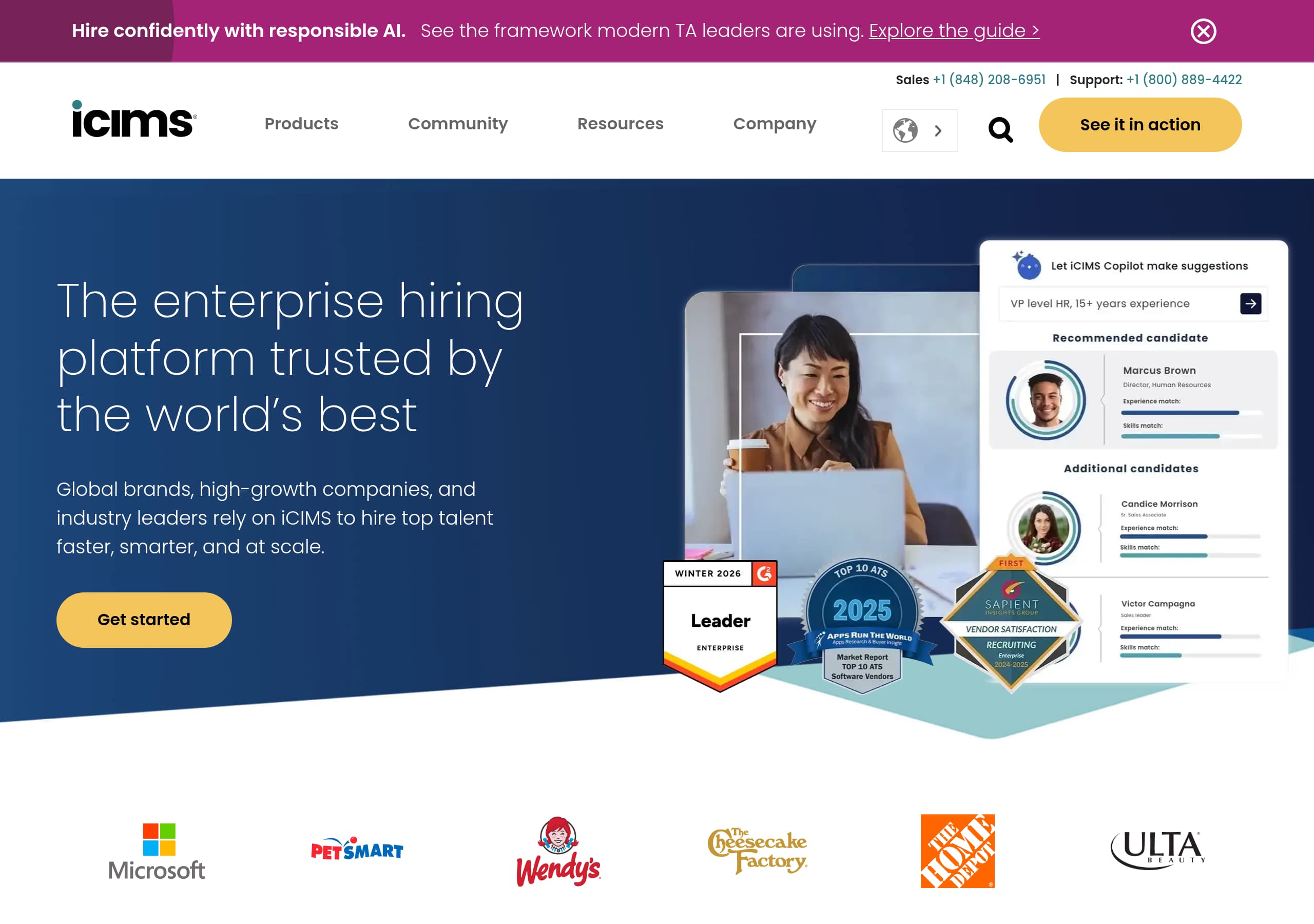
iCIMS makes its enterprise positioning unmistakable by pairing the hero claim “#1 Applicant Tracking System” with a specific value hook, “Hire confidently with responsible AI,” which quickly frames both category and differentiation.
Conversion is driven by persistent, high-intent CTAs such as “Get a Demo,” “See it in action,” and “Get Started Now,” but the site largely routes visitors into sales-led flows rather than self-serve evaluation.
The homepage uses quantified credibility (for example “570M+ candidate profiles,” “800 partners,” “25% of the Fortune 500”) to reduce perceived risk for enterprise buyers and to justify platform scale.
iCIMS strengthens trust by explicitly naming governance signals like “TrustArc’s Responsible AI framework,” plus encryption and audit trails, which supports security and compliance requirements for global recruiting teams.
Product messaging is organized around three solution pillars, iCIMS Hire, iCIMS Engage, and iCIMS Employer Branding, which clarifies the suite structure and maps well to common talent acquisition budgets.
Social proof is made tangible through customer stories with operational numbers like “hire 40,000+ annually” and outcomes like “increased applications 5x,” which helps buyers visualize impact beyond feature lists.
Home
iCIMS’s homepage is built to qualify enterprise talent acquisition buyers quickly, it pairs category authority with a clear differentiator: “#1 Applicant Tracking System” plus “Hire confidently with responsible AI.” The hero also promotes a framework guide (“See the framework modern TA leaders are using”), which functions as an early-stage CTA while the primary conversion CTAs remain sales-led.
The top navigation is dense but intentional, organized by Products, Solutions (by industry and by role), Integrations, and Company. This structure signals an enterprise buying committee site, not a lightweight SMB tool. Two primary CTAs appear repeatedly: “Get a Demo” and “Get Started Now,” plus “See it in action.” The presence of direct phone numbers for Sales and Support further reinforces a high-touch motion.
The mid-page “Talent Cloud advantage” block is a classic enterprise proof panel: it uses multiple numeric anchors in one place, including “200+ countries and territories,” “570M+ candidate profiles,” “800 partners,” and “25% of the Fortune 500 use iCIMS.” These are positioned as credibility shorthand for scale, integrations, and adoption. The page then transitions into iCIMS AI messaging with concrete promises like reducing time-to-fill “by as much as 50%,” and adds scannable benefit bullets (personalization at scale, machine learning matching).
What works especially well is the combination of suite clarity and segmentation. The three pillars, iCIMS Hire, iCIMS Engage, and iCIMS Employer Branding, are each introduced with a one-sentence outcome, which helps visitors self-select before they ever talk to sales. The homepage reads like a guided path for different stakeholders rather than a single generic pitch.
Pricing
iCIMS does not present transparent, self-serve pricing in the provided homepage experience, instead it funnels evaluation into sales-led CTAs like “Get a Demo,” “Talk to sales,” and “Contact us.” For enterprise recruiting platforms, this is common, but it shifts the pricing page job from listing tiers to de-risking the buying process with scope cues, packaging language, and proof.
From the navigation and page excerpts, iCIMS positions pricing implicitly through packaging and modules: iCIMS Hire (enterprise ATS), iCIMS Engage (sourcing and nurture campaigns), and iCIMS Employer Branding (career sites and brand tools). This modular framing typically supports custom quotes, since buyers can map components to business needs such as high-volume hiring, candidate experience management, and onboarding. The site reinforces this approach with solution paths “By industry” and “By role,” which signals that pricing is likely influenced by complexity, region, and org structure.
Instead of price tables, iCIMS uses value substantiation tools and content that act like pricing proxies. The “iCIMS value calculator” is a direct conversion asset for budget justification, and the site also references an “282% average potential ROI” metric in the credibility panel. Combined, these elements help the buyer build an internal business case even without line-item pricing.
To improve pricing clarity without harming enterprise qualification, iCIMS could: (1) add a “How pricing works” explainer that outlines variables like modules, employee size, and integrations, (2) include a packaging comparison with outcomes, not feature overload, and (3) add procurement-ready artifacts such as an RFP template (already present) and security summaries near the pricing entry points. As-is, the pricing motion is optimized for sales conversation readiness rather than fast self-serve purchase.
Features
iCIMS presents features as outcome-led solution pillars rather than a long checklist, which is a strong fit for enterprise TA leaders comparing suites. The primary structure is three product modules: iCIMS Hire (described as a “highly-configurable enterprise ATS”), iCIMS Engage (“automated sourcing and nurture campaigns”), and iCIMS Employer Branding (“become an employer of choice”). Each module is paired with “Learn more,” creating clear deep links for different needs.
Within iCIMS Hire, the navigation reveals sub-capabilities that buyers expect in an ATS suite, including applicant tracking system, frontline AI, text recruiting, onboarding management, and offer management. On the branding side, iCIMS highlights career sites, digital assistant, and video testimonials, which signals an emphasis on candidate experience and conversion. The site also lists “AI Recruiting Software” as a named area and gives iCIMS AI a dedicated narrative: responsible AI that is “purpose-built” and integrated into workflows.
Feature messaging is strengthened by specificity in the AI section. It includes a measurable claim, “reduce time-to-fill by as much as 50%,” and scannable micro-benefits like personalizing candidate experiences at scale and machine learning matching. Even without UI screenshots of the product, this layout communicates what the AI is for, not just that it exists.
Where iCIMS could sharpen feature comprehension is in bridging product names to job-to-be-done flows. A short, visual “end-to-end hiring stream” diagram showing sourcing, apply, screen, schedule, offer, onboard would help readers understand how iCIMS Talent Cloud components fit together. Still, the current approach avoids feature overload, keeps enterprise ATS value central, and supports multiple buying intents through clean module segmentation.
Signup
iCIMS’s site experience is optimized for enterprise, sales-assisted onboarding rather than a self-serve signup. The primary actions throughout the header and page are “Get a Demo,” “See it in action,” “Get Started Now,” plus “Talk to sales” and “Contact us.” This indicates the core “signup” motion is a lead capture workflow that routes to a sales representative, not an immediate account creation flow.
The excerpt includes a confirmation message, “Thank you for your interest in iCIMS. A Sales representative will be in touch with you shortly,” which implies a form submission step and a handoff to sales. This is consistent with enterprise ATS procurement where implementation, integrations, and security reviews typically require qualification.
From a conversion perspective, several elements reduce friction for high-intent buyers:
- Multiple contact paths: phone numbers for Sales and Support are visible, plus contact links in the header and footer.
- Role and industry routing: “By role” and “By industry” options help visitors pre-qualify and land on more relevant demo conversations.
- Value justification assets: the “iCIMS value calculator” and “How to create an RFP” template support mid-funnel buyers building internal alignment before requesting a demo.
The tradeoff is that the site provides limited immediate product evaluation for hands-on users, such as recruiters who want to click through an interactive tour. “See it in action” suggests this may exist, but it is not detailed in the excerpt. If iCIMS wants to capture more demand from comparison shoppers (for example, evaluating against Workday Recruiting, Greenhouse, or SmartRecruiters), adding a guided product tour and publishing an outline of the demo agenda could increase conversions while keeping the enterprise qualification gate.
Trust
iCIMS is unusually explicit about trust for an AI-forward recruiting platform, it names concrete security controls and governance frameworks rather than relying only on generic “secure” language. In the on-page FAQ, iCIMS states that data is encrypted in transit and at rest, includes role-based access and detailed audit trails, and supports global privacy standards like GDPR and CCPA. These are procurement-grade specifics that help IT and HRIS stakeholders evaluate risk.
The responsible AI positioning is also handled with more specificity than many vendors. The homepage headline “Hire confidently with responsible AI” is reinforced by mention of TrustArc’s Responsible AI framework, plus language that contrasts “proven outcomes” with “smoke and mirrors.” While the latter is marketing-forward, the presence of a named third-party framework creates an audit-friendly anchor for AI governance discussions.
Trust is further supported by scale and ecosystem claims that matter operationally: “200+ countries and territories,” “3M+ global platform users,” and “800 partners in the iCIMS ecosystem.” For an enterprise ATS, this communicates maturity in global deployment and integration breadth, both are common failure points in implementations.
The site also builds trust through organizational transparency: there are clear entry points to the Corporate newsroom (press releases, analyst recognition), leadership pages, and ESG pages (“Environmental, social & governance”). Those sections tend to be reviewed in enterprise vendor due diligence.
A tactical improvement would be to surface dedicated trust artifacts closer to primary CTAs, such as a security overview one-pager, SLA/uptime language, or links to SOC 2 reports if available. Even without those elements in the excerpt, iCIMS already provides actionable security language and recognizable governance signals that elevate credibility for regulated industries like healthcare and finance.
Footer
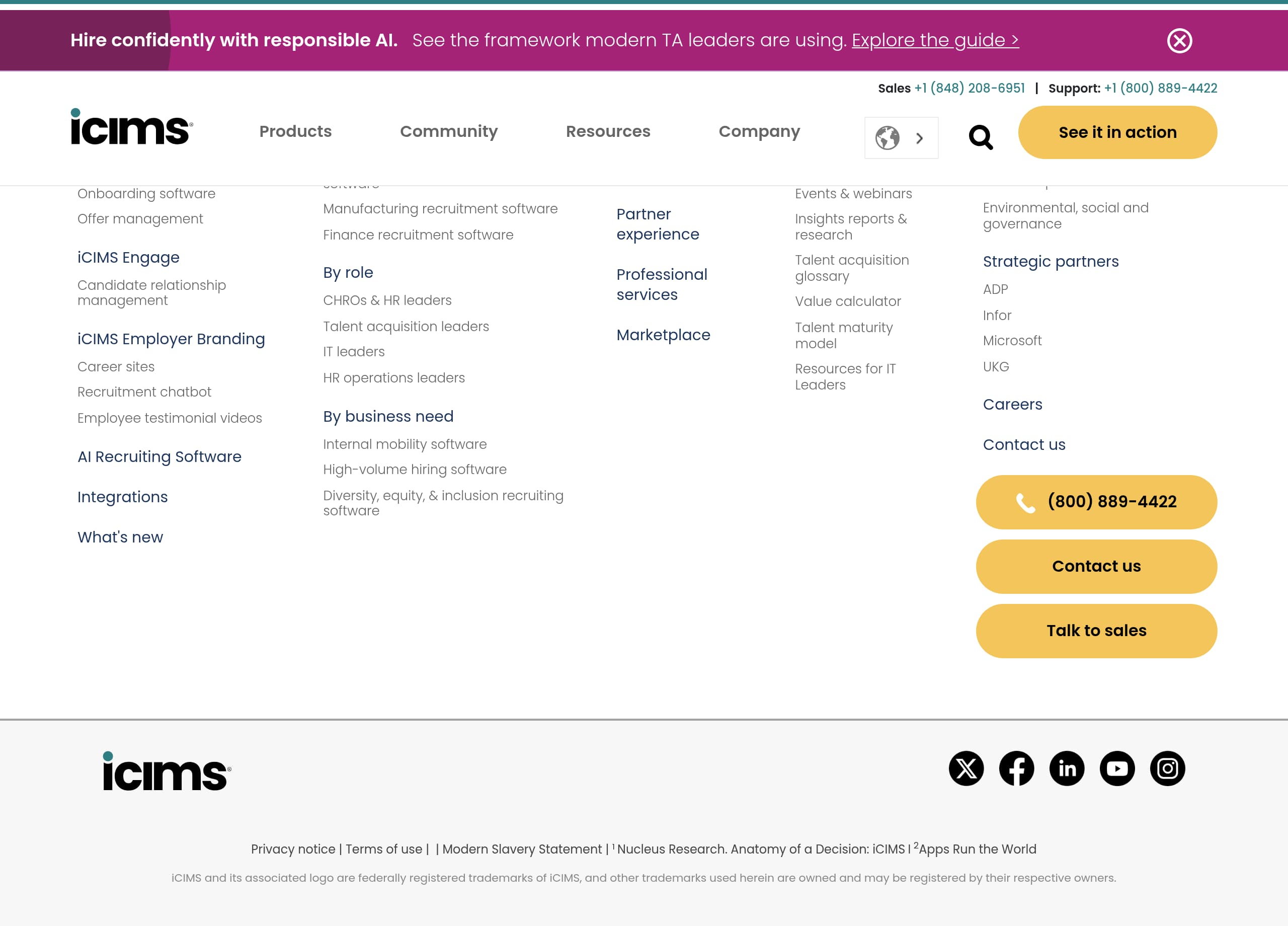
The iCIMS footer is built as a navigation and compliance hub, optimized for enterprise discovery and procurement, not just basic legal links. It repeats the full product and solutions architecture in a structured list: iCIMS Hire, iCIMS Engage, iCIMS Employer Branding, plus “AI Recruiting Software,” “Integrations,” and “What’s new.” This redundancy is useful because enterprise visitors often scroll to the bottom looking for a specific pathway, for example “High-volume hiring software” or “Diversity, equity, & inclusion recruiting software.”
The footer also supports multiple stakeholder journeys:
- TA buyers can jump to “Success stories,” “Professional services,” and “Marketplace,” which indicates an ecosystem and implementation support model.
- Content-driven visitors can access the “Resource center,” “Insights reports & research,” and “Talent acquisition glossary,” which strengthens SEO coverage and keeps research traffic within the iCIMS universe.
- IT and governance stakeholders can access “Resources for IT Leaders,” “Leadership,” and “Environmental, social and governance,” which are typical enterprise due diligence checkpoints.
From a conversion standpoint, the footer includes persistent contact options such as “Talk to sales” and a phone number, reinforcing the sales-led motion. It also provides community and developer-oriented links (“Community,” “Developer resources” implied via ecosystem language), which helps technical evaluators.
Legally, the footer includes standard compliance links: Privacy notice, Terms of use, Cookie settings, and Modern Slavery Statement, plus trademark language. These elements matter for global enterprises, especially those operating in the UK.
A small usability risk is sheer density, the list is long and can feel repetitive. However, for a platform with many modules and audiences, this footer functions like a mini sitemap. It is a practical design choice for enterprise navigation depth and improves internal linking for search and AI discovery.
Scores
Our framework scores for iCIMS's website in terms of clarity, conversion, and trust. See our methodology for how we calculate these.
How clear the value prop and structure are.
How conversion-friendly signup and pricing are.
How well trust and compliance are surfaced.
FAQ
The iCIMS homepage quickly establishes category and differentiation with “#1 Applicant Tracking System” and “Hire confidently with responsible AI.” It then backs the claim with quantified scale like “200+ countries and territories,” “800 partners,” and “25% of the Fortune 500 use iCIMS.” Clear module paths, iCIMS Hire, iCIMS Engage, and iCIMS Employer Branding, help visitors self-select before clicking “Get a Demo.”
In the provided site experience, iCIMS does not show public tiered pricing. Instead, it uses sales-led CTAs such as “Get a Demo,” “Talk to sales,” and “Contact us,” which suggests custom quoting. The site supports this motion with procurement tools like an RFP template and a value calculator, plus ROI and scale metrics that help buyers justify budget without seeing a price table.
iCIMS primarily routes users through a lead capture and sales follow-up flow rather than instant self-serve signup. CTAs like “Get Started Now” and “Get a Demo” indicate a request-based process, and the site includes a confirmation message stating a sales representative will follow up. This matches enterprise ATS buying, where implementation scope, integrations, and security reviews typically require qualification.
iCIMS combines scale metrics with customer outcomes. It highlights adoption signals such as “25% of the Fortune 500 use iCIMS,” and customer stories like The Cheesecake Factory hiring “40,000+ annually” and Suncoast Credit Union “increased applications 5x.” It also lists strategic partners including ADP, Infor, Microsoft, and UKG, which reduces perceived integration risk for enterprise buyers.
iCIMS states that data is encrypted in transit and at rest, and that the platform includes role-based access and detailed audit trails. It also references compliance support for GDPR and CCPA. For AI governance, iCIMS mentions certification under TrustArc’s Responsible AI framework, aligning its “responsible AI” positioning with a named third-party standard that enterprise teams can reference in due diligence.

The world's best-performing SaaS businesses share surprisingly similar patterns. We help you learn and apply them through our human-designed methodology, with AI-assisted research.