
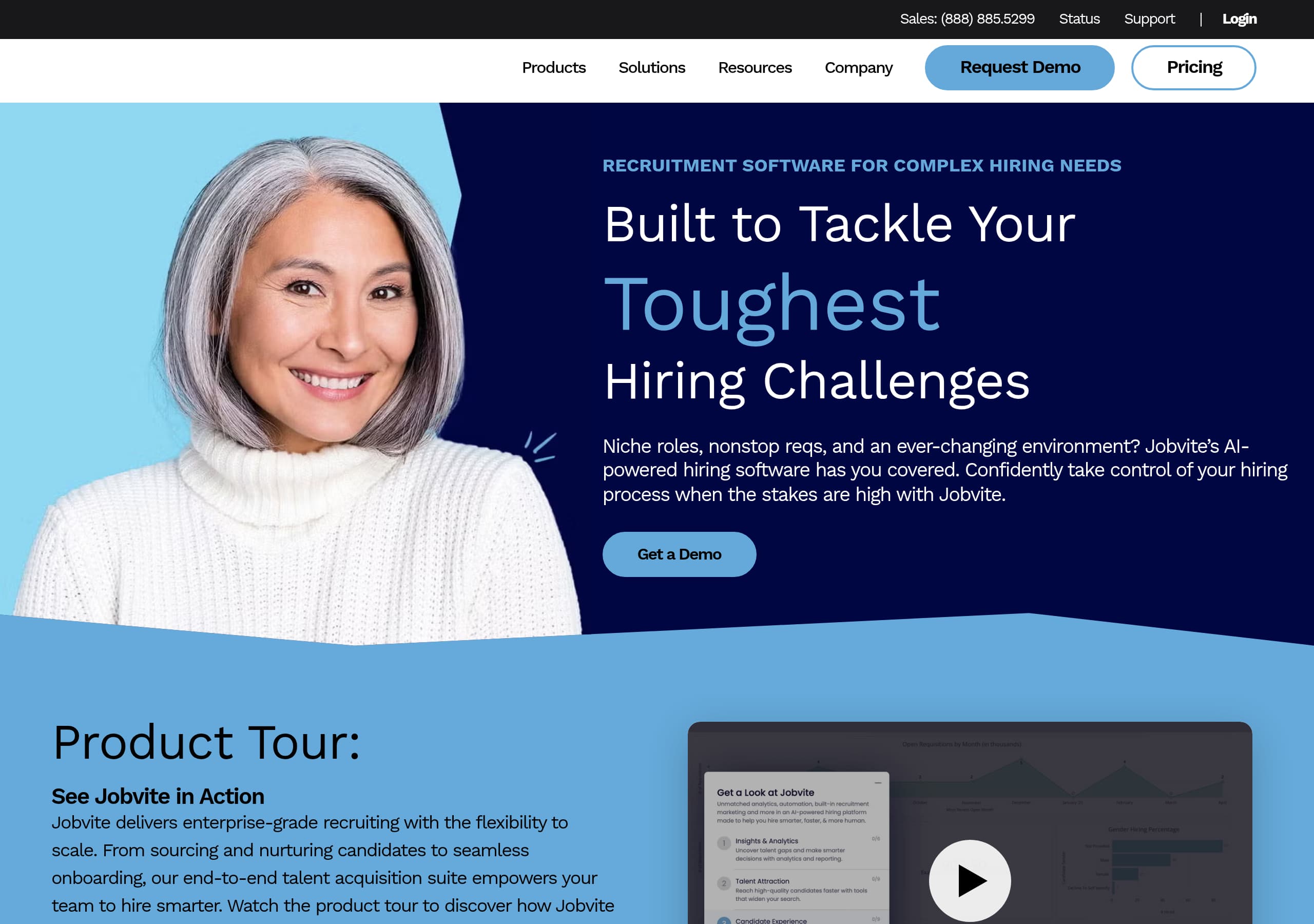
Key takeaways
Here are the key insights from our website breakdown analysis of Jobvite.
Jobvite’s homepage leads with a specific, high-intent promise, “Recruitment Software for Complex Hiring Needs,” which quickly qualifies enterprise and high-volume teams while setting expectations for a full talent acquisition suite.
Conversion is driven by repeated, consistent CTAs, especially “Get a Demo” and “Product Tour,” which match the enterprise buying motion and reduce decision friction by offering two next steps.
The site differentiates with an AI narrative that is packaged into named “AI Companions,” plus a dedicated “AI Interview Companion” (Pillar), which makes the AI value feel productized rather than abstract.
Pricing is positioned as modular and scalable rather than self-serve, which fits complex procurement, but it also means buyers must request a demo to get concrete numbers and packaging clarity.
Social proof is presented with multiple named-role testimonials and an analyst report offer (Gartner® AI Use-Case Assessment), which supports both practitioner and executive stakeholders.
Trust is reinforced through governance messaging, specifically “always-on governance” and “IBM watsonx.governance,” which signals risk management and auditability for regulated industries.
The footer behaves like a navigation and comparison hub, linking to “Jobvite vs Greenhouse,” “Jobvite vs iCIMS,” and “Jobvite vs SmartRecruiters,” which captures high-intent SEO traffic and mid-funnel evaluators.
Home
Jobvite’s homepage is built to qualify and convert complex hiring teams fast, the hero headline explicitly targets “Complex Hiring Needs” and pairs it with “AI-powered hiring software” to signal both audience and approach.
What’s working in the hero and above the fold
- The value prop is a single, scannable sentence: “Recruitment Software for Complex Hiring Needs,” followed by “Built to Tackle Your Toughest Hiring Challenges.” This is direct, not feature-first.
- There are two primary next steps: Get a Demo and a Product Tour (“See Jobvite in Action”). That dual-path CTA setup fits enterprise buyers who want proof before a sales conversation.
- Navigation is role-based and industry-based (“Solutions by Role,” “Solutions by Industry”), which matches how HR tech is evaluated and helps visitors self-identify quickly.
Positioning choices that increase relevance
Jobvite repeatedly anchors on scenarios like “niche roles,” “nonstop reqs,” and an “ever-changing environment,” which frames the product as built for operational pressure. It also introduces “enterprise-grade recruiting with the flexibility to scale,” a practical positioning line that pairs enterprise-grade with flexibility to scale instead of treating them as opposites.
Mid-page content that supports the narrative
The page introduces the AI layer as productized companions: AI Interview Companion, AI Screening Companion, and AI Sourcing Companion (marked “Coming Soon”). This format makes AI feel modular and adoptable, not an all-or-nothing platform change. The content also hints at interoperability by stating companions can be used with Jobvite ATS or an existing ATS, which reduces switching anxiety for cautious buyers.
Pricing
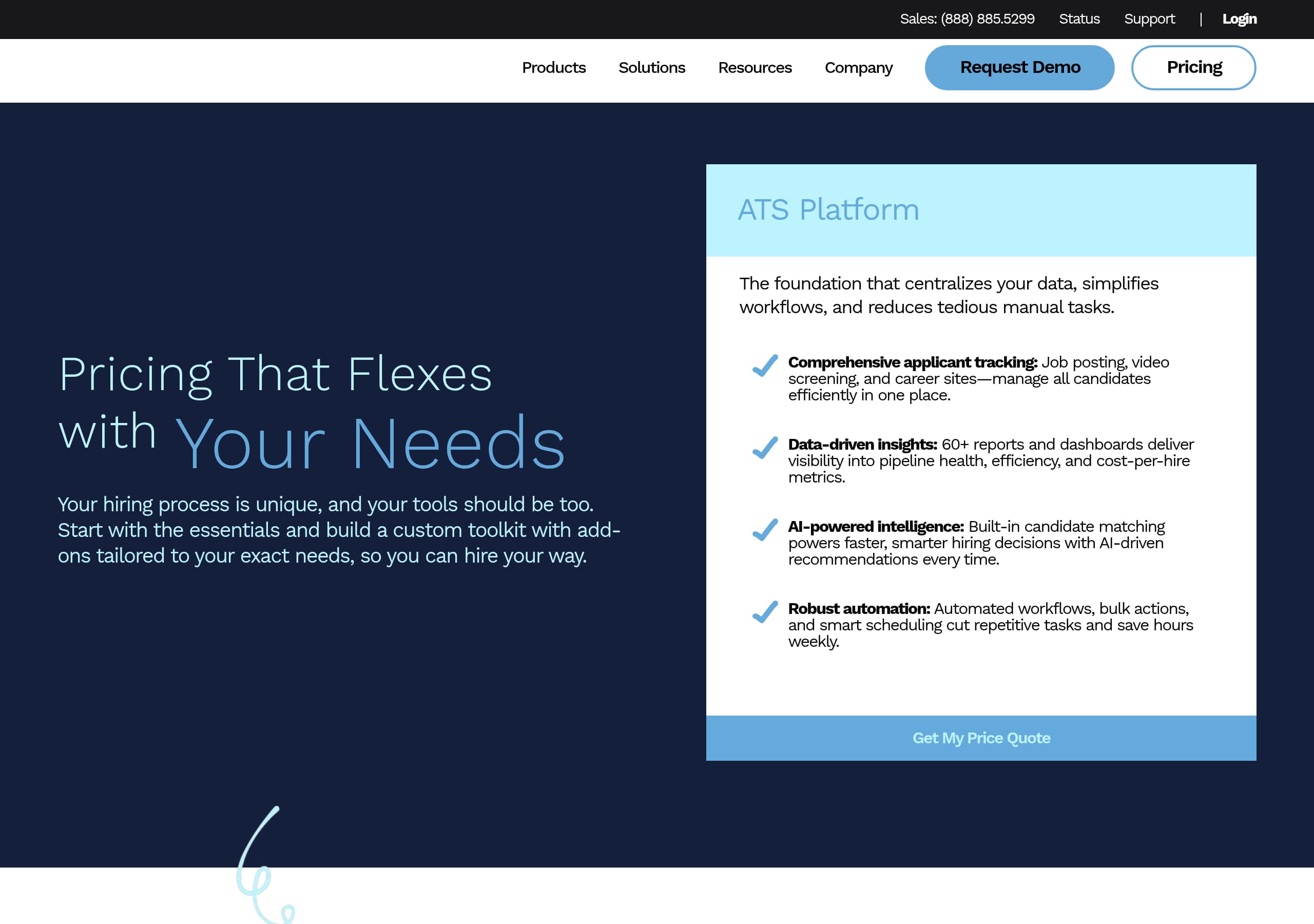
Jobvite’s pricing approach is designed for enterprise procurement, it emphasizes modular packaging and a sales-led motion rather than public tier numbers. The on-page FAQ explicitly states “flexible, scalable pricing” and a build-up model: start with the core Jobvite ATS and add modules like Onboarding, AI Companion, and recruitment marketing.
How pricing is framed (and why it converts the right buyers)
- Pricing is described as tailored to “your hiring needs,” which aligns with variable factors like req volume, user seats, and module selection.
- The modular language clarifies the packaging logic: buyers can add capabilities instead of overbuying an all-in suite.
- The primary action remains Request Demo or Explore Pricing, which matches the likely requirement for security review, integrations, and implementation planning.
What’s visible that reduces ambiguity
Even without showing numbers, the site lists concrete components that map to budget lines: ATS, recruitment marketing, onboarding, AI companions, analytics, and CRM/source. That specificity helps stakeholders understand what is “in scope” before they talk to sales. The FAQ reinforces this by naming example add-ons and describing the approach as “only pay for the Jobvite features you require,” which is a clear buyer-centric frame.
Where pricing clarity could improve
The tradeoff of this structure is that visitors cannot quickly self-qualify on budget. For comparison shoppers coming from “Jobvite vs Greenhouse” style queries, a small amount of extra structure would help, for example:
- a visible “modules available” checklist
- examples of “good fit for Essential vs Flexible vs Powerful” (the three ATS solutions named on the homepage)
As presented, Jobvite leans into custom pricing, module-based packaging, and a demo-first CTA to match complex hiring organizations.
Features
Jobvite presents features as a suite that covers the hiring lifecycle, but it avoids dumping a generic feature grid by organizing around product modules and AI companions. The FAQ lists a comprehensive set including Jobvite ATS, Career Site, Jobvite CRM, Recruitment Marketing Software, and Analytics, plus the AI layer via AI Companion.
Feature specificity that helps buyers map requirements
- The ATS is described as centralizing candidate management with “built-in automation and intelligence,” which signals workflow depth.
- The Career Site claim is framed as outcome-driven: “Convert 3x more applicants with mobile-optimized, branded experiences.” Even though the number should be validated elsewhere, the phrasing is concrete and conversion-oriented.
- Analytics is quantified as “60+ actionable dashboards and reports,” which gives evaluators a measurable sense of reporting breadth.
- AI-powered candidate matching is described with “clear explanations provided,” which supports auditability expectations.
Differentiation through AI companions
The “Employ Advantage” section productizes AI into discrete companions: AI Interview Companion (checks and balances for consistent interviews), AI Screening Companion (surfaces qualified candidates and re-engages), and AI Sourcing Companion (posting intelligence, marked “Coming Soon”). This structure is a strong way to present AI as purpose-built workflows rather than a single opaque model.
Packaging clarity across company sizes
The homepage also references “three unique, AI-powered ATS solutions,” labeled as Essential, Flexible, and Powerful. That triad acts like an implicit feature tiering system, even if exact inclusions are not listed. For complex buyers, this is useful, but it would be even clearer if each solution linked to a comparison table.
Overall, Jobvite’s feature presentation succeeds because it is module-based, workflow-aligned, and supported by quantified analytics depth rather than relying purely on broad claims.
Signup
Jobvite’s signup flow is intentionally enterprise-led: the primary conversion event is not account creation, it is a Request Demo or “Get a Demo” action that routes visitors into a sales-assisted evaluation. This matches the product category, an ATS and talent acquisition suite typically requires configuration, integrations, and stakeholder buy-in.
How the site nudges the right next step
- CTAs are consistent across sections: “Get a Demo” appears in the hero, after the product tour prompt, and again near the bottom (“Ready to master your high-stakes hiring activities?”).
- A secondary path exists for visitors who want to explore before talking to sales: “Product Tour: See Jobvite in Action” and downloadable assets like the Gartner® report and benchmarks report.
- The navigation includes “Login” for existing customers and “Support,” which reduces anxiety for buyers assessing vendor maturity.
Why this flow works for ATS buyers
ATS evaluations often include: implementation scope, data migration, security review, and integrations (HRIS, payroll, background checks). Jobvite’s demo-first motion makes it easier to qualify fit before asking users to invest time in setup. The FAQ reinforces integration readiness with language like “plays nice with your HR tech stack” and references a partner marketplace.
Friction points to watch
The biggest conversion risk is visitors who need a quick trial to validate usability. Jobvite offsets this with the product tour and heavy feature detail, but there is no obvious “free trial” path in the provided content. Another risk is pricing ambiguity, which can reduce demo submissions for mid-market teams.
Net: the signup experience is optimized for sales-qualified leads, supports multiple evaluation paths (demo, tour, reports), and aligns to how enterprise recruiting platforms are typically adopted.
Trust
Jobvite’s trust messaging leans into governance, auditability, and integration readiness, which is the right trust profile for regulated industries and complex hiring environments. The most concrete trust signal in the excerpt is the governance callout: “Unmatched, Always-On Governance” with “IBM watsonx.governance,” plus “verification, and security you can trust.”
Trust signals visible in the content
- The governance section is not buried in legal pages, it is positioned alongside AI companions, which directly addresses buyer concerns about AI risk.
- AI features are framed with process controls: the AI Interview Companion promises “checks and balances” for “consistent, fair” interviews, and candidate matching includes “clear explanations provided.” That language supports explainability and defensibility.
- Integration trust is explicit: Jobvite highlights connections to HRIS, payroll, background checks, and assessments, and points to a partner marketplace. This reduces perceived implementation risk.
Trust via market positioning
Jobvite claims it is designed for “highly regulated industries” and “complex compliance needs,” and the site architecture supports that with “Solutions by Industry” and “Solutions by Role.” While these are not certifications, they are strong signals that the product expects formal requirements.
What’s missing from the visible trust layer
Within the provided excerpt and screenshots set, there are limited explicit security artifacts like SOC 2, ISO 27001, GDPR, or data retention statements. The footer does include a “Security” link and “Compliance,” which implies those details exist deeper in the site, but the homepage itself could convert more cautious buyers by adding 2 to 3 visible proof points (for example, certification badges or a short security summary).
Overall, Jobvite establishes trust through governed AI, explainable evaluation language, and integration maturity, which is aligned with enterprise TA risk management.
Footer
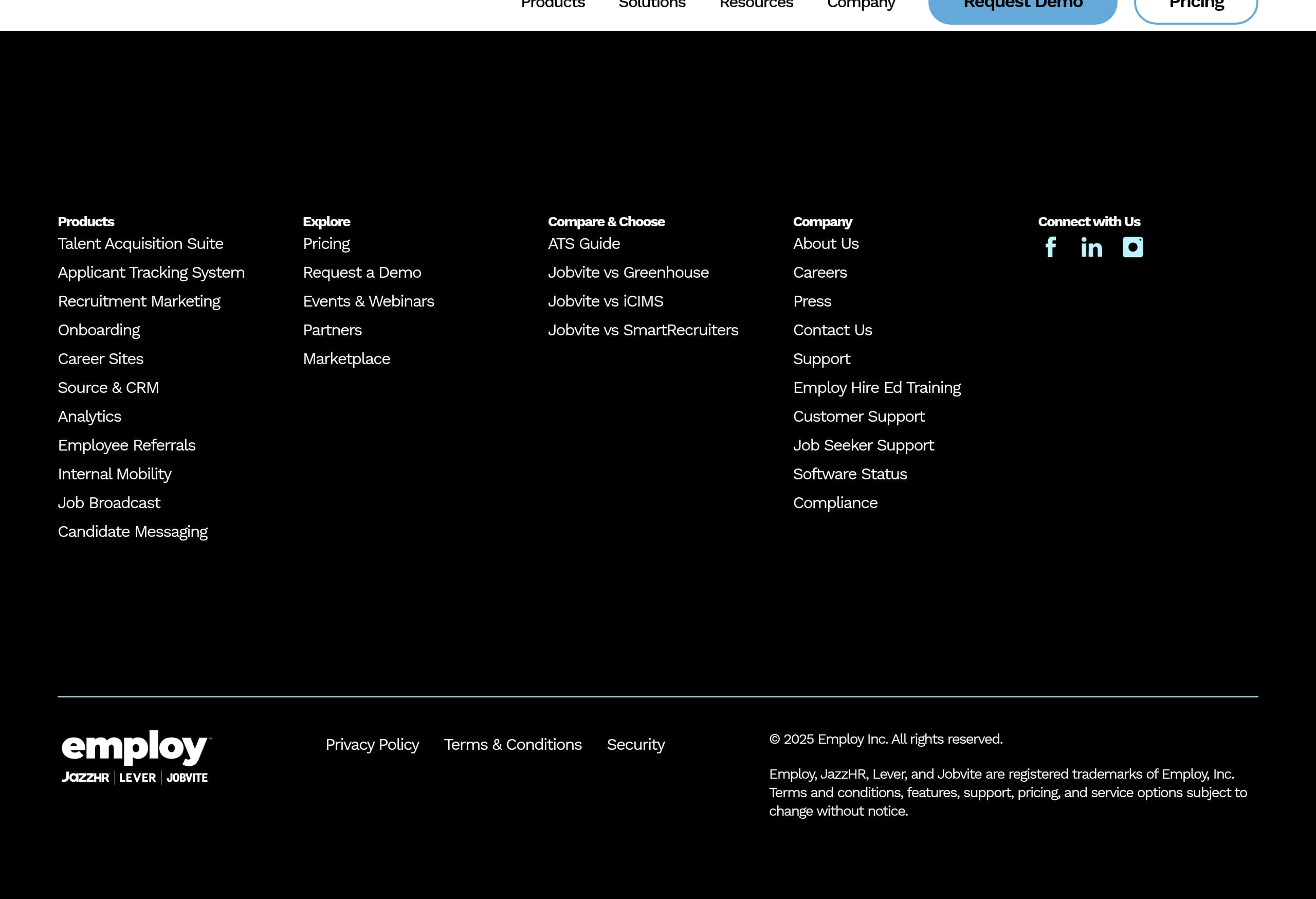
Jobvite’s footer is built as a high-utility navigation layer for evaluators, buyers, and existing customers, not just a legal block. It includes product links (Talent Acquisition Suite, ATS, Recruitment Marketing, Onboarding, Career Sites, Source and CRM, Analytics, Employee Referrals, Internal Mobility, Job Broadcast, Candidate Messaging), plus commercial actions like Explore Pricing and Request a Demo.
Why the footer supports conversion and SEO
- The footer contains comparison pages: Jobvite vs Greenhouse, Jobvite vs iCIMS, and Jobvite vs SmartRecruiters. These are high-intent queries and strong middle-funnel entry points.
- It also includes educational resources like an “ATS Guide” and partner ecosystem entry (“Partners Marketplace”), which keeps visitors in-site when they are still researching.
- Support is clearly separated into “Customer Support” and “Job Seeker Support,” reducing confusion for candidates who land on the site.
Trust and compliance elements
The footer links to Privacy Policy, Terms and Conditions, Security, “Compliance,” and “Software Status.” The presence of a status page link is an operational trust signal, indicating transparency about uptime and incidents. It also includes trademark and corporate ownership context: “© 2025 Employ Inc.” and that Employ owns JazzHR, Lever, and Jobvite trademarks, which helps enterprise buyers understand the vendor structure.
One improvement opportunity
The footer is dense, which is useful, but it can be overwhelming on mobile. Grouping links into clearer buckets (Buy, Compare, Learn, Support, Legal) and adding a short one-line positioning statement could improve scanability.
As implemented, the footer functions as a conversion backstop, a comparison-content hub, and a compliance gateway, all of which support enterprise evaluation flows.
Scores
Our framework scores for Jobvite's website in terms of clarity, conversion, and trust. See our methodology for how we calculate these.
How clear the value prop and structure are.
How conversion-friendly signup and pricing are.
How well trust and compliance are surfaced.
FAQ
Jobvite leads with a clear qualifier, “Recruitment Software for Complex Hiring Needs,” then reinforces the target scenario with language about niche roles and nonstop requisitions. It uses consistent CTAs like “Get a Demo” and a “Product Tour” to match enterprise buying behavior. The navigation is segmented by role and industry, helping visitors self-identify quickly, and the page introduces AI Companions as discrete, adoptable capabilities.
Jobvite describes pricing as flexible and modular rather than publishing fixed public tiers. The site explains you can start with the core Jobvite ATS and add modules such as Onboarding, AI Companion, and recruitment marketing based on need. This approach aligns with complex procurement and varying implementation scope, but it also means most buyers will need to request a demo to get exact numbers and packaging details.
Jobvite emphasizes an end-to-end talent acquisition suite: ATS, Career Site, CRM (Source and CRM), recruitment marketing, onboarding, and analytics. In the FAQ it calls out AI-powered candidate matching with explanations and “60+ actionable dashboards and reports” for analytics depth. It also highlights AI Companions such as an AI Interview Companion (Pillar), plus screening and sourcing companions, to position AI as workflow support.
Jobvite pushes a sales-assisted evaluation flow, with “Get a Demo” repeated across the homepage and supporting routes like a product tour video and downloadable reports. This is typical for ATS platforms that require configuration, integrations, and stakeholder review. The site also supports existing users with Login and Support links, which helps reduce perceived risk for buyers evaluating long-term vendor maturity.
Jobvite pairs its AI messaging with governance language, including “Always-On Governance” and a reference to IBM watsonx.governance. It frames the AI Interview Companion around consistency and fairness, and describes AI matching with “clear explanations provided,” which implies explainability. Trust is also supported via integration messaging (HRIS, payroll, background checks) and footer links to Security, Compliance, and a Software Status page.

The world's best-performing SaaS businesses share surprisingly similar patterns. We help you learn and apply them through our human-designed methodology, with AI-assisted research.