
Key takeaways
Here are the key insights from our website breakdown analysis of Salesforce.
Salesforce uses a portfolio-first navigation that lets enterprise buyers self-segment by function (Sales, Service, Marketing) and industry, reducing bounce from a broad “CRM” promise.
The hero messaging ties “AI CRM” to a named product line (Agentforce 360), which makes the AI claim concrete and gives prospects a clear concept to explore and compare.
Pricing is positioned as suite-based packaging (Starter/Pro and product-specific pricing) which simplifies initial evaluation, but still supports expansion paths into specialized clouds.
Social proof is embedded as a dedicated “Customer Stories” ecosystem (including Salesforce on Salesforce), reinforcing credibility for regulated and large-scale deployments.
Trust is reinforced through repeated “trusted platform” language and the presence of Data Security & Privacy and Data 360 sections, which match enterprise due diligence expectations.
Home
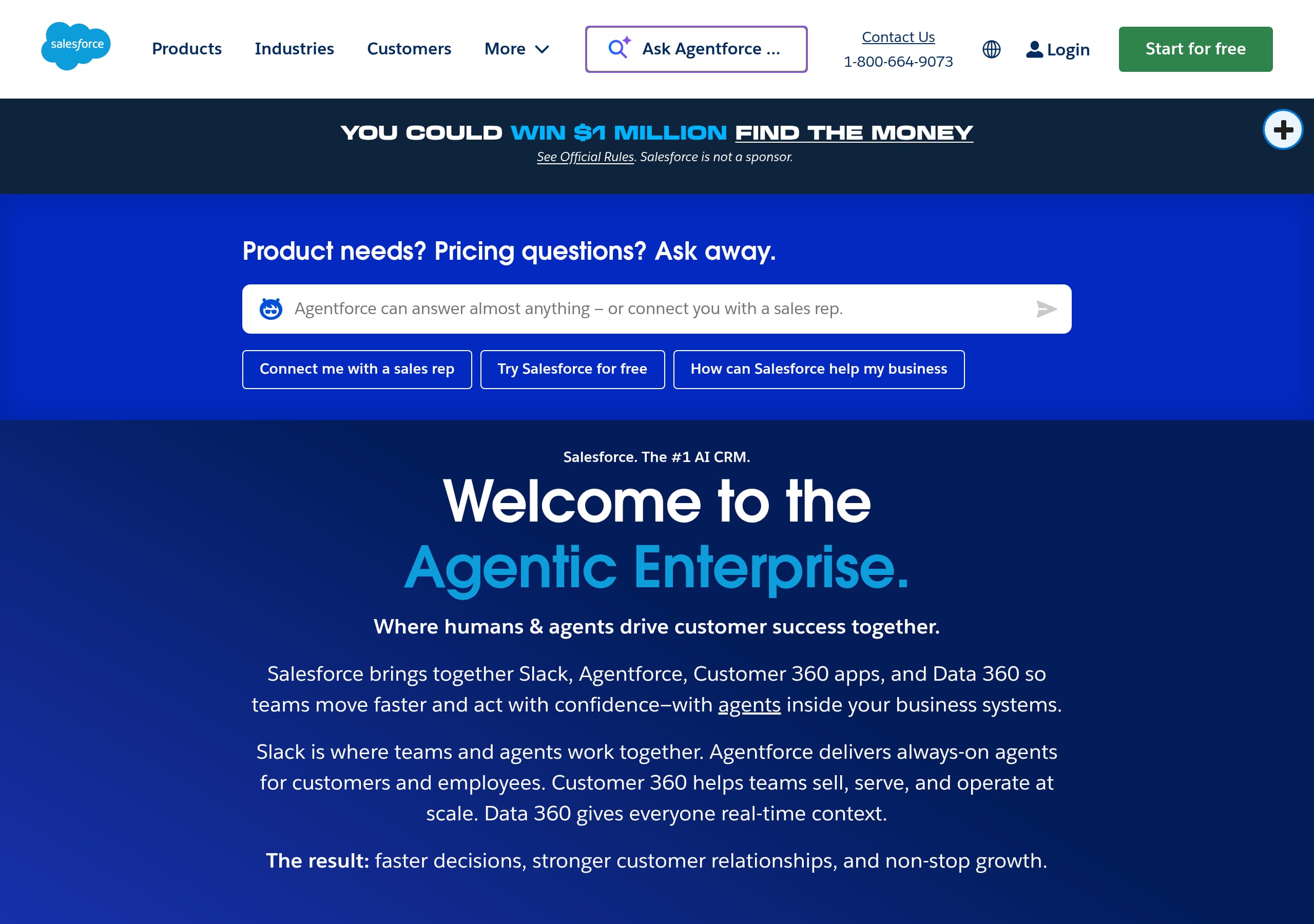
Salesforce’s homepage makes the positioning unambiguous by leading with “#1 AI CRM” and immediately naming the platform concept (Agentforce 360). That reduces ambiguity versus a generic “CRM” headline and gives visitors a clear exploration path.
The primary structure is a mega-menu that mirrors buying intent:
- Products grouped by function (Sales, Service, Marketing, Commerce, Analytics/Tableau, Slack)
- Industries grouped into vertical clouds (Financial Services, Healthcare, Public Sector, etc.)
- Customer Stories and Events as top-level credibility routes
The language is outcome-led (“increase productivity,” “improve operations,” “build stronger customer relationships”) and repeated consistently across sections, which improves recall. A notable UI choice is the depth of sub-navigation (e.g., CPQ, Revenue Lifecycle Management, Customer Data Platform), signaling completeness for enterprise use cases. The homepage also creates multiple “doors” into the ecosystem—products, industries, partners, learning—so different roles can self-qualify without hunting.
Pricing
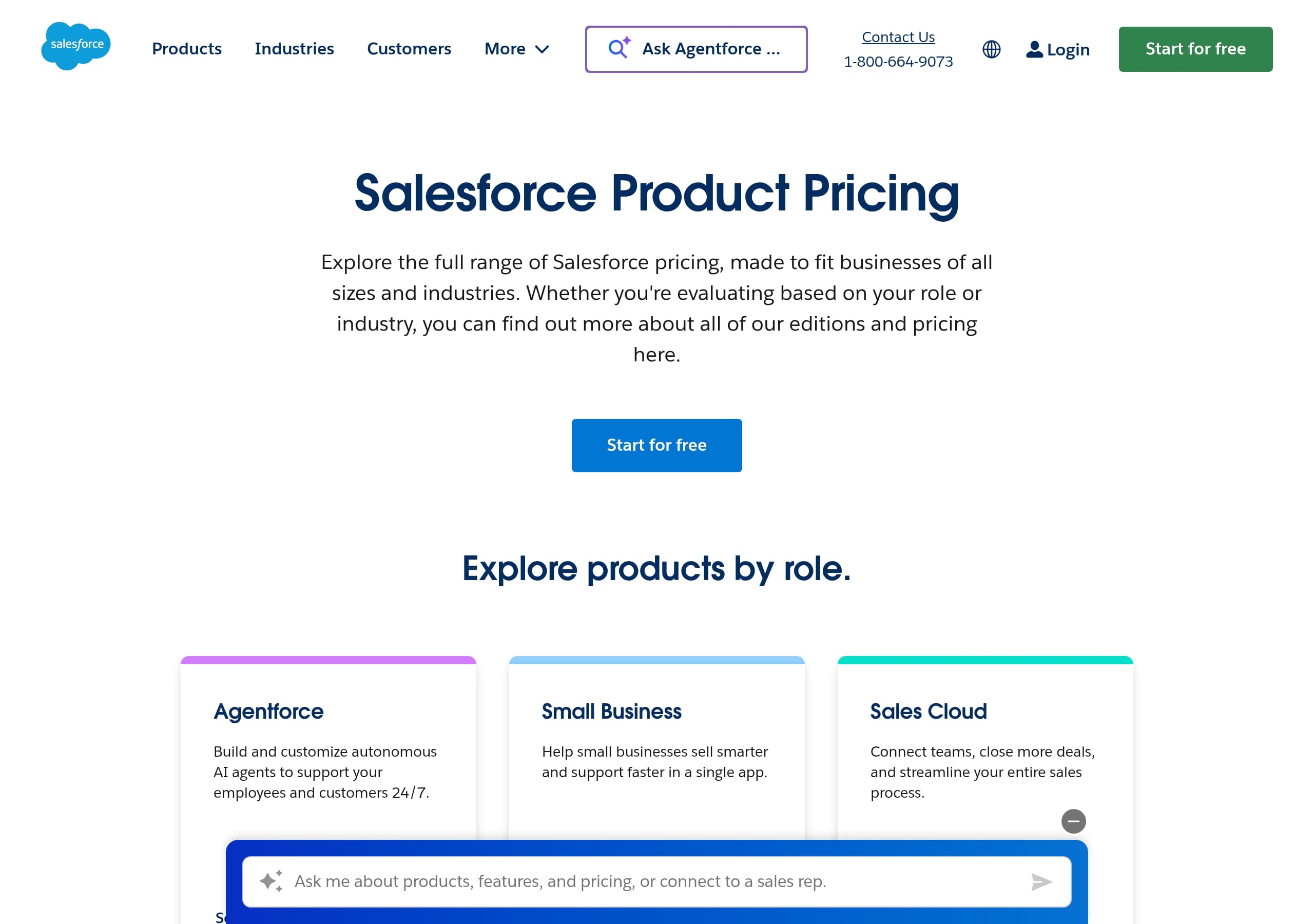
Salesforce’s pricing experience is designed to accommodate both self-serve evaluation and enterprise configuration. From the site structure, nearly every major cloud (Sales Cloud, Service, Marketing, Commerce, Analytics/Tableau, Small Business) includes a direct Pricing entry point, reducing the “where do I start?” friction.
In the pricing screenshot, the layout follows familiar SaaS conventions:
- Plan cards and tiered packaging to frame value at a glance
- A comparison pattern (visually grouped features) to justify tier jumps
- Clear CTAs for buying paths that likely split into “start” vs “contact sales” for complex deployments
The notable strategic choice is offering Small Business suites (Free/Starter/Pro) alongside enterprise clouds. That creates an entry ramp without undermining the broader portfolio. For conversion, the main improvement opportunity is minimizing decision overload by highlighting a recommended plan and explicitly stating key thresholds (users, automation limits, support level) near the fold.
Features
Salesforce communicates features through solution architecture rather than a single feature grid, which matches how CRM platforms are evaluated. The navigation exposes a layered stack:
- Agentforce capabilities (Builder, Voice, Dev Tools, AgentExchange)
- Cloud execution surfaces like Sales Cloud and Service (e.g., Sales AI, Sales Agents, Field Service)
- Data and integration foundations via Data 360, connectors, and platform components (MuleSoft, Flow Automation, Heroku)
This “capability map” approach helps buyers understand how pieces fit together: AI agents + unified data + workflows across departments. It also supports role-based exploration; a sales leader can click “Boost pipeline,” while a technical buyer can go straight to “Data Security & Privacy” or platform tooling.
A measurable strength is the depth of subcategories per cloud (often 6–10 links), which signals completeness. The tradeoff is complexity; Salesforce mitigates it by grouping features under outcomes and industries rather than listing everything at once.
Signup
Salesforce’s signup motion is intentionally segmented rather than a single universal “Sign up” flow, reflecting enterprise sales realities. The site presents multiple entry points—Small Business suites (including a Free Suite), product-level Pricing pages, and “Contact Sales” paths—so different budgets and timelines can convert appropriately.
Observable funnel design choices in the navigation suggest:
- A self-serve path for SMB via Starter/Pro suite packaging
- A guided path for enterprise via product-specific pricing and likely lead forms
- Enablement-first routes through Trailhead (free learning) and events, which can convert users into champions before procurement
This is conversion-friendly for complex software because it avoids forcing every visitor into the same demo request. The risk is decision paralysis from many options; Salesforce counterbalances by using outcome labels (“Cut service costs,” “Personalize engagement”) and suite naming to simplify initial selection. A tactical improvement would be clearer “recommended for” labels by company size and role on pricing entry pages.
Trust
Salesforce’s trust posture is reinforced through repeated “trusted platform” framing and dedicated navigation for governance-related topics. The Data and Platform sections explicitly surface Data Security & Privacy, connectors, and “How Connectivity Works,” which aligns with enterprise due diligence checklists.
Trust signals are distributed across the ecosystem:
- Customer Success (success plans, professional services) reduces perceived delivery risk.
- Partner Apps & Experts (AppExchange, consultants) signals vetted extensions and implementation capacity.
- Industry clouds (Financial Services, Healthcare, Public Sector) imply compliance-minded productization for regulated environments.
Even without reading a security page, the information architecture communicates that Salesforce expects scrutiny: security/privacy is a first-class topic, not a footer link. The inclusion of major events (Dreamforce, TDX) and extensive enablement (Trailhead) also supports trust by showing a mature operator ecosystem. For further credibility, pricing pages should consistently reference support/SLA levels and compliance badges near CTAs to reduce last-mile hesitation.
Detected tech stack
Tools and technologies we detected on Salesforce's site. Detection is best-effort and may be incomplete.
Scores
Our framework scores for Salesforce's website in terms of clarity, conversion, and trust. See our methodology for how we calculate these.
How clear the value prop and structure are.
How conversion-friendly signup and pricing are.
How well trust and compliance are surfaced.

The world's best-performing SaaS businesses share surprisingly similar patterns. We help you learn and apply them through our human-designed methodology, with AI-assisted research.