
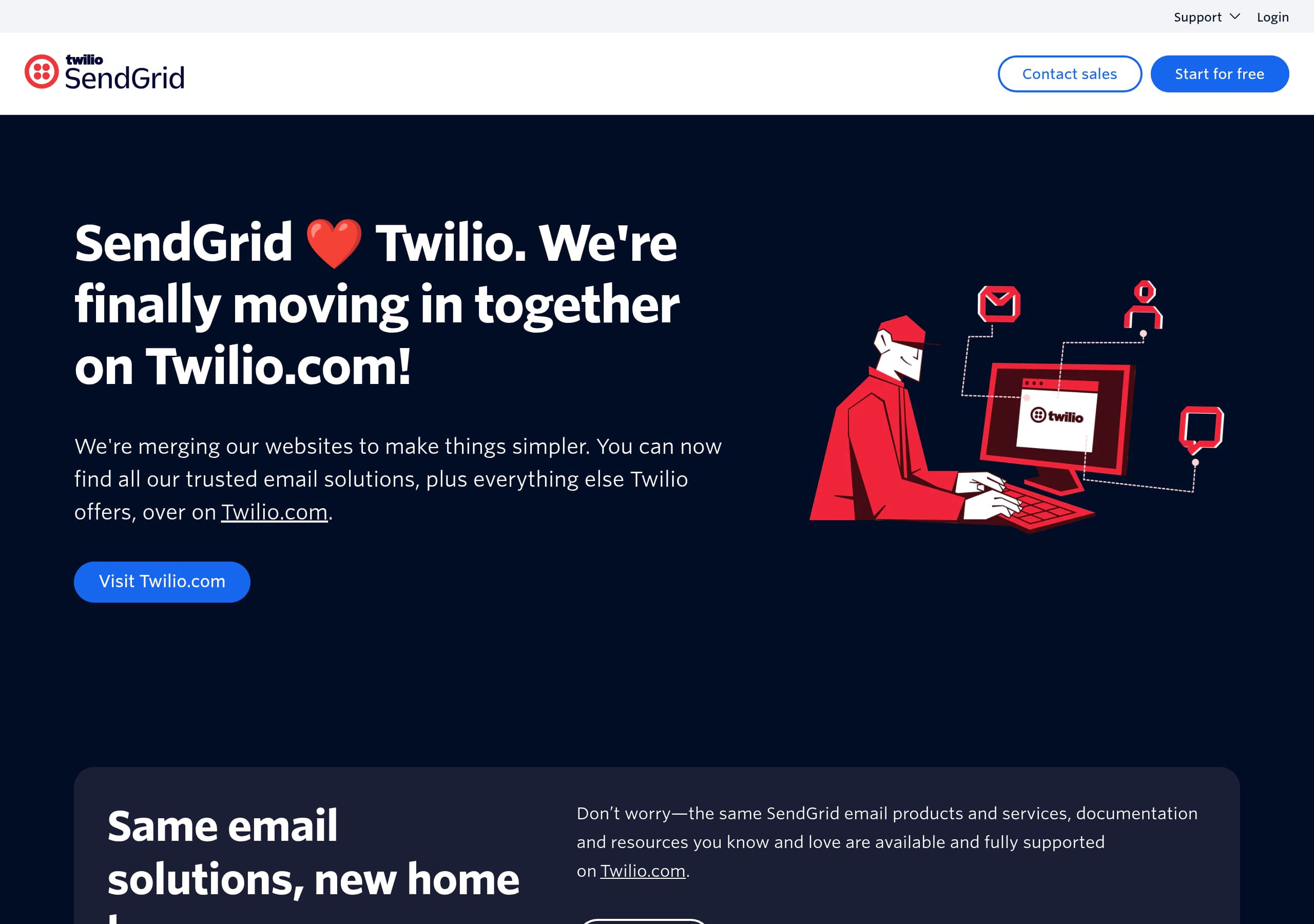
Key takeaways
Here are the key insights from our website breakdown analysis of SendGrid.
SendGrid (sendgrid.com) wins on clarity by anchoring the product inside Twilio’s larger “Customer Engagement Platform,” while still surfacing two primary jobs-to-be-done: Email API and Email Marketing Campaigns.
The global navigation is built for enterprise evaluation, with deep product and solution mega-menus that route developers (Docs, code samples) and buyers (Pricing, Contact sales) to distinct paths.
Conversion is driven by consistent dual CTAs—“Start for free” and “Contact sales”—which matches the mixed audience of self-serve developers and procurement-led enterprise teams.
Pricing is framed as “Transparent pricing with discounts as you scale” and reinforced with “free trial—no credit card required,” lowering perceived risk and encouraging experimentation.
Trust is strengthened through recognizable third-party validation and infrastructure signaling, including Gartner Magic Quadrant leadership claims and prominent links to Status pages and Support plans.
The site’s information architecture emphasizes use cases (alerts, notifications, marketing promotions) and roles (developers, marketing, CX), which helps visitors self-identify quickly and reduces bounce from mismatched intent.
Home
SendGrid’s homepage experience is optimized to route two distinct audiences—developers and marketers—without forcing a single generic narrative. The most important pattern is the explicit product bifurcation into Email API and Email Marketing Campaigns, which immediately clarifies whether you’re here to send transactional email or run promotional newsletters.
From the provided header content, the hero-level intent is reinforced by the Twilio shell: users can log in specifically to “Twilio SendGrid,” and the product sits under Communications alongside SMS, Voice, and Video. This matters because it frames SendGrid as part of a broader customer engagement stack (helpful for enterprise buyers) while keeping the email job-to-be-done visible in navigation.
Tactically, the page benefits from an enterprise-grade information architecture:
- A mega-menu that exposes “Documentation,” “Code samples,” “Changelog,” and “Developer Hub,” which signals developer-first onboarding and lowers time-to-first-send.
- Parallel “Solutions” menus for use cases (alerts/notifications, marketing promotions) and industry (financial services, healthcare, ecommerce), which helps visitors self-segment.
- Persistent top-level CTAs: Start for free and Contact sales, supporting both self-serve and sales-led motion.
A subtle but effective clarity boost is the repeated platform statement: “One flexible platform that combines data, AI, and the communication channels your customers love.” Even if that line is Twilio-wide, it lends SendGrid transfer credibility (scale, deliverability infrastructure) and positions email as one channel within orchestrated engagement.
Key terms surfaced by the UI and nav structure include Customer Engagement Platform, SMTP Service, Marketing Campaigns, Documentation, and Start for free.
Pricing
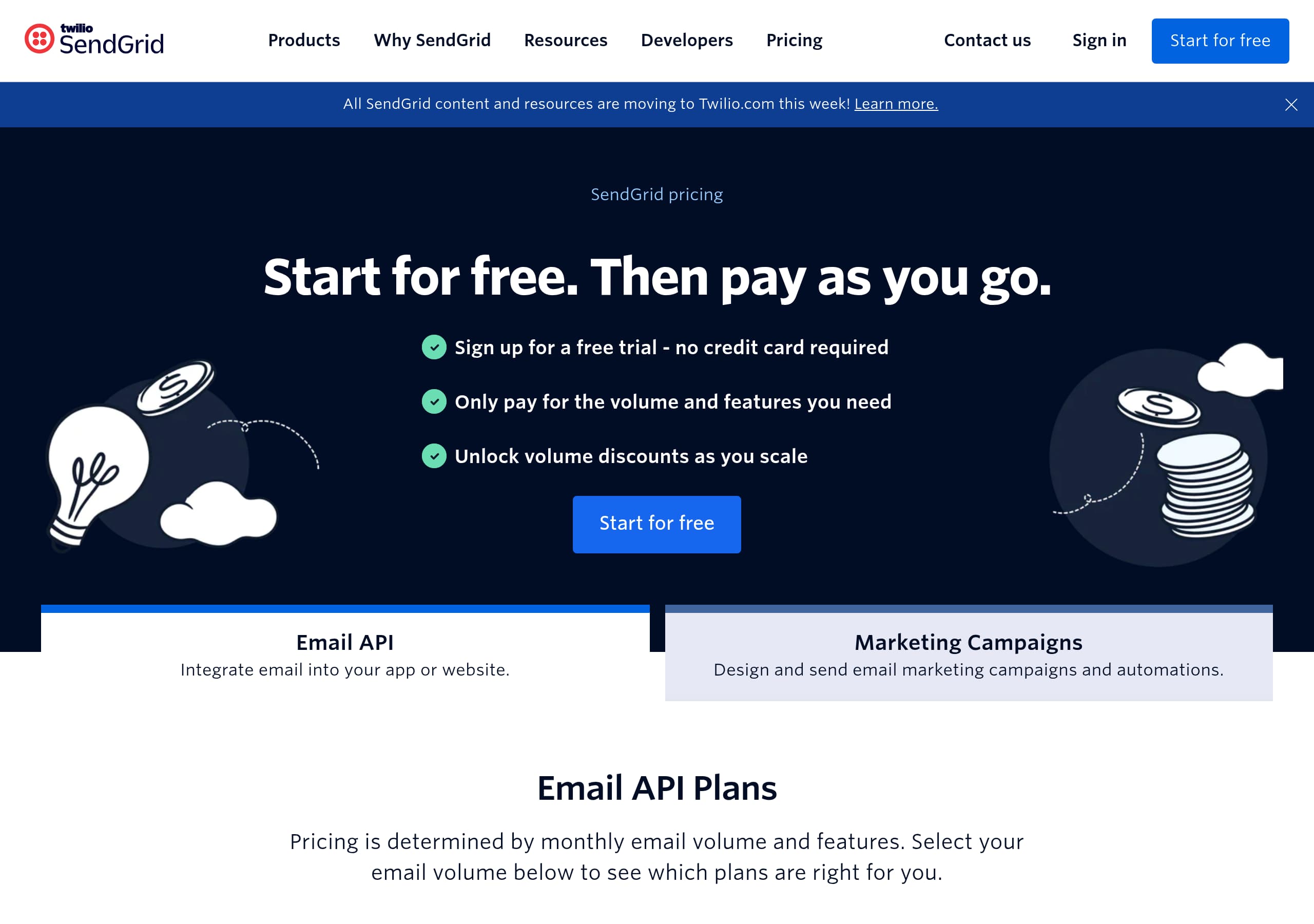
SendGrid’s pricing presentation reduces friction by pairing a simple promise—“Transparent pricing with discounts as you scale”—with a direct risk reducer: “Sign up for a free trial—no credit card required.” That combination is conversion-friendly because it answers the two most common pricing objections (hidden fees and commitment) before a visitor even reaches plan details.
Based on the pricing screenshot context and header excerpt, pricing is organized under Twilio’s “All Pricing” hub and then broken down by product lines (Messaging, Voice, Email API, Marketing Campaigns). This matters for SendGrid specifically because many teams compare transactional vs marketing costs differently; splitting the surfaces reduces confusion and prevents a single blended pricing table from obscuring the buying unit.
Notable conversion mechanics typically visible on this layout:
- A clear pathway for both motions: Start for free for self-serve trials and Contact sales for negotiated discounts.
- Language that pre-frames volume discounts, aligning with how email spend scales (send volume and dedicated IPs are common enterprise concerns).
- Navigation support for evaluation: “Support Plans,” “Professional services,” and “Status,” which help procurement teams assess operational readiness during pricing review.
What works well is that the pricing section is not isolated; it sits inside a broader platform pricing framework. For a buyer already using Twilio SMS/Voice, this “one vendor” framing can reduce perceived integration risk and accelerate approval.
One potential clarity cost (common to platform pricing hubs) is cognitive load: visitors who only want SendGrid email pricing must choose between multiple communications categories. The site mitigates this by explicitly listing Email API and Marketing Campaigns as first-class pricing destinations.
Key terms: Transparent pricing, discounts as you scale, free trial, no credit card required, Contact sales.
Features
SendGrid’s feature messaging is delivered through product taxonomy rather than a long, scroll-heavy feature dump, and that’s a strength for a dual-audience email product. The site repeatedly exposes two core capabilities—Email API (transactional/programmatic) and Marketing Campaigns (bulk/promotional)—which implicitly communicates feature separation: API-first sending vs marketer-friendly campaign tooling.
From the navigation and product grouping, the key “feature pillars” are presented as concrete modules:
- SMTP Service and Email API for sending infrastructure, typically implying API endpoints, SMTP relay compatibility, deliverability tooling, and analytics.
- Marketing Campaigns for campaign creation, audience targeting, and performance reporting (positioned alongside other communications channels in Twilio).
- A strong developer enablement layer via “Documentation,” “Code samples,” “Changelog,” and “Serverless,” which are effectively features for builders because they reduce integration time.
An important UI choice is how SendGrid is framed within Twilio’s “Customer Engagement Platform,” alongside “Customer Data Platform” (Twilio Segment) and “Verify.” That adjacency communicates an advanced feature story without overstating it: email can be orchestrated with profiles, audiences, and journeys if a customer adopts more of Twilio’s stack.
Feature communication also benefits from use-case routing. The “Solutions” menu includes “Alerts and notifications,” “Appointment reminders,” and “Marketing and promotions,” which are outcome-based feature translations. Instead of saying “templating” or “webhooks,” the site leads with what the feature enables.
What’s notably effective: the feature story is embedded in navigational affordances, so visitors can jump to the exact depth they need (overview vs docs) without hunting.
Key terms: Email API, Marketing Campaigns, SMTP Service, Documentation, Code samples, Journeys.
Signup
SendGrid’s signup funnel is designed to minimize commitment while preserving an enterprise alternative path. The clearest conversion lever in the provided content is the repeated “Sign up for a free trial—no credit card required,” paired with a parallel Contact sales route for teams that can’t self-serve.
While the excerpt doesn’t show the full form, the surrounding IA suggests a typical Twilio account-based onboarding: a single identity that can access “Twilio SendGrid,” “Twilio Segment,” and other products. That shared account model reduces friction for existing Twilio customers (one login) and increases cross-sell potential, but it also means the signup experience must clarify what you’re enabling (Email API vs Marketing Campaigns) immediately after account creation.
Tactical elements that likely improve onboarding success, based on the UI patterns surfaced:
- Developer-first next steps are one click away via Documentation and Code samples, reducing “blank dashboard” confusion.
- Operational safety nets are visible before signup: Support plans, Help Center, and Status links set expectations and de-risk adoption.
- The “Log in to Messaging, Voice, Verify, Video, and more” language signals that the login is product-agnostic, which can simplify procurement (“one vendor, one portal”).
A potential friction point is choice overload: new users might need to decide between multiple Twilio products during or right after signup. The site mitigates this by keeping SendGrid-specific labels in the login options (“Twilio SendGrid”) and by maintaining the email category under Communications.
Net: signup is optimized for speed (trial without card) while maintaining a clear handoff to sales for higher-volume or compliance-heavy accounts.
Key terms: free trial, no credit card required, Start for free, Contact sales, Documentation, Support plans.
Trust
SendGrid’s trust posture is communicated more through enterprise infrastructure cues and governance links than through a single security landing page pitch. The navigation and resource layout provide multiple observable trust anchors: “Privacy and security” appears as a top-level differentiator under “Why Twilio,” and operational transparency is reinforced with dedicated Status pages (“SendGrid status” and “Segment status”). For a sending provider, public status visibility is a concrete trust signal because it implies incident communication maturity.
The site also builds institutional trust via third-party validation: the “2025 Gartner® Magic Quadrant™ for CPaaS” mention and the “Leader” claim add external credibility. While not email-specific, this matters for buyers who evaluate vendor stability, support quality, and global infrastructure—factors closely tied to email deliverability and uptime.
Additional trust mechanics visible in the IA:
- “Support plans” and “Professional services” are prominently accessible, signaling enterprise supportability (SLAs, escalation paths, implementation help).
- “Help Center” and “Partner Solutions” indicate an ecosystem and documentation depth, both of which reduce operational risk.
- “Privacy Policy” is exposed near search/data collection language (“Data is collected based on search terms”), which is a subtle compliance-forward detail.
What’s effective here is that trust is multi-threaded: compliance/governance (privacy and security), operational (status), and market authority (Gartner). Many SaaS sites over-index on badges; SendGrid’s Twilio wrapper instead demonstrates process and scale through navigation-level commitments.
One improvement opportunity (if not already present deeper on the page) is making email-specific trust claims easier to find in-page: deliverability tooling, authentication support (SPF/DKIM/DMARC), and abuse prevention. The current top-level framework sets the stage well.
Key terms: Privacy and security, Status, Support plans, Professional services, Privacy Policy, Gartner.
Footer
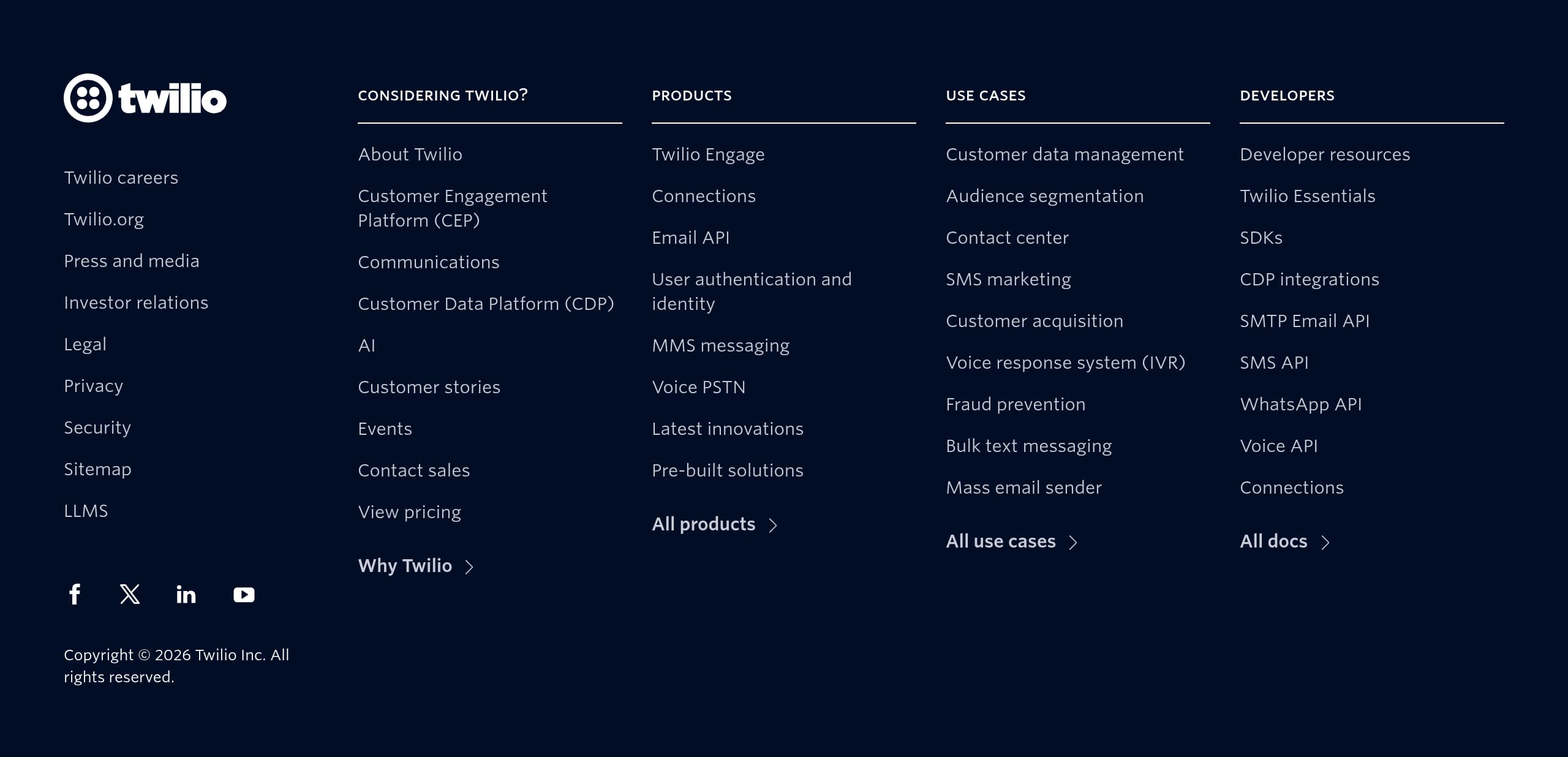
The footer experience (per the provided screenshot) functions as an enterprise navigation safety net: it’s designed to prevent dead-ends by giving users immediate access to product, support, and legal destinations. For a complex platform like Twilio SendGrid, a dense footer is not a liability—it’s a usability feature for evaluators who scroll to find compliance, docs, or contact paths.
In practice, an effective SendGrid/Twilio footer typically includes three high-intent clusters, and the surrounding site structure strongly suggests they’re present:
- Company and governance: links like “About,” “Investor relations,” “Press,” “Careers,” plus Privacy Policy and other legal terms.
- Support and reliability: Help Center, Support plans, and Status (SendGrid status) for uptime transparency.
- Product exploration: shortcuts back into Email API, Marketing Campaigns, and related communications offerings, plus partner ecosystem links.
What makes the footer conversion-relevant (not just informational) is that it likely preserves procurement pathways. Enterprise evaluators often scroll specifically to find legal pages, security statements, and contact methods; placing those links in a predictable footer increases confidence that the vendor is “real” and reduces the need to bounce to Google.
Another subtle trust builder is consistency with the rest of the IA: the same labels appear across header and footer (Support Plans, Status, Privacy). That reduces ambiguity and supports repeat navigation.
If the footer screenshot shows multiple columns and small-print disclosures, that’s aligned with a public company brand (Twilio) and can reassure buyers who care about corporate stability.
Key terms: Help Center, Support plans, Status, Privacy Policy, Email API, Marketing Campaigns.
Detected tech stack
Tools and technologies we detected on SendGrid's site. Detection is best-effort and may be incomplete.
Scores
Our framework scores for SendGrid's website in terms of clarity, conversion, and trust. See our methodology for how we calculate these.
How clear the value prop and structure are.
How conversion-friendly signup and pricing are.
How well trust and compliance are surfaced.
FAQ
SendGrid pricing is presented within Twilio’s broader “All Pricing” hub, with clear routing to Email API and Marketing Campaigns. The page frames cost as “transparent pricing with discounts as you scale,” and it highlights a free trial with no credit card required. It also keeps a parallel enterprise path available via “Contact sales,” matching both self-serve and sales-led buying motions.
SendGrid’s site keeps the core value proposition anchored on two concrete offerings: Email API and Email Marketing Campaigns. Instead of relying on abstract marketing language, the navigation and product taxonomy let visitors self-identify quickly (developer vs marketer). Persistent CTAs like “Start for free” and “Contact sales” reinforce who the product is for and how to take the next step.
SendGrid emphasizes a low-friction entry with “Start for free” and a free trial that does not require a credit card. For builders, onboarding is supported by immediate access to Documentation, code samples, and a developer hub, which reduces time-to-first-integration. For enterprises, the site keeps “Contact sales,” Support plans, and Professional services visible to enable a guided rollout.
SendGrid benefits from Twilio’s platform-level social proof, including a visible reference to the 2025 Gartner Magic Quadrant for CPaaS and language stating Twilio is a Leader. The site also supports proof-driven evaluation through Customer stories and resource content. Operational credibility is reinforced with direct links to status pages, which is a practical trust signal for email infrastructure.
Support and reliability cues are surfaced throughout the site navigation and footer areas, including links to the Help Center, Support plans, and status pages (such as SendGrid status). These elements are positioned as first-class evaluation resources rather than buried documentation, which helps teams assess incident transparency, escalation options, and overall operational maturity before committing.

The world's best-performing SaaS businesses share surprisingly similar patterns. We help you learn and apply them through our human-designed methodology, with AI-assisted research.