
Key takeaways
Here are the key insights from our website breakdown analysis of Sisense.
Sisense’s homepage nails message-to-product alignment by pairing a plain-language promise, “Analytics that make sense,” with specific, modern differentiators like AI-powered analytics, assistant, and an MCP server to signal developer-ready capabilities.
Conversion is strengthened with consistent dual CTAs, “Try free” and “Book a live demo,” plus a clearly described 7-day trial that emphasizes “No setup required,” reducing perceived onboarding risk before a visitor clicks.
Sisense positions strongly for embedded analytics by repeatedly naming developer-oriented building blocks like Compose SDK, SDK components, and “design control,” which pre-qualifies product teams who need in-app analytics rather than standalone BI.
Social proof is made scannable through multiple named customer testimonials (Bigtincan, Barrios, USA Swimming, Funraise, Bioforum) and a prominent claim of “500+ 5-star reviews,” helping de-risk evaluation for enterprise buyers.
The site architecture supports multiple personas with a dense top navigation including Platform, Developers (Documentation, Playground, Git integration), and Solutions/Industries, which helps users self-route without relying on a sales call.
Trust signals are present structurally with a dedicated “Trust and security” area in the nav and footer links to Privacy policy and Legal, but the strongest security specifics appear to live deeper than the homepage, creating an opportunity to surface more concrete assurances earlier.
Home
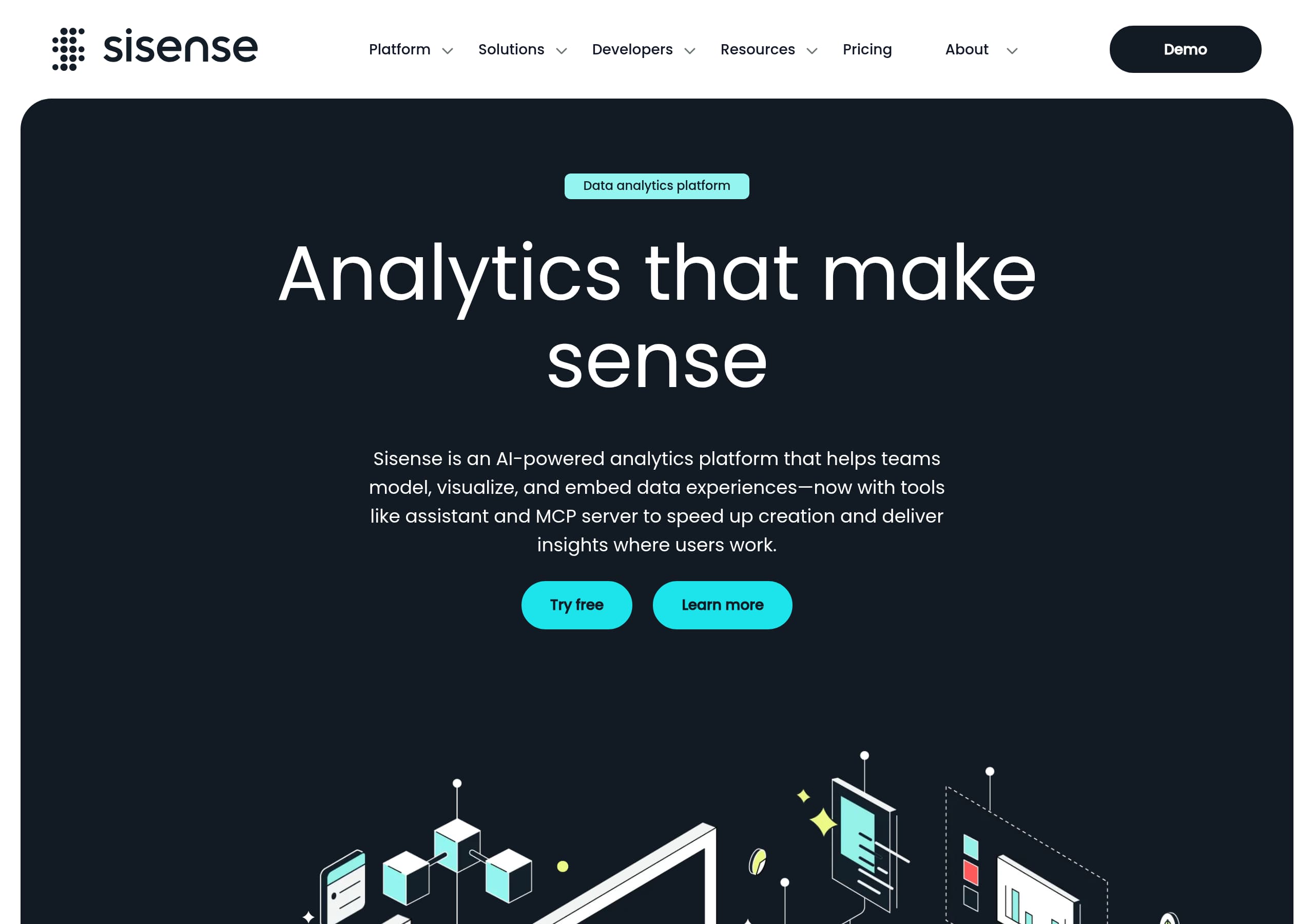
Sisense’s homepage is optimized to convert both business buyers and builders by leading with a simple promise, then immediately naming the technical primitives that make it believable. The hero pairs “Data analytics platform” with “Analytics that make sense,” and follows with a highly specific descriptor: AI-powered analytics platform that helps teams “model, visualize, and embed data experiences,” explicitly calling out assistant and an MCP server.
What stands out in the hero and above-the-fold
- Dual primary actions, Try free and Learn more, support two intents: hands-on evaluation vs. research.
- The value prop is not generic BI, it repeatedly centers embedded analytics and “deliver insights where users work,” which signals an in-product use case.
- Navigation is persona-based: Platform/Capabilities for evaluators, and a distinct Developers area with Documentation, Playground, Git integration, and GitHub, which reduces self-serve friction.
How the narrative moves visitors down the page
The page is structured into clear benefit modules that map to key jobs-to-be-done: “Build smarter, in less time,” “Go from data to insights in minutes,” and “Embed with precision and flexibility.” Each module includes concrete feature names like narrative, Compose SDK, and “reusable SDK components,” which reads like real product, not positioning.
Content that increases perceived modernity
Sisense reinforces an AI suite, “Sisense Intelligence,” and links it to practical outcomes: governed natural-language Q&A, summaries, anomaly surfacing, and predictive features like forecast and trend. The net effect is a homepage that stays readable for non-technical buyers while still giving developers enough specificity to trust the platform is implementation-ready.
Pricing
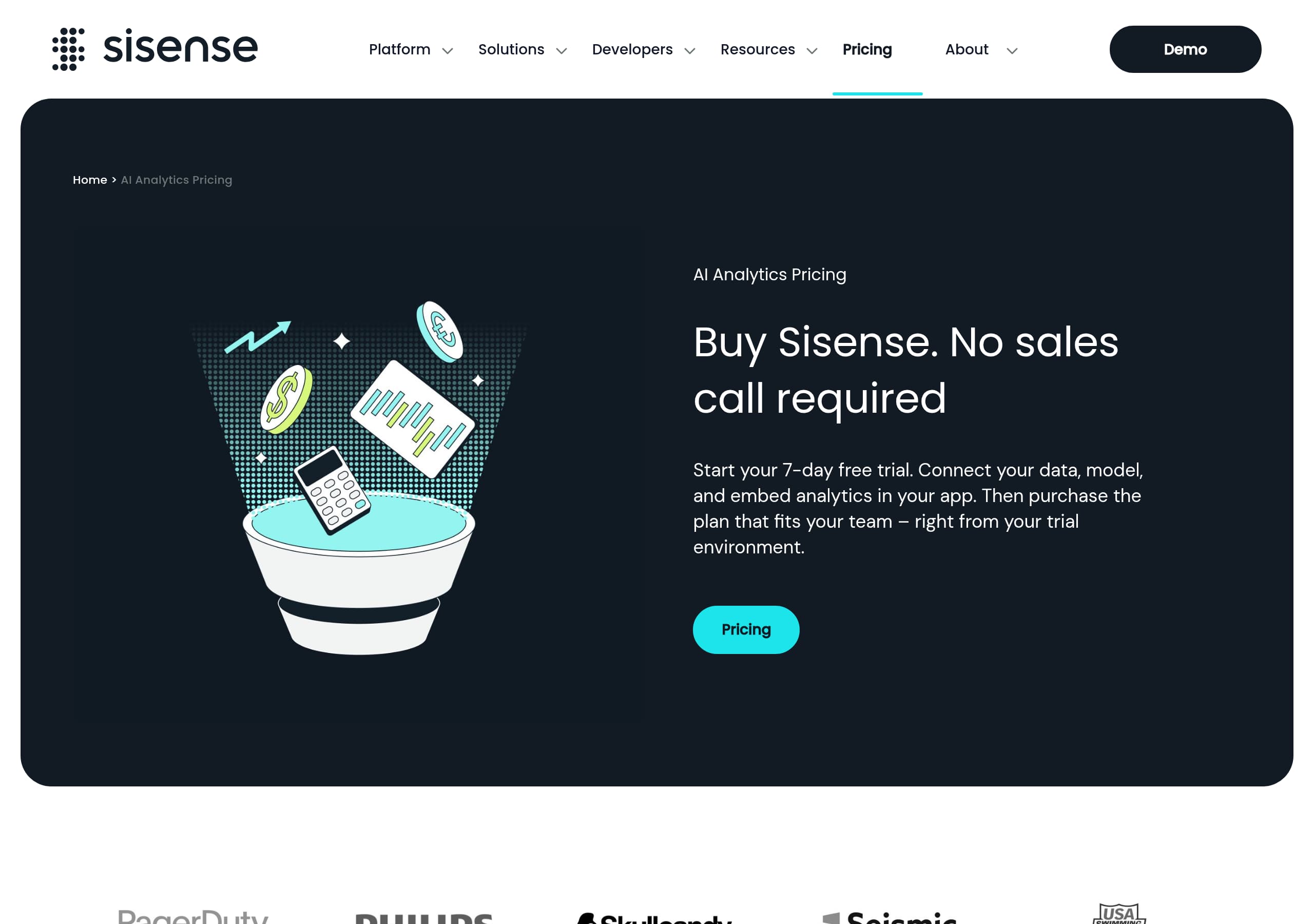
Sisense’s pricing experience is positioned more like enterprise software evaluation than self-serve checkout, with conversion paths that keep sales-assisted options prominent while still offering a low-friction trial. The global CTAs, Try free and “Book a live demo,” show up as the default decision fork, which fits a platform that commonly requires scoping, security review, and embedding requirements.
What the pricing page appears to optimize for
From the provided pricing screenshot context and the site’s repeated calls to action, Sisense is likely using pricing to:
- Encourage evaluation via 7-day trial rather than forcing plan selection upfront.
- Provide a demo path for teams who need architecture confirmation for embedded analytics and Compose SDK.
- Keep buyers moving without exposing potentially complex packaging (cloud, composable, embedded) too early.
Strengths for enterprise conversion
The strongest conversion element is the specificity around the trial: “Start your free trial,” “full-featured 7-day trial,” “guided sample data, or bring your own,” and “No setup required.” Those phrases answer the biggest pricing-adjacent objections: time, data access, and implementation burden.
Gaps and opportunities
If the pricing page leans heavily on “contact sales” style flows, Sisense can lose high-intent mid-market visitors who want quick ballpark costs. A strong compromise is to add scannable packaging anchors tied to the site’s own language, for example: embedded analytics, AI features (assistant, narrative), and developer tooling (Compose SDK). Even without dollar figures, clarifying what’s included in the full-featured trial and what typically requires an enterprise agreement would improve buyer confidence and reduce demo-only drop-off.
Features
Sisense presents features as outcome-led modules that still name the underlying components, which is especially effective for an embedded analytics platform. Instead of listing a long feature grid, the homepage excerpt shows four distinct capability blocks tied to Sisense Intelligence: building faster, self-serve insights, embedding flexibility, and predictive analytics. Each block includes concrete feature names like assistant, narrative, Compose SDK, and forecast/trend.
Feature positioning that maps to real users
- For creators: “Build smarter, in less time,” framed around building dashboards and embedding analytics, supported by “reusable SDK components.”
- For business users: “Go from data to insights in minutes,” emphasizing natural language questions over governed data and instant summaries.
- For developers: “Embed with precision and flexibility,” explicitly promising “maintain design control,” a key embedded analytics requirement.
- For analytics maturity: “Accelerate innovation with predictive analytics,” naming forecast and trend, plus anomaly surfacing.
Why the component names matter
Including product nouns like Sisense Intelligence and Compose SDK reduces ambiguity. Visitors can infer there is both an AI layer and a developer toolkit, not just “AI” as a vague label. Mentioning an MCP server in the hero also signals a forward-leaning integration story for teams experimenting with AI assistants and tool calling.
Opportunities to tighten feature comprehension
The site does a good job naming capabilities, but it could further improve scannability by adding 1 to 2 implementation cues per module, for example: where assistant lives (in-product builder vs embedded), what “governed data” means operationally, and how SDK embedding supports common frameworks. That said, the current structure already communicates a coherent set of differentiators: AI-assisted creation, embedded-by-design delivery, and developer control rather than one-size-fits-all BI.
Signup
Sisense’s signup pitch reduces friction by clarifying what happens after the click, not just offering a generic “Start free trial.” The page states: “Start your free trial,” “Get a full-featured 7-day trial with guided sample data, or bring your own. No setup required.” Those three specifics act like an onboarding checklist and significantly lower perceived effort for first-time evaluators.
What the signup flow is likely optimizing for
Based on the CTAs and trial copy, the intended flow appears to support two fast paths:
- A guided sandbox experience, “guided sample data,” for quick dashboard and AI feature exploration.
- A bring-your-own-data path for teams validating governance, embedding, and real workflows.
Conversion patterns on the page
Sisense repeatedly uses dual CTAs: Try free for self-serve evaluators and “Book a live demo” for higher-complexity buyers. This is a strong match for embedded analytics, where technical validation and stakeholder alignment often happen in parallel. The copy “Seamless analytics, right in your workflow” also reinforces the embedded mental model during signup, keeping the user anchored to the core value.
What to verify or improve in onboarding
To maximize completion, the signup form should keep the first step minimal, ideally email plus password or SSO choice, then route to persona selection (builder, developer, business user). Given the site’s developer emphasis (Documentation, Playground, Git integration), adding an immediate post-signup handoff, for example links to Compose SDK quickstart and a sample embedded app, would align onboarding with the developers-first promise. The current messaging is already strong because it sets expectations about time-to-first-value and avoids the common enterprise trap of vague trials with hidden setup steps.
Trust
Sisense communicates trust through information architecture and language that anticipates enterprise concerns, but most of the hard details appear to be one click deeper than the homepage. The top navigation includes a dedicated “Trust and security” section under Platform, and the footer repeats “Trust and security,” “Privacy policy,” and “Legal,” which signals that security is a first-class product concern rather than an afterthought.
Trust cues visible in the provided content
- A prominent navigation item for Trust and security suggests a standalone page with compliance and controls.
- Multiple testimonials mention production realities and security explicitly, for example “without sacrificing any of the security,” which supports buyer confidence even before seeing certifications.
- The site supports developer evaluation via Documentation and Developer Portal links, a softer trust signal that the product is well-supported and maintainable.
Where trust could be made more immediate
On the homepage itself, the strongest trust claims are social proof and the trial clarity. What is less visible in the excerpt is concrete security specificity such as SSO/SAML, SOC 2, ISO 27001, data residency, encryption, RBAC, audit logs, or uptime commitments. Even if these exist on the Trust and security page, adding one small “security strip” near the primary CTAs would help.
What best-in-class would look like
To reach standout trust performance, Sisense should surface 3 to 5 verifiable security markers above the fold or near pricing and trial CTAs, then link to details. The site already has the scaffolding, Trust and security in the nav and footer, plus enterprise-ready customer stories. Making the security posture more scannable earlier would reduce sales dependency and speed evaluation for regulated industries like healthcare and financial services.
Footer
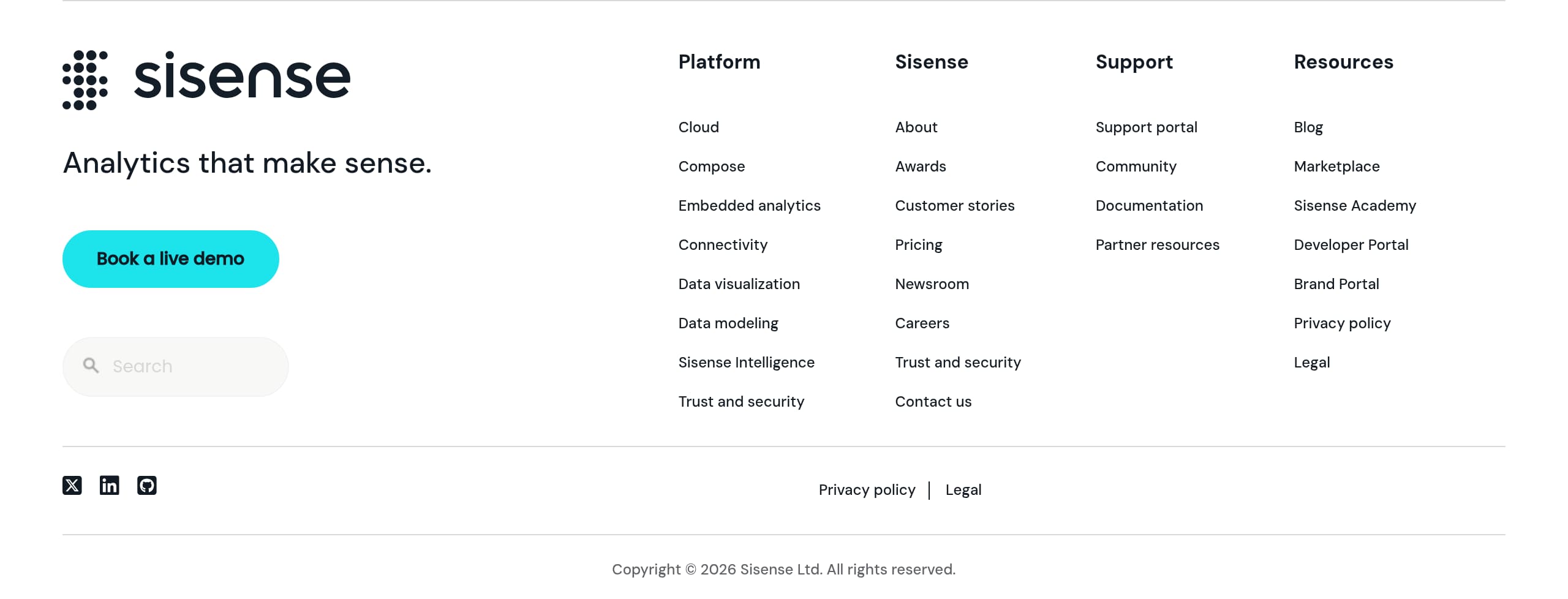
Sisense’s footer is built for enterprise navigation and governance rather than minimal marketing, and it supports SEO by exposing a large set of internal destinations. The footer includes structured columns for Platform (Cloud, Compose, Embedded analytics, Connectivity, Data visualization, Data modeling, Sisense Intelligence, Trust and security), company resources, and support paths. This is a strong pattern for a platform with multiple personas because it enables self-routing without relying on the top nav.
What the footer does well
- It mirrors key product entities like Sisense Intelligence and Trust and security, reinforcing topical relevance for search and for evaluators.
- It provides multiple help and learning endpoints: Support portal, Community, Documentation, Sisense Academy, Developer Portal, and Brand Portal.
- It includes standard legal governance links, “Privacy policy” and “Legal,” plus copyright “© 2026 Sisense Ltd.,” which adds legitimacy and reduces buyer doubt.
Conversion and intent capture
The footer supports both evaluation and education journeys by linking to Pricing, Customer stories, Marketplace, and Resources like Blog. For embedded analytics buyers, the presence of Developer Portal and Marketplace implies extensibility, which complements claims about SDK components and extensions.
Opportunities to improve usability
Given the density, the main risk is cognitive overload. Two improvements would keep the SEO value while improving scan speed:
- Group developer items into a clearly labeled cluster (Developer Portal, Documentation, GitHub resources) and keep it visually distinct.
- Add a lightweight “Contact us” or “Book a demo” link within the footer conversion cluster to match the site’s dual CTA strategy.
Overall, Sisense’s footer reinforces platform breadth, support maturity, and compliance hygiene, which helps close the trust gap for enterprise evaluation and improves discoverability across the site’s many capability pages.
Detected tech stack
Tools and technologies we detected on Sisense's site. Detection is best-effort and may be incomplete.
Scores
Our framework scores for Sisense's website in terms of clarity, conversion, and trust. See our methodology for how we calculate these.
How clear the value prop and structure are.
How conversion-friendly signup and pricing are.
How well trust and compliance are surfaced.
FAQ
Sisense leads with “Analytics that make sense” and quickly clarifies the embedded focus by stating it helps teams “model, visualize, and embed data experiences.” It reinforces that positioning with specific developer-facing terms like Compose SDK, reusable SDK components, and “maintain design control.” Dual CTAs, “Try free” and “Book a live demo,” support both self-serve evaluation and sales-assisted discovery.
Sisense emphasizes evaluation over plan shopping by steering visitors to “Try free” or “Book a live demo.” The site describes a “full-featured 7-day trial” with guided sample data or bring-your-own data, plus “No setup required,” which reduces friction without requiring visitors to choose a tier immediately. This approach fits enterprise embedded analytics where requirements often need scoping.
The trial messaging sets clear expectations: a full-featured 7-day trial, guided sample data, optional bring-your-own data, and no setup required. That framing suggests an onboarding experience designed for quick time-to-value. The site also supports builders and developers with links to Documentation, a Developer Portal, and community resources, which typically become key onboarding touchpoints after signup.
Sisense uses multiple attributed testimonials with customer names and titles, including Bigtincan, Barrios, USA Swimming, Funraise, and Bioforum. Several quotes reference production usage and security considerations, which reads as more credible than generic praise. Sisense also claims “500+ 5-star reviews,” and provides “Read the case study” links that let evaluators validate fit before committing to a demo.
Sisense includes a dedicated “Trust and security” destination in the main navigation and repeats “Trust and security” in the footer alongside Privacy policy and Legal links. While the homepage focuses more on AI features and embedded analytics benefits, the information architecture clearly indicates a separate security hub intended for enterprise review and procurement workflows.

The world's best-performing SaaS businesses share surprisingly similar patterns. We help you learn and apply them through our human-designed methodology, with AI-assisted research.