
Key takeaways
Here are the key insights from our website breakdown analysis of Slack.
Slack positions the product as an “AI Work Platform” with a single, memorable hero line (“Slack is your team’s collective brain”) and repeats two primary CTAs (“Get started” and “Request a demo”) to serve both self-serve and enterprise buyers.
The homepage is structured around a clear 4-part narrative—Knowledge, People, Process, Platform—so teams can map Slack to outcomes like faster context, better collaboration, automation, and secure integrations.
Slack uses quantified proof points (e.g., “97 min average time users can save weekly,” “700M messages sent daily,” “314 G2 market reports”) plus named customer stories (OpenAI, Box, Rivian) to reduce perceived risk.
Feature discovery is built for multiple entry points: a mega-menu by capability (Channels, Huddles, Canvas, Lists, Workflow Builder) and by audience (department/industry), improving findability and SEO coverage.
The site leans into Salesforce-native differentiation (Salesforce in Slack, Agentforce, a Salesforce company) to frame Slack as the system where customer data and agentic workflows meet conversations.
Home
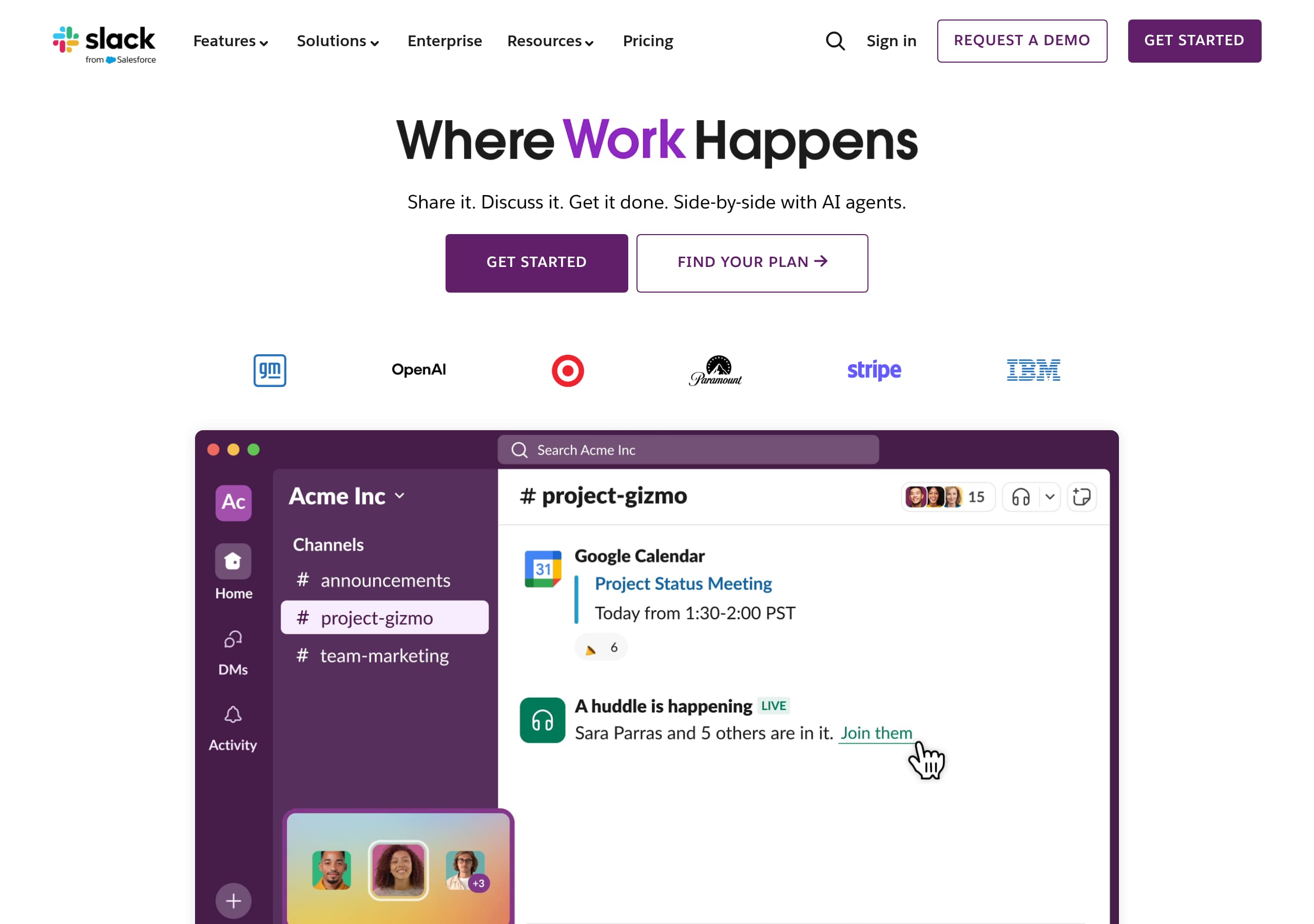
Slack’s homepage communicates the category shift immediately: “AI Work Platform” plus the hero promise “your team’s collective brain.” That pairing explains both what Slack is and why it matters without requiring product knowledge.
Key conversion mechanics are visible above the fold:
- Persistent CTAs for Get started, Find your plan, and Request a demo (self-serve vs. enterprise).
- A scrolling set of concrete jobs-to-be-done: “Plan launches,” “Run projects,” “Chat with clients,” “Ask an agent,” “Automate tasks.”
The page then uses a clear framework—Knowledge, People, Process, Platform—to organize a broad product into four outcome areas. Each subsection anchors AI to real actions (summaries, search, note-taking) and names recognizable integrations (Claude, GitHub Copilot, Agentforce). Quant stats like “97 min average time saved weekly” and visible customer stories (OpenAI, Box, Rivian) reinforce that the AI claims are operational, not speculative.
Pricing
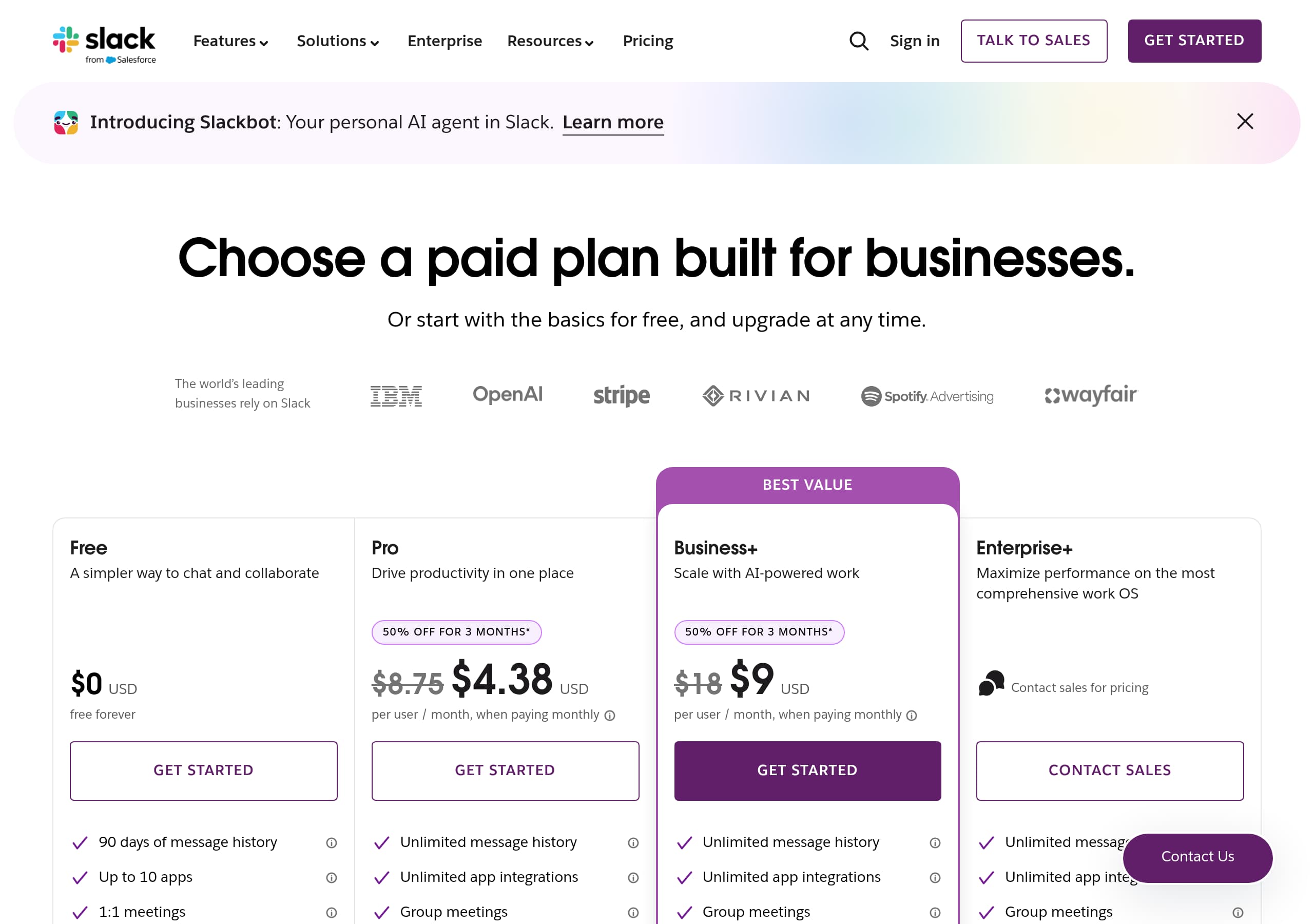
Slack’s pricing presentation (as shown in the pricing screenshot) is built to reduce comparison friction with a plan grid and repeated primary CTA placement. The site consistently routes visitors through “Find your plan,” which signals an assisted choice rather than a one-size-fits-all checkout.
What makes the pricing UX conversion-friendly:
- Plan comparison is scannable: users can evaluate value by reading down columns instead of hunting in paragraphs.
- The navigation keeps Request a demo available, acknowledging that Enterprise buyers may need procurement steps.
- Copy on the main site reinforces pricing value with quantified outcomes (e.g., “97 min saved weekly,” “35% increase in time saved”), which helps justify per-seat spend.
A practical strength is how pricing aligns to feature families shown elsewhere (AI in Slack, Security, Integrations). That continuity reduces mismatch between what the hero promises and what a plan appears to include, improving decision confidence for both SMB and enterprise evaluators.
Features
Slack’s feature presentation works because it’s organized like a product map, not a long list. The navigation and page content group capabilities into Collaboration, Project Management, Platform, Intelligence, and Admin & Security, making the surface area easier to scan and remember.
Specific, observable feature patterns:
- Familiar primitives (Channels, Huddles, Canvas, Lists, Workflow Builder) reduce learning anxiety.
- Each feature is paired with an outcome verb (“Organize teams,” “Automate everyday tasks,” “Find anything”), clarifying value without demos.
- AI is embedded across workflows: summaries, AI note-taking in huddles, and Enterprise Search “from a single search bar.”
Slack also highlights ecosystem extensibility: “From Atlassian to Zoom… Google Drive… ChatGPT… Workday,” plus a dedicated Slack Marketplace for apps and agents. This positions Slack as an integration layer and automation hub, not only a chat app—important differentiation versus point tools like Zoom Chat or standalone project trackers.
Signup
Slack supports two onboarding intents—fast self-serve and sales-led evaluation—by keeping Get started and Request a demo visible in the header and repeated throughout the page. That reduces dead-ends for different buyer types (individual users, team leads, IT, procurement).
What’s effective in the signup funnel cues from the live content:
- Multiple “start now” routes: Get started, Download Slack, and “Find your plan,” which match desktop app installs and web-first adoption.
- Contextual activation prompts: examples like “Summarize a conversation you missed” and “Turn on AI note-taking in huddles” tell new users what to do on day one.
- Enterprise readiness is signposted early (Security, Enterprise Key Management, Slack Atlas), which prevents later-stage objections from blocking rollout.
Because Slack is often adopted bottom-up, the site’s constant availability of self-serve CTAs is a conversion advantage. At the same time, the demo path accommodates complex org requirements and positions Slack as scalable infrastructure.
Trust
Slack builds trust by combining explicit security navigation, enterprise admin features, and “audit-like” footnotes for performance claims. The header includes an Admin & Security cluster (Security, Enterprise Key Management, Slack Atlas), which signals governance is a first-class product area, not an afterthought.
Trust signals visible in the provided content:
- Security positioning: “Protect data, ensure compliance” and “If it’s shared in Slack, it’s safe,” reinforced by a dedicated security program page.
- Enterprise controls: Enterprise Key Management is named directly, implying customer-managed access revocation and stronger compliance posture.
- Data transparency: stats and outcomes (97 minutes saved, 35% time saved via automations) include footnotes with timeframes (FY24/FY25) and sample sizes.
Slack also benefits from parent-company credibility (“Slack Technologies, LLC, a Salesforce company”) and tight integration messaging (“Salesforce in Slack,” Agentforce). Together, these elements reduce perceived risk for regulated industries comparing Slack to Microsoft Teams or legacy email workflows.
Footer
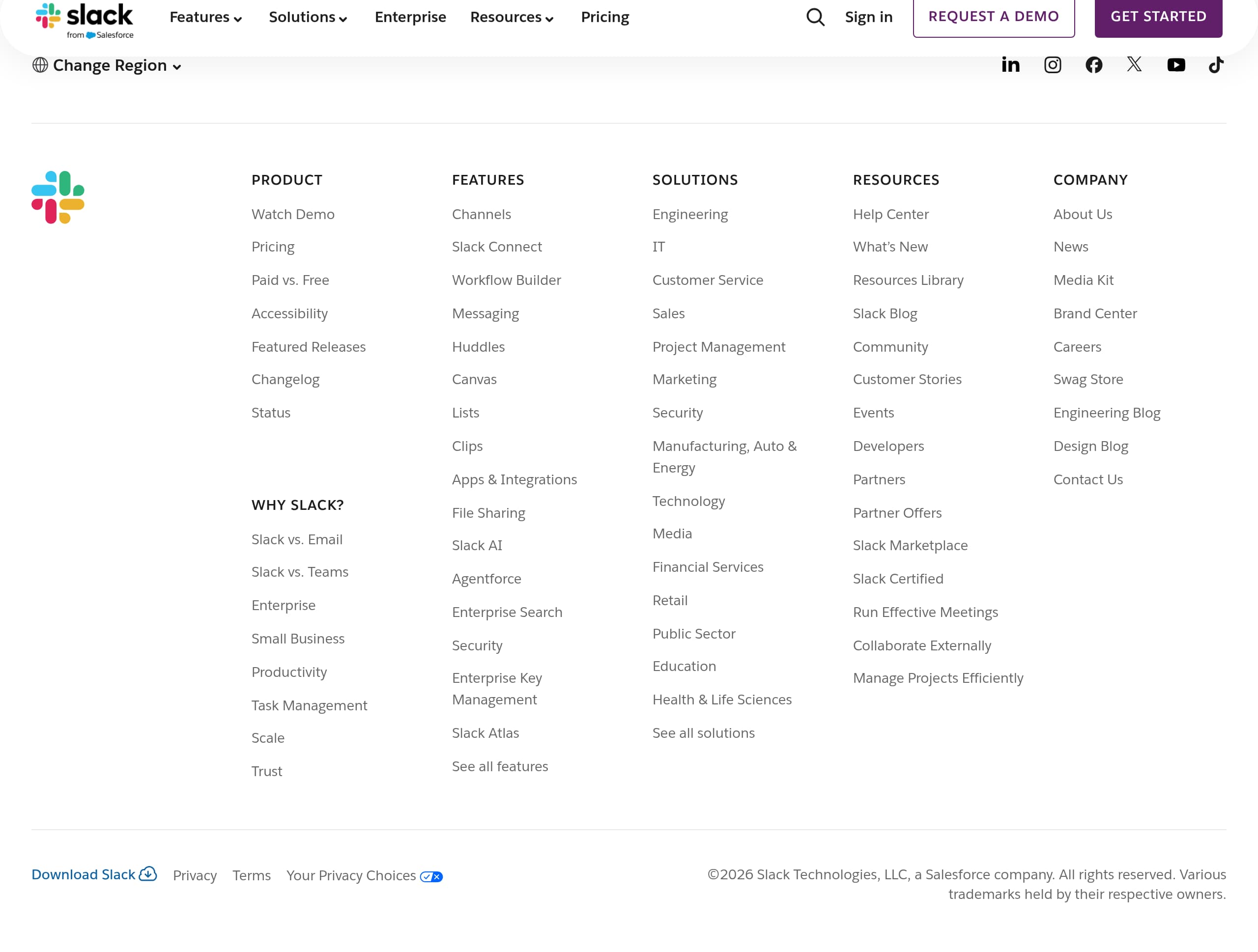
Slack’s footer is structured like an information architecture index, which improves discoverability, SEO coverage, and buyer self-education. It clearly separates Product, Why Slack, Features, Solutions, Resources, and Company—useful for both IT evaluators and end users.
Observed footer strengths (from the screenshot and excerpt):
- Direct paths to conversion and evaluation: Watch Demo, Pricing, Paid vs. Free, and Enterprise.
- Strong support ecosystem: Help Center, Customer Support, Status, Changelog, and Accessibility—signals operational maturity.
- Ecosystem depth: Slack Marketplace, Developers, Partners, and Slack Certified, which reinforces that Slack is a platform, not a single app.
Compliance and legal clarity is present with Privacy, Terms, Cookie Preferences, and “Your Privacy Choices,” plus region/language switching (“Change Region”) for global use. The ownership line “Slack Technologies, LLC, a Salesforce company” adds corporate provenance. Overall, the footer reduces friction for procurement research and helps visitors find security, policy, and support pages without search.
Detected tech stack
Tools and technologies we detected on Slack's site. Detection is best-effort and may be incomplete.
Scores
Our framework scores for Slack's website in terms of clarity, conversion, and trust. See our methodology for how we calculate these.
How clear the value prop and structure are.
How conversion-friendly signup and pricing are.
How well trust and compliance are surfaced.

The world's best-performing SaaS businesses share surprisingly similar patterns. We help you learn and apply them through our human-designed methodology, with AI-assisted research.