
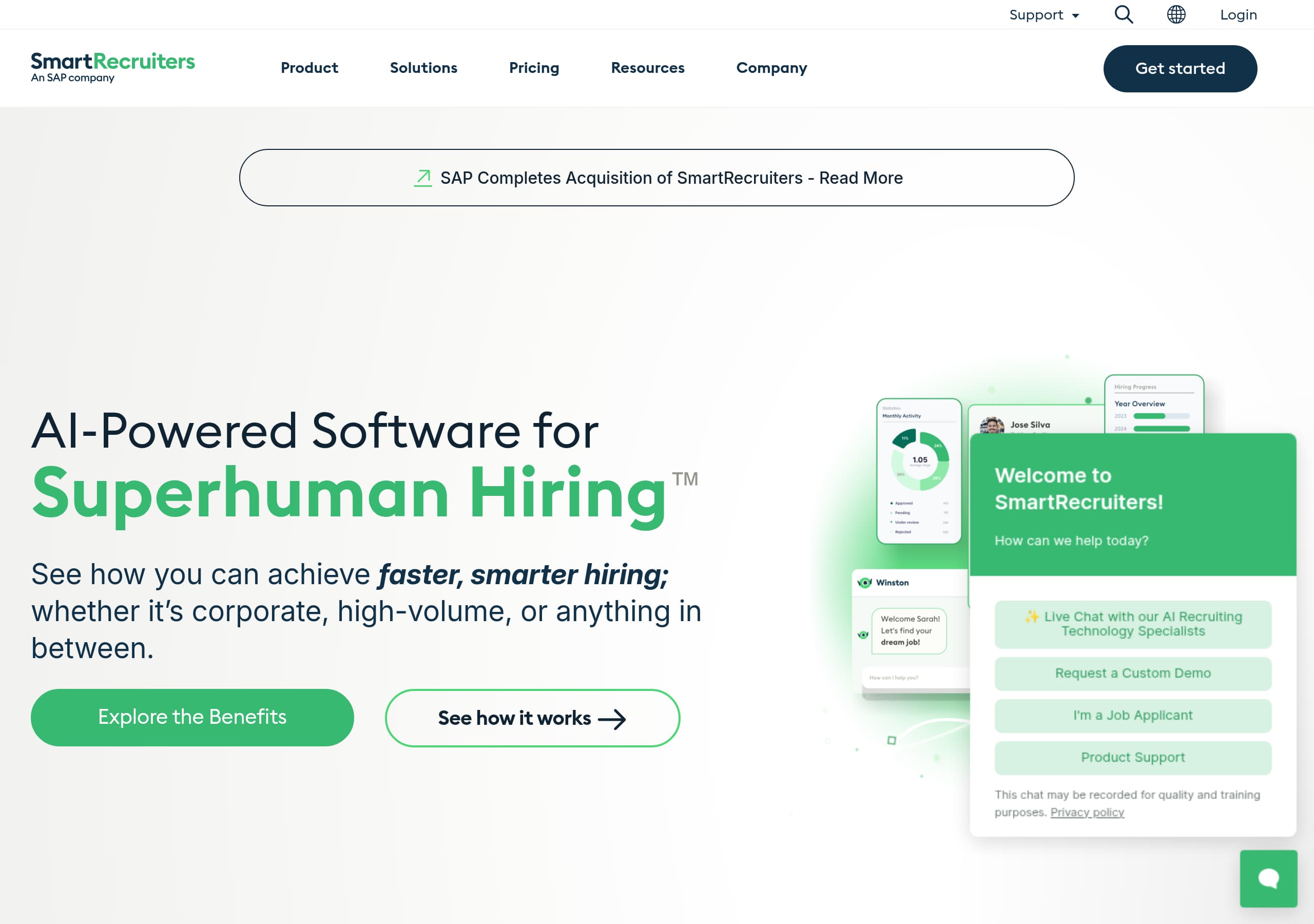
Key takeaways
Here are the key insights from our website breakdown analysis of SmartRecruiters.
SmartRecruiters makes its positioning explicit by pairing an end-to-end platform label, "SmartOS Platform," with an AI layer, "Winston Intelligence," so enterprise buyers can quickly map the product to their hiring workflow.
The homepage uses dual CTAs, "Speak with a sales rep" and "See a demo," then reinforces them with repeated "See a demo" placements to keep enterprise conversion paths consistently available.
The site improves qualification and sales efficiency by clearly stating who the product is for, including corporate hiring, not agencies, and a minimum scale expectation of at least 50 employees and significant requisition volume.
Pricing is presented as an enterprise conversation rather than self-serve checkout, which aligns to ATS buying behavior, but it also means the site must rely on ROI tools and case studies to reduce perceived risk.
Social proof is unusually concrete for an enterprise ATS site, combining a "4,000" customer claim, recognizable logos, a Gartner Magic Quadrant leader callout, and multiple named testimonials with quantified outcomes.
The features architecture mirrors a full-funnel hiring journey, Attract, Select, Hire, making it easier for stakeholders like HR, IT, and hiring managers to find relevant capabilities without reading long narrative pages.
Trust is supported by dedicated destinations such as "Trust Center," "Developer Documentation," and "Product Status," which helps both security reviewers and technical evaluators validate the platform beyond marketing copy.
Home
SmartRecruiters’ homepage is optimized for enterprise evaluation because it anchors on a complete platform narrative, then layers AI as an accelerator, not a separate product. The nav and hero quickly establish scope with "Talent Acquisition and Recruitment Software - AI-Powered" plus the paired modules SmartOS Platform and Winston Intelligence, which signals end-to-end coverage and an AI differentiation in the same viewport.
What you can observe on the page
- Prominent enterprise CTAs, including "Speak with a sales rep" and "See a demo", appear alongside a persistent "Get started" entry in the top navigation.
- A clear product architecture appears early, with three pillar links: platform, AI layer, and platform integrations via a marketplace.
- The homepage uses a funnel-based feature map, Attract, Select, Hire, with specific feature labels like Conversational AI Chat, Applicant Tracking, AI-Powered Candidate Screening, Dynamic Scheduling, Offer Management, and New Hire Onboarding.
Why the messaging converts for complex buying teams
The middle of the page shifts from claims to quantified outcomes, listing percentage improvements such as "Reduction in time-to-hire" and a "Reduction in scheduling administration work." Even without validating methodology, the inclusion of multiple metrics functions as decision support for HR and finance stakeholders, especially when paired with "Calculate your ROI" in the Resources menu. The copy also frames the AI layer as operational help, "anticipates your needs" and "reduces admin work," aligning to a do more with less narrative.
What could be clearer
Because the site serves multiple segments, the role and use-case navigation is extensive (roles, use cases, industries). This breadth is helpful, but it can dilute the primary storyline unless the hero and early modules keep re-centering on the end-to-end talent operating system positioning, which the page does reasonably well via repeated SmartOS references.
Pricing
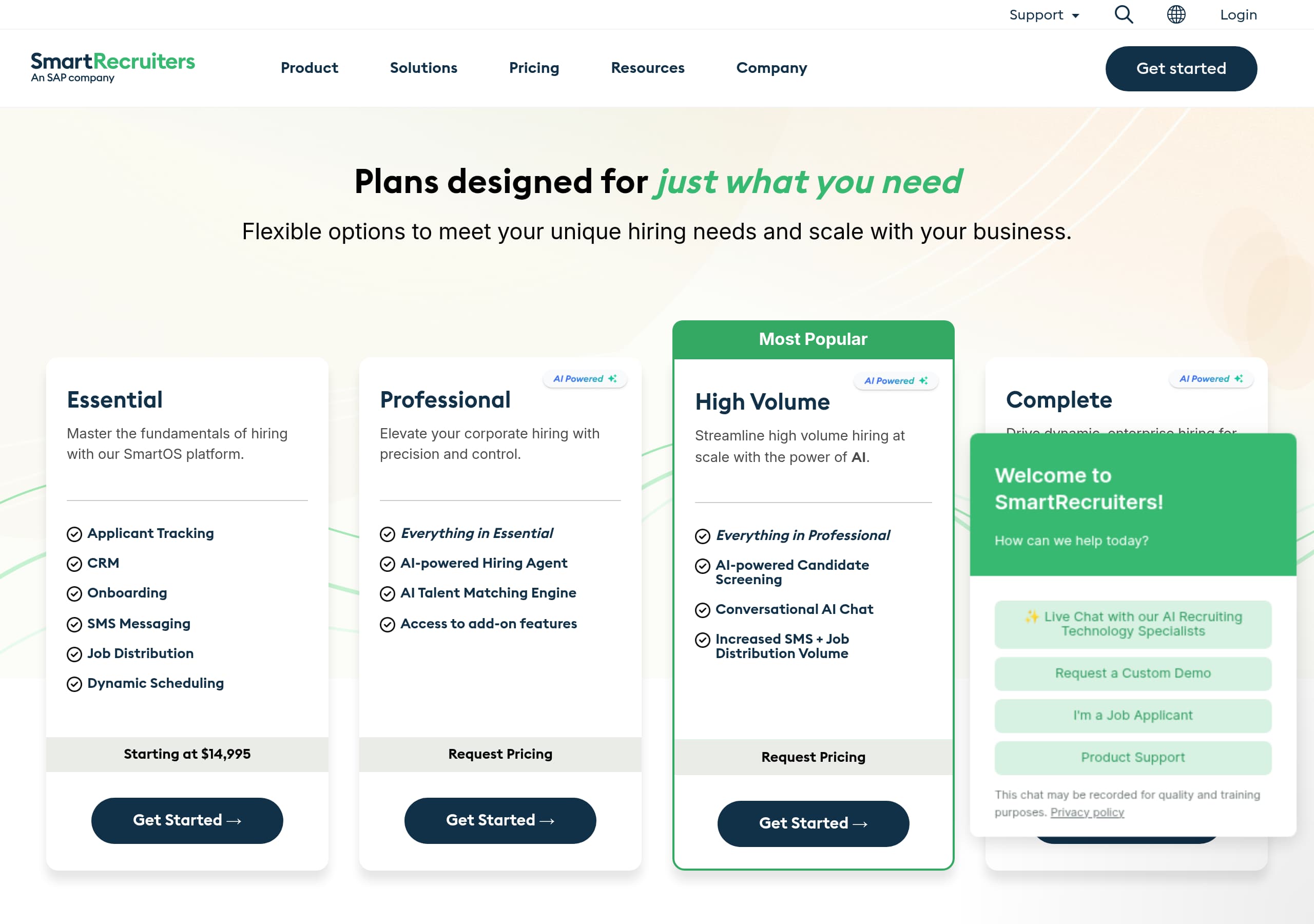
SmartRecruiters approaches pricing as an enterprise sales motion, not a self-serve checkout, which matches how ATS and recruiting suites are typically purchased. Instead of leading with a price table, the site routes intent toward "See a demo" and "Speak with a sales rep," while offering buyer enablement tools like an ROI calculator and RFP builder to compensate for the lack of public numbers.
What the pricing experience communicates
From the navigation and page structure, pricing sits alongside product and solutions, indicating it is a primary decision page, not a hidden link. However, the broader site repeatedly reinforces assisted conversion, with CTAs like "Book a Demo" and "Chat with sales." This suggests the pricing page likely emphasizes packaging and fit rather than exact fees, a common approach for enterprise hiring platforms where costs depend on requisition volume, modules, and integrations.
Strengths for enterprise buyers
- Qualification is explicit: the chat flow states the product is best suited for corporate hiring, not agencies, and for organizations with at least 50 employees and a significant number of open requisitions. That pre-frames pricing expectations and reduces mismatched conversations.
- The site provides procurement support paths: "Build your RFP" and a "ROI Calculator" are positioned as resources, which reduces friction for formal buying processes.
- The product is organized into clear capability groups, SmartOS core platform plus optional AI and integrations, which makes it easier to understand what pricing could vary by.
Where pricing clarity could improve
If the pricing page is primarily lead-gen, it risks leaving buyers uncertain about baseline affordability. A practical improvement would be to add packaging cues, for example, module bundles aligned to mid-size enterprises versus enterprise hiring, plus explicit “talk to sales” context like what inputs affect quotes (employees, annual hires, locations). That keeps the enterprise motion while improving buyer confidence.
Features
SmartRecruiters’ features are structured like a hiring lifecycle map, which makes the product easier to evaluate across stakeholders. Instead of a flat feature list, the site groups capabilities into Attract, Select, and Hire, mirroring how talent acquisition teams actually run processes from sourcing to onboarding.
What the feature system includes
- Attract features: Conversational AI Chat (labeled NEW), Career Websites, Job Distribution, CRM, Text Recruiting.
- Select features: Applicant Tracking, AI Talent Matching Engine (NEW), AI-Powered Candidate Screening (NEW), Dynamic Scheduling.
- Hire features: AI-Powered Hiring Agent (NEW), Analytics & Insights, Offer Management, New Hire Onboarding.
This taxonomy also supports internal selling. A TA leader can start with business problems like sourcing or scheduling, while IT can focus on Platform Integrations and the marketplace, and HR can evaluate onboarding and analytics.
Why the page is effective for evaluation
SmartRecruiters uses two complementary product entities, SmartOS and Winston, to explain the platform: SmartOS is the end-to-end suite, Winston Intelligence is the AI layer that “anticipates your needs” and “reduces admin work.” That is a useful framing because it suggests AI is embedded across the workflow, not a single chatbot feature. The inclusion of multiple NEW tags is also a subtle signal of active development and a modern roadmap.
What would make the feature story even stronger
The site could reduce ambiguity by adding a consistent “how it works” pattern per pillar, for example:
- 1 to 2 screenshots per feature cluster
- a short workflow sequence, such as post job, screen, schedule, offer
- integration callouts, such as HCM connectivity, since "Standalone or integrated with your favorite HCM" is mentioned
That would make the end-to-end talent operating system claim more visual, helping non-technical buyers validate fit faster without needing a demo.
Signup
SmartRecruiters’ signup is intentionally sales-led, and the site makes that explicit through demo and chat flows that qualify prospects before handing them to sales. This is appropriate for an enterprise ATS, where onboarding usually involves configuration, integrations, and stakeholder training, but it means conversion hinges on how smoothly the demo request and qualification steps work.
What the site does well in the signup path
- Multiple clear CTAs: "See a demo", "Speak with a sales rep," and "Book a Demo" appear across the experience, ensuring there is always a next step.
- Real-time assistance: a "Chat with sales" and "Chat Live" option is shown, suggesting a live qualification layer rather than email-only follow-up.
- Strong lead qualification copy: the chat message states the product is best for corporate hiring, not agency organizations, and flags that it is best suited for companies with at least 50 employees and significant open requisitions. It also redirects job seekers to resources, preventing dead-end form fills.
Why this increases close rate, not just lead volume
By pre-qualifying, SmartRecruiters likely reduces inbound noise and improves speed-to-meeting for qualified buyers. It also sets expectations that this is not a lightweight tool, which can reduce churn risk from misfit customers. The site supports evaluation content around signup with "Calculate your ROI," "Build your RFP," and success stories, which helps prospects build internal buy-in before the first call.
Friction points to watch
Sales-led flows can feel opaque if the user cannot estimate cost or implementation complexity. SmartRecruiters partially offsets that with resources, but could further improve by adding a short “what happens after you request a demo” timeline, for example, discovery call, tailored demo, security review, pilot. That would make the See a demo CTA feel more predictable and lower perceived effort.
Trust
SmartRecruiters supports enterprise trust requirements by exposing multiple “proof” destinations beyond marketing pages, including a Trust Center, product status, and developer documentation. This matters for ATS buyers because procurement and security teams often need evidence of controls, uptime practices, and integration support before they approve a vendor.
Trust signals observable from the site structure
- A dedicated Trust Center link appears in the top utility navigation and footer, suggesting a formal place for security and compliance information.
- "Developer Documentation" and "Platform Integrations" are prominent, reinforcing that SmartRecruiters expects technical evaluation and supports integration work.
- "Product Status" appears in the footer, a specific and credible pattern that signals operational transparency.
How trust is reinforced through content
The site also uses third-party credibility cues, including the Gartner Magic Quadrant leader callout with a report CTA. While analyst recognition is not a security control, it does indicate market validation and can help buyers reduce shortlist risk. Additionally, the site references multiple roles (IT, Finance, Developers) and topics like AI Security and Compliance in navigation, which implies content exists for governance and responsible AI conversations.
What could strengthen trust for AI-led recruiting
Because the product highlights Winston Intelligence and multiple AI features, enterprise buyers will look for clear AI governance language: data usage boundaries, model behavior, and auditability. The navigation already includes “AI” and “Security and Compliance,” so the next step is to ensure those pages contain scannable answers that procurement teams ask, such as data retention, customer data isolation, and how AI suggestions are reviewed by humans. Linking the Trust Center directly from AI feature pages would tighten the story.
Overall, SmartRecruiters’ trust posture reads as designed for enterprise review: transparent status, a security-focused hub, and pathways for both business and technical validation without forcing everything through a sales call.
Footer
The SmartRecruiters footer is built for enterprise evaluation and governance, not just basic navigation. It functions like a site map for multiple buyer personas, while also covering legal and operational transparency requirements that appear in later-stage procurement.
What the footer contains that matters
- Product architecture links: SmartOS Platform, Winston Intelligence, Platform Integrations, plus grouped feature areas under Attract, Select, and Hire.
- Buyer enablement: links to Marketplace, Product Updates, an RFP template, an ROI tool, and a glossary, which are practical for procurement and internal champions.
- Competitive comparison pages: "SmartRecruiters vs. Workday", "vs. iCIMS," "vs. Greenhouse," "vs. Paradox," and "vs. Phenom" are listed, which helps capture high-intent search traffic and keep evaluators on-site.
- Support and trust destinations: Community & Help Center, Trust Center, Developer Documentation, Product Status, and logins for customers and partners.
Why this footer is conversion-supportive
The footer reduces friction for different stakeholders arriving from different entry points, such as an IT evaluator looking for docs, or a TA leader looking for ROI proof. Including both “Contact Us” and logins makes the footer useful for existing customers too, not just new leads.
Governance and compliance cues
Legal links like cookie policy, privacy policy, legal imprint, and a visible copyright line help with compliance hygiene. The presence of “Status & Trust” and a trust hub is especially valuable for enterprise SaaS, where security reviewers often scroll for these links as a quick sanity check.
Improvement opportunity
Because the footer is dense, grouping links into fewer, clearly labeled columns, for example “Evaluate,” “Build,” “Trust,” could improve scan speed. Even small UI tweaks like emphasizing Trust Center and Developer Documentation could further support enterprise buying journeys without changing content depth.
Detected tech stack
Tools and technologies we detected on SmartRecruiters's site. Detection is best-effort and may be incomplete.
Scores
Our framework scores for SmartRecruiters's website in terms of clarity, conversion, and trust. See our methodology for how we calculate these.
How clear the value prop and structure are.
How conversion-friendly signup and pricing are.
How well trust and compliance are surfaced.
FAQ
SmartRecruiters quickly clarifies scope and differentiation by pairing “SmartOS Platform” (end-to-end hiring) with “Winston Intelligence” (AI layer). The page maps features into Attract, Select, and Hire, and it repeats clear CTAs like “See a demo” and “Speak with a sales rep.” It also includes quantified outcome claims and links to resources like ROI and RFP tools to support internal buy-in.
SmartRecruiters uses a sales-led pricing approach rather than publishing a self-serve price table. The site pushes evaluation actions like “See a demo,” “Book a Demo,” and “Chat with sales,” and it supports the pricing conversation with procurement-friendly resources such as an ROI calculator and RFP builder. This matches typical ATS buying behavior where costs depend on scale, modules, and integrations.
Signup is oriented around requesting a demo and speaking to sales, with chat available for real-time help. The chat flow qualifies visitors by noting the product is designed for corporate hiring, not agencies, and that it best fits organizations with at least 50 employees and meaningful hiring volume. This reduces low-fit leads and sets expectations that onboarding is guided rather than instant self-serve.
SmartRecruiters combines a Gartner Magic Quadrant leader recognition with breadth and depth signals. It claims over 4,000 customers, shows a “trusted by” logo section, and publishes named testimonials with company attribution and quantified outcomes, such as time-to-hire reduction and turnover reduction. Case study CTAs like “Read the Full Case Study” reinforce that these are expandable proof points, not anonymous quotes.
The site links to a dedicated Trust Center and also surfaces Product Status and Developer Documentation in the navigation and footer. These destinations are common enterprise evaluation requirements, helping security and IT teams validate operational transparency and integration readiness. The broader navigation also includes topics like AI and security/compliance, indicating additional governance content intended for procurement reviews.

The world's best-performing SaaS businesses share surprisingly similar patterns. We help you learn and apply them through our human-designed methodology, with AI-assisted research.