
Key takeaways
Here are the key insights from our website breakdown analysis of Teamtailor.
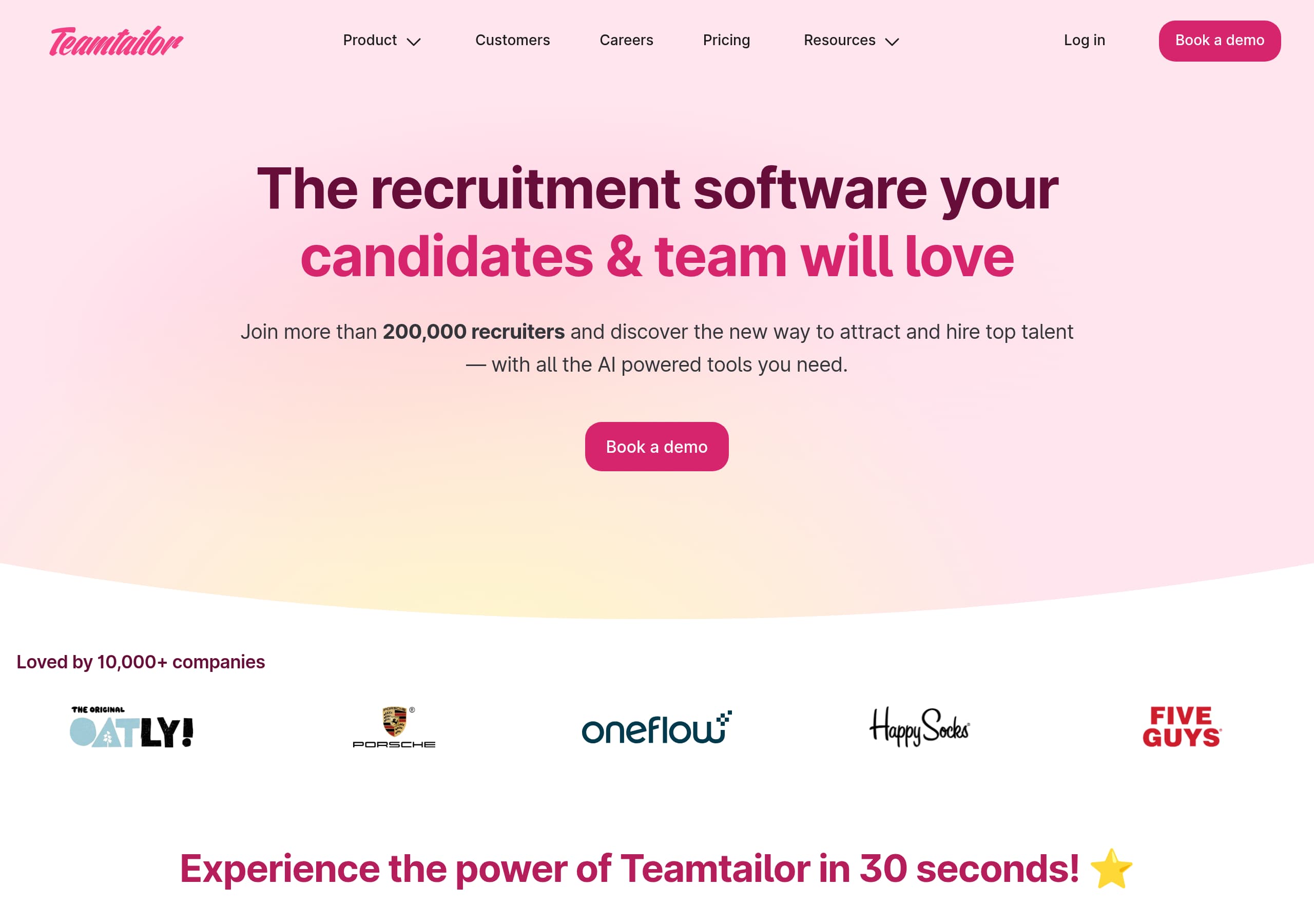
Teamtailor’s homepage makes the positioning unmissable by pairing a single-sentence value prop about a “next-generation ATS and employer brand” with a primary CTA (“Book a demo”) and immediate credibility (“Trusted by 10,000+ companies”).
The site converts across multiple intent levels by offering both “Book a demo” and “Get to know Teamtailor in 30 seconds!”, which supports buyers who want a sales-led demo and evaluators who want a fast product taste.
Social proof is a core page component, not a footer afterthought: named customer quotes (role + company) appear high on the page, followed by a long review wall that reduces perceived risk for ATS switching.
Teamtailor differentiates on candidate experience and employer branding, not just pipeline management, reinforced by repeated language like “candidate experience,” “careers pages,” and “job board integrations.”
The navigation and segmentation (“for enterprises” 1,000+ employees and “for SMBs” 0–1,000) clarifies product fit and routes users to the right story without forcing them through generic ATS messaging.
Trust is strengthened with concrete operational signals like “updates every 8 weeks,” “dedicated Customer Success Manager,” and “real-time chat support,” plus explicit policy links in the footer for privacy and security expectations.
Home
Teamtailor’s homepage succeeds because it states the category and the differentiator in one breath: “a next-generation recruiting system” paired with employer branding and candidate experience. The hero immediately supports that promise with two conversion paths: a primary CTA “Book a demo” and a fast self-serve exploration option “Get to know Teamtailor in 30 seconds!”, which reduces bounce for users who are not ready to talk to sales.
A few observable homepage patterns strengthen clarity and flow:
- The top navigation is solution-led, not feature-led: “Recruiting tool”, “Employer branding”, “Excellent candidate experience”, plus Co-pilot AI. This makes it easier for HR and Talent Acquisition buyers to map the product to their internal pain points.
- Segmentation is explicit: “Teamtailor for enterprises (Over 1,000 employees)” and “for SMBs (0–1,000 employees)”. That reduces uncertainty about fit and pricing expectations.
- Proof appears early and in multiple formats: “Trusted by 10,000+ companies”, plus a “⭐ What our customers are saying 💖” block with named quotes.
The mid-page structure is outcome-first, then product: “Better results”, “Optimized recruiting”, then two parallel storylines—one about employer branding and conversion, another about streamlining with an ATS. The line “Teamtailor isn’t just a system. It’s a way of working.” is a strong positioning statement, but it stays grounded by listing operational specifics like updates every 8 weeks and 450+ integrations.
Pricing
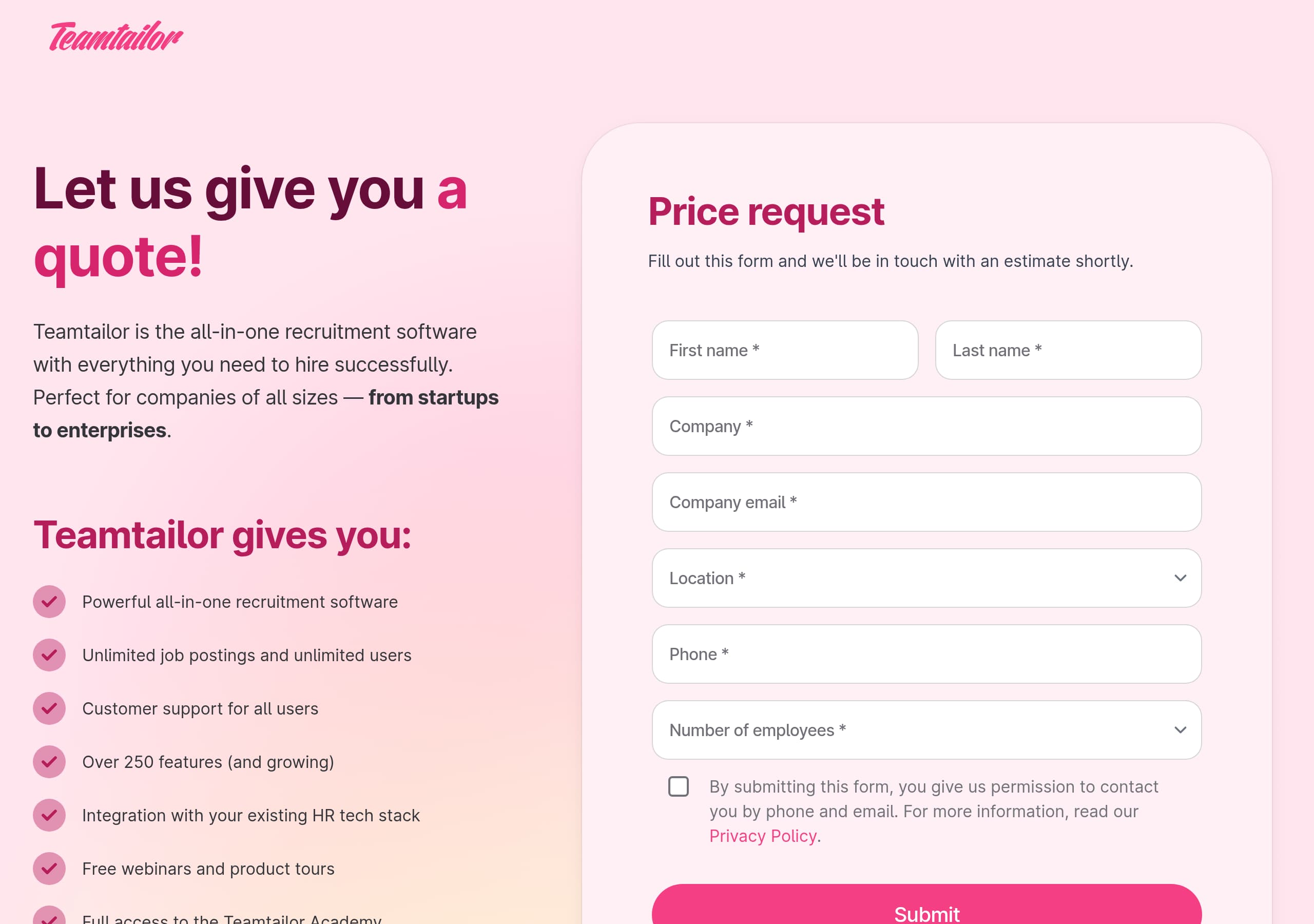
Teamtailor’s pricing presentation (as shown in the pricing screenshot) appears built to move users into a conversation rather than to enable pure self-checkout, which matches how ATS deals are commonly sold. The key conversion benefit is that the pricing page likely mirrors the site’s recurring demo-first pattern, keeping “Book a demo” visible as the next step for buyers who need a quote, procurement alignment, or enterprise requirements.
From the site-wide cues in the provided content, a few tactical pricing dynamics are evident even before line-item costs:
- The product is positioned as a platform: ATS plus employer branding plus automation, reinforced by statements like “Teamtailor isn’t just ATS software—it’s a comprehensive recruiting system”. This framing increases willingness to pay because the comparison set becomes “multiple tools” instead of “one ATS.”
- Segmentation elsewhere (SMB vs enterprise) suggests pricing likely needs nuance by company size, which is consistent with the visible enterprise and SMB pathways.
- The page’s conversion goal is supported by adjacent trust: the homepage repeatedly highlights dedicated Customer Success Manager, real-time chat support, and onboarding support, all of which reduce pricing objections around adoption.
What Teamtailor does well is pre-handle typical ATS pricing questions through surrounding content: integrations (“450+ powerful integrations”), continuous improvement (“updates every 8 weeks”), and candidate experience benefits. One improvement that would increase pricing-page conversion is adding more explicit “what’s included” modules in the pricing context—for example, a short checklist tying packages to Co-pilot AI, careers-site customization, and automation triggers—so users can self-qualify before booking the demo.
Features
Teamtailor’s feature story is strongest when it stays tied to outcomes: attracting applicants, improving candidate experience, and delegating repetitive work. Instead of listing isolated capabilities, the copy repeatedly anchors to workflows like “Streamline recruiting with our ATS” and “Attract and convert with strong employer branding,” which is more persuasive for cross-functional buying committees.
Several concrete feature clusters are visible in the excerpt:
- Candidate-facing experience: “highly customizable careers pages” and “a great experience” position the careers site as a differentiator, not a checkbox. This aligns with Teamtailor’s employer-branding angle.
- Automation and AI: “automated triggers” and Co-pilot AI are presented as time savers, framed as “Let us do the heavy lifting.” This is effective because the benefit is explicit, not just “AI-powered.”
- Integrations as a platform: “450+ powerful integrations” and “Meet 450+ of our friends” make ecosystem breadth a headline feature, which matters in ATS evaluations (job boards, HRIS, SSO, assessments).
- Service as a feature: “Personalized live customer support”, plus local, real-time support, is positioned alongside product capabilities, which can be decisive for teams migrating from a legacy ATS.
A subtle but important pattern is cadence: “updates every 8 weeks” implies an active roadmap and reduces fear of stagnation. A potential improvement is to show a tighter “feature to proof” loop in the same section—for example, pairing each cluster with a one-line customer outcome (already available elsewhere on the page) to prevent users from having to connect the dots across sections.
Signup
Teamtailor’s signup motion is clearly optimized for sales-assisted evaluation: the dominant CTA across the homepage content is “Book a demo”, and the footer repeats “Contact us”. This suggests the primary onboarding route is a demo-booking flow rather than a fully self-serve trial, which is common for ATS platforms where configuration, integrations, and permissions matter.
Even without a visible step-by-step form in the provided excerpt, the site provides multiple “soft-entry” paths that reduce friction before a buyer commits:
- A quick product preview CTA: “Get to know Teamtailor in 30 seconds!” caters to evaluators who want to see UI and value quickly.
- Clear segmentation before signup: enterprise vs SMB routes help users self-identify, which typically improves lead quality and lowers sales-cycle back-and-forth.
- Support-forward onboarding promise: “Fast and easy onboarding” plus “weekly training for all new users” sets expectations that adoption is guided—a critical concern when switching an ATS mid-year.
What works especially well is that onboarding is positioned as an experience, not a checklist: Dedicated Customer Success Manager and “real-time chat support for all users” are presented as part of the product. That reduces anxiety around implementation and change management.
The main opportunity is to make the “self-serve” path more explicit if Teamtailor offers it. The closing CTA line “Contact us or try independently” hints at an independent try option, but the homepage prioritizes demos. If a trial exists, a secondary CTA like “Try” next to “Book a demo” could capture more high-intent SMB leads without undercutting enterprise sales.
Trust
Teamtailor builds trust through volume, operational transparency, and support commitments rather than through heavy security claims in the hero. The most credible trust signals in the excerpt are specific and verifiable in nature: 10,000+ companies, “every month over 4 million applicants”, and a stated delivery cadence of updates every 8 weeks. These signals imply maturity and ongoing investment, which matters for an ATS that becomes the system of record for hiring.
Trust is also reinforced via service design, which is especially persuasive for HR software:
- Real-time chat support for all users, framed as “Get help in minutes,” signals responsiveness.
- “Fast and easy onboarding” plus weekly training reduces adoption risk for new teams.
- Dedicated Customer Success Manager (CSM) suggests an assigned owner post-sale, important for enterprise governance and rollout.
From a buyer’s perspective, the site also reduces trust friction by making company identity and contact straightforward: the footer includes a physical address (Stockholm), phone number, email, and corporate registration details (Teamtailor AB with registration number and VAT). These are “boring but powerful” legitimacy markers.
What is present but could be surfaced earlier is the explicit security and privacy posture. The footer includes “Privacy and security” plus “Privacy policy,” which is good, but high-intent evaluators often look for these links near pricing or procurement-focused pages. Bringing a short trust strip higher—for example, a line linking to Privacy and security alongside SSO or data handling summaries (only if true on the page)—would strengthen enterprise conversion without changing the product story.
Footer
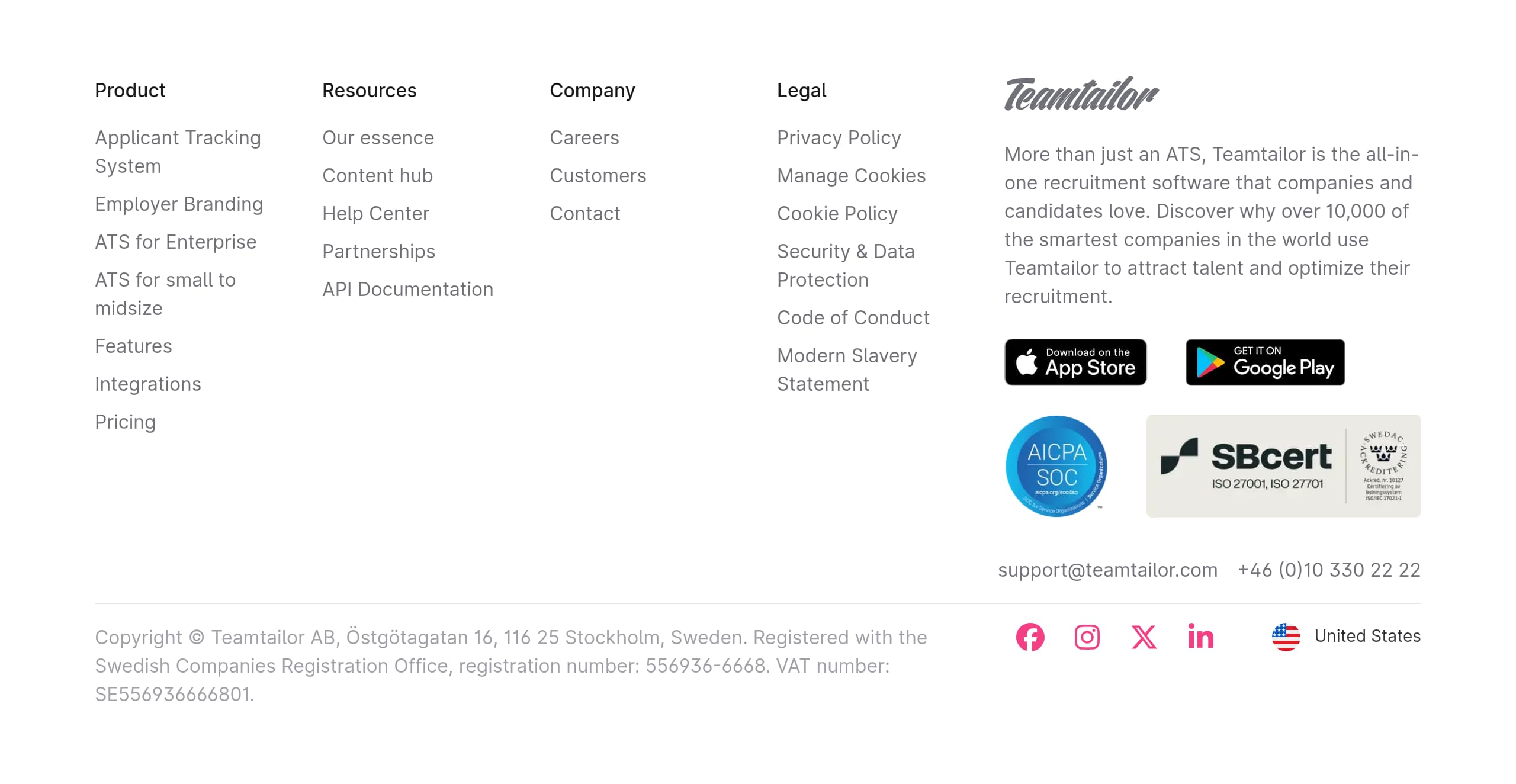
Teamtailor’s footer is built like a procurement-ready sitemap: it repeats the key product pillars, exposes support and developer resources, and provides comprehensive legal links. The main takeaway is that the footer is not just navigation—it is a trust and evaluation hub that helps HR teams complete diligence quickly.
From the screenshot and excerpt, the footer includes clearly grouped columns:
- Product routes: “Recruiting system”, “Building employer branding”, and separate pages for enterprises and SMBs. This mirrors the top navigation and reduces dead ends for users who scroll.
- Evaluation resources: “Help Center”, “Content Hub”, and “Partnerships” support research behavior.
- Developer and integration signals: “API documentation” appears in the footer, which is a strong indicator for teams that need custom integrations or want to validate extensibility.
On the trust and compliance side, the footer is unusually thorough, listing “Privacy policy”, “Cookie policy”, “Privacy and security”, “Code of conduct”, and “Modern slavery statement”. For larger organizations, that last item is a meaningful enterprise signal because it aligns with supplier compliance checks.
The footer also includes direct contact and corporate identity: support@teamtailor.com, a phone number, the Stockholm address, and legal entity details (Teamtailor AB with registration and VAT). One improvement would be to add a short line clarifying support hours or response expectations near the support email, but overall this is a strong, credibility-building footer for a recruiting platform.
Detected tech stack
Tools and technologies we detected on Teamtailor's site. Detection is best-effort and may be incomplete.
Scores
Our framework scores for Teamtailor's website in terms of clarity, conversion, and trust. See our methodology for how we calculate these.
How clear the value prop and structure are.
How conversion-friendly signup and pricing are.
How well trust and compliance are surfaced.
FAQ
Teamtailor’s homepage pairs a clear category statement (“next-generation recruiting system” plus employer branding) with immediate CTAs like “Book a demo” and “Get to know Teamtailor in 30 seconds!”. It also places proof early, including “Trusted by 10,000+ companies” and named testimonials with roles and companies. Segmentation for SMB (0–1,000 employees) vs enterprise (1,000+) helps visitors self-identify quickly.
Teamtailor’s pricing experience appears oriented toward a sales conversation rather than instant checkout, consistent with ATS procurement. The site repeatedly drives users to “Book a demo” and supports that step with adoption and service assurances like onboarding help, chat support, and a Customer Success Manager. The broader positioning as an all-in-one recruiting platform helps justify pricing by expanding beyond a simple ATS comparison.
Teamtailor uses multiple layers of social proof: a headline claim of 10,000+ companies, named customer testimonials (including role and company), and a high-volume wall of short reviews (first name plus initial). It also includes scale metrics like millions of monthly applicants connecting with customers. This mix reduces risk for buyers evaluating an ATS switch by combining credibility, relatability, and perceived consensus.
Teamtailor emphasizes candidate experience and employer branding, for example customizable careers pages, alongside ATS workflow collaboration. It highlights automation and AI via “automated triggers” and “Co-pilot AI” to reduce manual work. The site also pushes ecosystem breadth with “450+ integrations” and reinforces long-term product investment with updates every eight weeks.
Teamtailor markets onboarding and support as part of the product experience. The site promises real-time chat support for all users, fast onboarding, weekly training for new users, and an assigned Customer Success Manager. These elements reduce implementation risk, especially for teams adopting their first ATS or migrating from an older system, and they support the primary conversion step of booking a demo.

The world's best-performing SaaS businesses share surprisingly similar patterns. We help you learn and apply them through our human-designed methodology, with AI-assisted research.