
Key takeaways
Here are the key insights from our website breakdown analysis of Monday.com.
monday.com’s homepage anchors on a single, outcome-driven promise—“Outpace everyone with the best AI work platform”—and repeats a primary CTA (“Get Started”) across major scroll breaks to reduce decision friction.
The site converts broad interest into intent using structured exploration paths (team, use case, product) and concrete AI agent examples, which helps visitors self-qualify without reading long copy.
Pricing is positioned as low-risk with “No credit card needed” and an “Unlimited time on Free plan,” while Enterprise pathways stay prominent via “Contact sales” for higher-ACV motion.
Social proof is quantified (“Trusted by over 60% of the Fortune 500”) and reinforced with outcome metrics (e.g., 615% ROI, 105K hours saved annually), increasing credibility for executive buyers.
Trust and enterprise readiness are treated as first-class: a visible Trust Center, “enterprise-grade security,” and Gartner Magic Quadrant leadership claims support procurement and compliance-driven evaluation.
Home
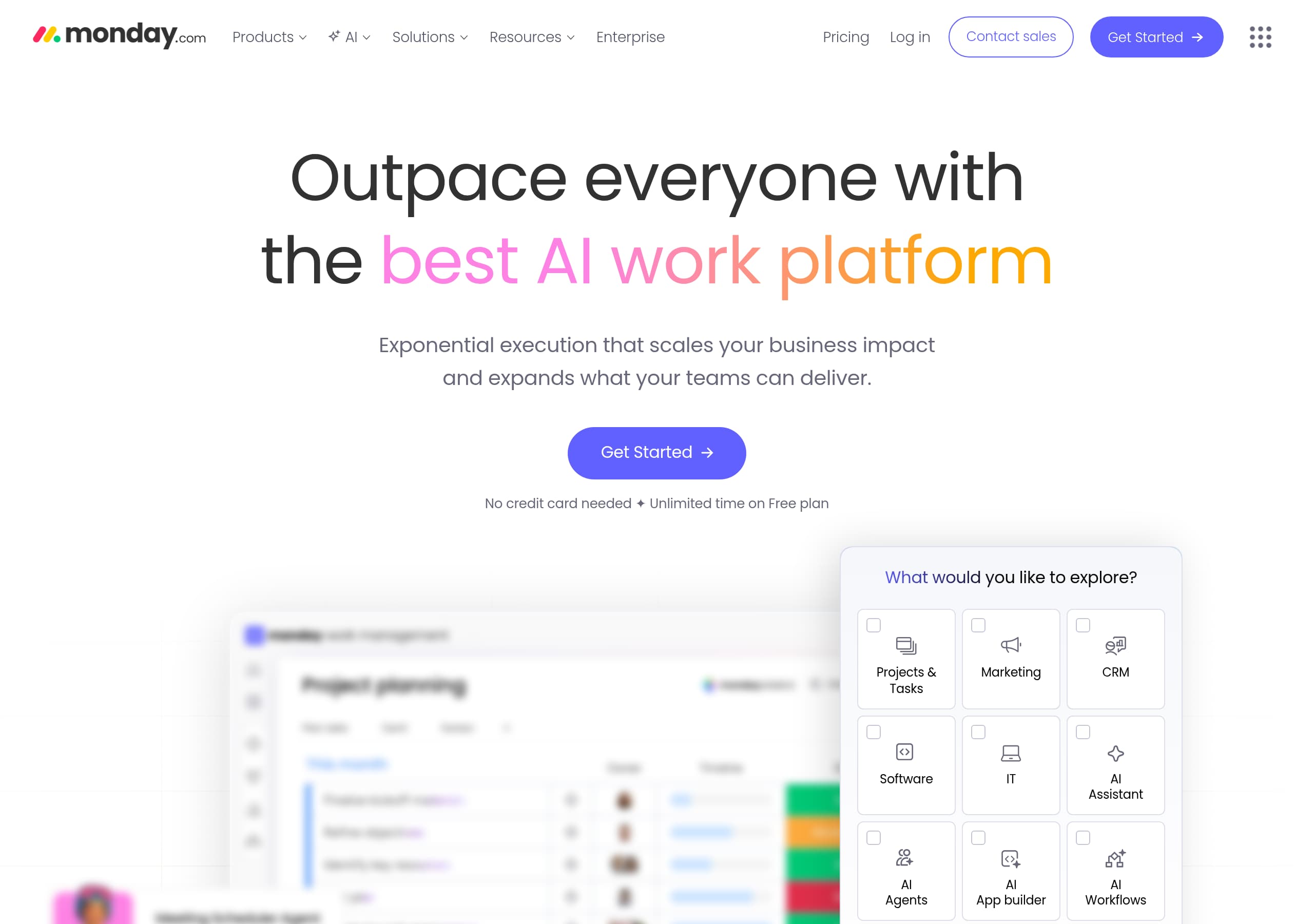
monday.com’s homepage wins by stating the value proposition in one sentence—“Outpace everyone with the best AI work platform”—and immediately tying it to outcomes (“exponential execution” and “scales your business impact”). The hero repeats a single primary CTA (“Get Started”) and adds two conversion reducers: no credit card and an unlimited Free plan.
The “What would you like to explore?” module functions like guided routing rather than a generic features list. It segments intent into Projects, Marketing, CRM, IT, and AI capabilities, which helps visitors self-qualify quickly.
Notably, the AI narrative is shown through concrete work objects:
- Boards, content calendars, bug trackers, onboarding flows
- Named agents (PMO Agent, Incident Resolver, Risk Analyzer)
This UI pattern turns “AI platform” into observable behavior and makes it easier to imagine adoption across teams, not just experimentation.
Pricing
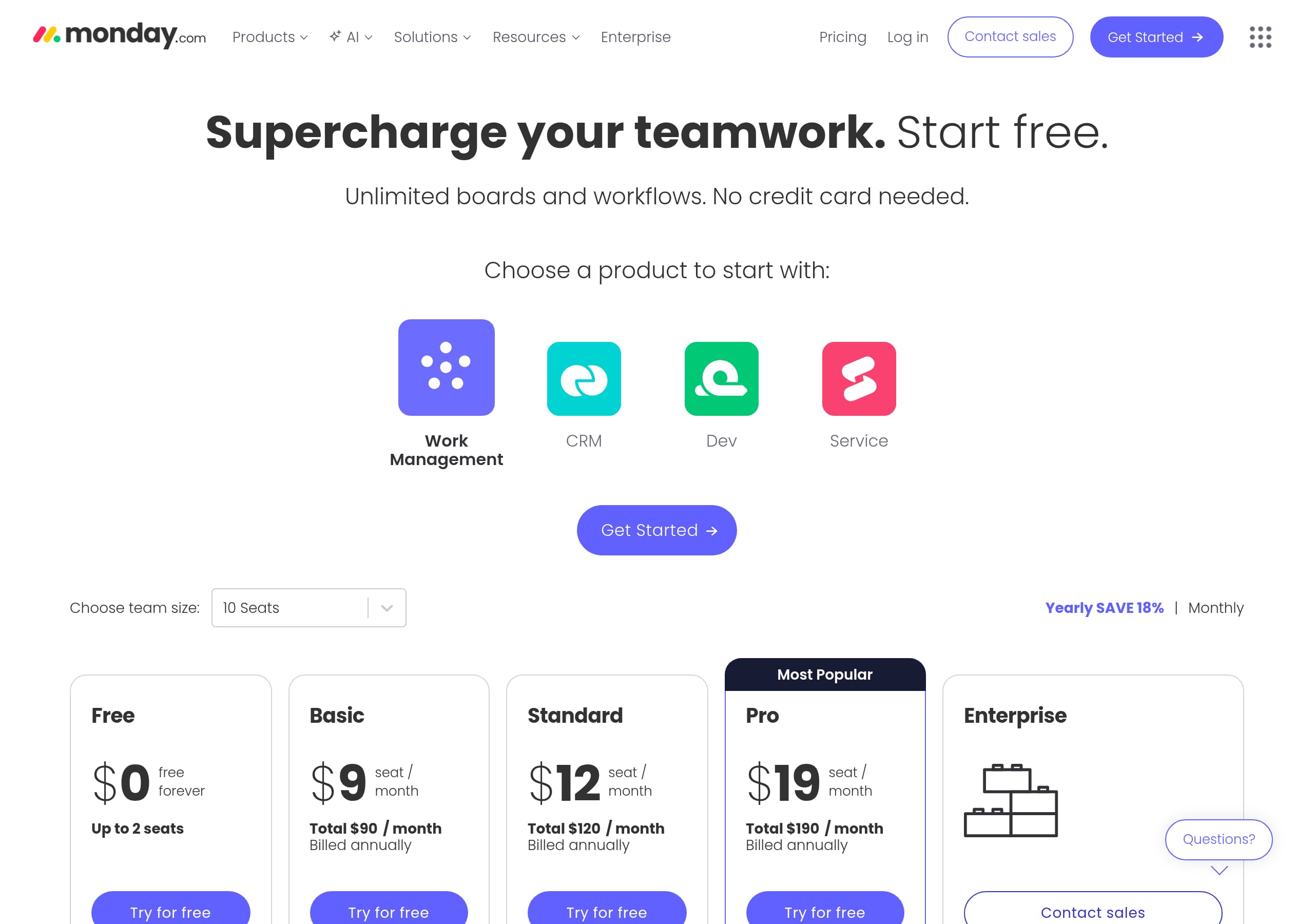
monday.com’s pricing approach is optimized for mixed motion: self-serve users are pushed to “Get Started,” while Enterprise buyers have persistent Contact sales paths. The homepage preview already pre-handles the biggest pricing objections with risk reversal copy (“No credit card needed” and “Unlimited time on Free plan”), so visitors arrive at pricing less defensive.
From the pricing screenshot, the layout appears structured as a comparison table, which supports fast plan scanning and internal sharing. Look for these conversion-positive patterns:
- Clear plan tiers with a single highlighted “best value” option
- Feature row comparisons for core capabilities (Automations, Integrations, Dashboards)
- A separate Enterprise column or section that emphasizes governance and security
A practical improvement would be adding a visible “common questions” area next to the table (seat minimums, billing cadence, AI add-ons) to reduce sales chat dependence and increase checkout completion for mid-market accounts.
Features
monday.com’s features messaging is effective because it translates platform breadth into a small set of repeatable feature pillars: Dashboards, Integrations, Automations, Kanban, Docs, Gantt, and Forms. These are recognizable UI patterns that make the platform feel learnable even for first-time buyers.
The AI feature set is presented as a layered system rather than a grab-bag:
- AI assistant for in-context recommendations and actions
- AI agents with named roles (Lead Agent, SLA monitor, Code Reviewer)
- AI workflows for end-to-end cross-functional processes
- AI app builder / custom apps to replace disconnected tools
The “one open, connected” foundation reinforces that these features share a data layer, which supports reporting and governance. The explicit “200+ integrations” and “Any AI model… Claude, GPT, Gemini” claims add technical specificity and reduce fear of lock-in. Net effect: buyers can map features to their org chart and tool stack quickly.
Signup
monday.com’s signup positioning reduces friction before a user even sees a form. The homepage repeatedly uses Get Started as the primary CTA and supports it with “No credit card needed” plus “Unlimited time on Free plan,” which removes trial anxiety and payment hesitation.
The site also improves signup intent quality by encouraging pre-selection of a use case (Projects, Marketing, CRM, IT) and showing concrete templates (content calendar, event planner, bug tracker). That pattern typically increases activation because new users land in a familiar workflow instead of a blank workspace.
For higher-consideration visitors, “Contact sales” is consistently available, creating a second conversion lane for Enterprise (security review, procurement, SSO requirements).
A tactical improvement would be to clearly preview the first-run experience (e.g., “3 steps: choose template → invite team → connect tools”) near the CTA, so evaluators know what happens immediately after clicking Get Started.
Trust
monday.com treats trust as a product requirement, not an afterthought. The homepage includes an explicit Trust Center entry (“Explore our Trust Center”) and frames the platform as “Enterprise-ready,” which aligns with how IT and security teams evaluate vendors.
Key trust signals called out in the content:
- Enterprise-grade security and “enterprise-grade AI infrastructure”
- Emphasis on data privacy, governance, permissions, and compliance
- Third-party credibility via Gartner recognition (“Leader in 3 Gartner® Magic Quadrant™ reports”)
The AI claims also include operational safeguards: “guardrails,” “full transparency into every action,” and “knowledge” sources (docs, PDFs, boards) that define what agents can use. That specificity helps mitigate fears around autonomous actions.
To strengthen trust further, monday.com could surface a short checklist near the CTA (SSO/SAML, SOC 2/ISO, data residency, audit logs) so enterprise evaluators don’t need to detour into documentation before converting.
Footer
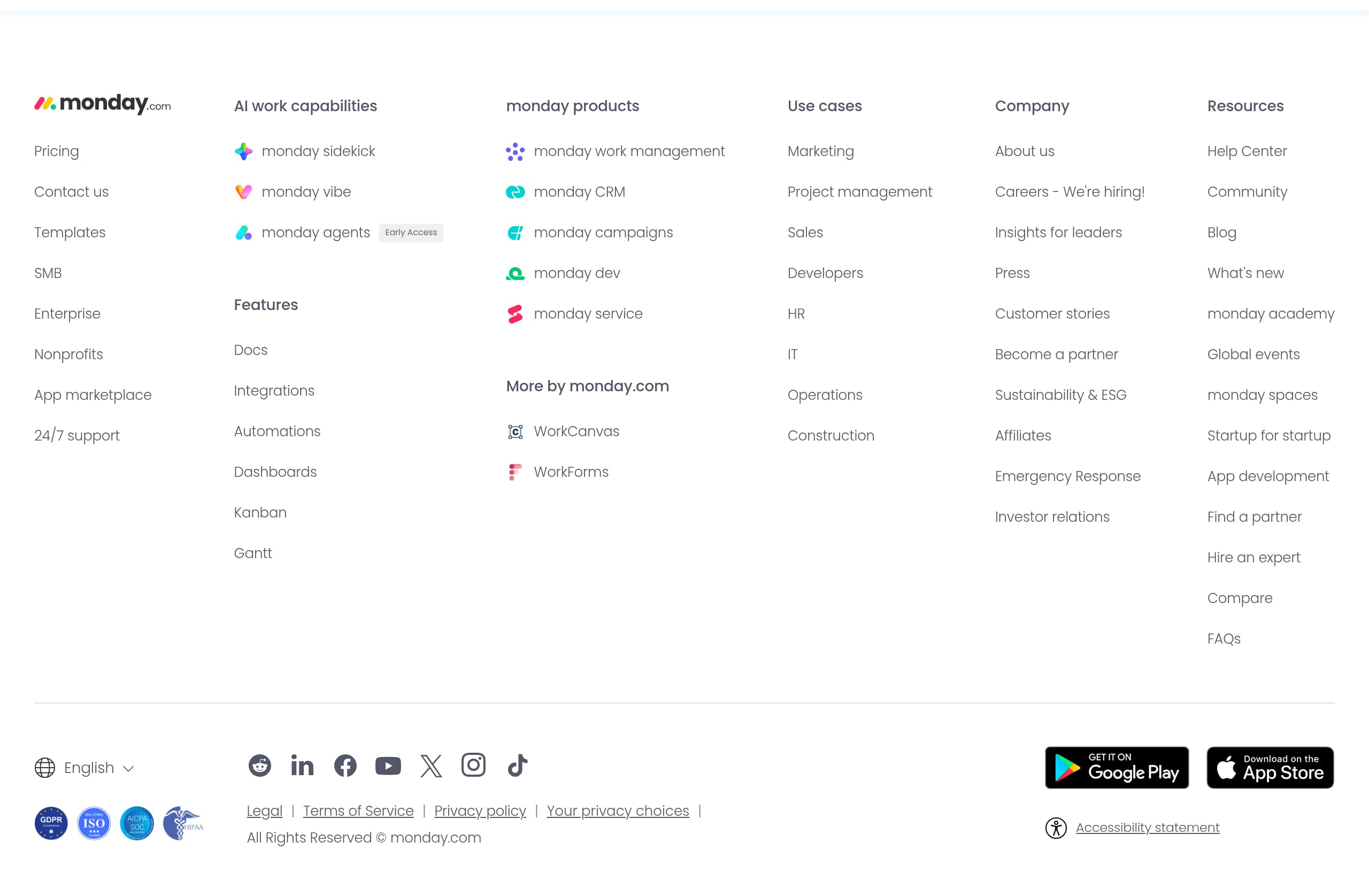
monday.com’s footer is built for scale: it acts as a site map that supports discovery across multiple SKUs (monday work management, monday CRM, monday dev, monday service) and adjacent products (WorkCanvas, WorkForms). This is useful for SEO because it reinforces entity relationships and internal linking for high-intent pages like Templates, App marketplace, and Integrations.
From the screenshot and excerpt, the footer includes dense navigation plus global controls:
- Language selector with many locales (improves international conversion)
- Legal links: Terms of Service, Privacy policy, “Your privacy choices”
- Support access: Help Center, Community, 24/7 support
It also reinforces credibility with corporate links (Investor relations, Press, Sustainability & ESG), which matters for enterprise buyers validating vendor stability.
A minor UX risk is cognitive load: long link lists can feel overwhelming. Grouping links into fewer, clearer columns (Buy, Product, Solutions, Developers, Company, Legal) would preserve SEO value while improving scanability.
Detected tech stack
Tools and technologies we detected on Monday.com's site. Detection is best-effort and may be incomplete.
Scores
Our framework scores for Monday.com's website in terms of clarity, conversion, and trust. See our methodology for how we calculate these.
How clear the value prop and structure are.
How conversion-friendly signup and pricing are.
How well trust and compliance are surfaced.

The world's best-performing SaaS businesses share surprisingly similar patterns. We help you learn and apply them through our human-designed methodology, with AI-assisted research.